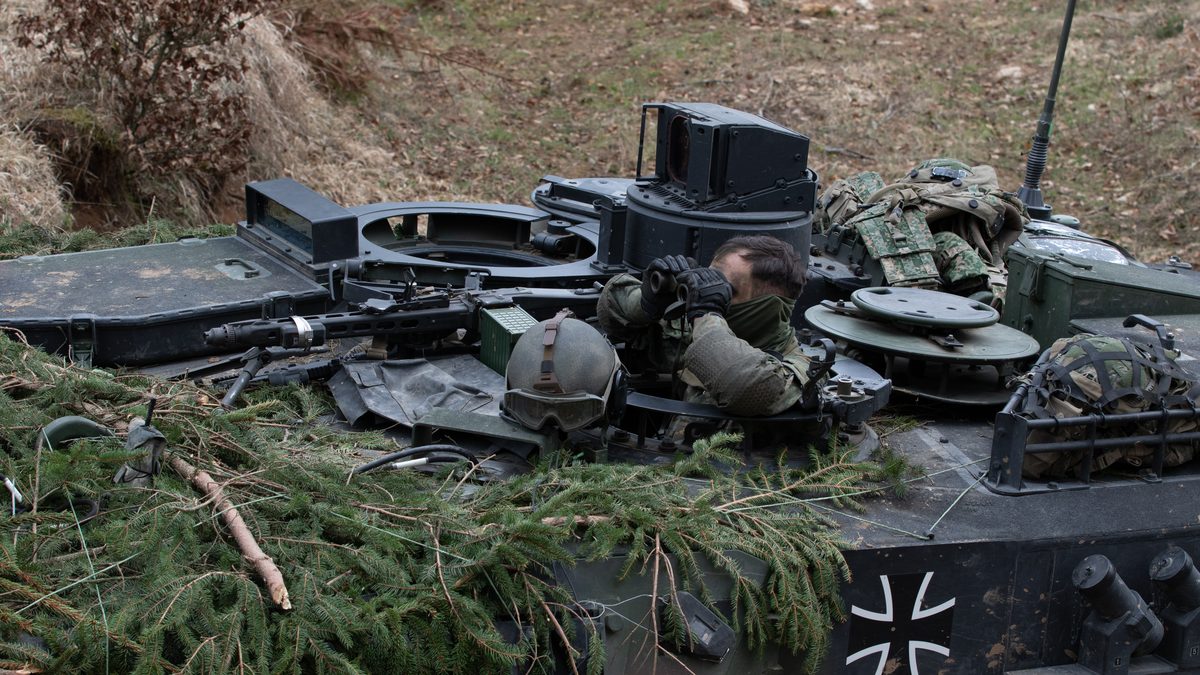
A Leopard 2-A7 of the German-Netherlands 414 Panzer Battalion during exercise Allied Spirit 24. The Leopard 2 mounts the Rheinmetall Rh-120 smoothbore gun and is one of the fleets a common European tank would replace. Photo: Pfc. Ayden Norcross, U.S. Army / DVIDS (U.S. Government work, public domain).
MARTE: Europe’s Next Tank Is a Production and Sustainment Test, Not Just a Platform
Technical Summary
Germany and ten European partners are working toward a common main battle tank under MARTE (Main ARmoured Tank of Europe), a study funded by the European Defence Fund (EDF). The European Commission launched the project on 1 July 2025 with a grant of about €20 million, drawing in 51 entities across 12 countries. Germany leads. Belgium, Estonia, Finland, Greece, Italy, the Netherlands, Norway, Romania, Spain and Sweden make up the other participating states. The work is coordinated by MARTE ARGE GbR, a joint venture of KNDS Deutschland and Rheinmetall Landsysteme, with Leonardo (Italy), Indra (Spain) and Saab (Sweden) in the core team.
Hartpunkt reports that the partners are aiming at a vehicle that could enter service in the early 2030s, with components built across at least two European production lines rather than concentrated in a single national industrial base. ISC treats both the in-service date and the two-line production model as reported design intent rather than fixed commitments. MARTE remains a concept and architecture study. It reached its mid-term milestone on 23 March 2026, when the Commission approved its deliverables and cleared the move into the system design and architecture phase.
Who Does What, and Why Saab’s Role Matters Most
The division of labour inside the consortium is itself part of the story. Saab AB of Sweden led the Concept of Operations (CONOPS) and the full requirements set for the future tank, working directly with the participating Ministries of Defence to turn eleven national positions into one consolidated, harmonised baseline that reflects what the future customers actually need. That places the Swedish partner at the exact point where operational demand is translated into engineering requirement. It is the most consequential seat at the table, because a common fleet is either made coherent here or quietly fragmented here. If the CONOPS and the requirements bake in shared aggregates and shared sustainment from the outset, the industrial logic downstream has something firm to build on. If they leave the door open to national exceptions, no amount of clever production engineering later will close the gap.
The rest of the split follows the same customer-first pattern. Indra Sistemas of Spain led an extensive market survey of the availability, technological readiness and performance of European subsystems and technologies. The design and architecture phase now underway is led by KNDS Deutschland, Rheinmetall Landsysteme and Leonardo of Italy, with the whole programme coordinated by MARTE ARGE GbR, the joint venture between KNDS Deutschland and Rheinmetall Landsysteme. The consortium held its General Assembly in San Sebastán in November 2025 and is chasing Preliminary Design Review (PDR) maturity within 24 months of its December 2024 kick-off, a deliberately compressed schedule for a multinational tank programme.
A common tank is only useful if a mechanic in one army can repair a vehicle built for another, using parts made in a third. The repair chain is the real test, not the prototype. ISC Assessment, July 2026
Analysis of Effects
The headline temptation is to judge MARTE by the gun, the turret or the armour package. The more important variable is the industrial logic underneath it. Europe’s problem has rarely been a shortage of capable armoured vehicles. The problem has been fragmentation: too many national variants, too many bespoke configurations, separate supply chains and too little wartime interchangeability. The reported MARTE approach attacks that directly through common core aggregates, distributed production and simplified maintainability, with national flexibility allowed only on subsystems that do not affect combat readiness. Radios, remote weapon stations and similar non-critical items can vary by nation. Engines, hulls, turrets, protection, electronics and firepower cannot become a museum of national exceptions if the fleet is to be sustained as one.
For the WOME (Weapons, Ordnance, Munitions and Explosives) community, the firepower decision carries a logistics tail that outlasts any single battle. A common main gun implies a common family of ammunition natures across eleven fleets. Today, Leopard 2, Leclerc and Ariete users maintain parallel 120 mm logistics chains despite long-standing NATO ambitions for tank ammunition interchangeability under STANAG 4385 and related agreements. Settle on shared natures, such as a common armour-piercing fin-stabilised discarding sabot round and a common multipurpose nature, and the wartime ammunition supply chain compresses across the coalition. Ukraine has made the wider point bluntly. Armour is not obsolete, but it now fights inside a drone, mine, artillery, electronic warfare and precision-strike ecosystem. Survivability is no longer only the protection bolted to the vehicle. It is production depth, battle-damage repair capacity, spare-part availability, software update cadence, recovery capability and the ability to regenerate combat power after losses.
Why ISC tracks a platform programme
MARTE is a vehicle study, but its firepower and sustainment choices are WOME decisions. A common gun sets the ammunition natures, the storage and transport hazard classifications, and the repair and recovery training burden for eleven national logistics systems at once. The platform headline hides the munitions and sustainment consequences that ISC exists to surface.
Personnel and Safety Considerations
Commonality changes the human picture for the people who keep armour in the fight. A fragmented fleet forces recovery mechanics, armourers and ammunition technicians to master many bespoke systems, which raises both the training load and the risk of error under pressure. Shared aggregates and shared ammunition natures reduce that burden and lower the chance of a handling or fitment mistake when crews from different nations operate side by side. None of this is guaranteed by the study alone. The benefits arrive only if requirements are frozen before national industry locks in divergent answers, and only if the maintainability and interchangeability claims survive contact with national procurement preferences.
Data Gaps
Several load-bearing details are not yet established in open sources. The main gun calibre is undecided, with 120 mm and 130 mm both in circulation as candidates. The armour and protection package is undefined at this stage. The specifics of the reported two production lines, meaning which states host them and which aggregates each builds, have not been published. The early-2030s in-service date is ISC-flagged as ambitious given that the study phase only closes in late 2026 and a full-scale development decision has not been taken. The relationship to the Franco-German Main Ground Combat System (MGCS), now reported as a 2040 to 2045 programme, and to Germany’s separate Leopard 3 interim work, is not resolved. Per-nation order quantities are unknown.
References
Source-evaluated under NATO STANAG 2022 (Reliability A–F / Accuracy 1–6). Tier 1 = government primary source; Tier 2 = quality news / specialist defence media; Tier 3 = authoritative aggregator / encyclopaedia.
- T1European Commission, Defence Industry and Space – MARTE – Main ARmoured Tank of Europe (EDF-2023-DA-GROUND-MBT), 2024. (Reliability A / Accuracy 1)
- T2Rheinmetall – The MARTE project strengthens Europe’s strategic autonomy, 23 March 2026. (Reliability B / Accuracy 2)
- T2KNDS Group – MARTE – Main ARmoured Tank of Europe, March 2026. (Reliability B / Accuracy 2)
- T2Hartpunkt – Deutschland rüstet mit Partnern einen gemeinsamen europäischen Kampfpanzer, June 2026. (Reliability B / Accuracy 3)
- T2European Security & Defence – EU’s Project MARTE gets underway to create a future European MBT, July 2025. (Reliability B / Accuracy 2)
- T3Militarnyi – MARTE European Tank Project Reaches the Midpoint of Development, March 2026. (Reliability C / Accuracy 3)
Corrections & updates welcome. If you hold open-source data that refines or corrects any parameter in this article, please contact [email protected] citing the specific claim and your source. Verified corrections will be incorporated and credited in the revision history. AI-assisted technical assessment based on open-source material. Not a formal intelligence product.