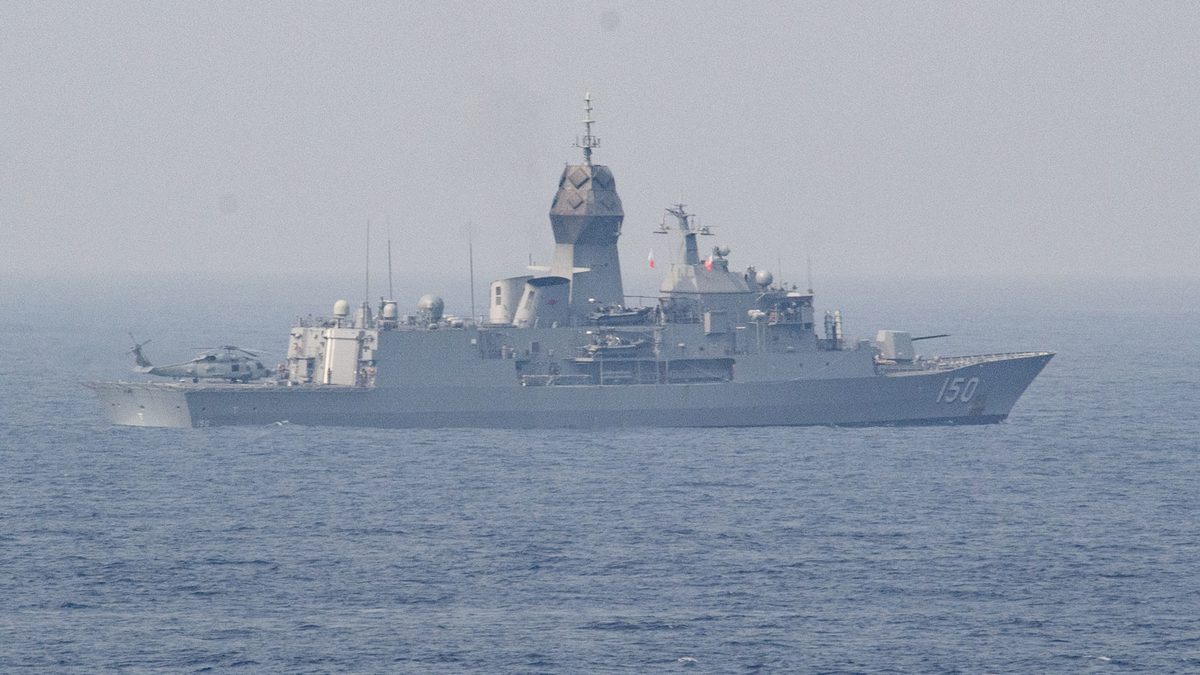
An Anzac-class frigate (hull 150), a MEKO 200-family design from the same lineage as the MEKO A-200, under way during multinational Exercise La Perouse, April 2021. Illustrative: the German F128 / MEKO A-200 DEU has not yet been built. U.S. Navy photo by Petty Officer 3rd Class Heath Zeigler / DVIDS, public domain. VIRIN 210405-N-JC800-1073.
Four MEKO A-200 DEU Frigates: Germany Trades Ambition for Delivery After the F126 Collapse
Technical Summary
On 8 July 2026 the Bundestag budget committee (Haushaltsausschuss) cleared the German Navy's procurement of four MEKO A-200 DEU frigates from ThyssenKrupp Marine Systems (TKMS), with an option for up to four further hulls. The German Navy designates the class F128. The firm order is valued at about €6.3 billion, and TKMS calls it the largest surface-vessel contract in the company's history. The first ship is scheduled for delivery in 2029, with reporting pointing to a handover late that year.
The decision follows Germany's cancellation of the F126 Niedersachsen-class programme in late June 2026. That project, led by the Dutch prime contractor Damen (Damen Schelde Naval Shipbuilding), covered six frigates under a 2020 award worth roughly €10 billion. Damen advised the ministry that the ships could not be delivered to the agreed schedule or budget. When Lürssen was examined as a replacement lead, the revised bill reached about €15.2 billion for six ships, and the total programme requirement passed €18 billion. Berlin chose to reset the requirement rather than keep paying to rescue it.
Four MEKO A-200 DEU hulls for about €6.3 billion, first delivery in 2029, after an F126 programme whose replacement bill had climbed past €18 billion. The trade is delivery speed and cost control against a smaller, less ambitious ship. ISC assessment, 9 July 2026
MEKO A-200 DEU: baseline specification (open sources)
| Displacement (full load) | About 3,950 tonnes |
| Length / beam | 121 m / 16.4 m |
| Complement | 125 core, plus berthing for 49 additional |
| Propulsion | CODAG-WARP (combined diesel and gas, water-jet and refined propeller) |
| Speed | Up to 29 knots |
| Main gun | Rheinmetall SeaSnake 30 (30 mm class) |
| Missiles / ASW torpedo | To be selected (open procurement decision) |
| Aviation | NH90 Sea Tiger (anti-submarine warfare) |
| Stage | When | Lead / funding owner |
|---|---|---|
| F126 award (six ships) | 2020 | Damen (prime); about €10 billion |
| F126 cancelled | June 2026 | German Ministry of Defence; cost and schedule terminated |
| F128 / MEKO A-200 DEU approved (four ships) | 8 July 2026 | Bundestag budget committee; TKMS; about €6.3 billion funded |
| Option (up to four more) | Reported to end 2026 | TKMS; about €5.3 billion optioned |
| First delivery | 2029 | TKMS / German Navy |
WOME scope note
This is a procurement and industrial decision, not an ordnance event, so there is no hazard classification to apply. Its Weapons, Ordnance, Munitions and Explosives (WOME) relevance sits in the deferred armament fit: the ships have been ordered with the vertical launch system, any anti-ship missile and the anti-submarine torpedo still to be selected. Those choices, not the hull, will decide the magazine and effector supply chain.
Analysis of Effects
The F128 is a deliberately smaller and cheaper platform than the F126. At about 3,950 tonnes full load the MEKO A-200 DEU sits well below the roughly 10,000-tonne F126, and the German Navy has framed it around anti-submarine warfare (ASW) rather than the F126's broader multi-role remit. The committee's conditions make the intent explicit. No changes to the performance specification that would push delivery beyond 2029 are permitted. Berlin is buying a proven export design at a fixed capability line to recover schedule, and accepting a lighter combatant in exchange.
For the armaments picture, the load-bearing detail is what is not yet fixed. Open sources list the main gun as the Rheinmetall SeaSnake 30, but the missile fit and the anti-submarine torpedo remain to be selected. That leaves the vertical launch system (VLS) type, any anti-ship missile, and the lightweight ASW torpedo as open procurement decisions rather than confirmed fits. The budget committee has told TKMS to prioritise former F126 subcontractors and shipyard sites, and to assess parallel production if the option is taken up, which ties the weapon and sensor supply chain to the same industrial reset that the cancellation forced.
Capability, Cost and Schedule: F126 Versus F128
The two ships are not interchangeable, and that difference is the real NATO capability gap this decision opens. The F126 Niedersachsen-class was a blue-water, multi-mission frigate of about 10,550 tonnes, designed for two-year out-of-area deployments with rotating crews and a heavy, reconfigurable weapon fit. The F128 MEKO A-200 DEU is a regional anti-submarine escort of about 3,950 tonnes. Germany gives up the high-end area air-defence magazine, the anti-ship and land-attack reach, and the modular flexibility that let a single F126 switch between anti-submarine, mine-countermeasures and special-forces roles. The MEKO does one job well. The F126 was built to do several, far from home, for months at a time.
| Parameter | F126 Niedersachsen (cancelled) | F128 / MEKO A-200 DEU (approved) |
|---|---|---|
| Role | Blue-water multi-mission frigate | Regional anti-submarine escort |
| Full-load displacement | About 10,550 tonnes | About 3,950 tonnes |
| Length | 166 m | 121 m |
| Endurance and reach | Over 4,000 nautical miles at 18 knots; built for two-year out-of-area deployment with rotating crews | Regional escort; endurance not published |
| Main gun | 127 mm OTO 127/64 Vulcano | 30 mm Rheinmetall SeaSnake |
| Area air defence | 16-cell Mk 41 vertical launch system, up to 64 ESSM Block 2B, plus two RAM launchers | To be selected |
| Anti-ship | Two Naval Strike Missile launchers, up to eight missiles | To be selected |
| Mission flexibility | Swappable modules: anti-submarine, mine countermeasures, detention, berthing for 84 special forces or signals personnel | Fixed anti-submarine fit |
| Hulls | Six planned (four firm plus two option) | Four firm, option for up to four more |
| Programme cost | About €8.35 billion base for six, escalated past €18 billion all-in | About €6.3 billion for four; about €11.6 billion for eight |
| First delivery | Slipped from a 2028 target to 2031 delivery, commissioning about 2032 | 2029 |
On cost and schedule the trade is real but narrower than the headline suggests. Against the escalated F126 bill, which had passed €18 billion all-in, the MEKO at about €6.3 billion for four is dramatically cheaper. Against the original 2020 F126 contract, about €8.35 billion for six, the per-hull price is broadly comparable for a much smaller ship. On timing the MEKO recovers ground rather than losing it, because the F126 first hull had slipped from a 2028 target to a 2031 delivery while the first MEKO is due in 2029. The high-end air-defence role the F126 partly carried now rests on the separate F127 frigate programme, which is where NATO will look to close the top-tier gap this decision leaves open.
Personnel and Safety Considerations
This is a procurement decision, not an ordnance or explosive-safety event, so there is no hazard classification to assess. The personnel and industrial reading is where the risk sits. The MEKO A-200 DEU is crewed by about 125 core personnel, with berthing for 49 more, a smaller ship's company than the F126 would have required, which eases a German Navy manning position already under strain. The programme risk falls on the workforce and suppliers. The committee has instructed TKMS to take on former F126 shipyard sites and subcontractors where it can, so the human cost of the cancellation is being managed through transfer rather than absorbed as redundancy, subject to how quickly TKMS can stand the work up against a 2029 first-delivery clock.
Data Gaps
Several load-bearing parameters are not confirmed in open sources. The size of the option is reported as up to four hulls, for a total of up to eight, but is not fixed in the resolution text seen. The final missile and vertical launch system fit and the ASW torpedo type are both listed as to be selected. The precise build split between TKMS yards and named partners such as the Rönner Group is reported but not confirmed in primary documents. The contract-signature date, distinct from the 8 July 2026 budget-committee clearance, is not yet public. Figures for displacement, length and crew are open-source values for the MEKO A-200 DEU variant and may be refined at contract.
Key Questions
What did the Bundestag budget committee approve on 8 July 2026?
The committee cleared procurement of four MEKO A-200 DEU frigates for the German Navy, designated the F128 class, from ThyssenKrupp Marine Systems, with an option for up to four more hulls. The firm order is worth about €6.3 billion and the first ship is due in 2029.
Why did Germany cancel the F126 frigate programme?
Germany ended the six-ship F126 Niedersachsen-class programme in June 2026 after the Dutch prime contractor Damen said the ships could not be delivered on the agreed schedule or budget. A switch to Lürssen would have pushed the total requirement past €18 billion, so Berlin reset the buy.
How does the MEKO A-200 DEU differ from the F126?
The MEKO A-200 DEU is a smaller, cheaper anti-submarine frigate of about 3,950 tonnes, against the roughly 10,000-tonne multi-role F126. It trades scope for delivery speed and cost control, with several weapon systems, including the missile and torpedo fit, still to be selected.
References
Source-evaluated under NATO STANAG 2022 (Reliability A–F / Accuracy 1–6). Tier 1 = government primary source; Tier 2 = quality news / specialist defence media; Tier 3 = authoritative aggregator / encyclopaedia.
- T1TKMS Group – Next Step for the MEKO A-200 DEU: Budget Committee Approves Procurement of Four Frigates and an Option for Additional Vessels for the German Navy, 8 July 2026. (Reliability A / Accuracy 1)
- T2Naval News – German Budget Committee Approves F128 Frigates With Strict Conditions, 8 July 2026. (Reliability B / Accuracy 2)
- T2Defense News – Germany Scraps F126 Frigate Program, Pivots to MEKO Warships Amid Cost and Contractor Chaos, 24 June 2026. (Reliability B / Accuracy 2)
- T2Naval Today – Germany Clears Purchase of Four MEKO A-200 Frigates, Eyes More Warships, 9 July 2026. (Reliability B / Accuracy 2)
- T3Wikipedia – MEKO A-200 DEU-class frigate (specifications and programme background), accessed 9 July 2026. (Reliability C / Accuracy 3)
- T2Naval News – German F126: Rheinmetall Plans to Deliver the Prototype Ship for Final Outfitting in 2028, 19 March 2026. (Reliability B / Accuracy 2)
- T3Wikipedia – Niedersachsen-class frigate (F126 specifications and programme background), accessed 9 July 2026. (Reliability C / Accuracy 3)
Corrections & updates welcome. If you hold open-source data that refines or corrects any parameter in this article, please contact [email protected] citing the specific claim and your source. Verified corrections will be incorporated and credited in the revision history. AI-assisted technical assessment based on open-source material. Not a formal intelligence product.