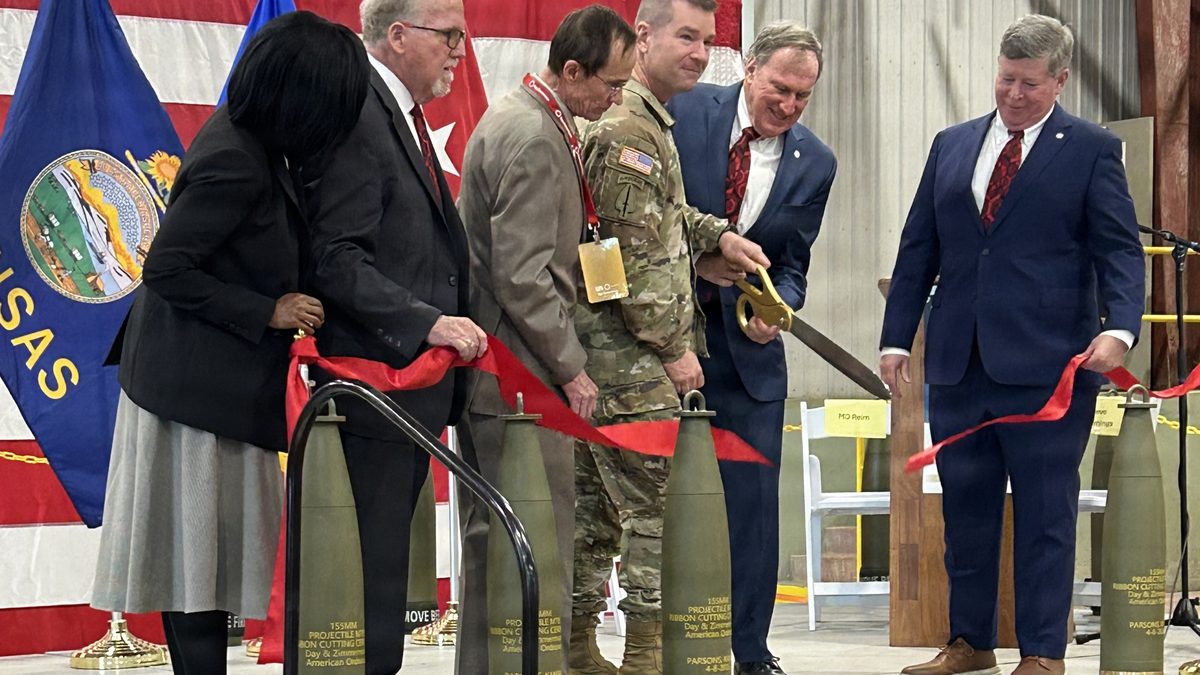
Illustrative: a new 155 mm M795 artillery projectile load, assemble and pack facility, Parsons, Kansas, 8 April 2026. U.S. Army photo by Eric Kowal (DVIDS, public domain). Representative image; not GENIFR-specific.
GENIFR: Nine Allies Set Out to Build One Interchangeable NATO 155 mm Round
Technical Summary
The Generic NATO Indirect Fire Round (GENIFR) is a multinational High Visibility Project (HVP) launched at the NATO Summit Defence Industry Forum in Ankara on 7 July 2026. Nine allies, namely Canada, Czechia, Denmark, Finland, Greece, Norway, Slovakia, Sweden and Türkiye, agreed to fund feasibility studies and build a prototype for a single, fully interchangeable and interoperable NATO 155 mm artillery round. NATO frames the aim as setting the parameters for one common round that any allied 155 mm howitzer can fire safely, streamlining and accelerating production across allied manufacturers.
The 155 mm nature is already nominally standardised through the 2009 Joint Ballistics Memorandum of Understanding (JBMOU), signed by France, Germany, Italy, the United Kingdom and the United States to maximise interchangeability potential across allied 155 mm weapon and ammunition systems, which harmonises the 52-calibre chamber; yet interoperable is not the same as interchangeable. A projectile from one nation, a modular propelling charge from another, a fuze from a third and a primer from a fourth form a combination that may never have been proof-tested together. ISC has previously documented tens of thousands of untested projectile, charge, fuze and primer permutations across allied inventories. GENIFR approaches that problem from the design end, defining one reference round with harmonised interior-ballistic parameters rather than certifying every legacy permutation after the fact.
GENIFR attacks the interchangeability problem from the design end: one reference 155 mm round with harmonised interior-ballistic parameters, rather than proof-testing tens of thousands of legacy projectile, charge, fuze and primer permutations after the fact. ISC Defence Intelligence technical assessment, 9 July 2026
| NATO ammunition initiative | Focus | Maturity |
|---|---|---|
| GENIFR | Design and prototype one generic, fully interchangeable 155 mm round | Feasibility / prototype |
| Interchangeability Test, Evaluation & Certification of Indirect Fire Munitions | Harmonise national fire-testing and certification for artillery natures | Active HVP |
| Multinational Ammunition Warehousing Initiative (MAWI) | Pooled multinational ammunition storage, 26 participating nations | Largest HVP |
| Land Battle Decisive Munitions (LBDM) | Aggregate allied demand for land munitions to drive volume | Established |
GENIFR at a glance (open sources)
| Initiative type | Multinational High Visibility Project (HVP) |
| Launched | 7 July 2026, NATO Summit Defence Industry Forum, Ankara |
| Participating allies | 9 (Canada, Czechia, Denmark, Finland, Greece, Norway, Slovakia, Sweden, Türkiye) |
| Calibre | 155 mm |
| Current stage | Feasibility study and prototype |
| Objective | One fully interchangeable, interoperable NATO round |
Analysis of Effects
A single reference round means harmonising the parameters that govern interior ballistics: maximum chamber pressure (155 mm/52-calibre chambers operate to a defined JBMOU limit), projectile mass and centre of gravity, obturation through driving-band engagement, and the modular charge system increments that set muzzle velocity and range tables. If those are fixed across both 39-calibre and 52-calibre barrels, any GENIFR-compliant howitzer in the nine-nation pool could draw ammunition from any allied stock without a national interchangeability caveat. That would collapse a real source of resupply friction in coalition fires, where a gun line can be co-located with allied stock it is not cleared to fire.
NATO explicitly frames GENIFR as a production accelerator. A common design lets multiple allied plants tool to one specification, from propellant houses to projectile forges, widening the qualified supplier base and reducing single-point dependency at a time when 155 mm demand remains acute. GENIFR complements two existing ammunition HVPs: the Test, Evaluation and Certification of Interchangeability of Indirect Fire Munitions project, which harmonises national fire-testing and certification at the back end, and the 26-nation Multinational Ammunition Warehousing Initiative (MAWI), which pools storage. Together they address design, certification and stockholding as one problem set.
Personnel and Safety Considerations
A conventional 155 mm high-explosive projectile is typically Hazard Division (HD) 1.1, mass-detonating, with a Net Explosive Quantity (NEQ) on the order of 10 to 11 kg trinitrotoluene (TNT) equivalent for a standard high-explosive fill, while modular propelling charges are typically HD 1.3. A generic round does not change those divisions, but harmonising the fuze-well interface, primer type and charge architecture across nine national stockpiles carries storage-licensing and transport implications under regimes such as ADR (road) and the IMDG Code (sea): mixed-origin combinations must retain a valid Compatibility Group (CG) assignment and a documented proof pedigree. For gun crews the safety dividend is a single certified interior-ballistic solution in place of nation-specific firing-table caveats that raise the risk of a charge or projectile mismatch. Insensitive Munitions (IM) compliance to STANAG 4439 (the NATO policy for the introduction and assessment of IM) should be a stated design target.
Data Gaps
No published reference-projectile design, propellant chemistry, fuze-well interface standard, primer type (percussion versus electric) or target maximum chamber pressure has yet been released for GENIFR. The prototype timeline, the budget, and whether the round targets 39-calibre, 52-calibre or both barrel lengths are unstated. The nine-nation membership may expand, and the NATO Support and Procurement Agency (NSPA) contracting role is not yet confirmed. The NEQ and Hazard Division cited here are ISC estimates based on comparable in-service 155 mm high-explosive natures, not GENIFR-specific figures.
Key Questions
What is GENIFR?
GENIFR (Generic NATO Indirect Fire Round) is a multinational High Visibility Project launched on 7 July 2026 at the NATO Summit Defence Industry Forum in Ankara. Nine allies will fund feasibility work and a prototype for a single, fully interchangeable and interoperable NATO 155 mm artillery round.
Which nations are involved?
Nine allies agreed to develop the prototype: Canada, Czechia, Denmark, Finland, Greece, Norway, Slovakia, Sweden and Türkiye. NATO frames the effort as a way to streamline and accelerate 155 mm production while widening the qualified supplier base across the Alliance.
How is interchangeability different from interoperability?
Interoperable 155 mm rounds share a common chamber under the Joint Ballistics Memorandum of Understanding, but a projectile, charge, fuze and primer drawn from different nations may never have been proof-tested together. GENIFR designs one certified combination from the outset, removing that untested-permutation risk.
References
Source-evaluated under NATO STANAG 2022 (Reliability A–F / Accuracy 1–6). Tier 1 = government primary source; Tier 2 = quality news / specialist defence media; Tier 3 = authoritative aggregator / encyclopaedia.
- T1NATO – Delivering capabilities through multinational cooperation (High Visibility Projects), accessed 9 July 2026. (Reliability A / Accuracy 1)
- T2GlobalSecurity.org – Tens of billions in new procurements revealed at the NATO Summit Defence Industry Forum in Ankara, 7 July 2026. (Reliability B / Accuracy 2)
- T2RaillyNews – NATO Allies Unite on Shared Munitions Strategy, July 2026. (Reliability B / Accuracy 2)
- T2The Sofia Globe – NATO allies invest $40 billion in counter-drone capabilities and drone training, 7 July 2026. (Reliability B / Accuracy 2)
- T3ISC Defence Intelligence – NATO Land Ammunition Interchangeability: The 155 mm Gap, 8 June 2026. (Reliability C / Accuracy 3)
- T1NATO – Allies meet strike capability requirements with multinational initiatives, 7 July 2026. (Reliability A / Accuracy 1)
- T3Modern War Institute at West Point – Guns and Ammo: The Ukraine War and NATO’s Ammunition Interoperability Problem, November 2025. (Reliability B / Accuracy 2)
Corrections & updates welcome. If you hold open-source data that refines or corrects any parameter in this article, please contact [email protected] citing the specific claim and your source. Verified corrections will be incorporated and credited in the revision history. AI-assisted technical assessment based on open-source material. Not a formal intelligence product.