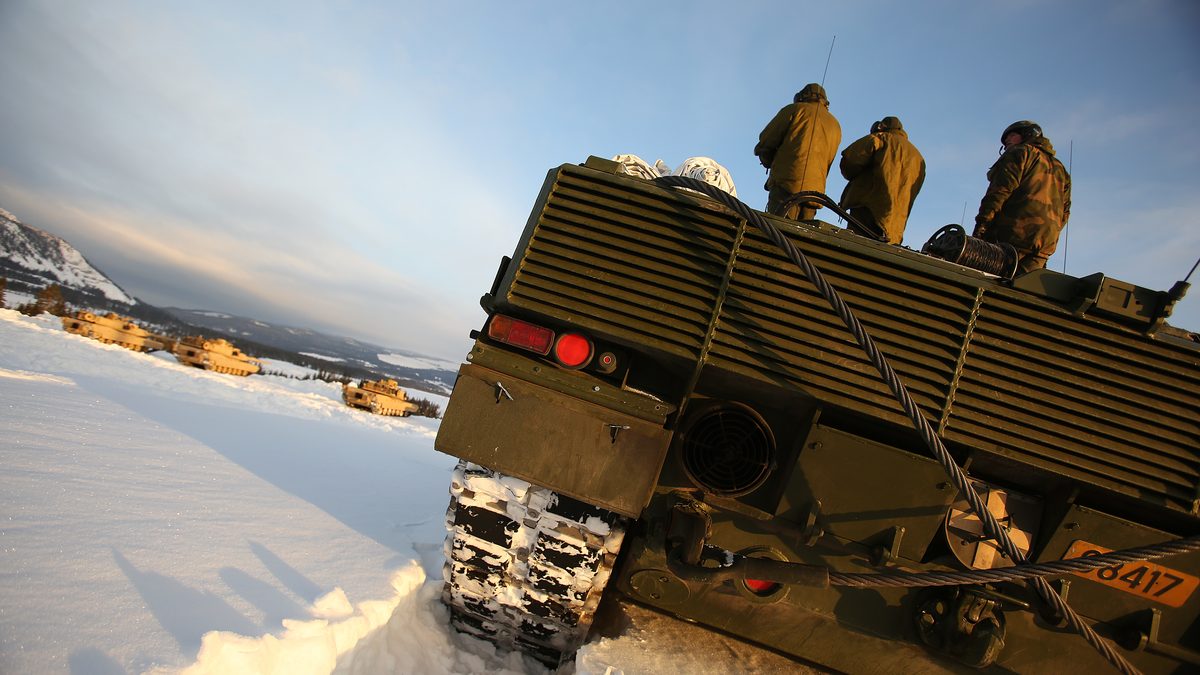
Abrams and Leopard 2 main battle tanks conduct a combined live-fire serial on a Norwegian range, February 2016. The two tanks fire the same family of 120 mm x 570 mm smooth-bore ammunition. Master Sgt. Chad McMeen / DVIDS, U.S. Marine Corps Forces Europe and Africa (Public Domain).
The Replacement of STANAG 4385: How NATO Governs 120 mm Tank Ammunition After the Smooth-Bore Standard Was Withdrawn
Technical Summary
STANAG 4385 is the NATO Standardization Agreement titled 120 mm x 570 Ammunition for Smooth-Bore Tank Guns. It was sponsored by the NATO Army Armaments Group (NAAG), the land-systems body sitting under committee AC/225, and the reviewed edition held in the NATO Archives (reference AC/225-D/1083-REV1) is dated 23 March 1990, running to 20 pages with an addendum. Its stated aim was interoperability: to let member states fire a common set of 120 mm x 570 mm ammunition natures from the various NATO 120 mm smooth-bore tank guns. That agreement has since been removed from the active NATO standards catalogue. Commercial standards databases now list it as withdrawn or superseded, and it survives as an archived historical record rather than a live control document.
In March 2026 ISC examined a clean example of standards succession in the artillery world: the cancellation of STANAG 4224 and its replacement by STANAG 4761 and the publication AAS3P-20 for 155 mm ammunition Safety and Suitability for Service assessment. The 120 mm smooth-bore case is not that tidy. There is no single publicly named successor STANAG that re-codifies the 120 mm tank ammunition interface in one place. Instead, three separate mechanisms now carry the function that STANAG 4385 once held in a single agreement. Understanding that split matters, because a requirement or safety case that still cites STANAG 4385 in 2026 is citing a document that no longer sits in the catalogue.
STANAG 4385 codified the 120 mm x 570 mm round in one 20-page agreement. Its withdrawal did not produce one replacement. It dispersed the function across a generic interchangeability procedure, bilateral interface control, and a commercial NATO framework. ISC Assessment, from NATO Archives records and open-source standards data
Analysis of Effects
The 120 mm x 570 mmR cartridge is a one-piece round built on a semi-combustible case: a short metallic stub case fitted with an elastomeric sealing ring, which allows a conventional sliding-wedge breech while cutting round weight. A Rheinmetall Armour-Piercing Fin-Stabilised Discarding Sabot (APFSDS) round has a mass of roughly 19.8 kg, only a little above the roughly 18 kg of a typical 105 mm APFSDS round with a full metallic case. The round became a NATO standard through practical politics as much as paper: a West German and French interoperability agreement in April 1979, followed by the September 1981 decision to install the American M256 120 mm smooth-bore gun on the M1A1 Abrams, locked the calibre into the alliance. Today the same round family feeds the Rheinmetall Rh-120 (L44 and the longer L55 barrel, on Leopard 2 and derivatives such as the K2 and Type 10), the M256 on the Abrams, the French CN120-26 on the Leclerc, and the Israeli MG253 on the Merkava.
With STANAG 4385 withdrawn, its work is now done in three places. First, ammunition interchangeability across the alliance is handled by a calibre-agnostic procedure rather than a calibre-specific agreement: STANAG 2459, implemented through Allied Ordnance Publication AOP-69 (Edition A, promulgated 8 September 2021), Procedures for Ammunition Interchangeability. This gives NATO a common method for declaring a nature safe to fire from a given weapon, applied to tank ammunition alongside every other calibre. Second, the physical gun and ammunition interface, meaning chamber geometry, maximum permissible pressures, and the projectile interface itself, is maintained through design-authority and manufacturer interface control, rooted in the bilateral United States and West German tank standardization Memorandum of Understanding of 1974 and its 1976 addendum rather than in a single public STANAG. Third, part of the standardizing function has migrated into commercial contracting: a framework agreement concluded in 2025 by the NATO Support and Procurement Agency (NSPA) now fixes agreed terms and, notably, technical specifications for several types of 120 mm ammunition for participating nations. In effect, some of what a standardization agreement once published in the open catalogue is now written into a contractual instrument rather than a STANAG, which changes who holds the master data and how easily an analyst can see it.
Two standards are easily confused here and are worth separating. STANAG 4385 was the dimensional agreement, and it is the one that was withdrawn. STANAG 4493, by contrast, is the tank ammunition Safety and Suitability for Service (S3) evaluation standard, a certification document rather than a dimensional one, and it is still cited in manufacturer compliance statements. The safety-assessment side of the house has always been separate from the cartridge-geometry side, so the withdrawal of the dimensional STANAG 4385 did not touch the S3 evaluation regime, and confusing the two is an easy way to misread what actually changed.
STANAG 4385 at a glance (open sources)
| Full title | 120 mm x 570 Ammunition for Smooth-Bore Tank Guns |
| Sponsoring body | NATO Army Armaments Group (NAAG), committee AC/225 |
| Archive reference | AC/225-D/1083-REV1, dated 23 March 1990, 20 pages plus addendum |
| Cartridge | 120 mm x 570 mmR, semi-combustible case, metallic stub base with elastomeric sealing ring, electric primer |
| Current status | Withdrawn from active catalogue; held as an archived historical record |
| Interoperability now via | STANAG 2459 / AOP-69 (interchangeability), bilateral interface control, NSPA framework |
Personnel and Safety Considerations
The point that matters for Ammunition Technicians and safety staff is that a withdrawn standard changes the paperwork, not the physics. Dimensional compatibility with a chamber is not a firing clearance. A nature is safe to fire from a specific weapon only where national firing trials and interface control confirm it, which is precisely the work AOP-69 procedures document. The energetic hazards are also unaffected by catalogue status: the propellant charge and the projectile filling retain their Hazard Division and Compatibility Group classifications, and high-explosive natures in the family, such as the DM11 and the older DM12 multipurpose round, remain governed by national and NATO ammunition safety publications, including AASTP-1 (Allied Ammunition Storage and Transport Publication) for storage and, in the United Kingdom, DSA 03.OME (the Defence Safety Authority Ordnance, Munitions and Explosives regulations that replaced the withdrawn JSP 482). The move from the L44 to the longer L55 barrel was made to exploit higher chamber pressures and drive kinetic-energy rounds faster, with the DM63 leaving the L55 at roughly 1,720 metres per second against roughly 1,650 metres per second from the L44, so the interface control that governs those pressures is a live safety matter even though the STANAG that once named the round is not.
Data Gaps
Several points are not fully resolved in open source and are flagged here rather than asserted. Commercial and government standards catalogues, including the United States Defense Logistics Agency standards database and equivalent commercial registers, record the withdrawal of STANAG 4385 as 4 August 2016. That date should be treated as reported rather than primary, because NATO has not published a single authoritative cancellation notice in open source, and the NATO Archives holds the reviewed 1990 edition as a historical item rather than a status record. Whether any single named successor STANAG or AOP re-codifies the 120 mm smooth-bore ammunition interface is not established: STANAG 2459 and AOP-69 are confirmed as the current interchangeability procedure, but they are calibre-agnostic and are not a 120 mm-specific replacement. The current NATO-level interface-control document for the 120 mm gun and ammunition interface, covering chamber and pressure limits, is not public and appears to rest with design authorities and the bilateral memorandum lineage. Finally, specific peak chamber-pressure figures for current kinetic-energy natures are not independently verified in this assessment. A qualified national ammunition authority should be consulted before any of these points is relied on for a live programme.
Key Questions
What was STANAG 4385?
STANAG 4385 was the NATO standardization agreement titled 120 mm x 570 Ammunition for Smooth-Bore Tank Guns. Sponsored by the NATO Army Armaments Group, it defined common ammunition natures so member states could fire the same 120 mm rounds from NATO smooth-bore tank guns such as the Rheinmetall Rh-120 and the American M256.
What replaced STANAG 4385?
No single named STANAG replaced it. In open source its interoperability function is now carried by three separate mechanisms: the calibre-agnostic interchangeability procedure STANAG 2459 and its publication AOP-69, bilateral interface control rooted in the 1974 United States and West German tank standardization memorandum, and the NSPA framework agreement with Rheinmetall signed in 2025.
Does withdrawing a standard change what ammunition is safe to fire?
No. Withdrawing STANAG 4385 removes a catalogue entry, not a hazard or a physical interface. A round remains safe to fire only where national firing trials and interface control confirm it. Energetic hazards and storage rules continue under national and NATO ammunition safety publications regardless of the standard's catalogue status.
References
Source-evaluated under NATO STANAG 2022 (Reliability A–F / Accuracy 1–6). Tier 1 = government primary source; Tier 2 = quality news / specialist defence media; Tier 3 = authoritative aggregator / encyclopaedia.
- T1NATO Archives Online – STANAG 4385, 120 mm x 570 Ammunition for Smooth-Bore Tank Guns (AC/225-D/1083-REV1), NATO Army Armaments Group, 23 March 1990. (Reliability A / Accuracy 1)
- T1NATO Standardization Office (NSO) – NATO standards database: STANAG 2459 / AOP-69 Edition A, Procedures for Ammunition Interchangeability, promulgated 8 September 2021. (Reliability A / Accuracy 2)
- T1Rheinmetall AG – Rheinmetall framework agreement with NATO procurement agency (NSPA) for 120 mm tank ammunition; initial order worth around 200 million euro, 13 February 2026 (framework Basic Contractual Instrument signed July 2025). (Reliability B / Accuracy 2)
- T2US Defense Technical Information Center (DTIC) – 120-mm Ammunition Feasibility Assessment (US and Federal Republic of Germany tank standardization Memorandum of Understanding, 1974, addendum 1976). (Reliability B / Accuracy 2)
- T3GlobalSpec / NATO standards record – STANAG 4385, 120 mm x 570 Ammunition for Smooth-Bore Tank Guns (catalogue and status record), retrieved July 2026. (Reliability C / Accuracy 3)
- T3Wikipedia – 120x570mm NATO (citing Hunnicutt, Abrams: A History of the American Main Battle Tank, and Ogorkiewicz, Technology of Tanks), retrieved July 2026. (Reliability C / Accuracy 3)
- T3ISC Defence Intelligence – STANAG 4224 Cancelled: STANAG 4761 and AAS3P-20 Now Govern 155 mm Howitzer Ammunition S3 Assessment, 25 March 2026. (Reliability C / Accuracy 3)
- T3NATO standards record (GlobalSpec) – STANAG 4493, Tank Ammunition, Safety and Suitability for Service Evaluation (2007 edition), retrieved July 2026. (Reliability C / Accuracy 3)
Corrections & updates welcome. If you hold open-source data that refines or corrects any parameter in this article, please contact [email protected] citing the specific claim and your source. Verified corrections will be incorporated and credited in the revision history. AI-assisted technical assessment based on open-source material. Not a formal intelligence product.