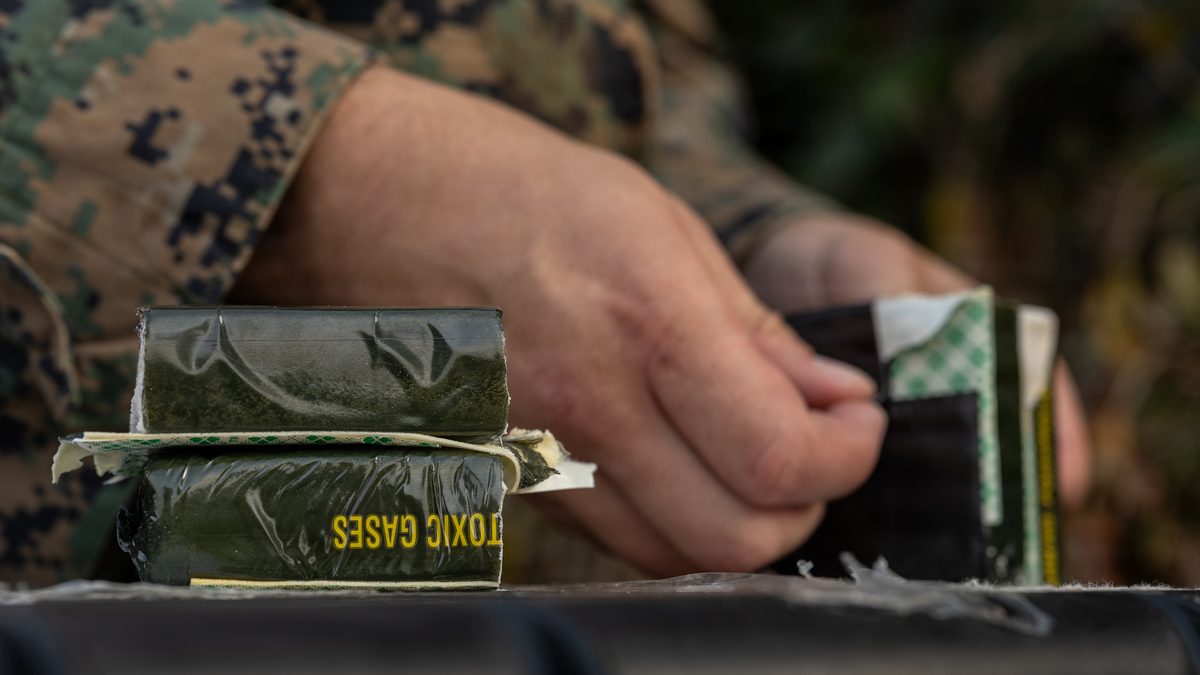
Illustrative: a US Marine Corps explosive ordnance disposal technician prepares a demolition charge during a disposal operation, Ie Shima, Japan, May 2026. Image shows generic EOD charge preparation, not the Alford Technologies equipment named in FBO 26LBS052. US Marine Corps photo by Lance Cpl. Joseph Kreis / DVIDS, public domain.
2,500 Units, 26 Nations, One UK SME: Inside NSPA Future Business Opportunity 26LBS052 for Alford's EOD Kit
Technical Summary
The NATO Support and Procurement Agency (NSPA) has issued Future Business Opportunity (FBO) 26LBS052, an information-only notice telling industry it may run a procurement for five explosive ordnance disposal (EOD) and improvised explosive device disposal (IEDD) items. The notice is published under NSPA Procurement Operating Instruction 4200-01, paragraph 6.2. It is not a solicitation, it carries no commitment to buy, and a response is not required to bid later. What it does do is put a marker down: NSPA is testing the supplier base ahead of a possible Request for Proposal (RFP) on its eProcurement portal.
The requirement is compact and specific. Five line items, 500 units of each, give a headline quantity of 2,500 units. Every stock number carries the NATO Codification Bureau (NCB) code 99, which identifies the United Kingdom as the country of origin, and every item traces to one original equipment manufacturer (OEM): Alford Technologies Limited of Trowbridge (Commercial and Government Entity, or CAGE, code U9625). Two lines sit in Federal Supply Class (FSC) 1385, Surface-Use Explosive Ordnance Disposal Tools and Equipment; three sit in FSC 1375, Demolition Materials. Quality assurance is set at Allied Quality Assurance Publication (AQAP) 2131, with a Certificate of Conformity signed by the Government Quality Assurance Representative (GQAR).
| Line | Nomenclature | NATO Stock Number | FSC | Qty |
|---|---|---|---|---|
| 10 | Kit, Basic (IEDD) | 1385-99-833-2491 | 1385 | 500 EA |
| 20 | Driver, Projectile, EOD | 1385-99-503-3673 | 1385 | 500 EA |
| 30 | Case, Demolition Charge | 1375-99-551-5882 | 1375 | 500 EA |
| 40 | Case, Demolition Charge | 1375-99-880-3695 | 1375 | 500 EA |
| 50 | Case, Demolition Charge | 1375-99-315-0156 | 1375 | 500 EA |
Five line items, five hundred units of each, twenty-six authorised supplier nations. FBO 26LBS052 turns a Trowbridge small firm's user-filled charge set into a codified, alliance-wide stores line. ISC assessment of NSPA FBO 26LBS052
What "user-filled" means for these items
Alford Technologies builds low net-explosive-quantity disruptor tools and charge containers that ship as inert hardware. The operator adds the energetic fill in the field, typically sheet explosive or detonating cord, and in the water-tamped designs water itself forms the projectile. The items in FBO 26LBS052 are therefore hardware and containers, not filled munitions. The delivered stores hold no explosive fill at the point of supply.
Analysis of Effects
Read against Alford's published catalogue, the five lines describe the backbone of a field EOD and IEDD set rather than a single tool. The basic kit at line 10 corresponds to the modular IEDD kit family, a case of user-filled charges that a bomb technician configures for the task; open-source cross-referencing associates this stock number with Alford's Vulcan user-filled modular shaped charge system, although ISC has not confirmed the exact stock-number-to-product binding against a primary catalogue page. The projectile driver at line 20 is the component that launches a charge's projectile, whether a copper jet-forming cone, an explosively formed projectile, or a water projectile, against a target device. The three demolition charge cases at lines 30 to 50 are the charge bodies themselves, the containers that sandwich the operator's explosive fill. The exact mapping of each stock number to a named catalogue product is not stated in the notice and is recorded below as a data gap.
The procurement structure is more revealing than the hardware. NSPA is aggregating alliance demand for a single small manufacturer's proprietary toolset and offering it across 26 authorised supplier nations, from Albania to the United States. The notice then adds a decisive clause: interested manufacturers must negotiate user rights and access to the Technical Data Package (TDP) with the OEM. That is the language of second-sourcing. NSPA is not simply buying from Alford Technologies; it is signalling that qualified firms may compete to build the design, provided they can secure the intellectual property. For a UK small and medium-sized enterprise (SME) whose value sits in patented, user-filled charge geometry, that clause is both a market-access opportunity and a sovereignty question.
Apparent omission: Slovenia is missing from the supplier list
The notice authorises 26 supplier nations, from Albania to the United States, but Slovenia is not among them. That roster closely tracks the membership of NSPA's Ammunition Support Partnership (ASP), the 1993 multinational framework through which participating nations aggregate demand and buy through common contracts. Slovenia joined the ASP in March 2026 as its 27th member. If 26LBS052 draws its authorised-supplier list from ASP membership, Slovenia's absence reads as an administrative lag rather than a deliberate exclusion, and a Slovenian manufacturer would be right to query it with NSPA before any Request for Proposal issues. ISC has flagged the discrepancy for correction.
Personnel and Safety Considerations
Because the items are supplied inert, their storage and transport hazard profile reflects component hardware rather than a filled charge, and the notice states no hazard division, compatibility group or net explosive quantity for the delivered stores. That is consistent with user-filled equipment, where the explosive is introduced downstream by the operator. The quality regime matters here more than the numbers. Setting AQAP 2131, NATO Quality Assurance Requirements for Final Inspection and Test, with a Certificate of Conformity countersigned by the GQAR, places government quality oversight on final inspection of safety-critical EOD stores. For equipment that a bomb technician will trust at close range against a live device, that final-inspection assurance and the associated right of government access to the supplier are the load-bearing controls.
Two weeks into their three-week IEDD course, the Dutch NATO Seniors are demonstrating dedication and expertise as they hone their skills and drills! Alford Training attracts operators from around the globe. #TrainingEx
— Alford Group (@ALFORDtech) June 5, 2024
Data Gaps
The following are not stated in FBO 26LBS052 and are recorded as gaps rather than inferred: the mapping of each NATO Stock Number to a specific named Alford Technologies catalogue product; any estimated contract value; the delivery schedule or contract duration; the hazard division, compatibility group and net explosive quantity of the delivered hardware; whether Alford Technologies intends to license its Technical Data Package to competing manufacturers; and the timeline for any follow-on Request for Proposal. Registration in the NSPA Source File is mandatory before a firm can respond to any RFP that may issue.
Key Questions
What is NSPA Future Business Opportunity 26LBS052?
It is an information-only notice from the NATO Support and Procurement Agency telling industry it may run a procurement for five Alford Technologies explosive ordnance disposal items, 500 units of each, across 26 authorised supplier nations. It is not a solicitation and creates no commitment to buy.
Which equipment does FBO 26LBS052 cover?
Five NATO-codified UK-origin line items: a basic IEDD kit and an EOD projectile driver in Federal Supply Class 1385, plus three demolition charge cases in class 1375. All are user-filled Alford Technologies hardware, shipped as containers that an operator fills with explosive in the field.
Why does the notice mention the Technical Data Package?
Interested manufacturers must negotiate user rights and Technical Data Package access with the original equipment manufacturer, Alford Technologies. That clause signals NSPA wants qualified second-source production of a proprietary UK design, raising the standing tension between alliance supply resilience and a small firm's intellectual property.
References
Source-evaluated under NATO STANAG 2022 (Reliability A–F / Accuracy 1–6). Tier 1 = government primary source; Tier 2 = quality news / specialist defence media; Tier 3 = authoritative aggregator / encyclopaedia.
- T1NATO Support and Procurement Agency – Future Business Opportunity 26LBS052 and Source File registration (NSPA eProcurement), 2026. (Reliability A / Accuracy 1)
- T2Alford Technologies – IEDD Kit product page, accessed July 2026. (Reliability B / Accuracy 2)
- T2Alford Technologies – IEDD Kit datasheet (D200-06), 2024. (Reliability B / Accuracy 2)
- T2ANSI Webstore / NATO Standardization Office – AQAP-2131 Edition C, NATO Quality Assurance Requirements for Final Inspection and Test, 2017. (Reliability B / Accuracy 2)
- T2Alford Technologies – Vulcan user-filled modular shaped charge system datasheet (VU-D200-09), 2024. (Reliability B / Accuracy 2)
- T2GlobalSecurity.org – Slovenia joins NSPO Ammunition Support Partnership as 27th nation, 26 March 2026. (Reliability B / Accuracy 2)
- T3Wikipedia – Allied Quality Assurance Publications, accessed July 2026. (Reliability C / Accuracy 3)
Corrections & updates welcome. If you hold open-source data that refines or corrects any parameter in this article, please contact [email protected] citing the specific claim and your source. Verified corrections will be incorporated and credited in the revision history. AI-assisted technical assessment based on open-source material. Not a formal intelligence product.