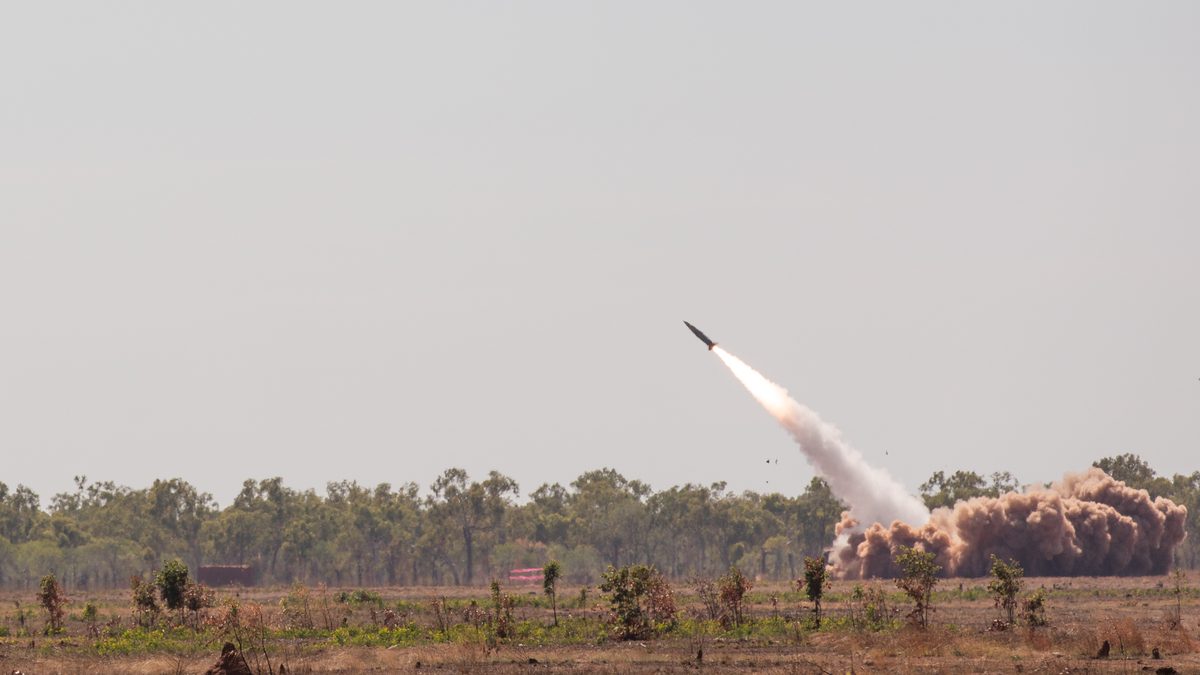
U.S. Army field artillery launch an Army Tactical Missile System (ATACMS) from an M142 HIMARS during Talisman Sabre 2023, Delamere, Australia. Photo: Sgt. 1st Class Andrew Dickson / U.S. Army (DVIDS, public domain). Illustrative of the ATACMS round; not the Unterluess facility.
Lockheed Martin and Rheinmetall Move to Co-Produce ATACMS Tactical Missiles at Unterluess
Technical Summary
On 7 July 2026, at the NATO Summit Defense Industry Forum in Ankara, Lockheed Martin and Rheinmetall signed a memorandum of understanding (MoU) to co-produce the Army Tactical Missile System (ATACMS) in Europe. The agreement, backed by the United States and German governments, is the first step toward a joint venture to manufacture, integrate and distribute ATACMS for NATO and allied European forces. Production would run at Rheinmetall's Unterluess site in Lower Saxony, which the companies describe as the first and only ATACMS production facility outside the United States.
ATACMS is a solid-propellant, guided surface-to-surface ballistic missile fired from the M270 Multiple Launch Rocket System and the M142 High Mobility Artillery Rocket System (HIMARS). One round is carried per HIMARS pod and two per M270 pod. The current in-service unitary variant guides on inertial and Global Positioning System (GPS) data and delivers a WDU-18/B high-explosive blast-fragmentation warhead in the 227 kilogram class to a range of roughly 300 kilometres. Rheinmetall states that rocket-motor and guided-missile component production at Unterluess is scheduled to begin as early as 2027, with full output scaling through 2028 and 2029.
By establishing ATACMS production at Rheinmetall's Unterluess site, we are creating new capabilities for Germany and Europe, securing supplies for our customers and strengthening our autonomy in defence policy. Armin Papperger, Chief Executive, Rheinmetall AG, 7 July 2026
Analysis of Effects
The technically significant element of this agreement is not the missile airframe but the energetics supply chain behind it. A guided ballistic missile such as ATACMS is built around a single solid rocket motor and a loaded high-explosive warhead, and both are the hardest parts of the round to localise. Solid-rocket-motor manufacture requires cast composite propellant, typically an ammonium perchlorate oxidiser with an aluminium fuel bound in a hydroxyl-terminated polybutadiene matrix, produced under tight process control and demanding explosive-facility siting. Rheinmetall reports that a dedicated rocket-motor factory at Unterluess is nearing completion alongside the artillery-ammunition plant that entered service in 2025. Standing up motor casting and warhead loading in Europe, rather than shipping finished rounds from Camden, Arkansas, is what turns this from an assembly arrangement into genuine sovereign capacity.
The procurement logic is driven by consumption. Rheinmetall estimates combined European and Ukrainian demand at 600 to 800 ATACMS rounds a year, a figure that reflects how quickly precision surface-to-surface munitions have been expended in recent operations. A European line shortens transatlantic delivery times for the growing pool of HIMARS and M270 operators across the alliance and reduces the single-point dependence on the United States production base. Lockheed Martin has stated it will keep its Camden production line running until the transition is complete, so the arrangement adds capacity rather than moving it. For NATO planners, the value is measured less in unit price than in the assurance that stocks can be replenished at wartime rates. The demand estimate also reflects programme timing: in United States service ATACMS is being superseded by the longer-range Precision Strike Missile (PrSM), so a European line sustains ATACMS output for the alliance and for Ukraine while the American production base pivots toward its successor.
Personnel and Safety Considerations
A packaged all-up ATACMS round combines a substantial mass of Hazard Division 1.1 solid propellant with a Hazard Division 1.1 high-explosive warhead, so any European storage and transport regime would need to be assessed against current standards, including Allied Ammunition Storage and Transport Publication AASTP-1 Edition C for storage and the relevant modal dangerous-goods rules for movement. Establishing a rocket-motor plant also introduces process-safety demands around propellant mixing and casting that are distinct from conventional artillery-ammunition production. The precise hazard classification and net explosive quantity (NEQ) that the Unterluess facility will work to are not published and should be treated as data gaps until the manufacturer confirms them.
Data Gaps
The following parameters are not confirmed in open sources and are recorded as data gaps: the net explosive quantity of the WDU-18/B warhead high-explosive fill and its exact composition; the hazard division and compatibility group assigned to the all-up round at the European facility; the solid propellant formulation to be produced at Unterluess; the specific ATACMS variant or variants covered by the joint venture and whether any submunition-carrying configuration is in scope, which ISC assesses as unlikely given the general move away from cluster natures; the annual production ceiling and the definitive in-service date; the commercial structure, ownership split and value of the planned joint venture; and the export-control and technology-transfer approvals, including United States International Traffic in Arms Regulations (ITAR) authorisation, required to transfer ATACMS production technology to a European facility.
Key Questions
What did Lockheed Martin and Rheinmetall agree at the 2026 NATO summit?
On 7 July 2026, at the NATO Summit Defense Industry Forum in Ankara, the two companies signed a memorandum of understanding toward a joint venture to manufacture, integrate and distribute the Army Tactical Missile System in Europe. Production would run at Rheinmetall's Unterluess site in Germany, backed by the US and German governments.
Why does producing ATACMS in Europe matter?
It would be the first ATACMS line outside the United States. Rheinmetall estimates European and Ukrainian demand at 600 to 800 rounds a year. Local production shortens supply chains and builds sovereign solid-rocket-motor and guided-missile capacity that Europe has largely lacked, easing dependence on the US production base.
What is ATACMS and how is it used?
The Army Tactical Missile System is a solid-propellant, GPS-aided surface-to-surface ballistic missile fired from M270 and M142 HIMARS launchers. The current unitary variant carries a high-explosive blast-fragmentation warhead to a range of about 300 kilometres against fixed, high-value targets such as command posts, air defences and logistics nodes.
References
Source-evaluated under NATO STANAG 2022 (Reliability A–F / Accuracy 1–6). Tier 1 = government primary source; Tier 2 = quality news / specialist defence media; Tier 3 = authoritative aggregator / encyclopaedia.
- T1NATO – Overview: 2026 NATO Summit in Ankara, 7 July 2026. (Reliability A / Accuracy 1)
- T2Lockheed Martin – Lockheed Martin and Rheinmetall Move Forward with ATACMS Co-Production in Europe, 7 July 2026. (Reliability B / Accuracy 2)
- T2Defense News – Germany set to become first international site for ATACMS missile production, 7 July 2026. (Reliability B / Accuracy 2)
- T2European Security & Defence – Lockheed Martin and Rheinmetall Move Forward with ATACMS Co-Production in Europe, 7 July 2026. (Reliability B / Accuracy 2)
- T3Wikipedia – MGM-140 ATACMS (technical baseline: launchers, warhead, range), accessed 8 July 2026. (Reliability C / Accuracy 3)
- T2Defense News – Army accelerates PrSM output as ATACMS nears sunset, 13 October 2025. (Reliability B / Accuracy 2)
Corrections & updates welcome. If you hold open-source data that refines or corrects any parameter in this article, please contact [email protected] citing the specific claim and your source. Verified corrections will be incorporated and credited in the revision history. AI-assisted technical assessment based on open-source material. Not a formal intelligence product.