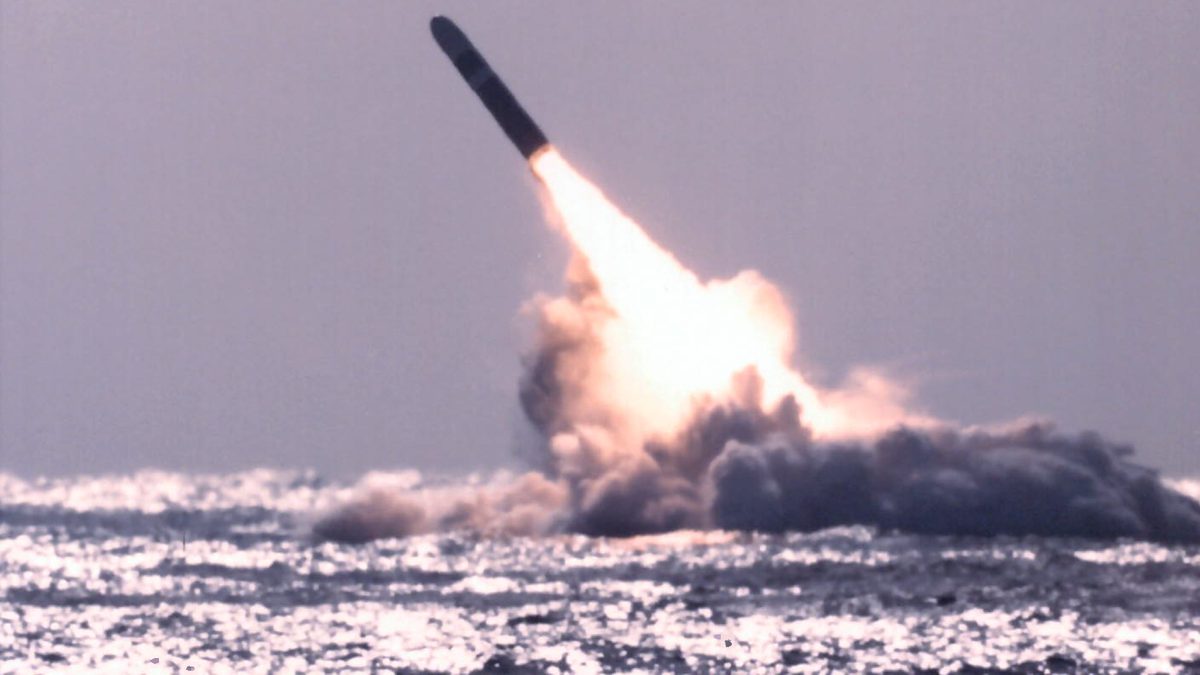
Illustrative image: a Trident II (D5) submarine-launched ballistic missile lifts off during a USS Tennessee (SSBN-734) performance evaluation launch. U.S. Navy photo, Naval Ordnance Test Unit (VIRIN 891204-F-N1010-1001), public domain via DVIDS. It shows a U.S. SLBM launch, not the 6 July 2026 Chinese test, and its appearance does not imply endorsement.
China Fires Submarine-Launched Ballistic Missile Into the Pacific as Joint Exercise With Russia Begins
Technical Summary
On Monday 6 July 2026, at around noon local time, the People's Liberation Army Navy (PLAN) test-fired a submarine-launched ballistic missile (SLBM) from the South China Sea into the Pacific Ocean. The PLAN said the missile carried a training dummy warhead and that the launch was routine training which complied with international law and was not directed at any country or target. Beijing released no imagery of the launch position and did not identify the submarine or the missile type.
The event matters less for what it destroyed, which was nothing, than for what it demonstrated. A dummy-warhead SLBM shot validates the delivery system rather than any warhead effect: the boost motors, stage separation, guidance, and the survivability of the reentry vehicle across the full flight profile. Sea-based ballistic missiles are the most survivable leg of a nuclear triad because a submerged launcher is hard to locate, so a successful open-ocean shot reads as a second-strike signal.
The PLA Navy operates six Type 094 ballistic missile submarines, each able to carry twelve JL-2 missiles credited in open sources with a range of roughly 7,200 kilometres and a single megaton-class or multiple-reentry-vehicle payload. ISC open-source assessment, 7 July 2026
The U.S. Naval Institute summarised the launch and carried the accompanying PLA Navy imagery:
China Tests Submarine-launched Ballistic Missile, Kicks Off Annual Exercise With Russia (USNI News)
— U.S. Naval Institute (@NavalInstitute) July 6, 2026
Analysis of Effects
The PLAN fields six Type 094 (Jin-class) nuclear-powered ballistic missile submarines and a single Type 032 diesel-electric boat used for SLBM development. Each Type 094 carries twelve missile tubes. The service's mainstay SLBM is the JL-2, credited in open sources with a range of roughly 7,200 kilometres and a payload of either a single warhead in the megaton class or multiple reentry vehicles. A newer JL-3, assessed at over 10,000 kilometres and reportedly able to reach the continental United States from Chinese waters, was displayed at the 2025 Victory Day parade.
China named neither the missile nor the boat. Taiwan's National Security Council Secretary-General Joseph Wu identified the weapon as a JL-2 and published a track showing a launch in the South China Sea, a flight over the northern coast of Luzon in the Philippines, and an impact in the Pacific between Nauru and Tonga. That geometry spans roughly 6,000 to 8,000 kilometres, which sits inside the JL-2's published envelope, so the JL-2 attribution is technically plausible on range grounds even though it rests on a third-party assessment rather than a Chinese confirmation. The last comparable event was in September 2024, when China fired a DF-31 series intercontinental ballistic missile (ICBM) from Hainan about 11,000 kilometres to a splashdown near French Polynesia, its first open-ocean ICBM test since 1980.
Personnel and Safety Considerations
The hazard from a training shot of this kind is the reentry body and spent stages falling into designated broad-ocean areas, not a warhead function. Chinese hydrographic authorities warned the Japan Coast Guard that debris could fall south of Cape Shionomisaki on Honshu, inside part of Japan's Exclusive Economic Zone (EEZ), and Tokyo urged Beijing to reconsider and to avoid Japanese airspace. New Zealand and several Pacific states were notified only hours ahead. For mariners and aircrew the practical point is the value of timely Notice to Mariners and airspace warnings when a strategic weapon transits a busy ocean region.
Data Gaps
Several core facts are unconfirmed. China has not stated the missile type (JL-2 or JL-3), the identity or class of the launch submarine, the exact launch position, the achieved range, or the number of reentry bodies carried. The JL-2 identification rests on a Taiwanese government assessment. Range figures for the JL-2 and JL-3 are open-source estimates that vary between publications. These points should be treated as reported claims rather than verified parameters.
Key Questions
What did China test on 6 July 2026?
The People's Liberation Army Navy fired a submarine-launched ballistic missile from the South China Sea into the Pacific Ocean, carrying an inert training warhead. Beijing described it as routine training and did not name the submarine, the launch position, or the missile type.
Which missile and submarine were involved?
China released no identification. Taiwan's National Security Council assessed the weapon as a JL-2, whose published range near 7,200 kilometres fits the reported impact area. The launch platform was probably a Type 094 Jin-class ballistic missile submarine, though this remains unconfirmed.
Why does the timing with the Russia exercise matter?
The launch opened on the same day as the annual China-Russia Joint Sea and Maritime Interaction exercise, running 6 to 13 July 2026 near Qingdao. Pairing a strategic-deterrent signal with a bilateral naval drill amplifies the political message to regional states.
References
Source-evaluated under NATO STANAG 2022 (Reliability A–F / Accuracy 1–6). Tier 1 = government primary source; Tier 2 = quality news / specialist defence media; Tier 3 = authoritative aggregator / encyclopaedia.
- T1Australian Government, Minister for Defence – Doorstop transcript, Nowra (Richard Marles on the Chinese missile test), 6 July 2026. (Reliability A / Accuracy 1)
- T1Government of Japan, Prime Minister's Office (Kantei) – Public notice on the Chinese ballistic missile launch and debris area, 6 July 2026. (Reliability A / Accuracy 2)
- T2USNI News (Dzirhan Mahadzir) – China Tests Submarine-launched Ballistic Missile, Kicks Off Annual Exercise With Russia, 6 July 2026. (Reliability B / Accuracy 2)
- T2CBS News – China test-launches ballistic missile from submarine in South Pacific, drawing protests, 6 July 2026. (Reliability B / Accuracy 2)
- T2Army Recognition – China conducts strategic submarine-launched ballistic missile test in the Pacific Ocean, July 2026. (Reliability B / Accuracy 3)
- T3Wikipedia – Type 094 submarine (platform and JL-2/JL-3 armament data), accessed 7 July 2026. (Reliability C / Accuracy 3)
Corrections & updates welcome. If you hold open-source data that refines or corrects any parameter in this article, please contact [email protected] citing the specific claim and your source. Verified corrections will be incorporated and credited in the revision history. AI-assisted technical assessment based on open-source material. Not a formal intelligence product.