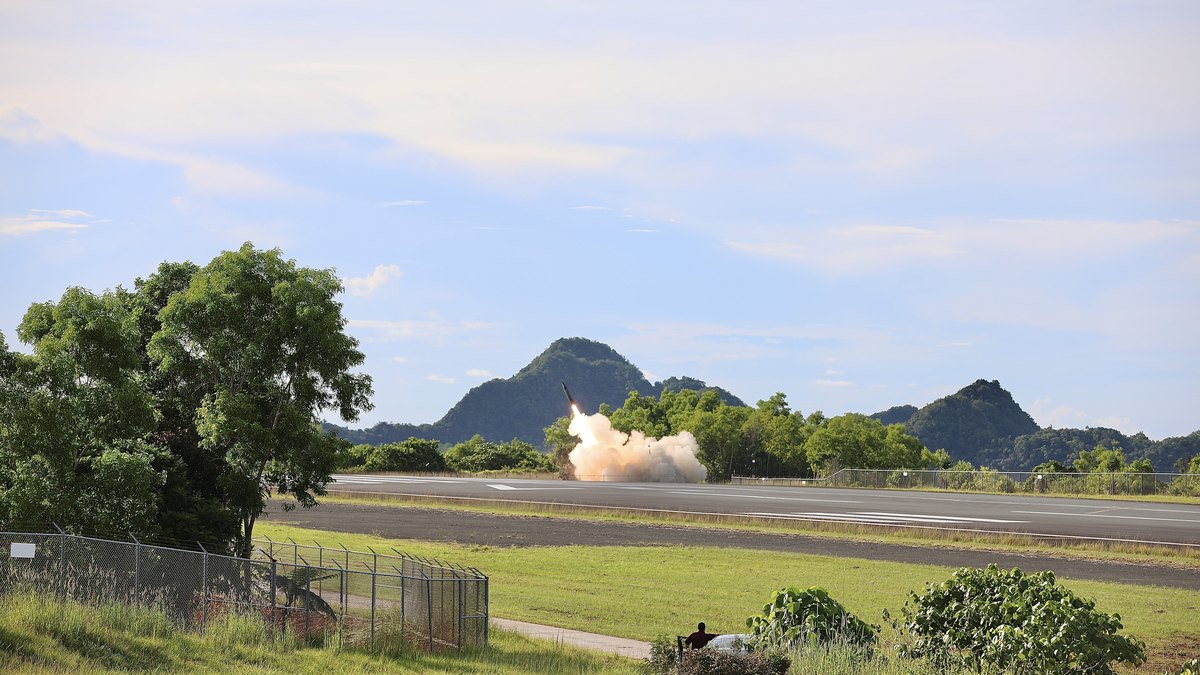
A U.S. Army Precision Strike Missile in flight. U.S. Army photo by Sgt. Perla Alfaro, via Wikimedia Commons (public domain).
£190m for Precision Strike Missile: The UK Buys Long-Range Fires Alongside the US and Australia
Technical Summary
The United Kingdom will invest £190 million in the Precision Strike Missile (PrSM), a surface-to-surface ballistic weapon built by Lockheed Martin, under the 2026 Defence Investment Plan (DIP) published on 30 June 2026. The commitment sits inside the plan's £11.1 billion munitions and weapons allocation. It buys the British Army into a weapon class that flies well beyond 400 kilometres, against the roughly 80 to 150 kilometres its current guided multiple-launch rockets deliver. The Ministry of Defence (MoD) frames the move as roughly tripling the Army's deep-strike reach and aligns it with the United States and Australia, both already in the programme.
PrSM replaces the ageing Army Tactical Missile System (ATACMS) and fires from launchers the British Army already operates, the tracked M270 and the wheeled M142 High Mobility Artillery Rocket System (HIMARS). The design packs two missiles into a launch pod that carried a single ATACMS, so a loaded launcher doubles its deep-strike salvo without any new vehicle. Propulsion is a solid rocket motor. The baseline Increment 1 round carries a blast-fragmentation warhead against fixed land targets, while later increments in United States development add a multimode seeker for moving and maritime targets and, further out, substantially greater range.
Two Precision Strike Missiles fit the launch pod that once held a single ATACMS, so every M270 or HIMARS in the British inventory doubles its deep-strike salvo the moment the new round is fielded. ISC technical assessment, open sources
Analysis of Effects
The value here is reach multiplied by magazine depth. A British M270 firing the current guided rocket can range a divisional rear area. The same launcher with PrSM reaches into an adversary's operational depth, the belt where command posts, logistics nodes, air-defence radars and follow-on echelons sit. Doubling the rounds per pod matters as much as the range, because deep targets are fleeting and a launcher that can service two aim points per reload before it displaces survives longer and strikes more. The DIP ties this to Project ASGARD, the Army's digital targeting effort, which is meant to connect sensors, artificial intelligence and shooters so a target found by a drone or a satellite can be struck before it moves.
PrSM is one line in a wider British strike portfolio the DIP sketches out. The plan names £770 million for a Deep Precision Strike effort with Germany, £1.4 billion for the Stratus missile, and further funding for one-way effectors and low-cost cruise missiles. Read together, these form the high-low mix the MoD talks about, expensive precision weapons for the hardest targets and cheap attritable munitions for the rest. The trilateral route with Washington and Canberra also spreads development cost and, in principle, widens the production base the three armies can draw on when stockpiles run down in a long fight.
Personnel and Safety Considerations
PrSM is a solid-propellant ballistic missile, so the handling and storage regime is the demanding end of the artillery world rather than the gun line. Loaded pods are sealed rounds that crews fit and fire without access to the energetics, which simplifies field handling but concentrates the explosive-safety burden into storage, transport and the licensing of the sites that hold them. A British buy raises the usual questions of net explosive quantity for magazines and vehicles, separation distances at forward arming points, and the qualification of UK facilities to hold a missile whose warhead and motor are United States designs. None of that is new to an army that has fielded ATACMS-compatible launchers. The larger magazine per pod and the intent to hold deeper stockpiles both push the storage footprint upward.
Data Gaps
Several parameters are not yet in open sources. The number of missiles the UK will buy for £190 million is not disclosed, nor is the increment the Army will acquire, the in-service date, or whether existing M270A2 launchers need modification. Lockheed Martin's published range for Increment 1 is stated as greater than 400 kilometres; a precise figure and the warhead mass are not confirmed in UK documents. The tripling characterisation is the MoD's own framing and depends on which current system is used as the baseline. ISC will update these figures as the DIP business case and any contract notice are published.
Key Questions
What is the Precision Strike Missile and what does the UK's £190 million buy?
The Precision Strike Missile, or PrSM, is a Lockheed Martin surface-to-surface ballistic missile that ranges beyond 400 kilometres and replaces the older ATACMS. The UK's £190 million, set out in the 2026 Defence Investment Plan, buys Britain into the programme alongside the United States and Australia to extend the British Army's deep-strike reach.
How does PrSM change British Army long-range fires?
PrSM fires from the M270 and HIMARS launchers the Army already uses, so no new vehicle is needed. It flies far past the roughly 80 to 150 kilometres of current guided rockets, and two missiles fit the pod that once held one ATACMS, doubling the deep-strike salvo per launcher.
Where does PrSM sit in the UK Defence Investment Plan?
PrSM is one line within the plan's £11.1 billion for munitions and weapons. It joins £770 million for Deep Precision Strike with Germany, £1.4 billion for the Stratus missile, and funding for one-way effectors and low-cost cruise missiles, forming the Army's high-low mix of long-range strike options.
References
Source-evaluated under NATO STANAG 2022 (Reliability A–F / Accuracy 1–6). Tier 1 = government primary source; Tier 2 = quality news / specialist defence media; Tier 3 = authoritative aggregator / encyclopaedia.
- T1UK Ministry of Defence – The Defence Investment Plan 2026, 30 June 2026. (Reliability A / Accuracy 1)
- T2Defence Industry Europe – UK plans £190 million Precision Strike Missile (PrSM) procurement, 6 July 2026. (Reliability B / Accuracy 2)
- T2House of Commons Library – Defence Investment Plan: Key decisions (CBP-10935), July 2026. (Reliability B / Accuracy 2)
- T2Lockheed Martin – Precision Strike Missile (PrSM), 2026. (Reliability B / Accuracy 2)
- T3The Aviationist – The UK's £298B Defence Investment Plan At A Glance, 4 July 2026. (Reliability C / Accuracy 3)
Corrections & updates welcome. If you hold open-source data that refines or corrects any parameter in this article, please contact [email protected] citing the specific claim and your source. Verified corrections will be incorporated and credited in the revision history. AI-assisted technical assessment based on open-source material. Not a formal intelligence product.