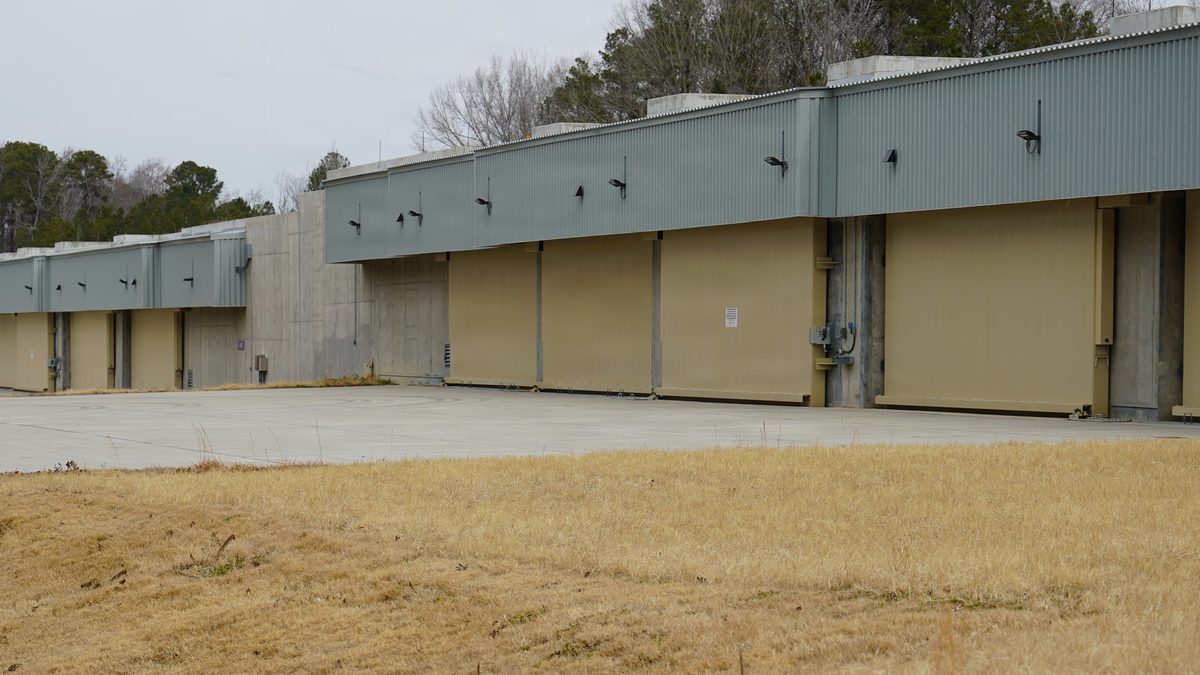
Illustrative: newly built ordnance magazines at Naval Weapons Station Yorktown, 10 March 2026. Photo: Max Lonzanida / U.S. Navy, via DVIDS (public domain). The image does not depict the Armag 3-Bar ECM; use does not imply U.S. Navy or Department of War endorsement.
TP-15 (2026) Confirms Armag's 3-Bar Steel-Box Earth-Covered Magazine as Approved Protective Construction
Technical Summary
The Department of War Explosives Safety Office (DWESO), successor to the Department of Defense Explosives Safety Board (DDESB), has issued Revision 5 of Technical Paper 15 (TP-15), "Approved Protective Construction," dated July 2026. Its Appendix 1 change record adds Armag Corporation's 3-Bar steel-box earth-covered magazine (ECM) to Table AP1-1, the register of ECM designs approved for new construction across the United States armed forces. TP-15 is the standing catalogue of protective construction designs that meet the criteria of the Department of War ammunition and explosives safety standard, and Table AP1-1 is the reference a facility planner draws from when specifying a new magazine.
The revision formalises guidance the DDESB first issued in a memorandum dated 16 January 2025, which approved the Armag steel-box ECM for a 3-Bar structural strength designation and directed that the design be added to Table AP1-1 as approved for new construction. The approved net explosive weight (NEW) is limited to 50,000 lb, about 22,680 kg, of ammunition or explosives, a ceiling set by the magazine's reduced footprint of 13.5 ft by 40 ft, roughly 4.1 m by 12.2 m. Separately, Armag reports that the 2026 update also covers intrusion detection system (IDS) installation on its reduced-arc products, including the Canine Explosive Training Aid Storage Magazine (CETASM) and the Advanced Explosive Ordnance Disposal (EOD) Magazine. ISC records the IDS provision as manufacturer-reported and flags it as a data gap below.
The design of reference (b) and (c) will be added to Table AP1-1 of [TP-15] as approved for new construction. DDESB approval memorandum, 16 January 2025
Armag 3-Bar Steel-Box ECM: baseline parameters (open sources)
| Design type | Steel-box earth-covered magazine, vertical walls and flat roof, continuously welded on all six faces |
| Structural rating | 3-Bar (permits reduced intermagazine distance (IMD) and reduced intraline distance (ILD)) |
| Maximum net explosive weight | 50,000 lb (approximately 22,680 kg) |
| Footprint | 13.5 ft by 40 ft (approximately 4.1 m by 12.2 m); body height about 9 ft (2.7 m) |
| Earth cover | Minimum 2 ft (0.6 m); maximum slope 2 horizontal to 1 vertical |
| Governing regulation | Defense Explosives Safety Regulation (DESR) 6055.09, Edition 1, Change 1, 23 February 2024 |
| Blast design standard | Unified Facilities Criteria (UFC) 3-340-02, Structures to Resist the Effects of Accidental Explosions |
| Forced-entry resistance | Greater than 10 minutes against a threat severity level III attack per UFC 4-026-01 |
Analysis of Effects
The significance sits in the structural rating, not in a new munition. Under the Department of War standard, earth-covered magazines are classed as 7-Bar, 3-Bar or undefined. The 7-Bar class carries the highest structural strength and the least restrictive separations, the undefined class the weakest, and 3-Bar sits between the two. A 3-Bar ECM headwall and door system are engineered to withstand the blast loading that DESR 6055.09 defines at 3-Bar intermagazine distances, which lets planners position magazines closer to one another than an undefined design permits. That reduction in intermagazine and intraline distance compresses the explosives safety quantity distance (ESQD) hazard arc and shrinks the storage-area footprint on the site plan. The Armag unit is the first prefabricated, factory-welded steel ECM to carry that rating, a category previously held by site-built reinforced-concrete arch and box magazines. Delivered as a single pre-manufactured unit, it removes the pour-and-cure construction cycle, and continuous welds on all six faces avoid the cracking and water ingress common to concrete ECMs. For durability, the steel headwall carries a zinc-rich primer and polyurethane topcoat rated for marine (environmental severity classification C5) conditions, and the exterior is finished with a Line-X protective coating.
Armag's reduced-arc line occupies a different niche. The CETASM and the Advanced EOD Magazine are small reduced-ESQD units whose maximum credible event (MCE) is engineered down to a single item by holding training aids or EOD stores in containers designed to prevent sympathetic detonation. The DDESB has approved CETASM siting at 25 ft from inhabited buildings, 15 ft from public traffic routes, and 4 ft from other magazines. Formal provision for IDS on these units matters for physical-security compliance, because reduced-arc siting deliberately places explosives close to occupied areas where intrusion detection is a standard control expectation.
Personnel and Safety Considerations
For explosives-safety staff, ammunition technical officers and facility planners, the practical effect is that a 3-Bar prefabricated ECM is now a compliant option on a new-construction site plan without a design deviation or waiver. Planners should still confirm the as-sited net explosive weight against the 50,000 lb ceiling, maintain the minimum 2 ft earth cover and the 2 horizontal to 1 vertical maximum slope, and confirm bonding and grounding to DESR 6055.09. The 3-Bar benefit applies to intermagazine and intraline distance only: the design carries no relaxation of quantity-distance to inhabited buildings or public traffic routes. Hazard division and compatibility group segregation, and the net-explosive-weight limits that flow from them, remain governed by DESR 6055.09 for the items actually stored, not by the magazine designation.
Data Gaps
Four items are unresolved at the time of writing. First, the IDS provision for the reduced-arc products is reported by the manufacturer; ISC could not locate the IDS language in the portion of TP-15 Revision 5 available and records it as manufacturer-reported pending confirmation in the published paper. Second, TP-15 does not itself set hazard division or compatibility group storage limits for the 3-Bar ECM; those follow the standard DESR 6055.09 rules for the stored items. Third, the 50,000 lb figure is a design ceiling, and the sited net explosive weight for any installation is set by the surrounding exposures through the local quantity-distance analysis. Fourth, the reflected-overpressure values that correspond to the 3-Bar rating are defined by the DESR 6055.09 loading paragraph and were not reproduced in open sources, so ISC has not converted the 3-Bar label to a specific pressure figure.
Key Questions
What did TP-15 (2026) change for the Armag 3-Bar earth-covered magazine?
Revision 5 of DWESO Technical Paper 15, dated July 2026, adds Armag's 3-Bar steel-box earth-covered magazine to Table AP1-1, the list of designs approved for new construction. It formalises a Department of Defense Explosives Safety Board memorandum of 16 January 2025 that granted the 3-Bar structural strength designation.
What does a 3-Bar rating allow that an undefined magazine does not?
A 3-Bar earth-covered magazine headwall is engineered to withstand the blast loading defined in DESR 6055.09 at 3-Bar intermagazine distances. This lets planners site magazines closer together, reducing intermagazine and intraline distance and shrinking the explosives safety quantity distance footprint. It does not reduce distance to inhabited buildings.
What is the maximum explosive storage in the Armag 3-Bar ECM?
The approved net explosive weight is limited to 50,000 lb, about 22,680 kg, of ammunition or explosives. The limit reflects the magazine's reduced 13.5 ft by 40 ft footprint. The sited quantity for any installation is set by the local quantity-distance analysis, not by the design ceiling alone.
References
Source-evaluated under NATO STANAG 2022 (Reliability A–F / Accuracy 1–6). Tier 1 = government primary source; Tier 2 = quality news / specialist media; Tier 3 = manufacturer or authoritative reference.
- T1Department of War Explosives Safety Office (DWESO) – Technical Paper 15, "Approved Protective Construction," Revision 5, July 2026. (Reliability A / Accuracy 1)
- T1Department of Defense Explosives Safety Board (DDESB) – DDESB Approval of 3-Bar Structural Strength Designation for the ARMAG Steel-Box Earth-Covered Magazine (ECM) Design, memorandum, 16 January 2025. (Reliability A / Accuracy 1)
- T2Society of American Military Engineers, The Military Engineer – Prefabricated Magazine Earns Protective Construction Designation (sponsored content, presented by Armag), 2025. (Reliability B / Accuracy 2)
- T2Whole Building Design Guide (National Institute of Building Sciences) – Ammunition & Explosive Magazines, accessed July 2026. (Reliability B / Accuracy 2)
- T3Armag Corporation – Armag 3-Bar Earth Covered Magazine, accessed July 2026. (Reliability C / Accuracy 3)
- T3Armag Corporation – K9 Explosives Magazines (CETASM), accessed July 2026. (Reliability C / Accuracy 3)
Corrections & updates welcome. If you hold open-source data that refines or corrects any parameter in this article, please contact [email protected] citing the specific claim and your source. Verified corrections will be incorporated and credited in the revision history. AI-assisted technical assessment based on open-source material. Not a formal intelligence product.