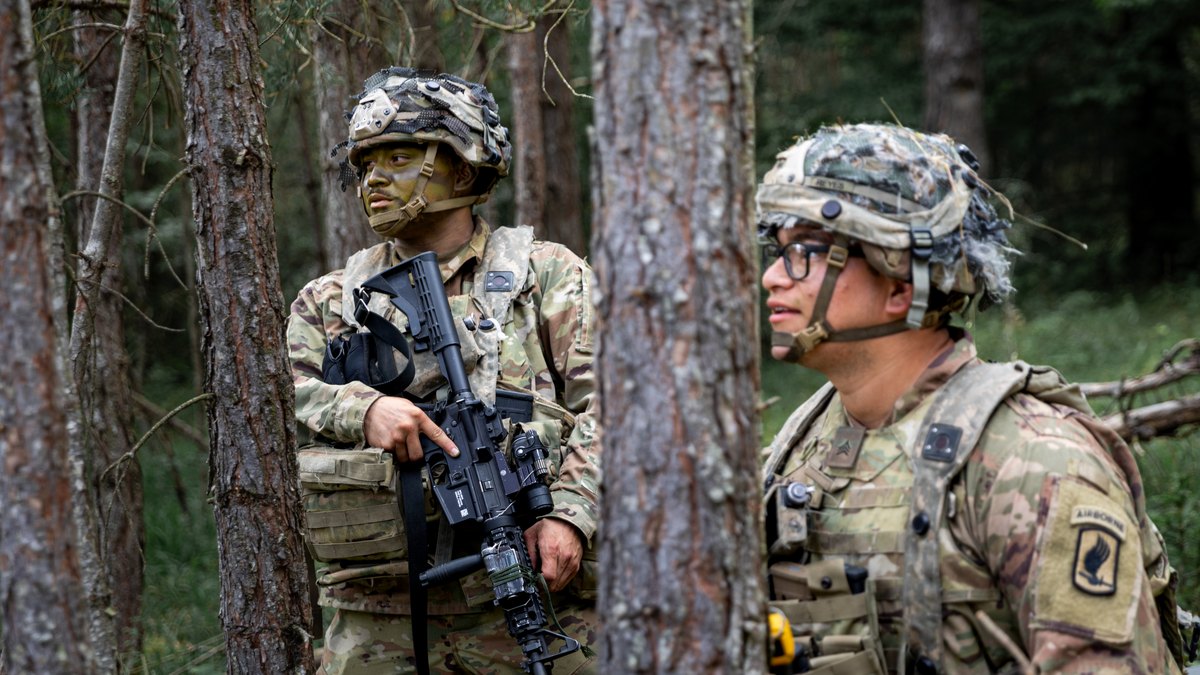
U.S. Army Soldiers train to counter unmanned aircraft systems. U.S. Army photo by Cpl. Danielle Rayon, via Wikimedia Commons (public domain).
AeroVironment's $500m US Army Counter-Drone Award: The Kinetic, Laser and RF Effector Stack
Technical Summary
AeroVironment has secured a $500 million United States Army contract for commercial counter-unmanned aircraft system (C-UAS) equipment, according to a notice dated 1 July 2026. The award is a three-year vehicle to buy layered defences against Group 1, 2 and 3 drones, the band that runs from a hand-launched quadcopter under 20 pounds to a one-way attack aircraft above 55 pounds. It buys effects, not a single system: radio-frequency detection and jamming, directed-energy lasers, kinetic interceptor missiles, and the command software that ties them together.
The kinetic layer is the part that reads as ordnance. AeroVironment's Freedom Eagle-1 (FE-1) interceptor, picked in October 2025 under a separate $95.9 million Army award for a next-generation C-UAS missile, uses a dual-thrust solid rocket motor and is built to kill Group 2 and Group 3 drones, with residual reach against Group 1 quadcopters and even crewed fixed-wing and rotary aircraft. The company lists a laser option, LOCUST X3, rated at 20 to 35 kilowatts, and a radio-frequency defeat unit, Titan 4, putting out more than 550 watts. Each answers a different failure case.
A hostile quadcopter can cost between $2,000 and $30,000. Answering every one with a missile that costs many times more is a losing exchange, which is why the Army is buying jammers and lasers to sit under the interceptor, not beside it. ISC technical assessment, open sources
Analysis of Effects
The logic of the award is a cost-exchange ladder. At the bottom sits radio-frequency defeat, which detects a drone's control link and jams it without a shot fired, cheap and reusable but useless against an autonomous aircraft flying a pre-programmed route on passive navigation. Above it sits the laser, a few dollars of electricity per engagement, constrained by line of sight, dwell time, and weather such as dust, smoke and rain. At the top sits the FE-1 missile, the expensive, high-confidence answer held in reserve for the drone that is too fast, too autonomous or too important to leave to the cheaper layers. A defended airfield or a logistics hub runs all three off one air picture, assigning the least costly response that will work.
Read as procurement, the contract is a pattern, not a one-off. AeroVironment already holds a $990 million Army contract from August 2024 for the organic stand-off weapons that arm dismounted infantry with small loitering munitions. The same company now supplies the defensive half of the same equation. That mirrors the wider United States turn set out in the December 2024 Strategy for Countering Unmanned Systems and the Replicator effort, and it fits an Army that in March 2026 began rewriting doctrine force-wide around persistent observation and counter-small-drone technique. The service is buying commercial and near-commercial kit in quantity, accepting iterative upgrades rather than waiting for a perfect system.
Personnel and Safety Considerations
The effector mix carries a real weapon-safety and airspace burden, most of it on the kinetic and directed-energy layers. A dual-thrust solid rocket motor and a warhead mean the FE-1 brings the storage, transport and net explosive quantity considerations of any guided interceptor, plus the range-safety problem of firing into congested airspace where friendly drones, crewed aircraft and civil traffic may share the volume. The laser layer is not benign either. When the Army deployed a 20 kilowatt LOCUST laser near El Paso International Airport in February 2026, aviation-safety concerns closed the airspace for seven hours, a plain reminder that homeland counter-drone work is bounded by law and flight safety as tightly as by physics.
Data Gaps
Key figures are not public. The Army has not disclosed the split of the $500 million ceiling across radio-frequency, laser and missile buys, the quantities of any system, or the delivery schedule. The FE-1 warhead type and fuzing are not stated in open sources, so its lethality mechanism against a small drone is inferred, not confirmed. Unit costs for the FE-1, LOCUST X3 and Titan 4 are not published. ISC will refine these points as the contract detail and any test results reach the public record.
Key Questions
What did AeroVironment win from the US Army?
AeroVironment secured a $500 million, three-year US Army contract, noticed on 1 July 2026, for layered counter-drone equipment. It covers effects rather than one system: radio-frequency detection and jamming, directed-energy lasers, the FE-1 kinetic interceptor missile, and the command software that links sensors and effectors into a single air picture.
What is the FE-1 interceptor and why does it matter?
The Freedom Eagle-1, or FE-1, is AeroVironment's kinetic counter-drone missile, chosen in October 2025 under a separate $95.9 million Army award. It uses a dual-thrust solid rocket motor to kill Group 2 and Group 3 drones, with residual reach against smaller quadcopters and some crewed aircraft. It is the hard-kill top layer of the stack.
Why buy lasers and jammers instead of just missiles?
Cost exchange. A hostile drone can cost as little as $2,000, so answering each one with a costlier missile loses the maths. Radio-frequency jamming and lasers defeat cheaper threats at low cost per shot, letting the Army reserve the expensive FE-1 interceptor for drones too fast, autonomous or important for the cheaper layers to stop.
References
Source-evaluated under NATO STANAG 2022 (Reliability A–F / Accuracy 1–6). Tier 1 = government primary source; Tier 2 = quality news / specialist defence media; Tier 3 = authoritative aggregator / encyclopaedia.
- T1US Army / SAM.gov – Counter-UAS commercial systems contract notice, 1 July 2026. (Reliability A / Accuracy 1)
- T2Army Recognition – U.S. Army Awards AeroVironment $500M Contract for Layered Counter-Drone Defense Systems, 2 July 2026. (Reliability B / Accuracy 2)
- T2AeroVironment – Freedom Eagle-1 (FE-1) counter-UAS interceptor, 2026. (Reliability B / Accuracy 2)
- T2US Department of Defense – Strategy for Countering Unmanned Systems, December 2024. (Reliability B / Accuracy 2)
- T3Congressional Research Service – Department of Defense Counter-Unmanned Aircraft Systems, 2025. (Reliability C / Accuracy 3)
Corrections & updates welcome. If you hold open-source data that refines or corrects any parameter in this article, please contact [email protected] citing the specific claim and your source. Verified corrections will be incorporated and credited in the revision history. AI-assisted technical assessment based on open-source material. Not a formal intelligence product.