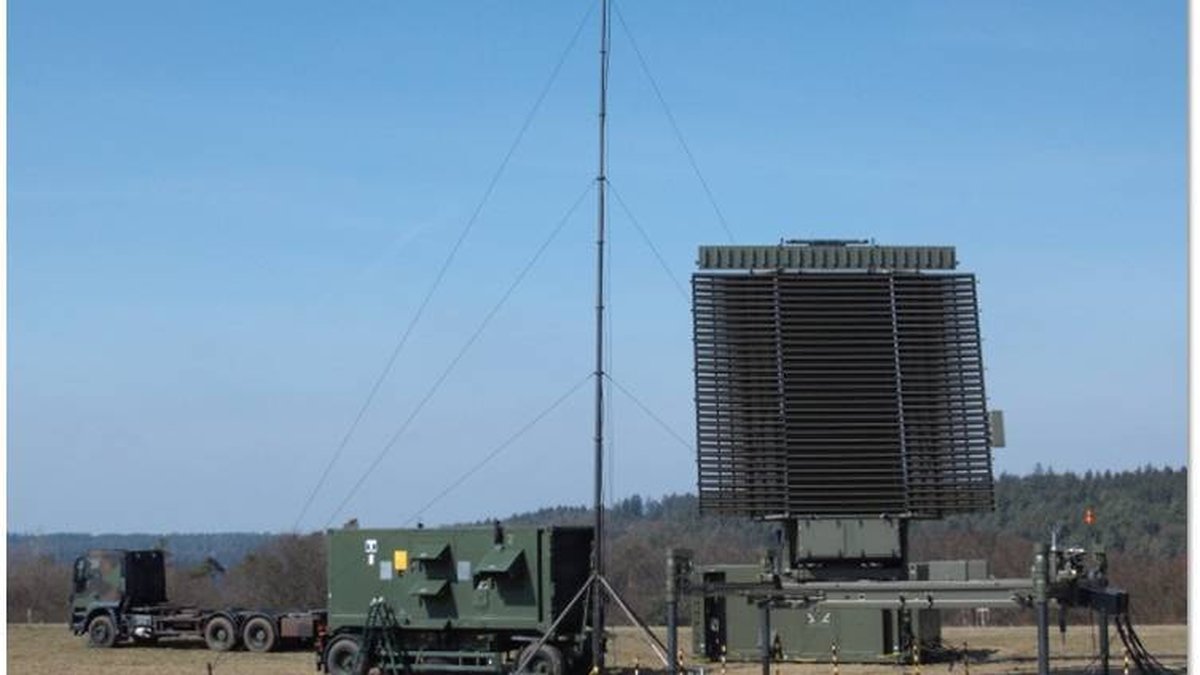
Leonardo RAT-31DL/M, the deployable member of the RAT-31DL family, set up in the field. Image: Leonardo press library (Digital Rights Management, Terms & Conditions, Copyright: None).
Which Radar Meets the NSPA Belgium FBO? The Case for the Leonardo RAT-31DL Family
Technical Summary
The NATO Support and Procurement Agency (NSPA) has flagged a Future Business Opportunity (FBO) for two three-dimensional early-warning air-defence radars for Belgium, one fixed and one deployable, sharing an identical core design. The notice sets a tight technical envelope: an Active Electronically Scanned Array (AESA) working in the NATO D-band, which is the 1215 to 1400 megahertz slice the Institute of Electrical and Electronics Engineers (IEEE) calls L-band, with a Tactical Ballistic Missile (TBM) detection mode and an Identification Friend or Foe (IFF) subsystem to Mark XIIB, including the cryptographically secure Mode 5. This companion piece takes that envelope and reads it against the radars actually in NATO service, to name the closest fit rather than describe the requirement in the abstract.
On open sources, one system stands out because it already exists in exactly the two forms the notice asks for, off a single radar family. Leonardo's RAT-31DL is the fixed member and the RAT-31DL/M is its deployable sibling, and they share the same L-band solid-state active phased-array core. That is the crux of the requirement, two systems of identical design differing only in how they are housed and moved, and it is a shape Leonardo has already productised rather than proposed.
The requirement, and the RAT-31DL family against it
| Two systems, identical core | Met: RAT-31DL (fixed) and RAT-31DL/M (deployable) share one radar core |
| 3D AESA, L / NATO D-band | Met: L-band solid-state active phased array, latest build uses gallium-nitride modules |
| Ballistic missile detection | Met: dedicated TBM mode, elevation scan to 60 degrees for high-elevation targets |
| Range for early warning | Published: over 470 km, with aircraft detection reported beyond 500 km |
| IFF Mode 5 / Mark XIIB | Met: integrated secondary surveillance and IFF, Mode 5 class |
| Deployability | RAT-31DL/M packs into two 20-foot ISO containers, five-person crew, near two-hour setup |
| NATO track record | RAT-31DL/M ordered by NATO in 2023; RAT-31 series in wide allied service |
The requirement is not really for a radar, it is for a pair. Two systems of identical core design, one fixed and one deployable, is a specification that rewards a manufacturer who has already built both off one array. On open sources, that description fits the Leonardo RAT-31DL and RAT-31DL/M more cleanly than any rival. ISC technical assessment, open sources
The Candidate Field
Three European houses can credibly answer a long-range L-band requirement, and one well-known name is ruled out by physics. Leonardo's RAT-31DL family leads because the fixed and deployable variants already coexist. Thales offers the SMART-L Multi-Mission line, an L-band AESA with a strong ballistic-missile and even space-surveillance pedigree, though its centre of gravity has been naval and large fixed installations rather than a matched fixed-and-deployable pair. Indra's LANZA family covers both ends, with the fixed LANZA 3D long-range radar and the deployable LTR-25, the latter a NATO Deployable Air Defence Radar (DADR) that has been fielded to Romania and bought by the United Kingdom. Saab's Giraffe radars are excellent AESA sensors, but they work in the higher S, C and X bands, so they do not meet a D/L-band requirement and fall out at the first technical filter.
| System | Band | Fixed / deployable | Missile role | Fit |
|---|---|---|---|---|
| Leonardo RAT-31DL / RAT-31DL/M | L-band (NATO D) | Both, one common core | TBM mode, elevation to 60° | Closest fit |
| Thales SMART-L Multi-Mission | L-band (NATO D) | Fixed and naval; land-deployable variant | BMD and space surveillance | Strong |
| Indra LANZA 3D / LTR-25 | L-band (NATO D) | Both, NATO DADR | TBM tracking | Credible |
| Saab Giraffe family | S / C / X-band | Deployable | Multi-mission | Band mismatch |
Analysis of Effects
The band choice is doing the heavy lifting. Long-range early-warning radars for air and missile defence cluster in the one to two gigahertz region because that spectrum trades angular precision for reach, power efficiency and weather penetration, and the longer wavelength gives useful performance against low-observable targets. The RAT-31DL answers this with a solid-state active array of 42 rows of transmit-receive modules that forms four simultaneous independent pencil beams in elevation, and the current build moves those modules to gallium-nitride, which lifts power efficiency and high-speed-target performance. The dedicated ballistic-missile mode lifts the elevation coverage to 60 degrees, which is the discriminator that turns a plain air-surveillance set into an early-warning sensor able to catch a tactical ballistic missile on the way up.
There is one point of genuine technical tension worth naming. The notice asks for electronic steering in both azimuth and elevation. The fielded L-band contenders, the RAT-31DL, SMART-L and LANZA, all scan electronically in elevation but rotate their antenna mechanically in azimuth, with electronic beam agility available inside the rotating beam. A strict reading that demands full electronic steering in azimuth as well would point instead at a fixed, multi-face array that stares in all directions without turning. Whether NSPA intends the phrase in the loose sense that the rotating incumbents satisfy, or the strict sense that would reshape the field, is the single most consequential ambiguity in the notice, and a bid team should clarify it with the logistic point of contact before committing.
Personnel and Safety Considerations
This is a sensor and infrastructure buy, so the safety envelope is electromagnetic and site-based rather than explosive. A high-power L-band emitter carries radio-frequency radiation-hazard (RADHAZ) implications: exclusion arcs around the array face, controlled zones for personnel and fuel, and siting clearances that keep the main beam off occupied structures. The Mark XIIB and Mode 5 subsystems bring cryptographic key-management duties that sit with the operating nation and NATO. The fixed-site scope names its own hazards and mitigations, the lightning protection and grounding, the fire detection and suppression system and the thermal-management plant that keeps a solid-state array in limits, while the radome shields the array from weather and preserves the low-sidelobe performance a long-range sensor depends on. A full radiation-hazard assessment would need the selected manufacturer's emission data, which is not part of a market notice.
Data Gaps
This assessment names a best-fit system from published capability data, not from any award. No contract has been placed, no manufacturer has been named by NSPA, and the OEM fields in the notice are marked not applicable, which is consistent with an open competition. The full FBO reference is redacted in the released text. The range and elevation figures quoted here are manufacturer and open-source values for the RAT-31DL family and are not independently instrumented by ISC. The azimuth-steering reading discussed above is unresolved pending the actual tender wording. Finally, there is as yet no separate Belgian Ministry of Defence statement tying this radar requirement to the wider 3.1 billion euro ground-based air-defence package, so that link remains inferred rather than confirmed.
Key Questions
Which radar best meets the NSPA Belgium requirement?
On open sources the Leonardo RAT-31DL family is the closest fit. The fixed RAT-31DL and the deployable RAT-31DL/M share one L-band solid-state 3D AESA core, which matches the requirement for two systems of identical design in one fixed and one deployable configuration, both with ballistic missile detection and NATO IFF.
What are the credible alternatives?
Thales SMART-L Multi-Mission and Indra's LANZA family, specifically the deployable LTR-25, are both L-band, ballistic-missile-capable and in NATO service. Saab's Giraffe radars are excluded because they operate in the higher S, C and X bands rather than the D/L-band the notice specifies.
Is there any technical catch in the requirement?
The notice asks for electronic beam steering in both azimuth and elevation. The fielded L-band contenders scan electronically in elevation but rotate mechanically in azimuth, with electronic agility inside the beam. A strict fully-electronic azimuth reading would favour a fixed multi-face array, so the exact wording matters at tender stage.
References
Source-evaluated under NATO STANAG 2022 (Reliability A–F / Accuracy 1–6). Tier 1 = government primary source; Tier 2 = quality news / specialist defence media; Tier 3 = authoritative aggregator / encyclopaedia.
- T1NATO Support and Procurement Agency – Air and Missile Defence, and the RAT-31 Radar Support Partnership, accessed 5 July 2026. (Reliability A / Accuracy 1)
- T2Leonardo – RAT-31DL fixed L-band 3D radar, and RAT-31DL/M deployable variant with 2023 NATO award, 2023 to 2026. (Reliability B / Accuracy 2)
- T2Thales – SMART-L Multi-Mission L-band AESA, air defence and ballistic-missile roles, accessed 5 July 2026. (Reliability B / Accuracy 2)
- T2Indra / defence-industry.eu – LANZA 3D and LTR-25 deployable L-band radars, NATO DADR, 2024 to 2026. (Reliability B / Accuracy 2)
- T3Wikipedia – Selex RAT-31DL, L-band solid-state phased array, range and antenna detail, accessed 5 July 2026. (Reliability C / Accuracy 3)
- T3Radartutorial – RAT-31DL/M deployable radar technical primer, accessed 5 July 2026. (Reliability C / Accuracy 3)
Corrections & updates welcome. If you hold open-source data that refines or corrects any parameter in this article, please contact [email protected] citing the specific claim and your source. Verified corrections will be incorporated and credited in the revision history. AI-assisted technical assessment based on open-source material. Not a formal intelligence product.