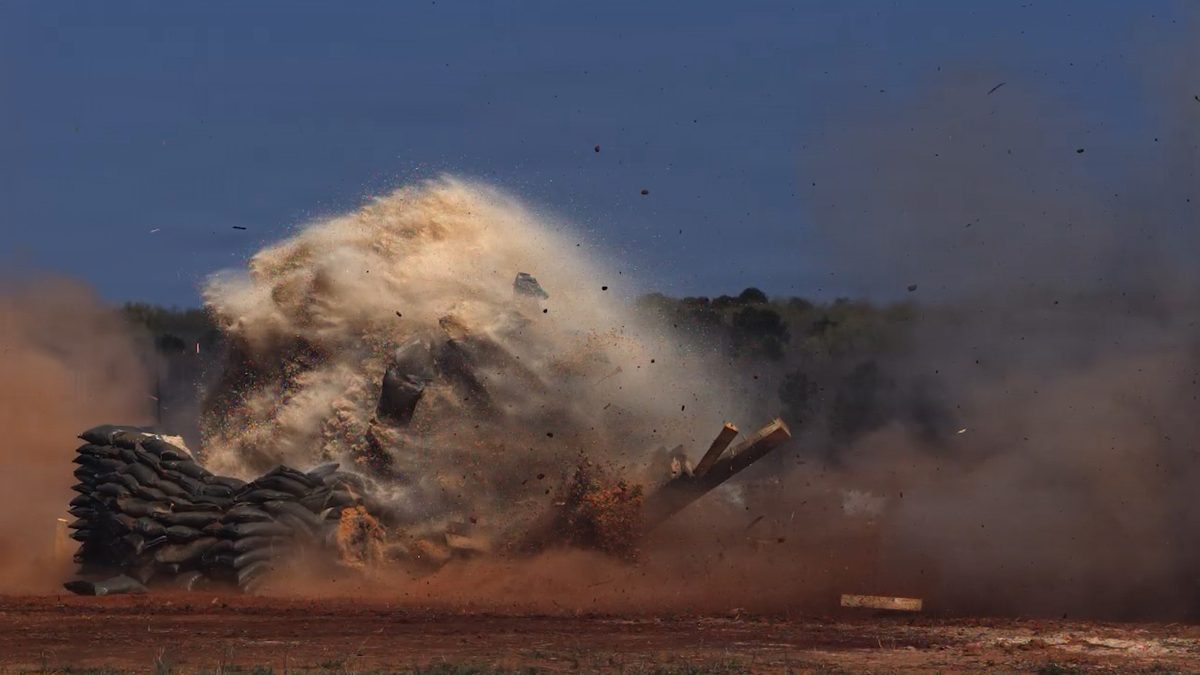
The BRAKER warhead and surrogate-bunker demonstration. Photo: Eric Kowal, U.S. Army, via DVIDS (public domain, U.S. Government work). Use does not imply endorsement.
BRAKER: The US Army's Drone-Delivered Bunker-Rupture Warhead, Concept to Live Fire in Two Weeks
Technical Summary
The United States Army has test-fired a new air-delivered warhead called BRAKER, short for Bunker Rupture and Kinetic Explosive Round, designed to be carried and delivered by a small, low-cost, one-way attack unmanned aerial system (UAS). In a live-fire demonstration at Redstone Arsenal, Alabama, on 26 March 2026, a drone-delivered BRAKER round struck and destroyed a surrogate bunker target in front of Army leadership. The project was led by the U.S. Army Combat Capabilities Development Command (DEVCOM) Armaments Center at Picatinny Arsenal, New Jersey, working with Project Manager Close Combat Systems under the Capability Program Executive for Ammunition and Energetics. According to the Army, the live fire was carried out by U.S. Marines and Soldiers drawn from the U.S. Army Aviation Center of Excellence at Fort Rucker, Alabama, placing the round in the hands of the drone operators who would employ it rather than armament engineers alone.
What sets the demonstration apart is speed. According to the Army, the Picatinny team went from initial concept to live fire in roughly two weeks, beginning design, explosive pressing, housing manufacture and drone integration in early March. Approximately a dozen prototype warheads were assembled using additively manufactured, or 3D-printed, housings, and one was fired against a makeshift bunker on a Picatinny test range before the surviving prototypes travelled to Redstone for the leadership demonstration. Exact explosive fill, net explosive quantity (NEQ), penetration depth and drone type were not disclosed.
Our Picatinny team went from concept to live-fire in two weeks. BRAKER proves our ability to rapidly develop and safely deliver devastating effects from small unmanned aircraft systems. Col. Vincent Morris, Project Manager Close Combat Systems, U.S. Army
Disclosed baseline (open sources)
| Designation | BRAKER (Bunker Rupture and Kinetic Explosive Round) |
| Type | Air-delivered kinetic-penetration plus internal-blast warhead |
| Delivery | Small one-way attack UAS, via the Picatinny CLIK payload interface |
| Housing | Additively manufactured (3D-printed) |
| Prototypes built | Approximately a dozen |
| First live fire | 26 March 2026, Redstone Arsenal, Alabama |
| Concept to test | About two weeks (early to late March 2026) |
| Lead organisation | DEVCOM Armaments Center, Picatinny Arsenal, with PM Close Combat Systems |
| Explosive fill / NEQ | Not disclosed |
| Penetration depth | Not disclosed |
| Fielding timeline | Not disclosed |
Analysis of Effects
Open-source descriptions indicate BRAKER combines a kinetic penetration phase with a follow-through internal detonation. On impact the round uses its mass and velocity to breach an overhead protective layer, soil cap or structural face, and then functions inside the enclosed volume. Confining the detonation within a bunker converts a larger share of the explosive energy into internal blast overpressure and quasi-static gas pressure acting on the structure and its occupants, rather than venting it to the open air. This is the established advantage of an internal-blast or follow-through warhead against fortifications: for a given net explosive quantity, a charge that functions inside a confined space is markedly more destructive than one that detonates against the outer surface.
A plausibility note is warranted on the word bunker. Conventional bunker-busting relies on high terminal velocity from a munition dropped or boosted from altitude, which a small, slow one-way attack drone cannot match. Purpose-built hard-target penetrators such as the GBU-57 Massive Ordnance Penetrator rely on precisely that combination of very high mass and altitude-derived velocity, which sets the ceiling on what a small drone payload can achieve. The kinetic energy available to BRAKER is therefore modest, and its effect is most credible against earth-covered field fortifications, sandbag or timber-and-soil emplacements, firing positions and lightly reinforced structures, rather than deep, hardened, reinforced-concrete bunkers. The Army's own wording, breaching protective layers such as soil or reinforced structures, is consistent with that reading. The demonstrated capability matters precisely because it delivers a confined-space blast effect at low cost, from an eye-level, low-altitude approach that manned strike aircraft cannot replicate. The wider context is the now routine battlefield use of small first-person-view (FPV) attack drones carrying improvised shaped or blast charges against trenches, firing positions and dugouts in the Russia-Ukraine war. BRAKER reads as a formalised, rapidly prototyped United States counterpart: a purpose-built follow-through warhead paired with a common integration interface, rather than a field-improvised charge.
Personnel and Safety Considerations
For weapons, ordnance, munitions and explosives (WOME) practitioners, two features stand out. First, the housing is additively manufactured, so structural integrity under launch, flight and impact loads, and consistent confinement of the pressed explosive fill, must be demonstrated rather than assumed. The Army states the test confirmed the warhead survived flight intact and functioned as intended. Second, the Picatinny Common Lethality Integration Kit (CLIK), the universal payload interface used to mount BRAKER, is described as a safe and effective method for integrating lethal payloads onto UAS platforms, which places arming, safety and separation logic at the interface rather than in each bespoke warhead. Hazard classification (Hazard Division and Compatibility Group), insensitive-munitions behaviour and the fuzing and arming sequence were not published and should be treated as data gaps, not assumptions. Neither the safety-and-suitability-for-service evidence nor render-safe procedures for an unexploded BRAKER round appear in open sources.
Data Gaps
Several load-bearing parameters remain undisclosed and are likely still in development or restricted. These include the explosive fill type and net explosive quantity; the achievable penetration depth and the target hardness against which BRAKER is effective; the specific drone platform or platforms used; the fuze type and arming distance; the hazard classification for storage and transport; and any fielding or production timeline. Reported follow-on work focuses on scaling the design through industry partners, using the CLIK interface as the common integration standard. Where figures are absent above, ISC has declined to estimate them rather than present a shaped guess as fact.
Key Questions
What is BRAKER and what does the name stand for?
BRAKER stands for Bunker Rupture and Kinetic Explosive Round. It is a lightweight, air-delivered US Army warhead carried by a small one-way attack drone. It penetrates a bunker or field fortification and detonates inside, concentrating the blast within the enclosed space for greater destructive effect.
How quickly was BRAKER developed?
The US Army says its DEVCOM Armaments Center team at Picatinny Arsenal went from initial concept to a live-fire demonstration in about two weeks during March 2026. The speed was enabled by additive manufacturing, or 3D printing, of the warhead housing alongside rapid explosive pressing and drone integration.
How is BRAKER attached to a drone?
BRAKER uses the Picatinny Common Lethality Integration Kit, or CLIK, a universal payload interface developed by DEVCOM Armaments Center engineers. Inspired by rifle rail systems, CLIK provides a safe, standard mount so various lethal payloads can be fitted to different small drones, and it is the interface the Army wants industry to build to.
References
Source-evaluated under NATO STANAG 2022 (Reliability A–F / Accuracy 1–6). Tier 1 = government primary source; Tier 2 = quality news / specialist defence media; Tier 3 = authoritative aggregator / encyclopaedia.
- T1U.S. Army – Eric Kowal, BRAKER breakthrough: Army successfully tests new air-delivered bunker busting warhead, army.mil, 21 April 2026. (Reliability A / Accuracy 1)
- T1DVIDS – BRAKER breakthrough demonstration imagery (Eric Kowal, U.S. Army), dvidshub.net, 21 April 2026. (Reliability A / Accuracy 2)
- T2Forbes – Zita Ballinger Fletcher, U.S. Army Pairs Drone With Bunker Buster Bomb In First Use, 24 April 2026. (Reliability B / Accuracy 2)
- T2Army Recognition – U.S. Army Tests BRAKER Drone Warhead for Precision Bunker Strike Without Artillery Support, April 2026. (Reliability B / Accuracy 2)
- T2New Atlas – US Army combines bunker-buster warhead with drone delivery, April 2026. (Reliability B / Accuracy 2)
- T2Army Technology – US Army successfully tests drone-delivered bunker busting warhead, April 2026. (Reliability B / Accuracy 2)
Corrections & updates welcome. If you hold open-source data that refines or corrects any parameter in this article, please contact [email protected] citing the specific claim and your source. Verified corrections will be incorporated and credited in the revision history. AI-assisted technical assessment based on open-source material. Not a formal intelligence product.