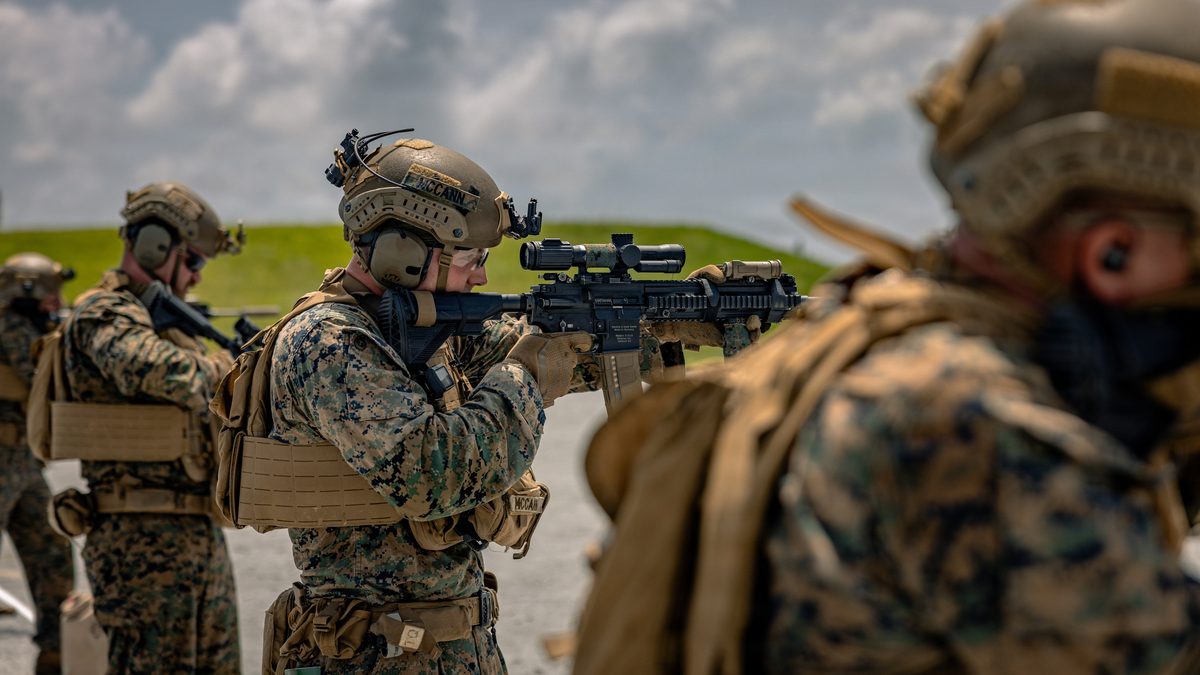
A Marine of 1st Battalion, 25th Marine Regiment fires an M27 Infantry Automatic Rifle fitted with the Trijicon VCOG Squad Common Optic, Camp Hansen, Okinawa, 24 June 2026. US Marine Corps photo by Joaquin Carlos Dela Torre, via DVIDS, public domain. Appearance of US Department of Defense visual information does not imply or constitute endorsement.
The M27 Infantry Automatic Rifle: How a Piston Rifle Became the Marine Corps Standard
Technical Summary
The M27 Infantry Automatic Rifle (IAR) is a 5.56×45mm NATO select-fire rifle derived from the Heckler & Koch HK416, adopted by the United States Marine Corps in 2010 to replace the belt-fed M249 within fire teams and then, from 2018, issued as the standard rifle of Marine infantry. The fleet settled at just over 14,000 weapons, in every infantryman’s hands from platoon commander down by mid-2021, with the M4 carbine retained at platoon and company leadership. In February 2026 the service confirmed it will keep the M27 rather than adopt the US Army’s 6.8mm M7, and this week’s establishment of the 0315 Scout specialty lists the M27 among the new career field’s weapons alongside the M4 and the M320 grenade launcher.
Mechanically the rifle pairs a short-stroke gas piston with a 16.5-inch cold-hammer-forged, free-floating barrel. The piston keeps propellant gas out of the receiver, so the action runs cooler and cleaner than direct-impingement M4s and M16s, while the free-floated barrel delivers a dispersion of roughly 2 minutes of angle (MOA) against about 4.5 MOA for a rack-grade M16A4. Published performance figures give a cyclic rate of 700 to 900 rounds per minute, a sustained rate of 36 rounds per minute, a muzzle velocity of 884 m/s, and effective ranges of 550 m against point targets and 700 m against area targets.
Baseline specification (open sources)
| Origin | Heckler & Koch, Germany; HK416 derivative |
| Calibre and feed | 5.56×45mm NATO; 30-round STANAG magazine |
| Action | Gas-operated short-stroke piston, rotating bolt |
| Barrel | 16.5 in (419 mm), cold hammer forged, free floating |
| Weight | 7.9 lb (3.6 kg) empty; 9.8 lb (4.4 kg) loaded with sling |
| Rate of fire | 700–900 rds/min cyclic; 36 rds/min sustained |
| Effective range | 550 m point target; 700 m area target |
| Optics | SU-258/PVQ Squad Day Optic; SU-281/PVQ Squad Common Optic (Trijicon VCOG 1-8×28) |
| Suppressor | Knight’s Armament Company NT4 quick-detach |
Programme History: From Automatic Rifle to Service Rifle
The requirement dates to a 1999 Universal Need Statement and matured through trials by 2nd Battalion, 7th Marines around 2000, before the IAR programme formally opened in July 2005. The Marine Corps wanted an automatic weapon that was portable, could sustain a high volume of fire, and looked like every other rifle in the squad so its gunner would not draw fire as the machine gunner. Fabrique Nationale offered a SCAR variant and Colt two designs, but the Heckler & Koch entry won in December 2009 and was designated M27 in the summer of 2010. After climatic trials and a limited evaluation of 458 rifles in Afghanistan, the Commandant ordered the M249’s replacement within fire teams in May 2011, and roughly 6,500 rifles were fielded by 2013 for about US$13 million. Between 8,000 and 10,000 M249s were retained for use at company commanders’ discretion.
The second act was unplanned. In early 2017 Commandant General Robert Neller directed that every 0311 rifleman should carry the weapon, an 11,000-rifle order was finalised in January 2018, and the M27 became the standard-issue infantry rifle. A pre-solicitation notice covering up to 50,184 rifles existed only to prove the sole-source production line could scale; the Corps ultimately bought just over 14,000. That made the Marine Corps the only service to arm an entire infantry force with what is, mechanically, a premium automatic rifle, and it set up the divergence with the US Army that followed.
Analysis of Effects
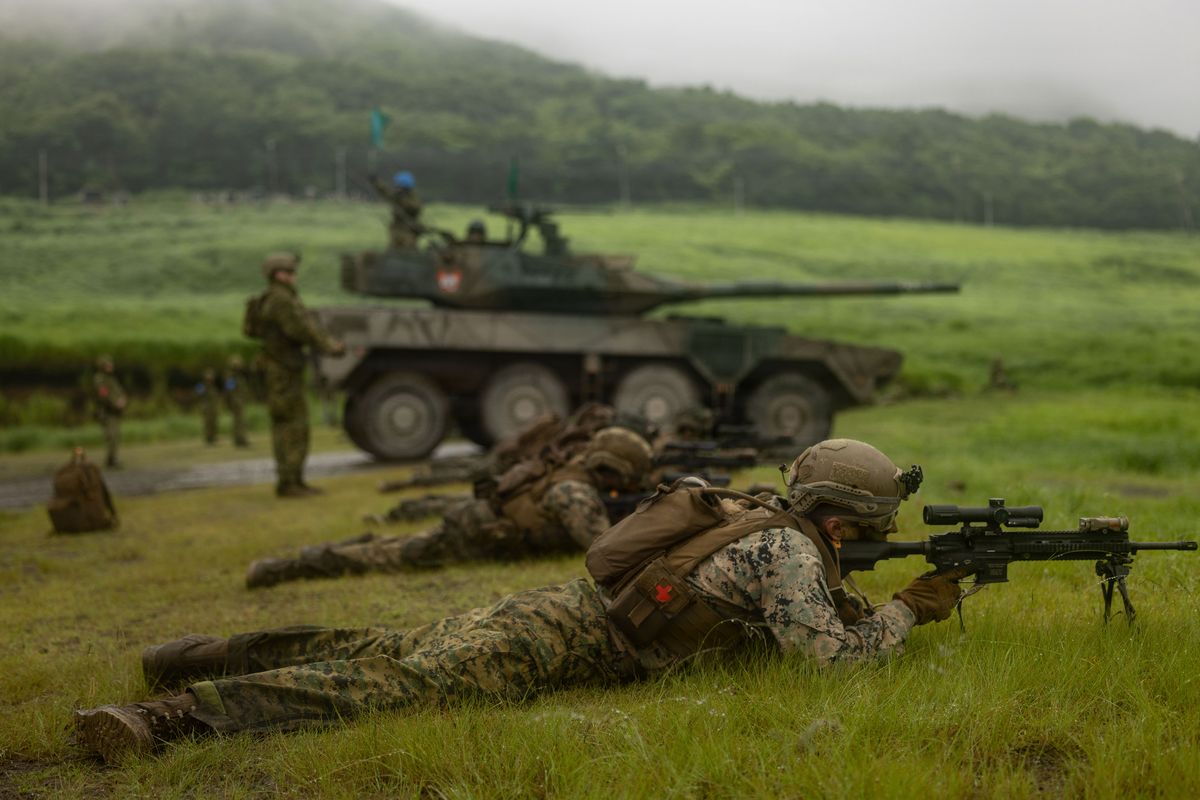
The engineering case rests on accuracy and thermal management, and the doctrine follows the engineering. Suppression with a belt-fed M249 is delivered through volume and noise; suppression with the M27 is delivered through precision, because experienced troops do not take cover from inaccurate fire. Users in Afghanistan credited one aimed M27 shot with the effect of three or four M249 bursts, described the rifle as two weapons in one, and valued a 9 lb weapon over a 22 lb one across long patrols. The cost is sustained fire: a closed-bolt, magazine-fed rifle cannot hold a machine gun’s rate, which is why the published sustained figure of 36 rounds per minute matters and why the retained M249s never fully left the armoury. Automatic riflemen carry up to 16, sometimes 21, thirty-round magazines against a rifleman’s 7, moving the logistic burden from linked belts to magazines distributed across the squad.
Two enabler programmes then converted an accurate rifle into a squad-level precision system. From February 2020 Trijicon was contracted for approximately 19,000 of its 1-8×28 Variable Combat Optical Gunsight under the SU-281/PVQ Squad Common Optic designation, fielding from January 2021, replacing the fixed 3.5×35 Squad Day Optic and giving every rifle true close-quarter and mid-range capability in one sight. In parallel, a January 2017 deployment to Norway trialled Knight’s Armament NT4 quick-detach suppressors across every weapon in the battalion; squads communicated better and achieved more surprise, and the Corps ordered suppressors for all close-combat M27s in July 2020, beginning the rollout that December with around 13,700 of a planned 30,000 units received by the end of that month.
Variants and the 2026 Decision
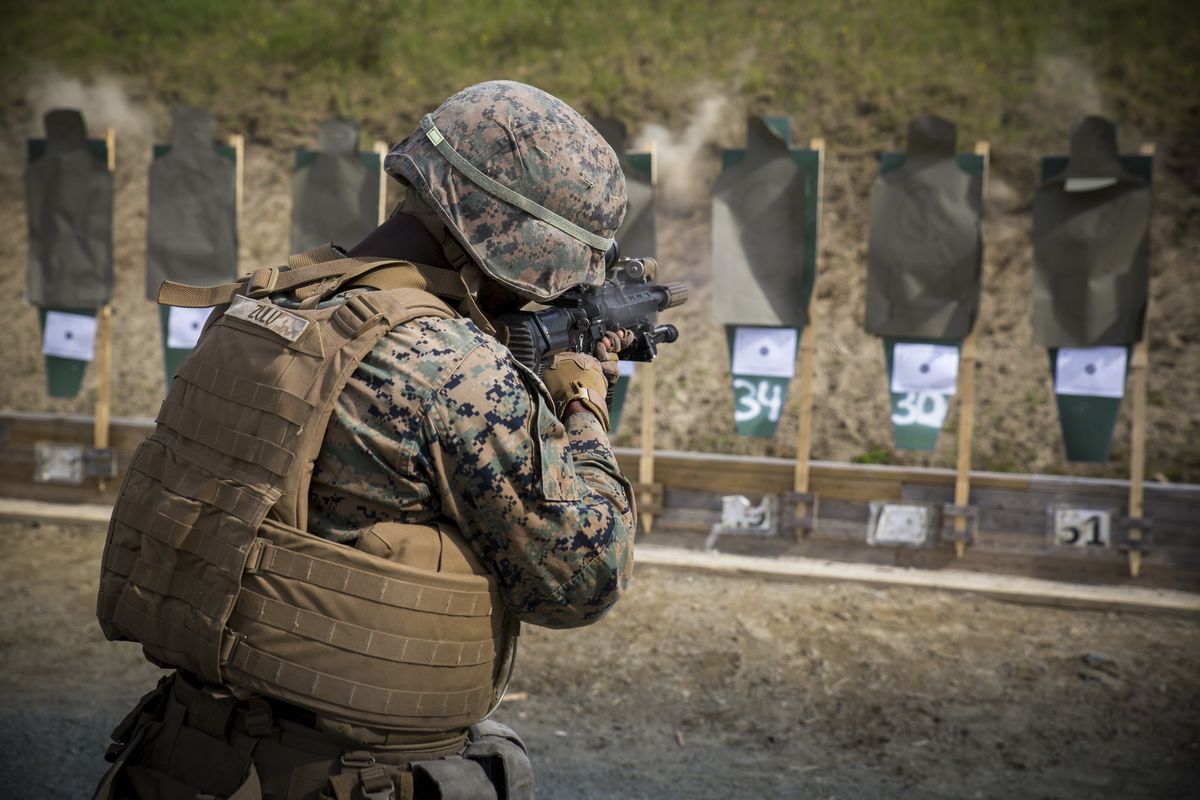
The M38 Squad Designated Marksman Rifle is an M27 fitted with the Leupold TS-30A2 Mark 4 MR/T 2.5-8×36 scope of the Mk 12 Special Purpose Rifle, retaining selective fire; one per squad, normally suppressed, reaches targets out to about 600 m, with fielding across all three Marine Expeditionary Forces complete by April 2018. An 11-inch-barrel Reconnaissance Weapons Kit serves reconnaissance units. The February 2026 retention decision then fixed the fleet’s course: Marine Corps Combat Development Command confirmed the M27 stays, citing amphibious employment doctrine, service-specific modernisation priorities and interoperability across the joint force and coalition partners, while continuing to monitor the Army’s Next Generation Squad Weapon rifle (NGSW-R) programme. The Army’s M7 buys range and armour penetration with its high-pressure 6.8×51mm cartridge, at the price of a 20-round magazine and heavier ammunition, and is paired with the belt-fed M250; the Marines run one 30-round 5.56mm rifle across the squad and invest their reach in optics, suppressors, drones and fires integration instead.
| System | Chambering | Feed | Role | Status |
|---|---|---|---|---|
| M27 IAR | 5.56×45mm NATO | 30-round STANAG magazine | Standard USMC infantry rifle and automatic rifle | In service; retained through the NGSW era |
| M249 Squad Automatic Weapon | 5.56×45mm NATO | Belt fed | Light machine gun the M27 displaced from fire teams | 8,000 to 10,000 retained at commanders’ discretion |
| M7 (NGSW-R) | 6.8×51mm | 20-round magazine | US Army close-combat rifle | Fielding, beginning with 25th Infantry Division |
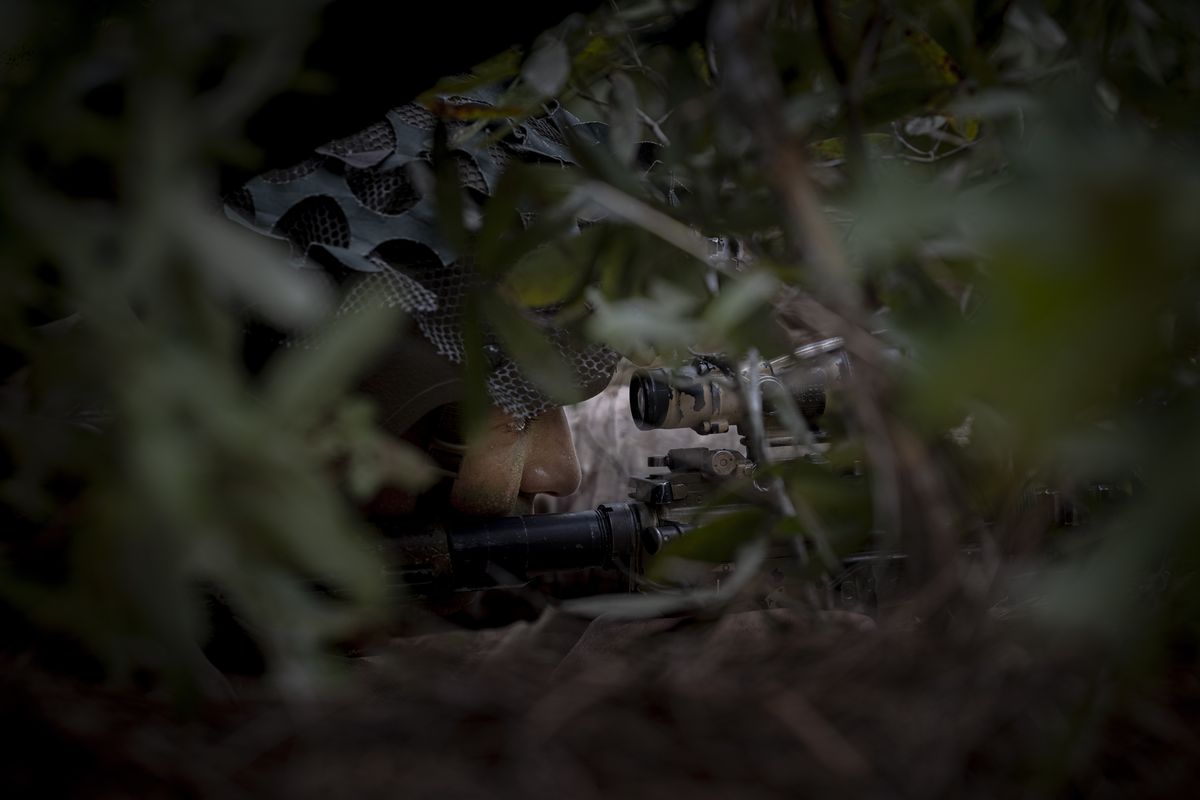
The M27 best aligns with our unique service requirements, amphibious doctrinal employment of weapons and distinct modernization priorities. Lt Col Eric Flanagan, Marine Corps Combat Development Command · February 2026
Personnel and Safety Considerations
Configuration control has mattered as much as design. Marine testing found the M855A1 Enhanced Performance Round induced feed failures in legacy magazines, and the remedy combined materiel and policy: the polymer PMAG GEN M3 Window was approved in December 2016 while incompatible magazine patterns were barred from issue. Thermal discipline is the other standing consideration. The suppressor adds heat and maintenance burden to a closed-bolt action whose sustained rate is already the design’s known boundary, so automatic-fire training emphasises burst discipline rather than volume. For armourers and ammunition technicians, the single 5.56mm nature across M27, M4 and retained M249s keeps unit-level ammunition accounting and NATO interchangeability straightforward.
Data Gaps
Open sources do not give an authoritative current unit cost across configurations, barrel-life figures under suppressed automatic fire, suppressor procurement totals beyond the December 2020 snapshot, or any decision on a mid-life update. Specification figures above are drawn from manufacturer and aggregate references, cross-checked against service reporting where available, and are flagged accordingly. Confidence in the programme chronology and the February 2026 retention decision is high; both trace to service statements and Tier 2 reporting.
Key Questions
What is the M27 Infantry Automatic Rifle?
The M27 is a 5.56mm NATO select-fire rifle derived from the Heckler & Koch HK416, with a short-stroke gas piston and a free-floating 16.5-inch barrel. Bought in 2010 to replace the M249 in Marine fire teams, it became the standard-issue rifle of Marine infantry, with a fleet of just over 14,000.
Why is the Marine Corps keeping the M27 instead of adopting the M7?
In February 2026 the Marine Corps confirmed it will retain the M27, citing amphibious employment doctrine, service modernisation priorities and joint and coalition interoperability. The 6.8mm M7 offers more range and penetration but brings a 20-round magazine and heavier ammunition. The Corps continues to monitor NGSW-R development.
What is the difference between the M27 and the M38?
The M38 Squad Designated Marksman Rifle is an M27 fitted with a Leupold TS-30A2 Mark 4 MR/T 2.5-8x36 scope and normally a suppressor, retaining selective fire. One is fielded per infantry squad to engage targets out to about 600 metres, with fielding completed across all three Marine Expeditionary Forces by April 2018.
References
Source-evaluated under NATO STANAG 2022 (Reliability A–F / Accuracy 1–6). Tier 1 = government primary source; Tier 2 = quality news / specialist defence media; Tier 3 = authoritative aggregator / encyclopaedia.
- T2Military Times – Stick to your guns: Why the Marine Corps is opting for the M27 over the Army’s M7, 27 February 2026. (Reliability B / Accuracy 2)
- T2Task & Purpose – Marines not interested in switching from M27 to Army’s M7 anytime soon, February 2026. (Reliability B / Accuracy 2)
- T1US Marine Corps – USMC Announces 0315 Scout MOS, 30 June 2026. (Reliability A / Accuracy 1)
- T1US Marine Corps – MARADMIN 296/26 (M4, M320 and M27 IAR listed as 0315 Scout weapons), 26 June 2026. (Reliability A / Accuracy 1)
- T3Wikipedia – M27 Infantry Automatic Rifle (aggregate for specifications and programme chronology, with embedded citations to Marine Corps Times, Military.com and USMC releases), accessed 2 July 2026. (Reliability C / Accuracy 3)
- T1DVIDS – Imagery assets 9772073, 9782509, 3489066 and 8603743, US public domain. (Reliability A / Accuracy 1)
Corrections & updates welcome. If you hold open-source data that refines or corrects any parameter in this article, please contact [email protected] citing the specific claim and your source. Verified corrections will be incorporated and credited in the revision history. AI-assisted technical assessment based on open-source material. Not a formal intelligence product.