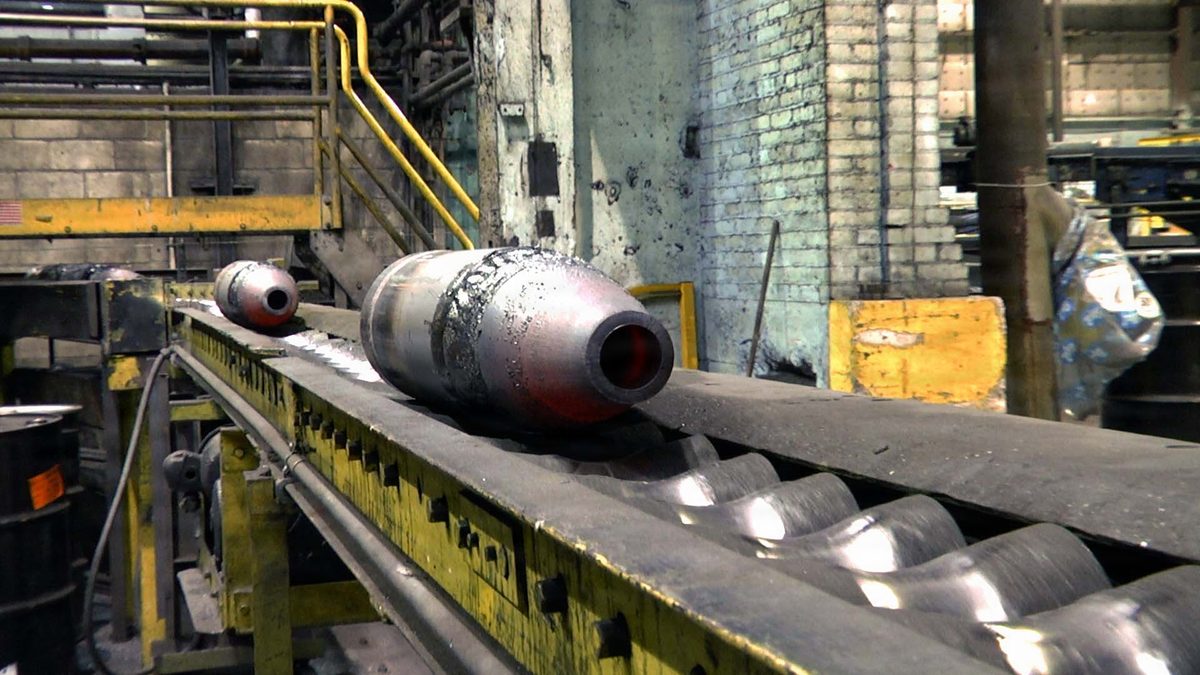
Illustrative: 155mm artillery projectiles on the heat-treat line at Scranton Army Ammunition Plant. Photo: Dori Whipple / U.S. Army (DVIDS, public domain). Shown for artillery-shell production context; the article concerns BAE Systems’ UK propellant and RDX facilities.
BAE Systems Propellant Breakthrough: Continuous Flow Synthesis and Domestic RDX Production Reshape UK Munitions Supply Chain
Technical Summary
BAE Systems announced in April 2025 that it had achieved breakthroughs in energetics manufacturing after investing more than GBP 8.5 million over five years in novel production methods. The central advance is continuous flow synthesis, a process that replaces traditional batch processing for the manufacture of energetic materials. Continuous flow eliminates dependence on nitrocellulose (NC) and nitroglycerin (NG) in propellant formulations. The replacement propellant is based on cyclotrimethylenetrinitramine (RDX, CAS 121-82-4), combined with an undisclosed alternative binder and plasticiser system that takes the place of the conventional NC/NG matrix. This represents a fundamental departure from the triple-base and multi-base propellant chemistries that have dominated Western artillery charge production for decades.
Continuous flow processing reduces the in-process Net Explosive Quantity (NEQ) present at any single point on the production line at any given time. Lower in-process NEQ directly reduces containment requirements and lowers the consequence severity of an accidental initiation event. In parallel, BAE Systems is deploying modular RDX production using shipping-container-sized manufacturing units, each rated at approximately 100 tonnes per year, across multiple UK sites. The strategic objective is twofold: displacing US-origin RDX imports eliminates International Traffic in Arms Regulations (ITAR) constraints that currently restrict UK munitions export flexibility, while displacing French-origin RDX removes a separate single-source supply-chain dependency governed by French and EU export-control regimes. Domestic, ITAR-free RDX feedstock production would restore sovereign energetics capability that the UK largely lost with the closure of Royal Ordnance Factory (ROF) Bridgwater (RDX and explosives) in 2008 and ROF Bishopton (propellants) in 2002.
Continuous flow processing keeps the quantity of explosive material being handled at any time to a minimum. BAE Systems, Major breakthroughs in UK munitions production, April 2025
Analysis of Effects
The Glascoed melt-cast explosive filling facility in South Wales is central to BAE Systems’ capacity expansion. Glascoed forms part of a wider GBP 150 million UK munitions investment programme since 2022 and is designed to deliver a 16-fold increase in 155mm artillery shell production capacity. Current UK output sits at approximately 3,000 to 5,000 shells per year. Post-expansion, the target is approximately 48,000 to 80,000 rounds per year. Facility completion was delayed by six or more months after a mid-2025 decision to double planned capacity beyond the original specification. As of early 2026, construction is complete and testing is underway, with initial capacity originally targeted for late 2026, although no revised date has been publicly confirmed. Defence Equipment and Support (DE&S) placed an initial GBP 190 million order under the Next Generation Munitions Solution (NGMS), a 15-year, GBP 2.4 billion framework with BAE Systems for general munitions supply to the British Army through 2037.
Continuous flow synthesis reduces capital expenditure per unit of output because smaller reactor vessels require less containment infrastructure than traditional batch kettles, which must be sized to contain the full consequence of a worst-case accidental initiation of the entire batch volume. The distributed node architecture, deploying multiple small production cells rather than concentrating output in one large facility, enhances survivability against adversary targeting and reduces single-point-of-failure risk across the national energetics supply chain. This architecture also allows rapid capacity scaling: adding a new shipping-container node requires procurement and commissioning of a modular unit rather than full-scale licensed explosive facility construction, with the regulatory and planning timeline that entails.
Continuous Flow: Technical Context and Cross-References
Continuous flow synthesis is an established technique in chemical engineering for highly exothermic, hazardous nitration reactions. Flow reactors offer superior heat and mass transfer compared with batch processing because they operate with smaller hold-up volumes, enable precise residence time and temperature control, and reduce the risk of thermal runaway. These characteristics allow safer scaling, higher throughput, better batch-to-batch reproducibility, and inline quenching and purification that are difficult to achieve in conventional batch kettles.
BAE Systems PLC has filed patent WO2025133577A1 describing flow synthesis of RDX via hexamine nitration in micro and meso flow reactors with staged temperature control: a low-temperature mixing zone manages the initial exotherm, followed by a warmer reaction zone that drives the nitration to completion. The patent covers two-stage temperature reactors and continuous product removal and stowage for safety. This approach builds on historical continuous RDX and HMX processes, such as the Bachmann process and earlier Woolwich work with continuous stirred-tank reactors, but advances to more controlled micro and meso-flow architectures suited to modern safety and modularity requirements. WO2025133577A1 sits within a patent family that includes earlier BAE filings WO2022123216A1 (priority date 2020) and WO2025037081A1, indicating that the underlying research and development programme predates the April 2025 public announcement by approximately five years.
The propellant shift, replacing the conventional NC/NG matrix with RDX paired with an alternative binder and plasticiser system, simplifies the upstream supply chain because both NC and NG are volatile, globally supply-constrained, and add significant process complexity. A comprehensive review of continuous flow chemistry applied to nitrations and energetic materials synthesis, covering process intensification and safety engineering principles relevant to this class of reaction, is available in the open literature (Beilstein Journal of Organic Chemistry, 2014, 10, 38; PDF).
BAE’s modular architecture follows a “numbering-up” strategy: deploying multiple parallel small reactors rather than scaling up a single large vessel. This aligns directly with the containerised production nodes described in the technical summary above and carries three strategic consequences beyond the safety benefits already noted. First, distributed production nodes are inherently more survivable than centralised mega-facilities because they present a harder targeting problem for adversaries. Second, each modular unit can be licensed and safety-cased independently against the explosive safety regime, reducing the regulatory timeline from investment decision to first output. Third, surge capacity can be added incrementally through procurement of additional container units, avoiding the multi-year construction cycle of a purpose-built licensed explosive facility.
Personnel and Safety Considerations
Continuous flow processing directly limits the in-process NEQ at any given point in the manufacturing sequence, reducing the Hazard Division (HD) 1.1 Mass Explosion Hazard exposure footprint for production personnel working on or adjacent to the process line. Lower in-process NEQ translates to reduced Quantity Distance (QD) requirements under DSA 03.OME (the current UK regulation for the management of ordnance, munitions, and explosives, replacing the withdrawn JSP 482) and AASTP-1 (Manual of NATO Safety Principles for the Storage of Military Ammunition and Explosives) Edition C. The modular, container-based approach also simplifies facility licensing because each node can be assessed independently against the explosive safety regime, rather than requiring a single integrated safety case for a large-scale facility. However, a significant data gap remains: the specific HD and Compatibility Group (CG) classifications of the new RDX-based propellant formulation have not been publicly disclosed. The binder and plasticiser chemistry is commercially confidential, making independent hazard assessment impossible at this stage. Until the full formulation is known, it is not possible to confirm whether the new propellant falls within existing HD 1.1 or HD 1.3 classification boundaries, or whether it introduces novel hazard characteristics requiring updated safety distances.
Data Gaps
The following data gaps constrain the confidence of this assessment. The precise chemical composition of the alternative binder and plasticiser system replacing NC and NG has not been disclosed. The HD and CG classification of the new RDX-based propellant under the UN Recommendations on the Transport of Dangerous Goods remains unpublished. Specific continuous flow reactor parameters, including operating temperature, pressure, residence time, and throughput rate per unit, are not available in open sources. The claim of 100 tonnes per year per shipping-container unit has not been verified against independent production data. The revised timeline for Glascoed initial operating capability following the mid-2025 capacity-doubling decision carries uncertainty of at least six months. Finally, it has not been confirmed whether the new propellant meets NATO STANAG 4170 (Principles and Methodology for the Qualification of Explosive Materials for Military Use), assessed through its companion test manual AOP-7, ballistic performance equivalence with existing NC/NG formulations across the full operational temperature range.
Key Questions
What is BAE Systems’ continuous flow propellant breakthrough?
BAE Systems has replaced traditional batch processing of propellant with continuous flow synthesis, eliminating dependence on nitrocellulose and nitroglycerin. The new RDX-based formulation uses an undisclosed binder system. Continuous flow reduces in-process explosive quantity, lowering containment needs and accidental-initiation consequences.
How will UK 155mm shell production capacity change?
BAE Systems projects a 16-fold increase from approximately 3,000 to 5,000 shells per year to between 48,000 and 80,000 rounds annually. The new Glascoed melt-cast facility in South Wales, part of a wider GBP 150 million UK munitions investment programme, was originally targeted for initial capacity in late 2026 following a six-month delay.
Why does ITAR-free RDX production matter for NATO allies?
The UK currently imports RDX from the US and France. US-origin material subjects munitions to International Traffic in Arms Regulations restrictions that constrain export, while French-origin material represents a separate single-source supply-chain dependency. Domestic modular RDX production in shipping-container units, each producing approximately 100 tonnes per year, removes this dependency and gives the UK unrestricted export flexibility for NATO partner nations.
References
Source-evaluated under NATO STANAG 2022 (Reliability A–F / Accuracy 1–6). Tier 1 = government primary source; Tier 2 = quality news / specialist defence media; Tier 3 = authoritative aggregator / encyclopaedia.
- T1BAE Systems (corporate) – Major breakthroughs in UK munitions production, April 2025. (Reliability A / Accuracy 2)
- T1DE&S (UK MoD) – DE&S places new order with BAE Systems to increase 155mm shells stockpile for British Army, August 2023. (Reliability A / Accuracy 1)
- T2Jane’s Defence – BAE Systems announces advances in ammunition supply chain, April 2025. (Reliability B / Accuracy 2)
- T2Kyiv Independent – UK’s largest ammo maker rebooting chemistry to break NATO’s dependence on explosive imports, April 2025. (Reliability B / Accuracy 2)
- T2Defense Express – UK Aimed for 16x Output Boost in 155mm Shells But BAE’s New Plant Is Already Six Months Behind Schedule, February 2026. (Reliability B / Accuracy 2)
- T2UK Defence Journal – BAE unveils new tech to boost UK ammo output sixteen-fold, April 2025. (Reliability B / Accuracy 2)
- T1BAE Systems PLC – Patent WO2025133577A1: Flow synthesis of RDX via hexamine nitration in micro/meso flow reactors. (Reliability A / Accuracy 1)
- T3Beilstein Journal of Organic Chemistry, 2014, 10, 38 – Continuous flow nitration: review of process intensification and safety engineering for energetic materials synthesis. (Reliability B / Accuracy 1)
- T1GOV.UK – £2.4 billion munitions deal secures thousands of UK jobs. (Reliability A / Accuracy 1)
Corrections & updates welcome. If you hold open-source data that refines or corrects any parameter in this article, please contact [email protected] citing the specific claim and your source. Verified corrections will be incorporated and credited in the revision history. AI-assisted technical assessment based on open-source material. Not a formal intelligence product.