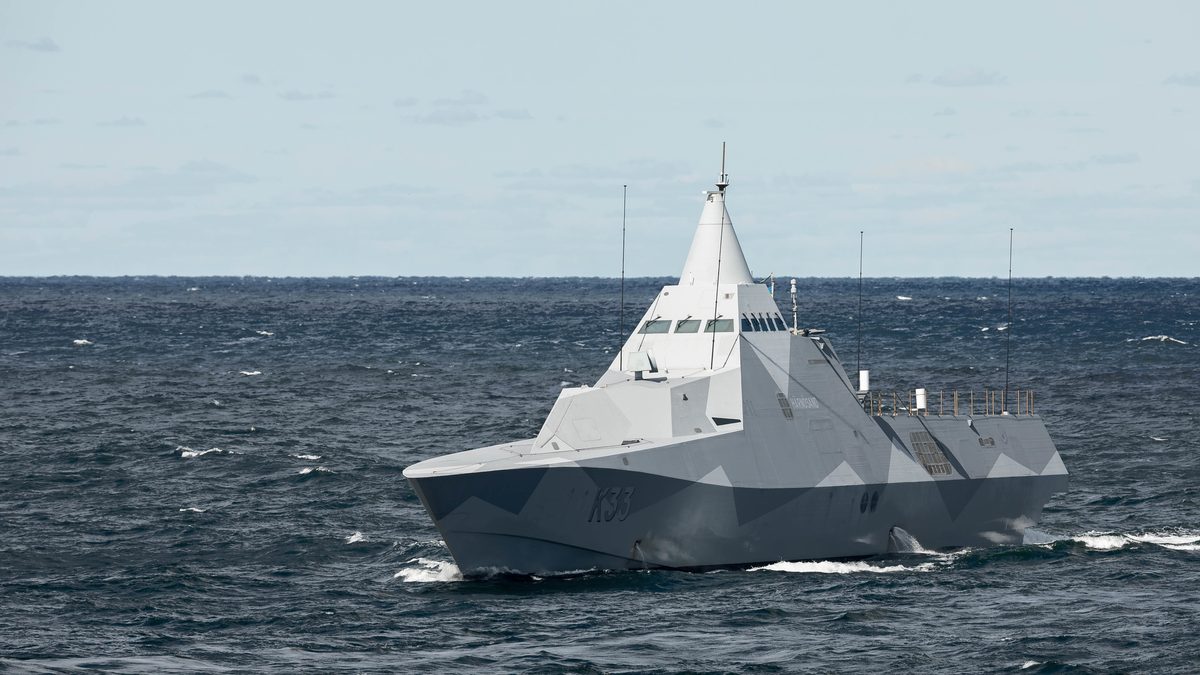
Swedish Navy Visby-class corvette HSwMS Härnösand (K33) transits the Baltic Sea during a photo exercise with the amphibious assault ship USS Kearsarge, 30 August 2022. US Navy photo by Mass Communication Specialist 2nd Class Jesse Schwab (public domain) via DVIDS.
Sweden's Visby-Class Stealth Corvettes: Baltic Firepower Meets the 2026 Air-Defence Upgrade
Technical Summary
The Visby class is a group of five stealth corvettes operated by the Swedish Navy (Svenska Marinen), designed by the Swedish Defence Materiel Administration (Försvarets materielverk, FMV) and built by Saab Kockums at Karlskrona. Each hull displaces roughly 640 tonnes, measures 72.7 metres in length, and exceeds 35 knots on a Combined Diesel or Gas (CODOG) plant driving two Kamewa waterjets. The ships entered service between 2002 and 2015 at a reported unit cost of about US$184 million, and all five remain active: Visby (K31), Helsingborg (K32), Härnösand (K33), Nyköping (K34) and Karlstad (K35). A sixth hull, Uddevalla, was cancelled.
What sets the class apart is signature management rather than raw tonnage. The hull is a sandwich of a polyvinyl chloride (PVC) core between carbon-fibre and vinyl laminate skins, a structure that weighs roughly half the equivalent-strength steel and cuts radar, infrared, acoustic and magnetic signatures together. The faceted, tumblehome superstructure hides weapons and sensors behind flush hatches, and the 57mm gun barrel folds into its turret to lower the radar cross-section further. One of the original designers told the BBC that the shaping reduces the radar cross-section by about 99 percent, which shortens the range at which the ship can be detected rather than making it invisible. From early 2026 the class also gains its first true area air-defence weapon, MBDA's Sea Ceptor, the naval form of the Common Anti-air Modular Missile (CAMM).
The mid-life upgrade fits nine Extensible Launching System cells to each hull, quad-packed with four CAMM rounds apiece for 36 ready air-defence missiles and a stated intercept envelope beyond 25 kilometres. ISC technical assessment, open sources
Baseline specification (open sources)
| Displacement | About 640 tonnes |
| Dimensions | 72.7 m length, 10.4 m beam, 2.4 m draught |
| Speed and range | Over 35 knots; 2,500 nautical miles at 15 knots |
| Complement | 43 |
| Propulsion | CODOG: 4 x Vericor TF50A gas turbines (about 16 MW), 2 x MTU 16V 2000 N90 diesels (about 2.6 MW), 2 x Kamewa 125SII waterjets |
| Hull | Carbon-fibre composite sandwich, non-magnetic |
| Main gun | 1 x Bofors 57mm Mk3 |
| Anti-ship missiles | 8 x RBS15 Mk2 |
| Anti-submarine | 4 x 400mm launchers for Torped 45 |
A $200M stealth warship built to vanish from radar and sonar. We spent 24 hours underway with the Swedish Navy aboard their Visby-class corvette for the newest episode of Access Granted.
— Sam Eckholm (@sameckholm) July 1, 2026
Analysis of Effects
The offensive weight of the class sits in the eight RBS15 Mk2 anti-ship missiles, carried below deck and fired through dedicated hatches to preserve stealth. The RBS15 Mk2 flies a sea-skimming profile at high subsonic speed, about Mach 0.9, out to a range in excess of 200 kilometres, and delivers a warhead in the order of 200 kilograms against surface targets. The exact net explosive quantity (NEQ) and warhead type are not published in open sources and are recorded below as a data gap. The Bofors 57mm Mk3 gun carries 120 ready rounds, sustains up to 220 rounds per minute and reaches to about 17 kilometres. Paired with the BAE Systems Bofors 3P round it becomes a genuine multi-target system. 3P stands for Pre-fragmented, Programmable, Proximity-fused: the 40mm and 57mm natures offer six selectable function modes, and each fuze is set individually by a proximity fuze programmer immediately before firing, fed by the fire control computer. A single ready magazine can therefore engage anti-ship missiles, aircraft, surface vessels and shore targets, and, through airburst modes, the small fast attack craft and uncrewed aerial systems (UAS) that older point-detonating natures struggled to defeat. Until the Sea Ceptor rounds are integrated, the gun and its 3P ammunition are the Visby class primary hard-kill air-defence layer.

Anti-submarine warfare is handled by four 400mm launchers for the lightweight Torped 45, backed by 127mm anti-submarine rocket-propelled grenades, mines and depth charges, and by a sensor fit that combines hull-mounted, towed-array and variable-depth sonar. The class has always been light on area air defence: the surface-to-air element was deferred in 2008 for cost reasons, leaving the corvettes reliant on the gun and soft-kill decoys for self-protection. That is the gap the mid-life upgrade closes. Sensors and combat direction run through the Saab 9LV combat management system, the Sea Giraffe AMB three-dimensional passive electronically scanned array (PESA) radar and Ceros 200 fire control, with a Rheinmetall Multi Ammunition Softkill System (MASS) decoy launcher for the electronic-warfare fight.
Visby-class corvette during minelaying. A true multi-mission warship!
— Naval Analyses (@D__Mitch) May 7, 2024
| Mid-life upgrade stage | When | Lead / owner |
|---|---|---|
| Product Definition Phase | January 2021 | FMV / Saab (SEK 190 million) Funded |
| CAMM (Sea Ceptor) selected | November 2023 | Swedish Navy / MBDA Funded |
| ExLS launcher selected | 2025 | Swedish Navy / Lockheed Martin Selected |
| Integration contract awarded | May 2025 | FMV / Saab (SEK 1.6 billion) Funded |
| Air-defence upgrade work begins | Early 2026 | Saab Scheduled |
| RBS15 Mk3 and Torped 47 fit | Planned | Swedish Navy Planned |
Personnel and Safety Considerations
For weapons and ordnance personnel the upgrade is as much a magazine and integration task as a missile one. The CAMM round is a canisterised, cold-launch (soft-launch) weapon ejected clear of the ship before its rocket motor ignites, which shapes deck arcs, handling and the below-deck stowage of the Extensible Launching System cells. The composite hull behaves differently from steel in a fire, with the laminate giving good thermal insulation but demanding its own damage-control regime around energetic stores. Anti-ship rounds and torpedoes stowed below deck, concealed launch hatches and folding mountings all constrain access for arming, maintenance and render-safe planning. Hazard Division (HD) and Compatibility Group (CG) assignments for the natures embarked are not published and would be governed by the operator's national regulations rather than by open sources.
Data Gaps
Open sources do not disclose the following, which are flagged here rather than estimated: the net explosive quantity (NEQ) and warhead classification of the RBS15 Mk2; the warhead mass and fuzing of the CAMM interceptor; the Hazard Division and Compatibility Group of the natures carried; magazine capacities and net explosive quantity limits per stowage; and the confirmed in-service dates for the RBS15 Mk3 and Torped 47 fit under the mid-life upgrade. Monetary figures are reported in Swedish kronor and converted at approximate rates.
Key Questions
What is the Visby-class corvette?
The Visby class is a group of five Swedish stealth corvettes built by Saab Kockums. Each displaces about 640 tonnes, uses a carbon-fibre composite hull for low radar, infrared and magnetic signatures, and carries anti-ship missiles, a 57mm gun and lightweight torpedoes for Baltic littoral operations.
What weapons does the Visby-class corvette carry?
Each corvette fields eight RBS15 Mk2 anti-ship missiles with a range beyond 200 kilometres, one Bofors 57mm Mk3 gun firing up to 220 rounds per minute, and four 400mm tubes for Torped 45 anti-submarine torpedoes, plus mines, depth charges and anti-submarine rocket grenades.
What is the 2026 Visby mid-life upgrade?
From early 2026 Saab is integrating MBDA's Sea Ceptor (CAMM) air-defence missile on the Visby class under a contract worth about 1.6 billion Swedish kronor. Lockheed Martin Extensible Launching System cells give 36 ready rounds per hull, with RBS15 Mk3 and Torped 47 also planned.
References
Source-evaluated under NATO STANAG 2022 (Reliability A–F / Accuracy 1–6). Tier 1 = government or manufacturer primary source; Tier 2 = quality news / specialist defence media; Tier 3 = authoritative aggregator / encyclopaedia.
- T1Saab – Saab Signs Two Contracts for Next Generation Corvettes for Sweden, 25 January 2021. (Reliability A / Accuracy 1)
- T2Naval News – Saab wins contract to integrate Sea Ceptor system on Visby-class corvettes, 28 May 2025. (Reliability B / Accuracy 2)
- T2Naval Technology – Sweden to begin Visby corvette air defence upgrade from 2026, 28 May 2025. (Reliability B / Accuracy 2)
- T2The War Zone – Sweden's Stealthy Visby Corvettes Getting Mk 41 Based Vertical Launch Systems For Air Defense Missiles, 14 April 2025. (Reliability B / Accuracy 2)
- T1Vericor Power Systems – Marine Propulsion: Visby Corvette (TF50A gas turbines), accessed 1 July 2026. (Reliability A / Accuracy 2)
- T1BAE Systems Bofors – FUZE 3P Programmable All-Target Ammunition, accessed 1 July 2026. (Reliability A / Accuracy 1)
- T3Wikipedia – Visby-class corvette, accessed 1 July 2026. (Reliability C / Accuracy 3)
Corrections & updates welcome. If you hold open-source data that refines or corrects any parameter in this article, please contact [email protected] citing the specific claim and your source. Verified corrections will be incorporated and credited in the revision history. AI-assisted technical assessment based on open-source material. Not a formal intelligence product.