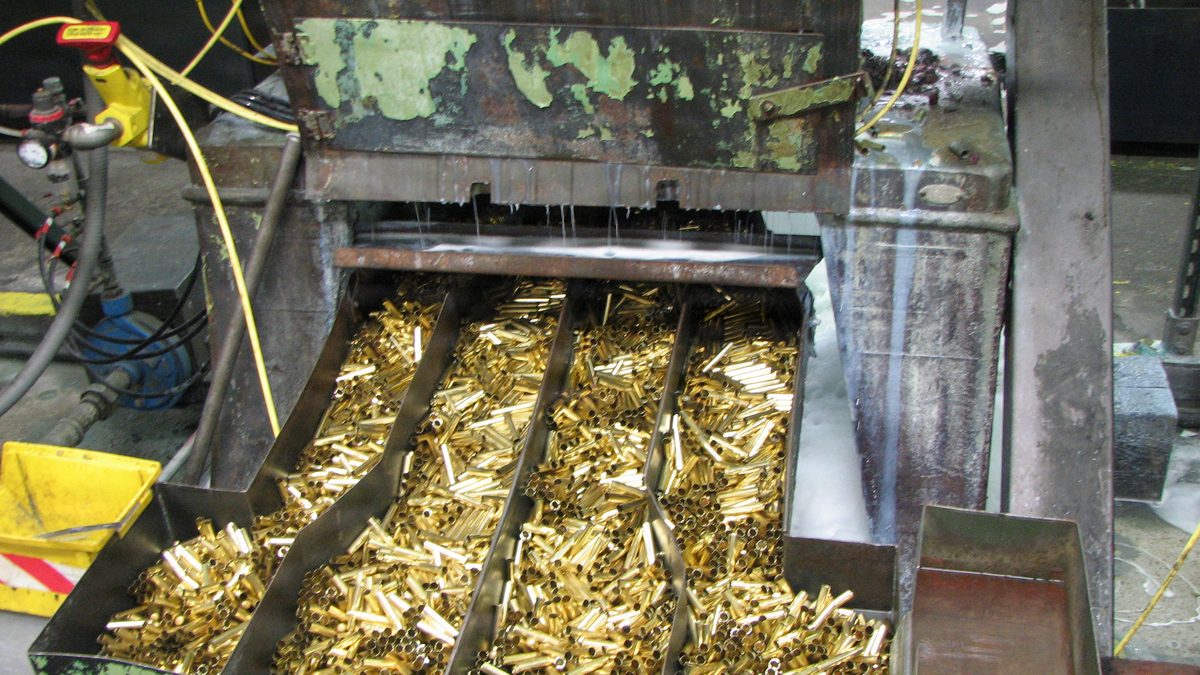
Illustrative: 7.62mm small-calibre round production on the SCAMP line at Lake City Army Ammunition Plant, not the Tembo Amravati facility. U.S. Army photo by Dori Whipple, Joint Munitions Command (DVIDS, public domain).
Tembo Enters India's Small-Calibre Arms Race With a 120-Million-Round Ammunition and Pistol Plant at Amravati
Technical Summary
Tembo Global, an Indian precision-engineering group, has confirmed its entry into small-arms production through its defence subsidiary, Tembo Classic Engineering Private Limited. In an interview published by The Week on 29 June 2026, managing director Sanjay Patel set out a planned investment of 1,000 crore rupees (about 120 million US dollars) in a greenfield arms and ammunition complex at Amravati, Maharashtra, on 100 acres secured through a Memorandum of Understanding (MoU) signed with the state government at the World Economic Forum (WEF) in Davos. The company has already obtained a central government licence for ammunition manufacture.
The first production phase targets small-calibre ammunition and related components for the armed forces, paramilitary and law-enforcement users, alongside a handgun line rated at an initial 15,000 pistols per year, scalable to 30,000. Ammunition output is quoted at up to 12 crore rounds (120 million rounds) annually. Patel confirmed the group is pursuing a Transfer of Technology (ToT) arrangement with an unnamed Austrian defence company. For Weapons, Ordnance, Munitions and Explosives (WOME) readers the substance sits below the corporate framing: calibre selection, cartridge construction and quality-assurance regime will decide whether the plant feeds standard-issue service ammunition or a narrower commercial and law-enforcement niche.
At full scale the Amravati complex is quoted at up to 120 million small-calibre rounds and 30,000 pistols a year, backed by a 1,000 crore rupee investment on a 100-acre site secured at Davos. ISC assessment of Tembo Global figures, The Week, 29 June 2026
Analysis of Effects
Small-calibre service ammunition is defined less by headline volume than by conformance. If Tembo intends to supply Indian defence and paramilitary users, the line must hold chamber-pressure, dimensional and proof standards for the natures involved, most plausibly 9x19mm for the pistol programme and the 5.56x45mm and 7.62x51mm rifle and machine-gun natures that dominate Indian service inventories. None of these calibres has yet been confirmed, which is the first data gap. Projectile construction (full metal jacket ball, versus armour-piercing, tracer or frangible law-enforcement loads), primer type and propellant sourcing all remain unstated.
Volume claims are plausible for a modern greenfield line. A single automated small-calibre plant producing on the order of 120 million rounds per year sits within the mid-size band of contemporary output, and 15,000 to 30,000 pistols annually is consistent with one licensed handgun line. The stated Transfer of Technology with an Austrian partner matters more than the numbers: small-calibre propellant chemistry, primer manufacture and case-forming metallurgy are the hard-to-transfer elements, and an established European ammunition or weapons house would shorten the qualification path. Whether the resulting cartridges are built to a NATO Standardization Agreement (STANAG) interchangeability specification, rather than to a domestic proof standard alone, will determine any export and interoperability value. Successful Transfer of Technology from an established Austrian small-arms or munitions house would typically move not only machinery but the validated processes that decide cartridge quality: precision case forming (deep drawing, annealing and metallurgical control), primer sensitivity and automated primer insertion, propellant formulation and precise metering to tight velocity and chamber-pressure tolerances, and statistical process control for lot-to-lot homogeneity. These elements are materially harder to indigenise quickly than final assembly, and they are where a European partner adds the most value for a new entrant chasing consistent interchangeability performance.
Personnel and Safety Considerations
At the industrial scale described, the dominant hazards are propellant and primer handling rather than the finished cartridge. In transport and storage, boxed small-arms ammunition with inert-cored projectiles is normally assigned United Nations serial UN 0012 (cartridges for weapons) at Hazard Division (HD) 1.4, Compatibility Group (CG) S, while bulk smokeless propellant is typically HD 1.3, CG C and primer compositions can reach HD 1.1. Net Explosive Quantity (NEQ) is not a meaningful single figure for ball ammunition, but propellant and primer inventories on site will drive the licensed explosives limits, magazine separation distances and the plant process-safety case. A new entrant will need a quality-assurance and lot-acceptance regime, including proof and inspection to a recognised standard, before any service acceptance.
Greenfield explosives manufacturing in India also requires site and magazine approvals from the Petroleum and Explosives Safety Organisation (PESO) under the Explosives Act 1884 and the rules made under it, alongside a documented process-safety case that shows risk reduced As Low As Reasonably Practicable (ALARP) across every stage from primer receipt or compounding to finished-cartridge packaging. A private entrant will typically commission Hazard and Operability (HAZOP) studies and a quantitative risk assessment to satisfy both the regulator and its insurers before any bulk propellant or primer operations begin.
Data Gaps
Confirmed calibres and load types; the identity of the Austrian Transfer of Technology partner; whether ammunition will be produced to a STANAG 4172-class interchangeability specification or to a domestic proof standard only; primer type (boxer or berdan) and propellant source; the handgun design and whether it is licensed or indigenous; the proof-house and lot-acceptance arrangements; and a firm first-production date. Financial figures and capacities are as stated by the company and are not independently verified.
Key Questions
What is Tembo building at Amravati?
Tembo Classic Engineering, the defence arm of India's Tembo Global, plans a 1,000 crore rupee arms and ammunition complex on 100 acres at Amravati, Maharashtra. It is designed to produce up to 120 million small-calibre rounds a year plus 15,000 to 30,000 pistols annually, under a government ammunition-manufacturing licence.
Why does it matter for defence users?
It adds private small-calibre ammunition and handgun capacity to India's supply base under the Atmanirbhar Bharat self-reliance drive. Its value to the armed forces depends on which calibres it makes and whether the cartridges meet service proof and interchangeability standards, details the company has not yet confirmed.
What is still unknown?
The specific calibres and load types, the named Austrian technology partner, whether output will meet a NATO Standardization Agreement interchangeability specification, primer and propellant sourcing, the handgun design, and a first-production date all remain unstated. Investment and capacity figures are the company's own and are not independently verified.
References
Source-evaluated under NATO STANAG 2022 (Reliability A–F / Accuracy 1–6). Tier 1 = government primary source; Tier 2 = quality news / specialist defence media; Tier 3 = authoritative aggregator / encyclopaedia.
- T1Government of India, Make in India – Defence Manufacturing sector overview, accessed 1 July 2026. (Reliability A / Accuracy 1)
- T2The Week (India) – Why Tembo Global is betting big on India's defence boom, 29 June 2026. (Reliability B / Accuracy 2)
- T2Dalal Street Investment Journal – Order book crosses Rs 1,525 crore; defence firm secures 100 acres at Amravati for arms and ammunition facility, June 2026. (Reliability B / Accuracy 2)
- T2Trade Brains – Metal stock secures defence manufacturing licence from the government, June 2026. (Reliability B / Accuracy 2)
- T3Tembo Defence – Tembo Defence corporate website, accessed 1 July 2026. (Reliability C / Accuracy 3)
Corrections & updates welcome. If you hold open-source data that refines or corrects any parameter in this article, please contact [email protected] citing the specific claim and your source. Verified corrections will be incorporated and credited in the revision history. AI-assisted technical assessment based on open-source material. Not a formal intelligence product.