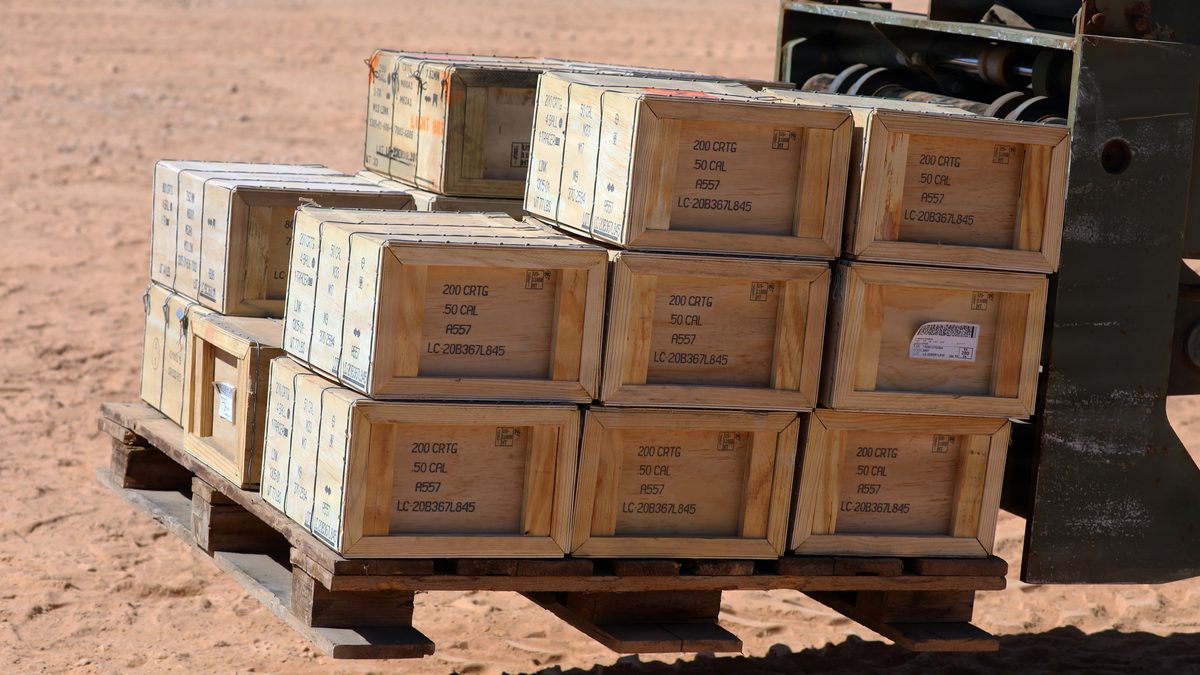
Palletised small-arms ammunition handled by a 10K forklift at an ammunition supply point during Exercise African Lion 26. U.S. Army photo by Sgt. 1st Class Rodney Roldan, DVIDS, public domain. Illustrative; not connected to FBO 26LBS049.
NSPA Flags a 246-Unit Deployable Ammunition Storage Programme for NATO Nations
The Requirement
The NATO Support and Procurement Agency (NSPA) has published Future Business Opportunity (FBO) No. 26LBS049, an advance-notice document that tells industry what the agency intends to buy before any formal tender opens. The subject is Deployable Ammunition Storage (DAS), built specifically on the ISO 20-foot Type 1C freight container, the standard six-metre steel box that moves by road, rail, sea and air without special handling. NSPA frames the requirement as secure, portable and durable storage of ammunition for use by NATO nations.
An FBO is issued for information only. It is not a solicitation, it does not commit NSPA to buy anything, and a response is not mandatory. It exists so that manufacturers can position themselves ahead of the Request for Proposal (RFP), which NSPA tentatively dates to the fourth quarter of 2026. Any firm that wants to bid must first complete NSPA Source File registration, without which no proposal can be submitted. This FBO was published under NSPA Procurement Operating Instruction 4200-01, paragraph 6.2.
| Line item | Description | Estimated quantity over 5 years |
|---|---|---|
| 10 | DAS Storage container | 239 each |
| 20 | DAS Workshop container | 7 each |
| 30 | Spare parts | 246 each |
| 40 | Training | 25 each |
Two container variants are specified. The DAS Storage unit is a container designed to hold and manage ammunition in a way that allows quick, efficient deployment. The DAS Workshop unit is equipped only with tools, not machines, for repairing articles, which in a Weapons, Ordnance, Munitions and Explosives (WOME) context points to field inspection, minor repair and serviceability tasks rather than a machining or manufacturing capability. The headline figure is 246 units over five years, split as 239 storage containers and 7 workshops, alongside 246 spare-parts sets and 25 training deliverables.
The synopsis lists 239 storage containers, 7 workshop containers, 246 spare-parts sets and 25 training packages: a 246-unit programme routed through one five-year Outline Agreement, with the Request for Proposal not expected before the fourth quarter of 2026. NSPA Future Business Opportunity 26LBS049, 2026
Framework and Contracting Route
The special remarks are where the procurement mechanics sit. NSPA states the project will run under the NATO Logistics Stock Exchange (NLSE) framework through an Outline Agreement (OA), an eCat1 catalogue contract, for five years, and that the case has been consolidated among COMMIT nations. Each of those terms carries weight. The NLSE is NSPA's secure, web-based logistics platform that automates ordering once an Outline Agreement is in place, so the winning supplier is effectively loaded into a catalogue that participating nations then draw against.
COMMIT is the Common Item Materiel Management Support Partnership, established in 1999. Luxembourg joined as the 25th full NATO member nation on 1 May 2026, taking the partnership to 27 participants including two associate members. Consolidation among COMMIT nations means the individual national demands for deployable ammunition stores have been aggregated into a single case, which is the core logic of the partnership: pool the requirement, compete it once internationally, and let members order against the resulting agreement. Quality assurance is set at OEM or authorized-manufacturer Certificate of Conformity (CoC) under Allied Quality Assurance Publication (AQAP) 2070, the NATO Mutual Government Quality Assurance process. Delivery terms are Free Carrier (FCA) at the contractor's facility under Incoterms 2020, with an estimated period of performance in the fourth quarter of 2027.
The programme home matters for reading the requirement. The reference number 26LBS049 places the case in NSPA's LB, General and Cooperative Services, line rather than in any ammunition-support partnership. The subject sits in the agency's deployable-infrastructure domain, which spans Construction Engineering and Deployable Infrastructure Acquisition and Deployable Infrastructure Storage, Deployment and Maintenance, and is run through the Southern Operational Centre in Taranto, Italy, the NATO centre of expertise for deployable camps and infrastructure. Read that way, the DAS containers are deployable infrastructure that happens to hold ammunition, procured on the infrastructure side of NSPA, with the ammunition-safety standards applying to what goes inside rather than defining the programme itself.
End Users Versus Suppliers: Reading the Country List
The authorized supplier countries are listed as all NATO nations plus Austria and Ukraine. This line is easy to misread. Austria and Ukraine are named as eligible sources of supply, meaning manufacturers permitted to bid, not as recipients of the containers. The location of delivery and use is NATO countries, and the requirement was consolidated by COMMIT member nations. Ukraine's presence on the supplier list is the notable detail: it reflects the widening access, through NSPA's brokerage and partnership arrangements, for NATO-aligned industry to compete for common-item work, and it aligns with the wartime expansion of Ukrainian defence manufacturing. Nothing in the FBO indicates the containers are destined for Ukraine.
Technical and Explosive-Safety Reading
A deployable ammunition store built inside a fixed ISO 20-foot Type 1C envelope has to reconcile a rigid external footprint with the internal demands of holding live ordnance. The controlling variable is Net Explosive Quantity (NEQ): the mass of explosive a single container may hold, which drives the quantity-distance (QD) separation required between containers and between the container line and exposed personnel or assets. Storage also has to respect Hazard Division (HD) and Compatibility Group (CG) rules, so that, for example, HD 1.1 mass-detonating natures are segregated from HD 1.4 items and incompatible compatibility groups are not co-located. The FBO does not publish an NEQ ceiling or a hazard classification for the containers, so both are recorded below as data gaps.
Because these are deployable field magazines rather than fixed, licensed storehouses, the governing safety framework is AASTP-5, the NATO manual for the storage, maintenance and transport of ammunition on deployed missions and operations. AASTP-5 applies reduced Field Distances suited to an operational posture, in place of the larger peacetime Quantity Distances of AASTP-1 Edition C, while still preventing prompt propagation between stacks, so the AASTP-1 Edition C principles remain the reference for how the containers are sited. In practical terms a deployed ammunition store is a mobile explosives facility that still needs a site-specific explosive licence, a QD assessment, temperature and humidity management to keep propellants stable, and electrostatic-discharge and lightning-protection measures. In deployed regimes the governing safety parameter is often the Maximum Credible Event (MCE), the worst-case explosive outcome a site is licensed to withstand, which caps the aggregate NEQ that may be co-located and drives the spacing between containers. The DAS Workshop variant, tools only and no machines, is consistent with in-theatre inspection and light maintenance under controlled conditions rather than energetic repair.
Container Design Considerations
The FBO fixes the external envelope by naming the ISO 20-foot Type 1C container. Under ISO 668, that designation is a standardised steel freight container measuring 6.058 metres long, 2.438 metres wide and 2.438 metres high, fitted with the eight corner castings that allow crane and spreader-bar lifting and multi-high stacking, plus forklift pockets for mechanical handling. Converting that standard box into a licensable ammunition store is an engineering task in its own right. It calls for temperature and humidity control to hold propellants and pyrotechnics within stable limits, equipotential bonding and conductive flooring to manage electrostatic discharge, external lightning protection, and blast venting or internal compartmentalisation to limit the effects of an internal deflagration. Physical-security hardware and, where specified, intrusion detection and barcode or radio-frequency inventory tagging that integrates with NLSE stock tracking complete the conversion. For carriage the container itself has to hold Convention for Safe Containers (CSC) plate certification, while its contents drive United Nations Hazard Class 1 classification and the associated maritime (IMDG Code) and road (ADR) transport compliance.
| ISO 20-foot Type 1C (ISO 668 baseline) | Value |
|---|---|
| External length | 6.058 m |
| External width | 2.438 m |
| External height | 2.438 m (8 ft 0 in) |
| Internal volume | Approximately 33 m³ |
| Maximum gross mass | Typically 24,000 to 26,500 kg (ISO 668 rating) |
| Handling fittings | ISO corner castings; forklift pockets |
| Ammunition fit-out (beyond FBO scope) | Climate control, ESD bonding, lightning protection, blast venting, physical security |
Market Example: A Fielded ISO 1C Ammunition Store
The requirement is not speculative. At least one NATO-catalogued product already meets the profile the FBO describes. The Italian manufacturer A.R.I.S. SpA markets the ASTM (Ammunition Storage Module), assigned NATO Stock Number (NSN) 8140-15-158-4682, a container built to ISO 668 Type 1C dimensions and to international standards for explosive transport and storage. It shows how a standard freight envelope is engineered into a deployable magazine, and it maps onto the two capability themes in FBO 26LBS049: secure storage and quick field deployment.
Per the manufacturer's public specification, the ASTM uses passive conditioning to hold stored explosives below critical temperatures without a generator or active air conditioning, and it operates across an external temperature range of -32°C to +49°C. It carries STANAG 4569 armour protection, Level 1 in the standard version, and it is designed so that a deflagration of the stored material does not harm people or goods outside, which is what allows it to sit inside an equipped compound at reduced minimum safety distances. Published figures give a loading capacity of 11,100 kg, a net volume of 18.5 m³ and a usable floor area of 8.8 m², with options including an integrated power and air-conditioning module, external lighting, an intrusion alarm and supplementary ventilation.
The workshop half of the requirement has a parallel in the United States market. Armag Corporation, a Kentucky manufacturer of military explosives-storage magazines, produces a relocatable Ammunition Inspection Facility, also called an Ammunition Surveillance Building, built to military magazine specification for ammunition inspection and maintenance. Its standard fit reflects the same electrostatic and spark-control discipline a DAS Workshop container would need: an internally mounted ground loop for bonding tables, tools and ordnance, spark-resistant heating, ventilation, air conditioning and lighting, an external copper touch pad to dissipate static before entry, and optional non-sparking aluminium workbenches. Armag supplies US forces through a single-award Indefinite Delivery Indefinite Quantity (IDIQ) contract. As a United States firm it would be an eligible source under the FBO, though its magazines are not marketed as ISO 668 Type 1C units, so the form-factor fit would need confirmation.
The deflagration-containment and reduced-safety-distance claim is the commercially significant feature. If a container is certified to contain the effects of an internal event, it changes the quantity-distance arithmetic at a deployed site, letting more natures be held in a smaller footprint. Both the A.R.I.S. ASTM and the Armag inspection facility are cited here as publicly documented market examples, not as selected or endorsed suppliers for FBO 26LBS049, which will be competed internationally among all authorised sources.
Supplier Landscape: Who Could Bid
The FBO names no original equipment manufacturer, so identifying who could bid is a market-match exercise rather than a read on the selected supplier. An open-source scan of defence-container makers finds several that already list 20-foot ISO products against one or both DAS variants. The strongest single match is Maru Defence, which publishes both a 20-foot ISO ammunition container and a 20-foot ISO repair and workshop container.
| Manufacturer | Storage fit | Workshop fit | Assessment (open-source) |
|---|---|---|---|
| Maru Defence (Estonia) | Yes | Yes | Cleanest match found. A 20-foot ISO ammunition and ADR container with ATEX climate control and heating, and a separate 20-foot repair and workshop container with workbench, drill bench, pneumatics, generator and HVAC. |
| DC-Supply A/S (Denmark) | Yes | Likely | Credible secondary match. A side-door 20-foot ammunition container with grounding, climate and humidity control and a technical room, plus a 20-foot insulated military workshop container. |
| Armag Corporation (United States) | Yes, non-ISO | Yes | Fielded US supplier through a single-award IDIQ. Offers relocatable military explosives magazines and a relocatable Ammunition Inspection Facility that matches the DAS Workshop role, but its products are not marketed as ISO 668 Type 1C, so the container form factor would need confirmation. |
| Ozturk Container (Turkey) | Yes | Catalogue-level | Potential bidder. Markets ISO ammunition, workshop and custom army containers, but with less public technical evidence than Maru or DC-Supply. |
| MC Containers | Yes | Not proven | Offers a 20-foot ammunition container for NATO operations to ISO and CSC standards. Military containers are modifiable, but no dedicated workshop product page was found. |
| CSG / Excalibur Army | Generic | Generic | Advertises ISO 1C and 1CC containers for armed forces including warehouse and workshop units, but with no specific ammunition-storage container matching DAS. |
| Sicom S.p.A. (Italy) | Possible | Possible | Makes 20-foot ISO 1C army containers in side and end-door and customised configurations, but the public pages show no dedicated ammunition and workshop pairing. |
| Polstore | Fit-out supplier | Fit-out supplier | Strong for armoury, ammunition racks, tool control and workshop fit-outs including deployable containers, but an internal fit-out and storage-system supplier rather than a complete ISO DAS builder. |
On public evidence, Maru Defence is the one maker that clearly offers both halves of the requirement as 20-foot ISO products, one for ammunition and explosive storage and one for repair and workshop use, which makes it the cleanest single-source match. DC-Supply A/S is the closest second, strong on the ammunition container but with workshop evidence less specifically tied to ammunition repair. Armag Corporation is the strongest United States option and the clearest match for the workshop variant through its relocatable Ammunition Inspection Facility, though its magazines are not ISO 668 containers. One dimensional caveat runs through the whole field: the FBO specifies ISO 20-foot Type 1C, while several product pages advertise the taller ISO 668 1CC. The two differ mainly in height, so any bidder would have to confirm exact compliance with the NSPA dimensional requirement rather than rely on a general 20-foot ISO claim.
Data Gaps
Several load-bearing parameters are absent from the FBO and are not asserted here. The NEQ ceiling per container is not stated. The Hazard Division and Compatibility Group rating the containers are certified to carry is not given. The internal fit-out, meaning climate control, blast venting, shelving and physical-security specification, is not described. The total contract value and any unit price are not disclosed, which is normal for an information-only FBO. The specific COMMIT nations that consolidated the requirement are not named, and the precise scope of the DAS Workshop repair function is not defined beyond tools for repairing articles. Each of these would ordinarily be clarified in the RFP and its specification annexes. The gaps concern the FBO's specific parameters, not the feasibility of the requirement: NATO-catalogued products such as the A.R.I.S. ASTM show the capability is mature and available within the ISO 1C envelope today.
Key Questions
What is NSPA FBO 26LBS049?
It is a Future Business Opportunity notice from the NATO Support and Procurement Agency, published for information only. It signals a planned five-year buy of up to 246 Deployable Ammunition Storage units built on ISO 20-foot Type 1C containers for NATO nations, with a tentative Request for Proposal in Q4 2026.
Who will actually use the Deployable Ammunition Storage containers?
The end users are NATO nations that consolidated the requirement through the COMMIT Support Partnership. Austria and Ukraine appear only as authorized supplier countries, meaning manufacturers eligible to bid, not recipients. Delivery is planned around Q4 2027 under a single five-year Outline Agreement.
What quality and safety standards govern the containers?
Quality assurance uses an OEM or authorized-manufacturer Certificate of Conformity under AQAP-2070, the NATO Mutual Government Quality Assurance process. As field magazines the containers fall under AASTP-5 for deployed ammunition storage, with AASTP-1 Edition C quantity-distance principles informing siting.
References
Source-evaluated under NATO STANAG 2022 (Reliability A–F / Accuracy 1–6). Tier 1 = government primary source; Tier 2 = quality news / specialist defence media; Tier 3 = authoritative aggregator / encyclopaedia.
- T1NATO Support and Procurement Agency – Future Business Opportunity No. 26LBS049, Deployable Ammunition Storage (published for information under Procurement Operating Instruction 4200-01, paragraph 6.2), 2026. (Reliability A / Accuracy 1)
- T1NATO Support and Procurement Agency – Luxembourg joins the COMMIT Support Partnership, 8 May 2026. (Reliability A / Accuracy 1)
- T1NATO Support and Procurement Agency – NATO Logistics Stock Exchange (NLSE), accessed 2026. (Reliability A / Accuracy 2)
- T1Munitions Safety Information Analysis Center (MSIAC) – Promulgation of AASTP-1 Edition C, accessed 2026. MSIAC is the NATO custodian body for the AASTP munitions storage and safety series, which includes AASTP-5 for storage on deployed operations. (Reliability A / Accuracy 2)
- T1NATO Standardization Office – AQAP-2070, NATO Mutual Government Quality Assurance (GQA) Process, accessed 2026. (Reliability A / Accuracy 2)
- T2GlobalSecurity.org – Luxembourg joins the COMMIT Support Partnership, 8 May 2026. (Reliability B / Accuracy 2)
- T2A.R.I.S. SpA – ASTM Ammunition Storage Module (NSN 8140-15-158-4682), public product specification, accessed 2026. (Reliability B / Accuracy 2)
- T2Armag Corporation – Ammunition Inspection Facility, relocatable inspection and maintenance building, accessed 2026. (Reliability B / Accuracy 2)
- T2Maru Defence – Ammunition storage (ADR) container and Repair and workshop container, 20-foot ISO defence products, accessed 2026. (Reliability B / Accuracy 2)
- T2DC-Supply A/S – Ammunition container and military workshop container, 20-foot custom-built units, accessed 2026. (Reliability B / Accuracy 2)
- T1NATO Support and Procurement Agency – Construction Engineering and Deployable Infrastructure Acquisition, accessed 2026. (Reliability A / Accuracy 2)
- T1NATO Support and Procurement Agency – Deployable Infrastructure Storage, Deployment and Maintenance (Southern Operational Centre, Taranto), accessed 2026. (Reliability A / Accuracy 2)
Corrections & updates welcome. If you hold open-source data that refines or corrects any parameter in this article, please contact [email protected] citing the specific claim and your source. Verified corrections will be incorporated and credited in the revision history. AI-assisted technical assessment based on open-source material. Not a formal intelligence product.