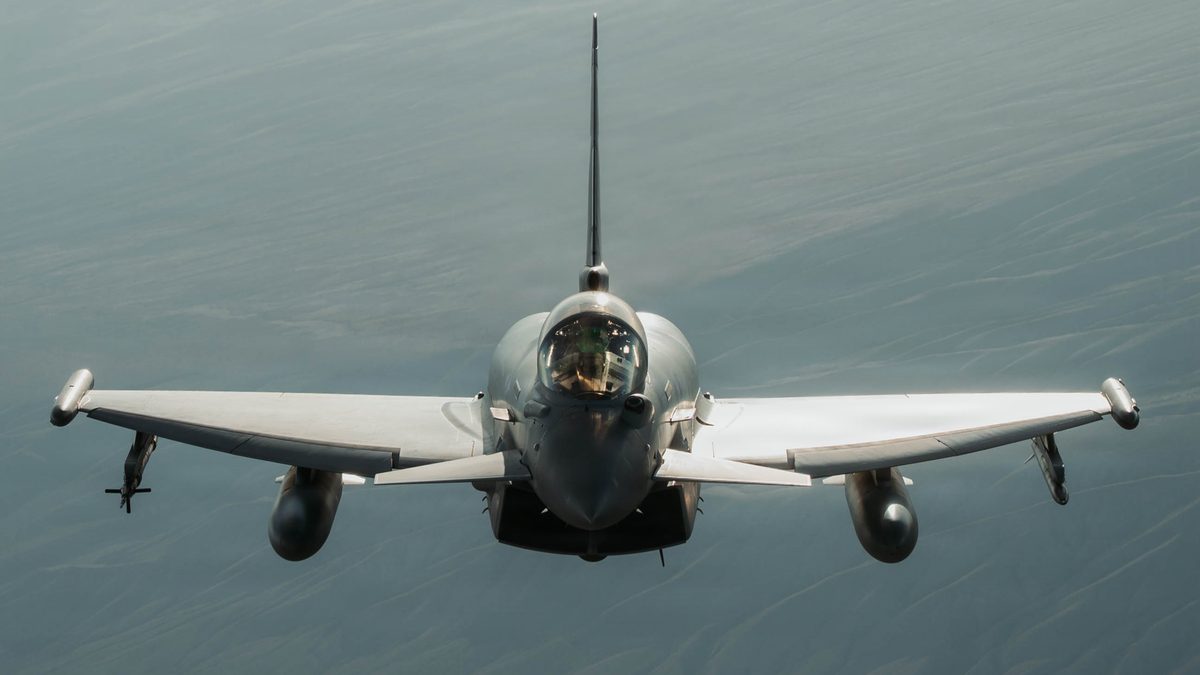
A British Royal Air Force Eurofighter Typhoon, the type GCAP will replace in UK and Italian service, flies during Red Flag-Nellis 26-1 on 6 February 2026. U.S. Air Force photo by Senior Airman Lauren Clevenger (DVIDS, public domain). Appearance of U.S. Department of Defense visual information does not imply or constitute endorsement.
UK, Japan and Italy Extend GCAP Sixth-Generation Fighter Contract Through 2027
Japan, the United Kingdom and Italy have agreed to extend the Global Combat Air Programme contract through 2027, resolving an impasse that had left the sixth-generation fighter effort on bridge funding since April 2026. The extension followed Britain's Defence Investment Plan. GCAP will replace the Eurofighter Typhoon and Mitsubishi F-2, with service entry targeted for 2035. Edgewing runs the design work.
Programme Summary
Japan, the United Kingdom and Italy have agreed to extend the contract for the Global Combat Air Programme (GCAP) through 2027, resolving an impasse that had left the trilateral sixth-generation fighter effort running on temporary bridge funding since April 2026. Nikkei Asia first reported the extension. It follows the publication of Britain's Defence Investment Plan (DIP), the comprehensive document that sets out the United Kingdom's multi-year defence budget commitments and whose delay had denied the programme's industrial partners the funding certainty they needed.
GCAP is a trilateral effort to design and field a sixth-generation fighter that will replace the Eurofighter Typhoon flown by Britain and Italy and the Mitsubishi F-2 operated by Japan's Air Self-Defense Force. The programme was established by a leaders' agreement in December 2022 and elevated to treaty status a year later, when defence ministers signed the Convention creating the GCAP International Government Organisation (GIGO), the intergovernmental body that manages the effort for the three nations. Target service entry for the operational aircraft is 2035, a date Tokyo treats as non-negotiable because it coincides with the planned end of the F-2's service life.
More than 4,000 UK-based engineers across BAE Systems, Rolls-Royce and Leonardo faced possible redeployment if long-term contract certainty was not established before the bridge funding expired at end-June 2026. Warning attributed to BAE Systems executive Herman Claesen, 2026
The Funding Gap and the Bridge Contracts
The industrial vehicle executing GCAP's design and development is Edgewing, a joint venture established in June 2025 and headquartered in Reading, England. Its shareholding is split in equal thirds among the three national prime contractors: BAE Systems of the United Kingdom, Leonardo of Italy, and Japan Aircraft Industrial Enhancement Co. (JAIEC), a firm backed by Mitsubishi Heavy Industries and the Society of Japanese Aerospace Companies. Edgewing was originally due to receive its first development contract by the end of 2025.
Britain's failure to publish the DIP on schedule broke that timeline. The first contract did not land until 2 April 2026, and even then it was only a three-month bridge worth 686 million pounds (about 907 million US dollars), running to end-June 2026 and designed purely to keep Edgewing funded while the United Kingdom settled its wider defence budget. The stakes of that gap became public when BAE Systems executive Herman Claesen warned that the more than 4,000 UK-based engineers working on GCAP across BAE Systems, Rolls-Royce and Leonardo could be redeployed if longer-term certainty was not secured. By May 2026, Italy had revised its cost estimate for the concept and assessment phase to 18.6 billion euros (about 21.2 billion US dollars), roughly three times what Rome's parliament had originally been told to expect.
The British government signalled its intent to close the gap on 13 June 2026, confirming that a full international contract would be signed by month end, timed to coincide with a London visit by Japanese Prime Minister Sanae Takaichi. The United Kingdom had committed approximately 2 billion pounds (about 2.65 billion US dollars) to GCAP since 2021 and, according to reporting in May 2026, was preparing to add approximately 6 billion pounds (about 7.94 billion US dollars) more. The formal budget settlement that the DIP represents was the missing piece that had kept producing successive short-term bridge arrangements rather than the multi-year commitment the programme needed.
| Milestone | When | Status |
|---|---|---|
| Leaders' agreement establishing GCAP | December 2022 | Complete |
| GIGO Convention (treaty) signed | December 2023 | In force |
| Edgewing joint venture stood up | June 2025 | Operating |
| First contract: 686 million pound bridge | 2 April 2026 | Awarded |
| Full contract and extension through 2027 | Reported 1 July 2026 | Committed |
| Demonstrator first flight | Before end 2027 | Targeted |
| Operational fighter service entry | 2035 | Target |
Industrial Base and Workforce Risk
The reason a funding gap of a few months mattered so much lies in the nature of the workforce. Skilled combat-air engineers do not sit idle, and the design authority for a sixth-generation aircraft rests on teams that decades of European programmes have built up. Once such a base disperses, it cannot be reconstituted quickly. That is why Claesen's redeployment warning, rather than the headline contract value, was the sharpest signal of how seriously the industrial partners viewed the budget indecision. The extension through 2027 restores enough certainty for the primes to retain those teams and hold delivery momentum.
The demonstrator aircraft expected to fly before the end of 2027 will be the first British combat-air prototype since the Eurofighter Typhoon development era, nearly four decades ago. It is intended to test the technologies that will define the production fighter, including advanced stealth shaping, next-generation sensors, electronic warfare systems and propulsion beyond what the Typhoon represents. GCAP has also drawn external interest: Canada began participating as an observer in March 2026, Germany has examined the programme as an alternative to its troubled Future Combat Air System (FCAS) effort with France and Spain, and Saudi Arabia has expressed persistent interest. Japan has been explicit that it opposes adding participants if doing so would delay the 2035 target.
WOME and armament scope note
GCAP is a platform and industrial-programme story rather than a weapons, ordnance, munitions and explosives (WOME) event. No air-to-air or air-to-surface weapons fit, internal-carriage geometry or munitions-integration schedule has been disclosed for the demonstrator or the production aircraft in the reporting reviewed here. Weapons integration for a sixth-generation, low-observable platform is a distinct and later work strand; ISC will treat any published weapons load-out or integration milestone as a separate technical assessment.
Data Gaps
Several parameters remain unconfirmed in open sources. The value and precise duration of the extension contract through 2027 have not been published, nor has it been independently confirmed whether the full international contract trailed for the end of June and the 2027 extension reported by Nikkei are one instrument or two sequential commitments. The build standard, weapons fit and internal-carriage arrangement of the demonstrator are undisclosed. Italy's revised 18.6 billion euro figure covers the concept and assessment phase only and should not be read as a whole-life programme cost. Figures converted to US dollars follow the values cited in the source reporting and will move with exchange rates.
Key Questions
Why did the UK, Japan and Italy have to extend the GCAP contract?
Britain's Defence Investment Plan, the document setting out its multi-year defence budget commitments, was published late. Without it the three governments could not commit long-term funding, so GCAP ran on short bridge contracts. With the plan now published, they can extend the programme contract through the end of 2027.
What is Edgewing and how much has it been paid so far?
Edgewing is the trilateral joint venture that designs the fighter, owned in equal thirds by BAE Systems, Leonardo and Japan Aircraft Industrial Enhancement Co. It received its first contract on 2 April 2026, a three-month bridge worth 686 million pounds, about 907 million US dollars, running only to the end of June 2026.
When will the GCAP demonstrator fly and when does the fighter enter service?
The demonstrator aircraft is expected to make its first flight before the end of 2027, the first British combat-air prototype since the Eurofighter Typhoon development era. The operational sixth-generation fighter is targeted to enter service in 2035, a date Japan treats as non-negotiable.
References
Source-evaluated under NATO STANAG 2022 (Reliability A–F / Accuracy 1–6). Tier 1 = government primary source; Tier 2 = quality news / specialist defence media; Tier 3 = authoritative aggregator / encyclopaedia.
- T1UK House of Commons Library – What is the Global Combat Air Programme (GCAP)?, briefing CBP-10143. (Reliability A / Accuracy 1)
- T1Royal Air Force / UK Ministry of Defence – UK, Japan and Italy sign international stealth fighter jet programme treaty, 2023. (Reliability A / Accuracy 1)
- T2Nikkei Asia – Japan, UK and Italy to extend next-gen fighter jet contract through 2027, July 2026. (Reliability B / Accuracy 2)
- T2Defense News – Money starts flowing for new GCAP fighter, as Britain sorts out finances, 2 April 2026. (Reliability B / Accuracy 2)
- T2Breaking Defense – Edgewing receives first GCAP next-gen fighter international contract to boost design activities, April 2026. (Reliability B / Accuracy 2)
- T3The Defence Blog – UK, Japan and Italy extend GCAP fighter contract through 2027, 1 July 2026. (Reliability C / Accuracy 3)
Corrections & updates welcome. If you hold open-source data that refines or corrects any parameter in this article, please contact [email protected] citing the specific claim and your source. Verified corrections will be incorporated and credited in the revision history. AI-assisted technical assessment based on open-source material. Not a formal intelligence product.