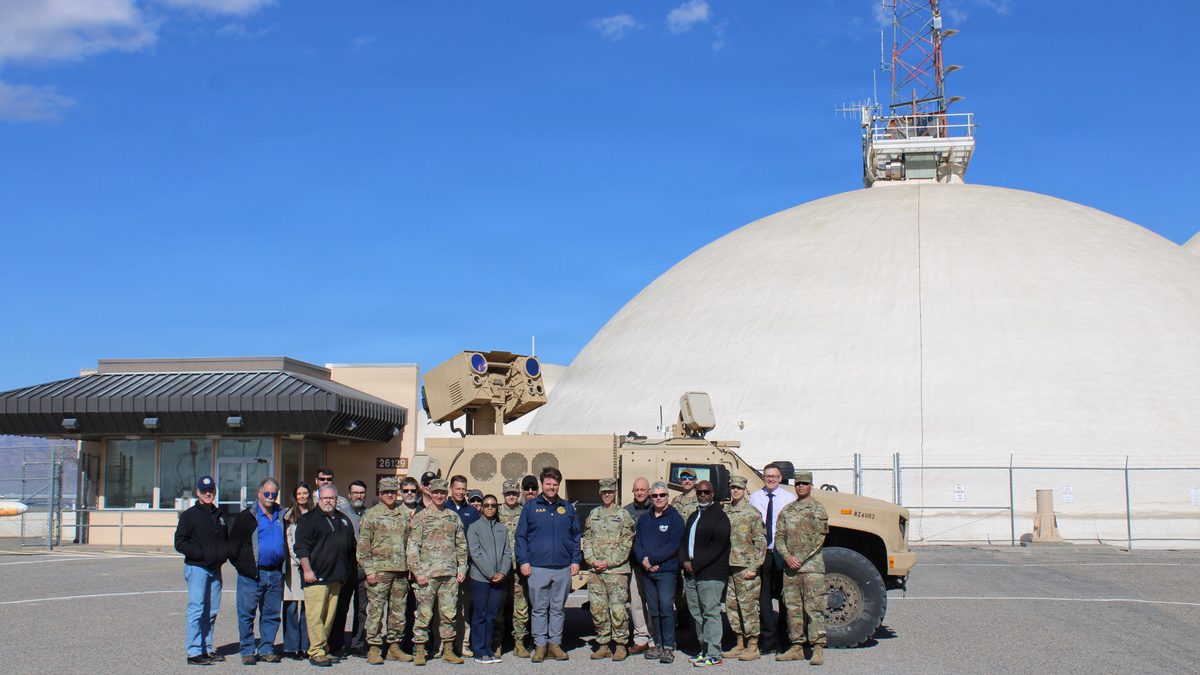
Representative image: a high-energy laser test at White Sands Missile Range, 7 March 2026. Photo: Joint Interagency Task Force 401 / U.S. Department of Defense, via DVIDS (public domain). Illustrative of the directed-energy counter-drone mission; not a European system.
Europe Builds Its Laser Drone Shield as Directed-Energy Effectors Reach the Fleet
On 13 February 2025 NATO defence ministers endorsed a new Integrated Air and Missile Defence policy calling for a layered, 360-degree defence against threats from small drones to complex missiles. Lasers answer the cheapest end. The UK's DragonFire is funded for a Royal Navy Type 45 destroyer by 2027, while Rheinmetall and MBDA have handed the Bundeswehr a naval laser demonstrator.
Technical Summary
On 13 February 2025, NATO defence ministers endorsed a new Integrated Air and Missile Defence (IAMD) policy. It sets the framework every Allied air defence programme now works within, and it is blunt about the problem driving Europe's laser push. The air domain, it warns, is increasingly contested by threats ranging from large numbers of small, unsophisticated unmanned aircraft systems (UAS) to longer-range and more complex missiles. The policy calls for a layered, 360-degree defence built from a mix of surface-based systems, and it singles out the volume and quality of defensive systems as a critical factor. High-energy lasers are Europe's answer to the cheapest end of that threat spectrum.
Read against that backbone, the recent industry announcements stop looking like isolated press releases. In the United Kingdom, the DragonFire laser-directed energy weapon (LDEW) is funded for a first fit on a Royal Navy (RN) Type 45 destroyer by 2027, brought forward from an original 2032 target, under a contract worth about £316 million led by MBDA UK. In Germany, Rheinmetall and MBDA handed the Bundeswehr a naval laser demonstrator in late October 2025 after a year of trials aboard the frigate Sachsen. In the sensor and effector chain, Rohde & Schwarz and TRUMPF have paired radar and radio-frequency sensing with a high-energy laser (HEL) under the THORIS banner, short for Tactical High-Energy Opponent Response and Interception System. Each of these is a national or industrial contribution to the surface-based layer the NATO policy describes.
NATO policy requires surface-based air and missile defence to span the full threat set, “from small, low- and slow-flying UASs to all types of cruise and ballistic missiles.” NATO Integrated Air and Missile Defence Policy, 13 February 2025
European laser counter-drone programmes (open sources)
| DragonFire (UK) | ~50 kW class; £316m contract led by MBDA UK; first Type 45 destroyer fit by 2027; downed drones at up to 650 km/h in trials |
| Rheinmetall / MBDA (Germany) | ~20 kW demonstrator; frigate Sachsen; over 100 live engagements; scalable design toward 100 kW-plus; naval service targeted ~2029 |
| THORIS (Rohde & Schwarz / TRUMPF) | Sensor plus HEL C-UAS ecosystem; laser output class not published; infrastructure and airspace protection |
NATO's Framework: Four Functional Areas, Four Effects
The policy builds IAMD from four functional areas: air surveillance; battle management, command, control, communications and information (BMC3I); active air and missile defence; and passive air and missile defence. Air surveillance fuses active and passive, military and civilian sensors from the surface to space, with artificial intelligence and machine learning flagged as tools for building the picture and particular weight placed on detecting low and slow threats. BMC3I turns that picture into a prioritised engagement decision. Active defence then splits into airborne air defence, flown by fighters and helicopters, and surface-based air and missile defence (SBAMD), the ground and maritime layer where lasers belong. Passive defence, the hardening, dispersion, camouflage and deception that limit damage when something gets through, runs alongside all three.
Beneath the functional areas sits a chain of effects the policy calls no threat, no launch, no impact, no consequences. Deterrence, arms control and diplomacy aim for no threat and no launch. Active defence is described as the only mechanism that delivers no impact by actually nullifying an inbound attack. Passive measures then cut the consequences of whatever leaks through. A high-energy laser is a no-impact tool, and specifically an SBAMD effector against the Class I UAS category, unmanned aircraft below 150 kilograms, that the policy flags as a distinct and growing challenge.
Analysis of Effects
A high-energy laser changes the cost exchange that underpins air defence. DragonFire sits in the 50 kilowatt (kW) class and uses coherent beam combining to merge several fibre-laser beams into one focused spot. The UK MoD states that a single 10-second engagement costs on the order of £10 in electricity, and that in trials the weapon downed drones travelling at up to 650 km/h. Set that against a surface-to-air missile costing hundreds of thousands of pounds, and the defender's problem inverts. A laser magazine is measured in prime power and cooling capacity, not in rounds, so a warship with sufficient generation can keep firing long after a missile magazine would be empty.
The physics still imposes hard limits. A laser is a line-of-sight weapon that must hold its spot on a target long enough to burn through it, and that dwell time grows with range. Cloud, rain, fog, dust and atmospheric turbulence scatter and defocus the beam. Power generation and thermal management remain the binding constraints on smaller platforms. The German demonstrator operates at roughly 20 kW today, enough for small unmanned aircraft and light surface targets, on an architecture its makers say can scale past 100 kW for larger threats. None of these systems replaces kinetic air defence. They add a cheap, deep magazine layer against Group 1 to Group 3 drones and loitering munitions, which frees missiles and guns for cruise missiles, aircraft and saturating raids. That is the volume and quality the NATO policy demands: more shots available against a mass drone attack, without draining the interceptor stock the same ship needs for cruise and ballistic threats.
Where the Lasers Fit, and Who Pays for Them
Mapping the European programmes onto the policy's functional areas shows where each one contributes and which government or European vehicle funds it. The directed-energy hard kill is the new inner layer of surface-based air and missile defence, sitting below the kinetic guns and missiles rather than replacing them.
| NATO functional area / layer | Effect | Backing programme |
|---|---|---|
| Air surveillance | Detect, track and classify from surface to space, with weight on low and slow drones | THORIS radar and RF sensing (Rohde & Schwarz); national and NATO networked sensors |
| Battle management, C3I | Fuse the picture, prioritise the threat, assign the effector | THORIS command logic; NATO Air Command and Control |
| Active defence: soft kill | Jam or spoof control links and satellite navigation first | THORIS electronic-warfare layer (Rohde & Schwarz) |
| Active defence: directed-energy hard kill (SBAMD inner layer) | Low-cost defeat of Class I / Group 1 to 3 drones and loitering munitions | UK DragonFire (MBDA UK); German naval laser (Rheinmetall / MBDA, Bundeswehr); THORIS LCS (TRUMPF); EU PESCO DES; EDF TALOS-TWO |
| Active defence: kinetic (SBAMD short to long range) | Guns, close-in weapons and missiles for hard, fast, distant or weather-degraded targets | National surface-based air defence under NATO IAMD |
| Passive defence | Hardening, camouflage, concealment, deception, dispersion | National measures under NATO IAMD |
Two European collaborative vehicles sit behind the directed-energy layer. The Permanent Structured Cooperation (PESCO) Directed Energy Systems project, approved on 27 May 2025 and led by Italy with Spain, aims to field a modular, scalable high-energy laser in the 10 to 100 kilowatt band on any mobile platform for short and very-short-range air defence, with Leonardo and MBDA as industry partners. Feeding it is the European Defence Fund project TALOS-TWO, a 25 million euro effort that brings together 21 firms from eight countries, among them CILAS, Leonardo and Rheinmetall, to build a fully European 100 kilowatt-class laser source and beam-combining chain by 2030. The national programmes provide the near-term hardware. The EU vehicles aim to turn today's separate demonstrators into a common, sovereign supply chain.
Personnel and Safety Considerations
For weapons, ordnance, munitions and explosives (WOME) practitioners, the shift cuts two ways. A directed-energy effector holds no energetic fill, so it carries no net explosive quantity (NEQ), no hazard division and no compatibility group to store, transport or dispose of, and it leaves no unexploded-ordnance footprint when a missed or dud interceptor would. Different hazards take their place. A weapon-grade beam sits in Class 4, the highest laser hazard class, and presents an eye and skin hazard well beyond the visible spot. Operation demands a designated laser safety officer, defined exclusion zones and strict beam-containment controls. Reflective or ablative counter-coatings on target drones raise the risk of specular returns. Force protection planning has to treat the laser as an optical-radiation hazard source, not as a benign alternative to a gun.
Data Gaps
Several parameters sit outside the open-source record and are treated here as data gaps. The output power class of the TRUMPF laser inside THORIS has not been published. DragonFire's exact power, effective range and single-shot kill probability against specific target sets are not disclosed, and the widely cited 50 kW figure is a reported estimate rather than a confirmed specification. Published atmospheric-performance envelopes, dwell times to kill, and cooling and prime-power demands for each system are absent. Claims about adversary anti-laser coatings are recorded as reported, not independently verified.
Key Questions
How does Europe's laser drone shield fit NATO's air defence framework?
NATO's Integrated Air and Missile Defence policy, endorsed on 13 February 2025, calls for a layered mix of surface-based systems against threats from small drones to hypersonic missiles. Europe's high-energy lasers slot in as a new, low-cost inner layer of that surface-based air and missile defence.
Which government programmes back the laser layer?
The UK DragonFire contract led by MBDA UK, the Rheinmetall and MBDA German naval laser, and the Rohde & Schwarz and TRUMPF THORIS system provide near-term hardware. The EU PESCO Directed Energy Systems project and the European Defence Fund's TALOS-TWO build a common sovereign supply chain.
Why does NATO want lasers against drones?
The policy stresses the volume and quality of defensive systems against mass drone salvos. A laser engages for about the price of its electricity, with a magazine set by power and cooling, so it lets scarce interceptor missiles be held for cruise, ballistic and hypersonic threats.
References
Source-evaluated under NATO STANAG 2022 (Reliability A–F / Accuracy 1–6). Tier 1 = government or primary corporate source; Tier 2 = quality news / specialist defence media; Tier 3 = authoritative aggregator / encyclopaedia.
- T1NATO – NATO Integrated Air and Missile Defence Policy, official text, 13 February 2025. (Reliability A / Accuracy 1)
- T1Rohde & Schwarz – Rohde & Schwarz and TRUMPF cooperate in drone defense, 22 October 2025. (Reliability A / Accuracy 1)
- T1Rheinmetall – Rheinmetall and MBDA: German laser weapon system close to market readiness, 28 October 2025. (Reliability A / Accuracy 1)
- T2Navy Lookout – DragonFire directed energy weapon to be fitted to four Royal Navy warships by 2027, 2025. (Reliability B / Accuracy 2)
- T2Defense News – Rheinmetall, MBDA tout German shipborne laser gun for zapping drones, 28 October 2025. (Reliability B / Accuracy 2)
- T2The War Zone – USS Preble used HELIOS laser to zap four drones in expanding testing, February 2026. (Reliability B / Accuracy 2)
- T1PESCO (EU) – Directed Energy Systems (DES), project page, 2025. (Reliability A / Accuracy 1)
- T2The Engineer – Europe beefs up TALOS-TWO laser weapon project (European Defence Fund), 2025. (Reliability B / Accuracy 2)
- T3Wikipedia – DragonFire (weapon), accessed July 2026. (Reliability C / Accuracy 3)
Corrections & updates welcome. If you hold open-source data that refines or corrects any parameter in this article, please contact [email protected] citing the specific claim and your source. Verified corrections will be incorporated and credited in the revision history. AI-assisted technical assessment based on open-source material. Not a formal intelligence product.