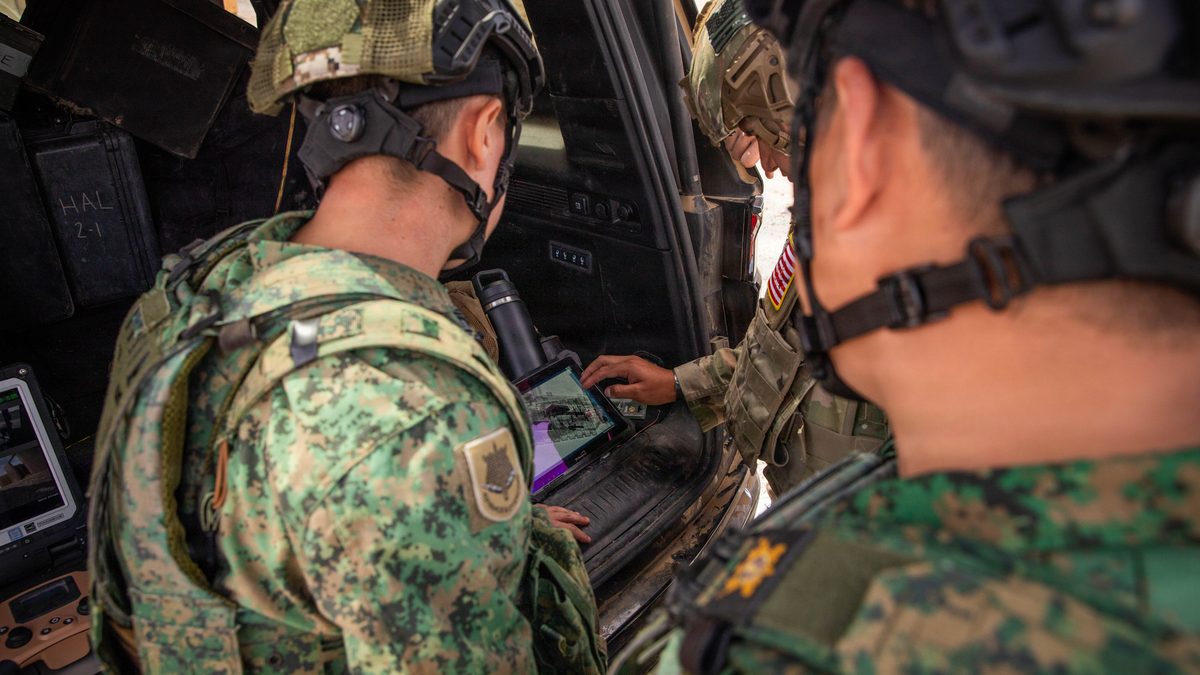
US and Singapore explosive ordnance disposal personnel examine X-ray imagery of ordnance during Exercise Tiger Balm 2026 at Yakima Training Center, Washington, 12 May 2026. US Army photo by Sgt. Abigail Clark (DVIDS, US Government work, public domain).
US and Singapore EOD Teams Run Joint UXO Clearance Lanes at Exercise Tiger Balm 2026
Technical Summary
Explosive ordnance disposal (EOD) teams from the United States and Singapore trained together on unexploded ordnance (UXO) clearance during Exercise Tiger Balm 2026 (TiB26), the 45th iteration of the longest running bilateral exercise between the two armies. The EOD serial took place at Yakima Training Center, Washington, on 12 May 2026, inside a wider exercise that ran from 4 to 15 May 2026 across Yakima and Joint Base Lewis-McChord (JBLM). United States soldiers from the 759th Ordnance Company (EOD), 3rd EOD Battalion, 71st EOD Group, 20th Chemical, Biological, Radiological, Nuclear and Explosives (CBRNE) Command worked alongside members of the Singapore Armed Forces 36th Battalion, Singapore Combat Engineers.
The training followed a graded progression: a classroom phase on procedures and coordination, a demonstration range day, and live situational training exercise (STX) lanes in which team leaders and operators worked scenarios through end to end. UXO clearance as practised here runs across the five recognised EOD functions of detect, identify, render safe, recover and dispose. Singapore operators used unmanned ground vehicle (UGV) EOD robots for remote tasks, and personnel were fitted with EOD protective suits during the practical serials. The stated emphasis was communication, operational coordination, explosive hazard response procedures, and alignment of each side's tactics, techniques and procedures (TTPs).
Our TTPs aligned very well together, which has allowed us to move into integration earlier and then build upon that partnership in a deeper way. 1st Lt. Dakota Jennings, platoon leader, 759th Ordnance Company (EOD), 20th CBRNE Command
Analysis of Effects
The value of a bilateral EOD serial lies less in any single render-safe task than in whether two national teams can hold a common picture of a hazard and act on it together. Tiger Balm placed US and Singapore operators on the same STX lanes, which forces shared sequencing of the detect-to-dispose chain, common command terminology, and a single agreed approach to standoff. The US platoon leader's assessment that the two sides' TTPs aligned closely enough to move into integration early is the substantive interoperability claim, and it sits within the two armies' record of combined training since 1981.
The use of UGV EOD robots is the most technically notable element. Remote means of investigation and disruption keep the operator out of the casualty radius during the approach and diagnosis phase, which is the highest-risk part of any UXO task. Practising robot handling inside a combined lane also surfaces the practical friction points, such as differing controller interfaces, video and X-ray review workflows, and how a remote operator and a suited number one divide responsibility. Those coordination details determine whether two forces can genuinely plug into one another on operations rather than exercise in parallel.
Personnel and Safety Considerations
This was a controlled training event on a US Army range, not an operational clearance, and no live operational ordnance, net explosive quantity (NEQ) figures or fuze states were released. The reported posture of remote investigation by UGV before any manual approach, with EOD protective suits worn for the practical serials, is consistent with the as low as reasonably practicable (ALARP) principle and recognised EOD doctrine, which prioritise standoff and remote means over manual procedures wherever the tactical situation allows. Combined EOD training of this kind carries a standing benefit beyond the exercise: aligned TTPs reduce the risk of miscommunication during a real multinational incident, when an operator may have to act on information passed by a partner-nation team.
Data Gaps
Open sources describe the training at a deliberately high level, which is normal for live EOD serials. The following were not disclosed and are recorded as data gaps: the specific ordnance types or surrogate targets used on the STX lanes; any NEQ, hazard division (HD) or compatibility group (CG) data for training charges; the make and model of the UGV EOD robots and protective suits fielded by each nation; the number of EOD personnel from each side; and whether render-safe demonstrations used inert, simulated or live disposal charges. These omissions reflect operational security practice and do not indicate any gap in the training itself.
References
Source-evaluated under NATO STANAG 2022 (Reliability A–F / Accuracy 1–6). Tier 1 = government primary source; Tier 2 = quality news / specialist defence media; Tier 3 = authoritative aggregator / encyclopaedia.
- T1Singapore Ministry of Defence – Singapore and US Armies Successfully Conclude Exercise Tiger Balm 2026, 16 May 2026. (Reliability A / Accuracy 1)
- T1DVIDS, 122nd Theater Public Affairs Support Element – The 45th iteration of Exercise Tiger Balm 2026, 16 May 2026. (Reliability A / Accuracy 2)
- T1DVIDS – EOD training operation between U.S. and Singapore during Exercise Tiger Balm 2026 (image series, Sgt. Abigail Clark), 12 May 2026. (Reliability A / Accuracy 1)
- T1DVIDS – Defusing Danger Together: U.S.-Singapore EOD Ops at Tiger Balm 2026, 17 May 2026. (Reliability A / Accuracy 2)
- T2U.S. Army – Washington Guard, Singapore launch Exercise Tiger Balm, May 2026. (Reliability B / Accuracy 2)
Corrections & updates welcome. If you hold open-source data that refines or corrects any parameter in this article, please contact [email protected] citing the specific claim and your source. Verified corrections will be incorporated and credited in the revision history. AI-assisted technical assessment based on open-source material. Not a formal intelligence product.