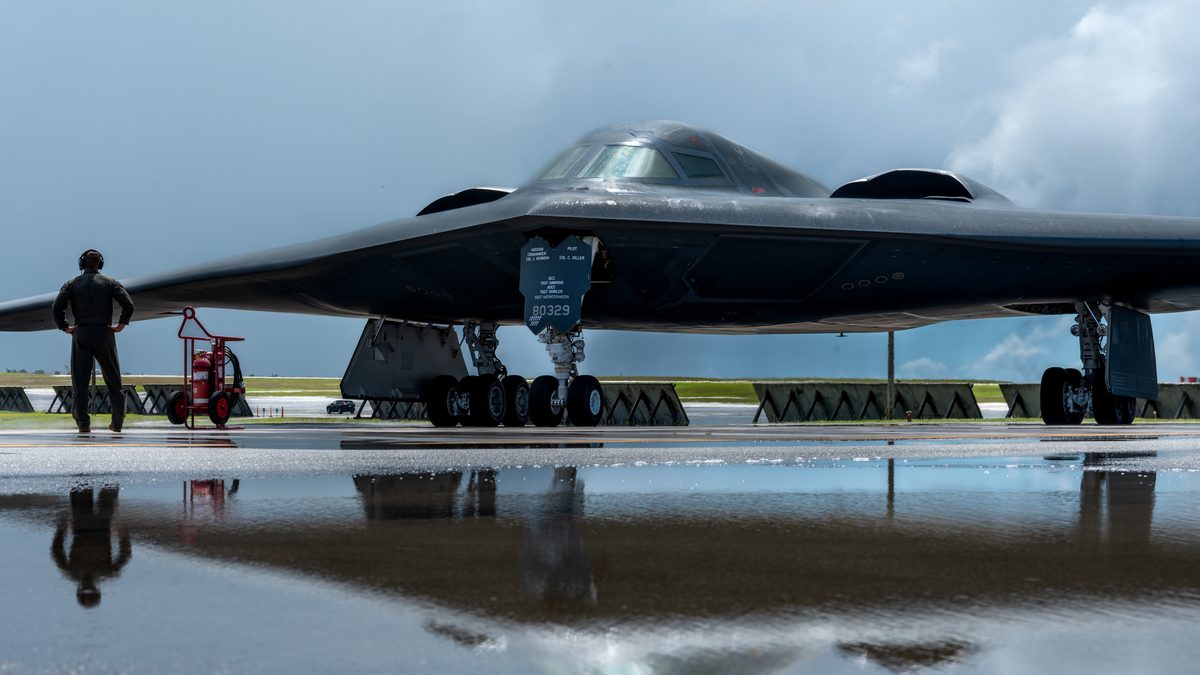
Illustrative: a B-2 Spirit at Andersen Air Force Base, Guam, during Exercise Valiant Shield 2024. The 29 June 2026 disclosure concerns a B-2 LRASM live-fire conducted during Valiant Shield 2026. U.S. Air Force photo by Airman 1st Class Manasseh Demissie, 36th Wing; public domain.
B-2 Spirit Fires Stealth LRASM Anti-Ship Missile in Pacific Sinking Exercise
Pacific Air Forces has disclosed that a United States Air Force B-2 Spirit fired an AGM-158C Long Range Anti-Ship Missile during a live sinking exercise north of the Marianas, sinking the decommissioned ex-USS Juneau. The shot formed part of Valiant Shield 2026. The B-2 had not previously been acknowledged as LRASM-capable, so the readout confirms a fielded anti-ship capability on the service's only penetrating bomber.
Technical Summary
Pacific Air Forces (PACAF) has disclosed that a United States Air Force B-2 Spirit stealth bomber fired an AGM-158C Long Range Anti-Ship Missile (LRASM) during a live-fire Sinking Exercise (SINKEX) north of the Mariana Islands. The shot formed part of Exercise Valiant Shield 2026 (VS26), and the target was the ex-USS Juneau (LPD 10), a decommissioned Austin-class amphibious transport dock that was sunk in deep water roughly 200 nautical miles off Guam. The B-2 had not previously been acknowledged as an LRASM-capable platform, so the announcement carries more weight than a routine exercise readout: it confirms a fielded anti-ship strike capability on the Air Force's only operational penetrating bomber.
The AGM-158C is the anti-ship member of the AGM-158 Joint Air-to-Surface Standoff Missile (JASSM) family. It carries a WDU-42/B blast-fragmentation penetrating warhead in the 1,000-pound (approximately 450 kg) class, initiated by an FMU-156/B fuze, on an airframe with an all-up weight reported at around 2,500 pounds (roughly 1,134 kg). Air Force Global Strike Command (AFGSC) told reporters that all details of how the missile is integrated onto the B-2, and whether the SINKEX represented a first for the bomber, are classified. A review of the Fiscal Year 2027 budget request does not list the B-2 among cleared LRASM platforms, which makes the live-fire the first public confirmation that integration has matured to an employable state.
Pairing a passive, jam-resistant 1,000-pound-class anti-ship missile with the Air Force's only penetrating bomber lets a single airframe hold multiple high-value warships at risk from several hundred nautical miles, inside contested waters where non-stealthy launch platforms cannot safely operate. ISC technical assessment
Weapon and Platform Characteristics
LRASM navigates to a designated target area using Global Positioning System-aided Inertial Navigation System (GPS/INS) guidance, then relies on an onboard route-planning capability linked to an electronic support measures (ESM) package. The ESM lets the missile re-route autonomously around newly detected emitters and use those radio-frequency emissions to refine its picture of the target group. In the terminal phase an imaging infrared (IIR) seeker takes over, comparing the scene against an onboard target library to select and strike a specific aim point on a chosen ship. Because the seeker is passive, it emits no radio-frequency energy for an adversary to detect, and it is not vulnerable to radio-frequency jamming. A two-way data link allows in-flight target updates and cooperative engagement between multiple missiles.
The B-2 already carries the land-attack AGM-158A JASSM and the extended-range AGM-158B JASSM-Extended Range (JASSM-ER), and is documented as able to load up to sixteen AGM-158A rounds across its two rotary launcher assemblies. The AGM-158C shares the family form factor, so a comparable magazine for LRASM is plausible, though the exact cleared loadout for the B-2 is not in open sources. That shared airframe, propulsion and ground-handling lineage also lets the B-2 reuse much of its existing JASSM mission-planning software and carriage hardware, which helps explain how integration could reach an employable state without a drawn-out public development programme. Published figures put the range of current LRASM variants at a reported 200 to 300 miles, broadly in line with the baseline JASSM, while a developmental AGM-158C-3 (C-3) is expected to extend reach toward the roughly 600-mile class of JASSM-ER and to add improved beyond-line-of-sight data-link and survivability features. The Air Force has not released an official range figure for any LRASM variant.
AGM-158C LRASM: baseline parameters (open sources)
| Type | Air-launched stealthy anti-ship cruise missile (AGM-158 / JASSM family) |
| Warhead | WDU-42/B blast-fragmentation penetrator, 1,000 lb (approx. 450 kg) class |
| Fuze | FMU-156/B |
| All-up weight | Reported approx. 2,500 lb (approx. 1,134 kg) |
| Guidance | GPS/INS midcourse, ESM-cued autonomous routing, passive IIR terminal seeker |
| Range (current) | Reported 200 to 300 miles; not officially disclosed |
| Propulsion | Turbojet, high-subsonic |
Where the B-2 Sits in the LRASM Inventory
The disclosure widens an already broad LRASM integration programme. The table below summarises the publicly acknowledged status of the principal launch platforms.
| Platform | Public status | Maturity |
|---|---|---|
| F/A-18E/F Super Hornet | Cleared launch platform (FY2027 budget) | Fielded |
| B-1B Lancer | Cleared launch platform; crews trained for mass anti-ship strike | Fielded |
| B-2 Spirit | Live-fire confirmed at Valiant Shield 2026; integration detail classified | Demonstrated |
| F-15E / F-15EX | Integration publicly under way | In integration |
| F-16C/D, F-35 variants, P-8A | Integration publicly under way | In integration |
| B-52 | Planned per budget documents | Planned |
Analysis of Effects
The operational value of the pairing comes from combining two survivability mechanisms rather than one. The B-2 is a low-observable platform that can penetrate dense integrated air defences to reach a launch point; LRASM is itself a low-observable, passively guided weapon that completes the run-in after release. A non-stealthy carrier such as the F/A-18 or B-1 must launch LRASM from outside the threat envelope and rely on the missile's reach and signature to survive the final legs. A B-2 can carry the launch basket forward into contested water, shortening the missile's transit, reducing adversary warning time, and bringing well-defended targets such as aircraft carriers and large amphibious assault ships within reach. Against a maturing anti-access and area-denial (A2/AD) posture in the Western Pacific, that geometry matters.
The effect is also magnitude. A single B-2 sortie can place a salvo of independently targeting, network-capable anti-ship missiles against a surface action group, with the missiles cooperating to allocate aim points across multiple hulls. The WDU-42/B penetrating warhead is designed to defeat ship structure before detonating, concentrating blast and fragmentation inside the target rather than against its outer plating. The disclosure should also be read as a signal in its own right: releasing a previously classified capability around a high-visibility Pacific exercise is a deliberate message to Beijing, consistent with how the United States has used long-range weapon demonstrations in the theatre before. LRASM is not the bomber's only maritime-strike option, either: the B-2 has separately been tested with Quicksink, a lower-cost anti-ship capability built on the Joint Direct Attack Munition (JDAM) guidance kit, including a 2025 trial conducted with the Royal Norwegian Air Force.
Personnel and Safety Considerations
This was a controlled SINKEX against a decommissioned, environmentally remediated hull in a designated range area, not a storage or transport event, so the relevant safety frame is weapon employment and range clearance rather than magazine hazard division management. Standard SINKEX practice requires the target hull to be cleaned to environmental standards, a cleared surface and subsurface danger area, and deconfliction of the multiple firing platforms taking part. Joint and allied participation, including a Japan Maritime Self-Defense Force (JMSDF) submarine that delivered a heavyweight torpedo as part of the same evolution, increases the coordination load on range safety staff managing concurrent air, surface and subsurface engagements against one target. For weapons and ammunition technical personnel, the wider point is that an insensitive-munition penetrating warhead such as the WDU-42/B is engineered to balance terminal lethality against safer handling and stowage characteristics aboard the launch platform, which is precisely what makes carriage on a high-value asset like the B-2 acceptable.
Data Gaps
Several parameters remain unconfirmed and are flagged here rather than asserted. The official range of any LRASM variant is not disclosed; the 200-to-300-mile figure is press-reported. The exact net explosive quantity (NEQ) and explosive fill of the WDU-42/B are not separately published, so only the warhead class is stated. The cleared LRASM magazine and any carriage restrictions specific to the B-2 are classified, as AFGSC confirmed. The number of missiles fired in the SINKEX, the launch range, and whether this was the first such B-2 employment were not released. The C-3 variant's quantified range improvement is described qualitatively in budget documents but not given as a figure. None of these gaps undercuts the central, primary-sourced fact: a B-2 fired an LRASM in a live-fire SINKEX during Valiant Shield 2026.
References
Source-evaluated under NATO STANAG 2022 (Reliability A–F / Accuracy 1–6). Tier 1 = government primary source; Tier 2 = quality news / specialist defence media; Tier 3 = authoritative aggregator / encyclopaedia.
- T1Air Force Global Strike Command (Pacific Air Forces) – U.S. Airmen and Sailors Conduct B-2 LRASM Live-Fire Sinking Exercise, 29 June 2026. (Reliability A / Accuracy 1)
- T1DVIDS – Multilateral, Joint Forces execute sinking exercise during Valiant Shield 2026, 27 June 2026. (Reliability A / Accuracy 1)
- T2USNI News – Former U.S. Amphib Sunk in Pacific Maritime Strike Drills, 29 June 2026. (Reliability B / Accuracy 2)
- T2The War Zone – Air Force Discloses B-2 Can Launch Stealth Anti-Ship Missiles In Surprise Announcement, 29 June 2026. (Reliability B / Accuracy 2)
- T2The Maritime Executive – Photos: U.S. and Allies Conduct SINKEX 2026 Using Former Amphib, 29 June 2026. (Reliability B / Accuracy 2)
- T3Designation-Systems.net – Lockheed Martin AGM-158 JASSM / AGM-158C LRASM, accessed 30 June 2026. (Reliability C / Accuracy 3)
Corrections & updates welcome. If you hold open-source data that refines or corrects any parameter in this article, please contact [email protected] citing the specific claim and your source. Verified corrections will be incorporated and credited in the revision history. AI-assisted technical assessment based on open-source material. Not a formal intelligence product.