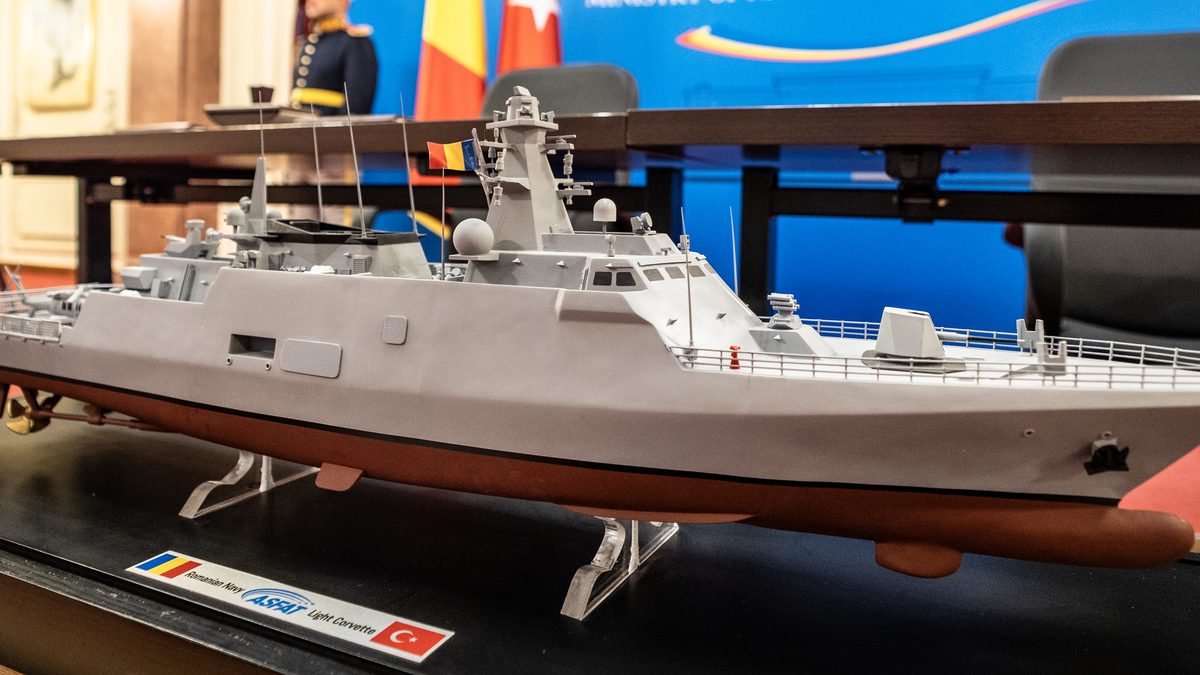
Scale model of the Hisar-class light corvette shown at the Romanian acquisition contract signing, with Romanian and Turkish flags. Romanian Ministry of National Defence (MApN), CC BY-SA 4.0, via Wikimedia Commons.
Turkiye Delivers Its First Combat Warship Export to a NATO and EU Member: Romania's Hisar-Class Corvette
Technical Summary
Turkiye has delivered the Hisar-class vessel Rear-Admiral August Roman to the Romanian Naval Forces, marking its first export of a combat-capable naval platform to a state that belongs to both the European Union (EU) and the North Atlantic Treaty Organization (NATO). The handover ceremony took place on 20 June 2026 at Istanbul Shipyard Command (ITK), with President Recep Tayyip Erdogan and Romanian President Nicusor Dan in attendance. The ship entered Romanian service as Contraamiral Roman (Cvt 261), styled in English as Rear-Admiral August Roman. It is the former Turkish Navy lead-of-class unit TCG Akhisar (P-1220), built by state defence contractor ASFAT at Istanbul Naval Shipyard as part of the wider MILGEM (National Ship) programme.
The intergovernmental contract was signed on 3 December 2025 for approximately 223 million euros (excluding value-added tax, and roughly 259 million United States dollars), a package that the Romanian Ministry of National Defence states also covers crew training and logistic support. The platform is classed by ASFAT and the Turkish Navy as an offshore patrol vessel (OPV), and by Romania as a light corvette: the two labels describe the same hull. Imagery from the delivery appeared to show the MKE 76 mm naval gun fitted forward, indicating that the export includes Turkish-origin weapons and subsystems alongside the platform itself. The same ceremony marked the commissioning of TCG Kochisar (P-1221), the second Hisar-class unit for the Turkish Navy, underlining that Ankara is fielding the class at home while exporting it to an Allied navy.
With the sales agreement we signed with Romania, Turkiye exports a warship to a NATO and EU member country for the first time in its history. President Recep Tayyip Erdogan, Istanbul Shipyard Command, 20 June 2026
Hisar-class: baseline specification (open sources)
| Type | Offshore patrol vessel / light corvette (MILGEM derivative) |
| Builder | ASFAT, Istanbul Naval Shipyard |
| Length overall | 99.56 m |
| Beam | 14.42 m |
| Draught | 3.77 m |
| Full displacement | approximately 2,300 tonnes |
| Propulsion | CODELOD (Combined Diesel-Electric Or Diesel) |
| Maximum speed | 24 knots |
| Range / endurance | 4,500 nautical miles; up to 21 days unreplenished |
| Complement | up to 104 (Romanian crew reported at approximately 85) |
| Combat management system | ADVENT (Turkish-developed) |
| Main gun | MKE 76 mm / 62-calibre dual-purpose |
| Aviation | flight deck for one 10-tonne-class helicopter and uncrewed air systems |
The Hisar class is built to a "fitted for but not necessarily with" philosophy, leaving margin for Turkish indigenous effectors. At handover the Romanian hull carried the baseline delivered fit: one forward MKE 76 mm gun and two 12.7 mm remote-controlled stabilised weapon stations, plus two rigid-hull inflatable boats (RHIBs) for boarding and special-forces tasks. The advanced effectors associated with the class remain fitted-for or scheduled for later Romanian-led integration: the ROKETSAN ATMACA anti-ship cruise missile, up to eight MIDLAS (National Vertical Launch System) cells for the HISAR-D point-defence surface-to-air missile, an ASELSAN GOKDENIZ 35 mm close-in weapon system (CIWS), and an anti-submarine-warfare (ASW) rocket capability. Sensors include a three-dimensional search radar, fire-control radar, hull-mounted sonar and an electronic support measures (ESM) suite. This modular, fit-for-but-not-with approach explains both the rapid transfer timeline and Romania's decision to field the hull as a light corvette rather than a pure patrol vessel.
Design Philosophy and Lineage
The Hisar class is a cost and schedule optimised evolution of the MILGEM Ada-class corvette hull, keeping the same low radar-cross-section shaping while changing the powerplant and internal arrangement for cheaper series production and longer patrol endurance. Where the Ada class uses a CODAG (Combined Diesel and Gas) plant tuned for sprint speed, the Hisar class adopts CODELOD (Combined Diesel-Electric or Diesel), trading top-end speed for fuel efficiency and the 21-day unreplenished endurance that suits persistent Black Sea presence and exclusive-economic-zone patrol. The lead ship was cut in August 2021, launched on 23 September 2023, began sea trials in December 2024 and delivered in June 2026: a roughly five-year cycle on a first-of-class hull. Turkiye plans ten of the class for its own navy, and the fitted-for-but-not-with margins let a buyer field a constabulary patrol vessel quickly, then add the full combat fit later without major structural rework.
Analysis of Effects
The delivery resolves a long stall in Romanian naval recapitalisation. Naval Group won Bucharest's 2019 programme for four Gowind corvettes and the modernisation of two Type 22 frigates, but the effort collapsed in 2023 after prolonged disputes over costs, industrial arrangements and implementation. Four of the years lost to that programme coincided with Russia's full-scale war against Ukraine, during which the Black Sea became an active theatre of missile strikes, sea-mine threats, maritime disruption and contested sea control. Bucharest therefore re-entered the market for a hull in a far harsher security environment than the one in which its original corvette requirement was framed, and chose an in-service, already-trialled platform that could transfer quickly rather than a clean-sheet build.
For the Alliance, the more interesting effect is on Black Sea posture. Since February 2022 several NATO members, the United States and the United Kingdom prominent among them, have pressed for a stronger standing Allied naval presence in the basin. Turkiye, as the riparian power controlling the Turkish Straits, has held to the 1936 Montreux Convention framework that limits the transit and tonnage of non-littoral warships. Delivering a combat-capable vessel to a littoral Ally points to a different way of reinforcing the maritime balance: strengthening a resident Black Sea navy from within, rather than reopening the legal and political settlement that governs access through the Straits. The transaction therefore advances NATO capability targets and the regional balance without touching Montreux.
Comparative Context: the Hisar Class Among 2026 Programmes
At roughly 2,300 tonnes the Hisar class sits between a pure offshore patrol vessel and a light missile corvette. Its closest relative is the Turkish Ada-class corvette, the more anti-submarine-oriented MILGEM sibling from which it descends. Measured against the Gowind design Romania cancelled in 2023, a roughly 2,500-tonne combatant armed from the keel, the Hisar offers a lower-risk, faster-to-field entry at the cost of a lighter baseline fit.
Set beside other current programmes, the trade is one of tempo against ambition. Germany's K130 Braunschweig Batch 2 corvette is smaller, near 89 metres and about 2,000 tonnes, and littoral-focused, its lead Batch 2 unit FGS Koln commissioned only in September 2025. Australia's Arafura-class offshore patrol vessel, around 80 metres and 1,640 tonnes, is a constabulary platform; its second hull, HMAS Eyre, commissioned in May 2026. At the high end, Australia's 8,800-tonne Hunter-class frigate cut steel in June 2024 with first delivery not expected before 2032, while the multinational European Patrol Corvette remains in a design phase running to November 2026 with first delivery targeted from 2030. Against that field the Hisar transaction is notable less for the hull than for the speed: Romania reached an in-service combatant in months, where larger Western programmes are measured in years.
Personnel and Safety Considerations
The export carries a weapons-engineering and munitions dimension that extends well beyond the steel hull. Introducing the MKE 76 mm gun, and any subsequent ATMACA, HISAR-D or 35 mm CIWS fit, brings Turkish-origin natures of ammunition and guided weapons into the Romanian and, by extension, the Allied inventory. Each effector imposes its own through-life requirements: explosive ordnance storage and handling to recognised standards such as Allied Ammunition Storage and Transport Publication AASTP-1 (Edition C), magazine compatibility-group segregation, qualified ammunition technician oversight, and a sustainable spares and propellant supply chain. The welcomed Romanian initiative to develop in-country maintenance facilities for the vessel will need to encompass weapon and magazine support, not only hull and machinery, if the corvette is to be sustained as a fighting unit rather than a presence platform. None of this is unusual for a new class, but it is the part of an export that takes longest to mature.
Data Gaps
The installed fit is now partly clear: the 76 mm gun and the two 12.7 mm stations were physically present at the 20 June ceremony, while the MIDLAS cells, HISAR-D, GOKDENIZ CIWS and a full ASW fit are understood to be fitted-for or scheduled for Romanian-led integration. What remains open in open sources is the net explosive quantity and storage classification of the embarked natures, the precise calibre length and ammunition family of the 76 mm mount as delivered, and the duration and depth of the contracted logistic-support and training package. ISC treats the contract value of approximately 223 million euros (excluding value-added tax) as the authoritative figure, with United States dollar conversions in some outlets varying by exchange-rate date.
Today in Istanbul we are jointly celebrating with the President of the Republic of Türkiye @RTErdogan, our defence ministers and high-ranking military officials, the “Rear-Admiral August Roman” – 261 Hisar-class vessel corvette entering into the service of the Romanian Naval Forces under the national flag.
— Nicușor Dan (@NicusorDanRO) June 20, 2026
References
Source-evaluated under NATO STANAG 2022 (Reliability A–F / Accuracy 1–6). Tier 1 = government primary source; Tier 2 = quality news / specialist defence media; Tier 3 = authoritative aggregator / encyclopaedia.
- T1Office of the President of Romania – Statement on the entry into service of the “Rear-Admiral August Roman” (261), 20 June 2026. (Reliability A / Accuracy 1)
- T1Romanian Ministry of National Defence (via GlobalSecurity) – The corvette “Rear-Admiral August Roman” 261 entered service with the Romanian Naval Forces, 23 June 2026. (Reliability A / Accuracy 1)
- T2Naval News (Tayfun Ozberk) – Turkiye Finalizes Export of Hisar-Class Light Corvette to Romania, 4 December 2025. (Reliability B / Accuracy 2)
- T2Naval News (Tayfun Ozberk) – Turkiye's first indigenous Hisar-class OPV starts sea trials, 13 December 2024. (Reliability B / Accuracy 2)
- T2Quwa Defence News & Analysis Group – Turkiye Delivers Its First Warship to a NATO and EU Member as Romania Receives a Hisar-class OPV, June 2026. (Reliability B / Accuracy 2)
- T3Wikipedia – Romanian corvette Contraamiral Roman, accessed 29 June 2026. (Reliability C / Accuracy 3)
- T3Wikipedia – Hisar-class offshore patrol vessel, accessed 29 June 2026. (Reliability C / Accuracy 3)
Corrections & updates welcome. If you hold open-source data that refines or corrects any parameter in this article, please contact [email protected] citing the specific claim and your source. Verified corrections will be incorporated and credited in the revision history. AI-assisted technical assessment based on open-source material. Not a formal intelligence product.