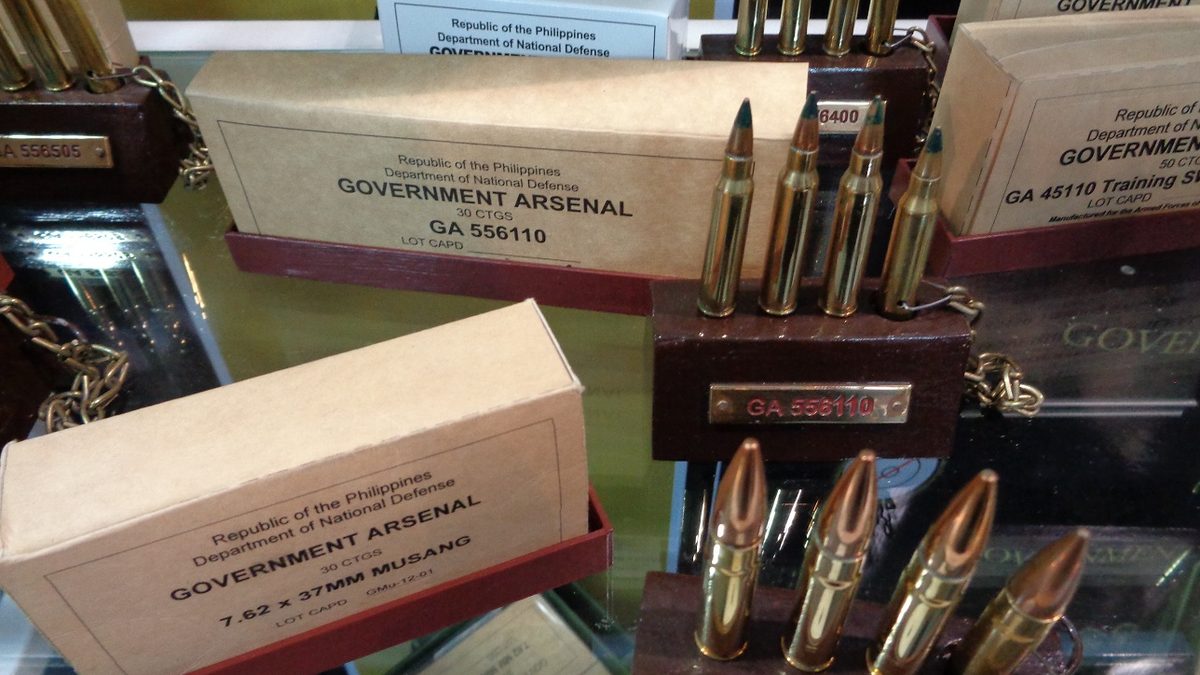
5.56x45mm NATO ball (M855/SS109) and blank cartridges. Photo: Girder2139, CC BY-SA 4.0, via Wikimedia Commons. Illustrative; used for subject context.
FBI Selects Federal and Remington for All Four 5.56mm NATO Rifle Ammunition Categories in $77.4m Award
Technical Summary
The Federal Bureau of Investigation (FBI) has awarded Federal Premium and Remington Ammunition, two brands within The Kinetic Group (TKG), a contract valued at 77.4 million US dollars covering four distinct 5.56x45mm North Atlantic Treaty Organization (NATO) rifle loads. TKG was selected as the sole supplier across all four rifle product categories, one of the larger law-enforcement awards in the group's history. Deliveries are scheduled to begin during 2026.
The four loads span the full duty-to-training spectrum and three projectile-construction families. Federal supplies a 64-grain (gr) Premium Tactical Bonded duty load, a 64gr Modified Jacketed Soft Point reduced-lead training load, and a 45gr BallistiClean Reduced Hazard Training (RHT) non-jacketed frangible load. Remington holds the jacketed frangible category with its 55gr Disintegrator Lead-Free round, which combines a HEVI powder-metal core with a conventional gilding-metal jacket. All four cartridges share the 5.56x45mm NATO case and chamber interface defined by NATO Standardization Agreement (STANAG) 4172. The duty nature also steps up from the FBI's established 62gr Tactical Bonded round, the so-called FBI load, to the heavier 64gr Premium Tactical Bonded, a change that points to incremental refinement of projectile design and barrier consistency rather than a new terminal concept.
Winning all four FBI rifle ammunition categories, from bonded duty rounds to lead-free frangibles, places a single industrial group in control of the Bureau's entire 5.56x45mm supply at a stated value of 77.4 million US dollars. ISC Defence Intelligence assessment
| Category | Supplier | Projectile | Weight | Key features | Primary use |
|---|---|---|---|---|---|
| Duty | Federal | Premium Tactical Bonded (bonded jacketed soft point) | 64gr | Barrier-blind; controlled expansion and high weight retention after intermediate barriers (glass, sheet steel, wallboard) per the FBI protocol | General duty |
| Training (reduced lead) | Federal | Modified Jacketed Soft Point | 64gr | External ballistics close to the duty load; lower lead content | Cost- and health-optimised training |
| Non-jacketed frangible | Federal (Ervin) | BallistiClean Reduced Hazard Training (sintered frangible matrix) | 45gr | Breaks up on hard surfaces; reduced ricochet, back-splash and airborne lead | Steel targets, close-quarter and indoor ranges |
| Jacketed frangible | Remington (HEVI core) | Disintegrator Lead-Free (powder-metal core, gilding-metal jacket) | 55gr | Fragments reliably while the jacket aids feeding and reliability | Training requiring some barrier behaviour |
Analysis of Effects
The award buys four deliberately different terminal behaviours on one cartridge case. The Premium Tactical Bonded duty round chemically bonds the jacket to the lead core so the projectile holds the bulk of its mass and expands in a controlled manner after passing intermediate barriers such as automotive glass, sheet steel and wallboard, the performance set the FBI test protocol is built around. That protocol scores expansion, weight retention and penetration, with a working window of roughly 12 to 18 inches in calibrated 10 per cent ordnance gelatine, across a standard barrier array of bare gelatine, heavy clothing, laminated automotive glass, sheet steel, plywood and wallboard. The Modified Jacketed Soft Point training round approximates that trajectory while lowering lead content. The two frangible natures, the sintered non-jacketed RHT load and the powder-metal Disintegrator, are engineered to break up on hard surfaces, cutting ricochet and back-splash energy at close range and on steel targets. All four operate within the 5.56x45mm NATO chamber-pressure regime, with a maximum mean pressure of 430 megapascals (62,366 pounds per square inch) measured by the NATO Electronic Pressure, Velocity and Action Time (EPVAT) method, a figure assessed from the published standard rather than the contract.
The procurement signal is supplier concentration. TKG, which houses Federal, Remington, CCI and Speer, has taken every category in a single award. The group was carved out of Vista Outdoor and acquired by the Czechoslovak Group (CSG) for 2.225 billion US dollars in a sale completed on 27 November 2024, so this consolidated United States small-calibre base now sits under European ownership within CSG's ammunition division. The move follows a May 2026 agreement under which Federal will supply 40 million Peak Alloy steel cartridge cases and license the high-pressure case technology to the US Army. Read together, the two deals show one group consolidating both law-enforcement and military small-calibre supply. The NATO dimension sits in the cartridge itself: 5.56x45mm is one of four NATO-standard small-arms calibres alongside 9x19mm, 7.62x51mm and 12.7x99mm, and STANAG 4172 is what allows a buyer to specify wildly different projectiles while keeping a single logistics interface.
Personnel and Safety Considerations
Small-arms cartridges of this type are assigned, for transport and storage, to United Nations (UN) serial 0012 (cartridges for weapons, inert projectile), Hazard Division (HD) 1.4 and Compatibility Group (CG) S. Net Explosive Quantity (NEQ) is confined to the propellant and primer composition and is not the governing hazard for ball or frangible natures, so a conventional bursting-charge NEQ assessment does not apply. The principal considerations are propellant fire hazard in bulk storage and, for the frangible and lead-free loads, the engineered reduction of airborne lead and ricochet energy. The reduced-lead and lead-free natures materially lower occupational lead exposure on enclosed ranges. Frangible projectiles cut ricochet and splash-back injury risk in close-quarter and steel-target training but should not be assumed to defeat intermediate barriers the way the bonded duty load is designed to.
Data Gaps
The contract vehicle (firm-fixed-price, indefinite-delivery, or base plus options), the period of performance and the annual delivery quantities were not disclosed. The split of the 77.4 million US dollar value across the four loads, and the FBI's planned issue ratio between duty and training natures, are not public. Manufacturing sites (Federal at Anoka, Minnesota; Remington at Lonoke, Arkansas) are inferred from existing production lines rather than confirmed in the award. Whether the Premium Tactical Bonded duty load is general-issue or reserved for specialist units is also unstated.
References
Source-evaluated under NATO STANAG 2022 (Reliability A–F / Accuracy 1–6). Tier 1 = government primary source; Tier 2 = quality news / specialist defence media; Tier 3 = authoritative aggregator / encyclopaedia.
- T1North Atlantic Treaty Organization – Standardization (STANAG 4172, interchangeability of 5.56mm ammunition), 2024. (Reliability A / Accuracy 1)
- T2American Rifleman (NRA) – Federal & Remington Awarded All Four Categories of FBI Rifle Ammunition Contract, 23 June 2026. (Reliability B / Accuracy 2)
- T2American Hunter (NRA) – Federal and Remington Awarded FBI Rifle Ammunition Contracts, June 2026. (Reliability B / Accuracy 2)
- T2American Rifleman (NRA) – Federal Signs Agreement With U.S. Army to Improve Ammo Performance, May 2026. (Reliability B / Accuracy 2)
- T2PR Newswire (Czechoslovak Group) – CSG acquisition of The Kinetic Group from Vista Outdoor (completed 27 November 2024 at 2.225 billion US dollars per US Securities and Exchange Commission filings), 2024. (Reliability B / Accuracy 2)
- T1North Atlantic Treaty Organization – AEP-97 Multi-Calibre Manual of Proof and Inspection (EPVAT test methodology), current edition. (Reliability A / Accuracy 1)
- T3Wikipedia – 5.56x45mm NATO, 2026. (Reliability C / Accuracy 3)
Corrections & updates welcome. If you hold open-source data that refines or corrects any parameter in this article, please contact [email protected] citing the specific claim and your source. Verified corrections will be incorporated and credited in the revision history. AI-assisted technical assessment based on open-source material. Not a formal intelligence product.