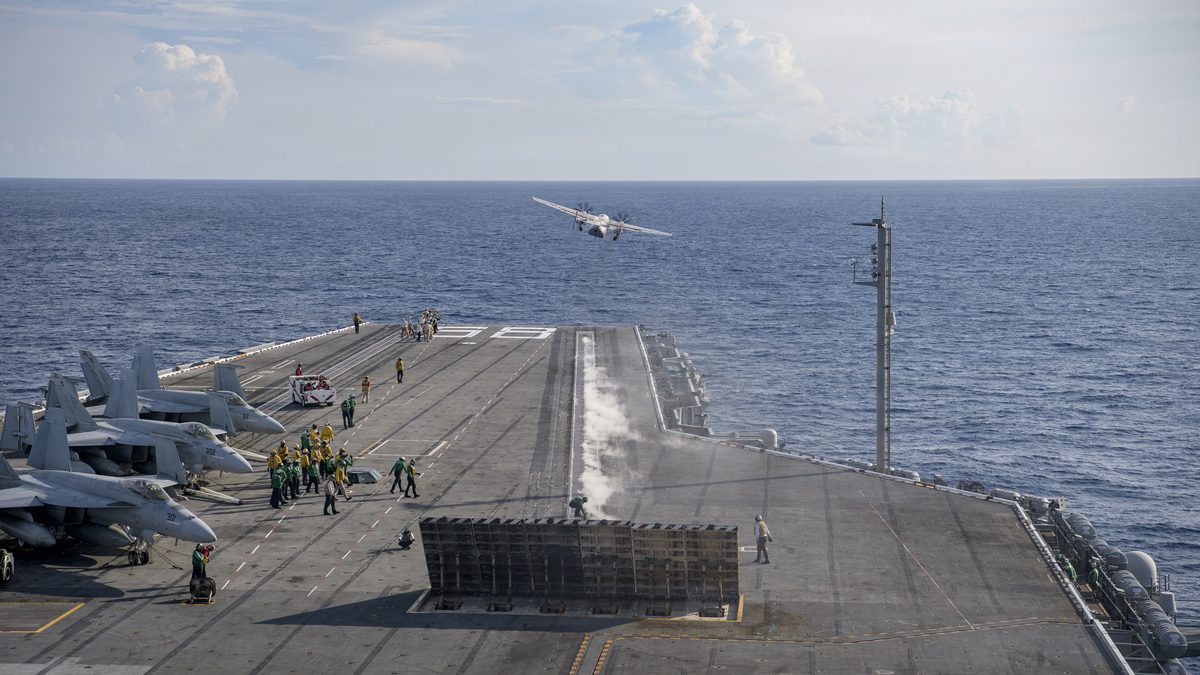
A C-2A Greyhound of the “Rawhides” of Fleet Logistics Support Squadron 40 conducts the last catapult launch of the type from USS Nimitz (CVN 68) during FLEETEX 250, 25 June 2026. U.S. Navy photo by Mass Communication Specialist 2nd Class Peter K. McHaddad (public domain).
C-2 Greyhound Flies Its Final Carrier Trap as Navy COD Passes to the Osprey
Technical Summary
Two Grumman C-2A Greyhound logistics aircraft made the last anticipated Carrier Onboard Delivery (COD) flights aboard the aircraft carrier USS Nimitz (CVN 68) in the Atlantic Ocean on 25 June 2026. Both aircraft, attached to the “Rawhides” of Fleet Logistics Support Squadron 40 (VRC-40), recovered aboard Nimitz in the morning after flying from Naval Station Norfolk, Virginia. One Greyhound was catapulted off the deck at about 1800 local time, with Vice Admiral Doug Perry, commander of Joint Force Command Norfolk and US 2nd Fleet, aboard, recorded by the Navy as the last ever catapult launch of the type from a US aircraft carrier. The ship was operating as part of Fleet Exercise (FLEETEX) 250, a multilateral training serial involving units from the United States and 13 partner and allied nations.
The C-2 has served the carrier logistics mission for roughly 60 years, entering fleet service in 1966. It is a fixed-wing, twin-turboprop aircraft cleared to carry a payload of up to about 10,000 pounds (4,536 kilograms) of cargo or around 26 passengers, launched by catapult and recovered by arrested landing, the recovery commonly called a trap. The Navy intends to retire its last 15 Greyhounds by September 2026 and has already stood down VRC-30, the West Coast COD squadron, in December 2023, leaving VRC-40 as the final operator. The mission passes to the Bell-Boeing CMV-22B Osprey, the carrier-logistics tiltrotor variant of the V-22, of which the Navy has placed orders rising to 48 airframes against an initial programme of 38.
The replacement tiltrotor carries up to 6,000 pounds of cargo to a 1,150 nautical mile range, yet the Pentagon test office judged the CMV-22B fleet not operationally suitable, with its ice protection system alone driving 44 percent of operational mission failures. ISC assessment, drawing on DOT&E Fiscal Year 2023 annual report
COD platform comparison (open sources)
| Outgoing platform | Grumman C-2A Greyhound, fixed-wing twin turboprop |
| Replacement | Bell-Boeing CMV-22B Osprey, tiltrotor |
| C-2A payload | Up to ~10,000 lb (4,536 kg) or ~26 passengers |
| C-2A range | Up to ~1,300 nautical miles (2,408 km) |
| C-2A crew | Two pilots plus two aircrew |
| CMV-22B payload | Up to 6,000 lb (2,722 kg) cargo and/or personnel |
| CMV-22B range | ~1,150 nautical miles (2,130 km) |
| Recovery method | C-2A: catapult launch and arrested recovery. CMV-22B: vertical take-off and landing (VTOL) |
| F-35C support | Only the CMV-22B cargo bay accepts the Pratt & Whitney F135 power module |
Analysis of Effects
The retirement closes the era of catapult-launched fixed-wing logistics aboard US carriers and reshapes how the air wing is sustained at sea. The CMV-22B was selected for one capability the Greyhound never had: its cargo bay accepts the Pratt & Whitney F135 power module, the core engine section of the F-35C Lightning II carrier-based strike fighter. With every US carrier air wing transitioning to the F-35C, the ability to fly a replacement engine module directly to the deck is a readiness-critical enabler rather than a convenience. The Osprey reached initial operational capability (IOC) in February 2022 and first delivered an F135 module to a carrier in February 2021 during testing aboard USS Carl Vinson.
Operationally the tiltrotor changes the deck choreography. Because the CMV-22B lands vertically in a small footprint, it does not need the catapult and arresting gear that a Greyhound recovery consumes, so COD movements interrupt the launch and recovery cycle less. The trade is reduced unrefuelled payload, 6,000 pounds against the Greyhound’s roughly 10,000, and a documented suitability problem. The Office of the Director of Operational Test and Evaluation (DOT&E) assessed the CMV-22B fleet as not operationally suitable in its Fiscal Year 2023 report, attributing 44 percent of operational mission failures to the ice protection system and recording maintenance hours per flight hour (MH/FH) above the requirement. The wider V-22 fleet has also been subject to repeated groundings on airworthiness grounds, which is precisely why the ageing Greyhound force was surged through 2024 to cover COD tasking.
Personnel and Safety Considerations
COD is a high-priority logistics function rather than a weapons-handling one. Greyhound and Osprey loads are typically repair parts, avionics, mail, passengers and readiness-critical items such as engine modules; bulk natured ammunition and explosive stores move to the carrier by underway replenishment (UNREP) and vertical replenishment (VERTREP) from dedicated logistics ships, not by COD. The relevant safety consideration for Weapons, Ordnance, Munitions and Explosives (WOME) readers is therefore indirect but real: the COD chain delivers the spares, test equipment and engine modules that keep the air wing’s strike and ordnance-delivery capability serviceable. A single COD type with an open suitability finding concentrates that sustainment risk on one platform. Deck handling of the tiltrotor also differs from a fixed-wing aircraft, with rotor downwash and folded-rotor spotting introducing handling factors that flight-deck crews must train against.
Data Gaps
Several points remain unconfirmed at the open-source level and are recorded here rather than asserted. First, whether the 25 June event is the absolute final C-2A flight or only the final carrier COD movement, given residual airframes may continue shore-based logistics or museum delivery flights before the September 2026 out-of-service date. Second, the precise number of CMV-22B airframes delivered and mission-capable as of June 2026, as published totals describe orders rather than fielded availability. Third, whether the ice protection and reliability deficiencies recorded in the Fiscal Year 2023 DOT&E report have been closed by subsequent follow-on test and evaluation, the results of which were not available in open sources at the time of writing. Fourth, the through-life cost and engine-module throughput rate that a tiltrotor-only COD force can sustain across a deployed strike group.
References
Source-evaluated under NATO STANAG 2022 (Reliability A–F / Accuracy 1–6). Tier 1 = government primary source; Tier 2 = quality news / specialist defence media; Tier 3 = authoritative aggregator / encyclopaedia.
- T1US Navy / DVIDS – C-2A Greyhound from “Rawhides” Conducts Last Catapult Launch From an Aircraft Carrier, 25 June 2026. (Reliability A / Accuracy 1)
- T2Jane’s – C-2A Greyhounds make final Carrier On-Board Delivery flights, June 2026. (Reliability B / Accuracy 2)
- T2The War Zone (TWZ) – The C-2 Greyhound Has Trapped Aboard A Carrier For The Last Time, June 2026. (Reliability B / Accuracy 2)
- T1NAVAIR – CMV-22B Osprey programme page (payload, range, F135 module), accessed June 2026. (Reliability A / Accuracy 2)
- T2The War Zone (TWZ) – CMV-22B Osprey “Not Operationally Suitable” According To Test Report (DOT&E FY2023), February 2024. (Reliability B / Accuracy 2)
- T2USNI News – Navy Surging C-2A Greyhounds as V-22 Groundings Continue, 13 February 2024. (Reliability B / Accuracy 2)
Corrections & updates welcome. If you hold open-source data that refines or corrects any parameter in this article, please contact [email protected] citing the specific claim and your source. Verified corrections will be incorporated and credited in the revision history. AI-assisted technical assessment based on open-source material. Not a formal intelligence product.