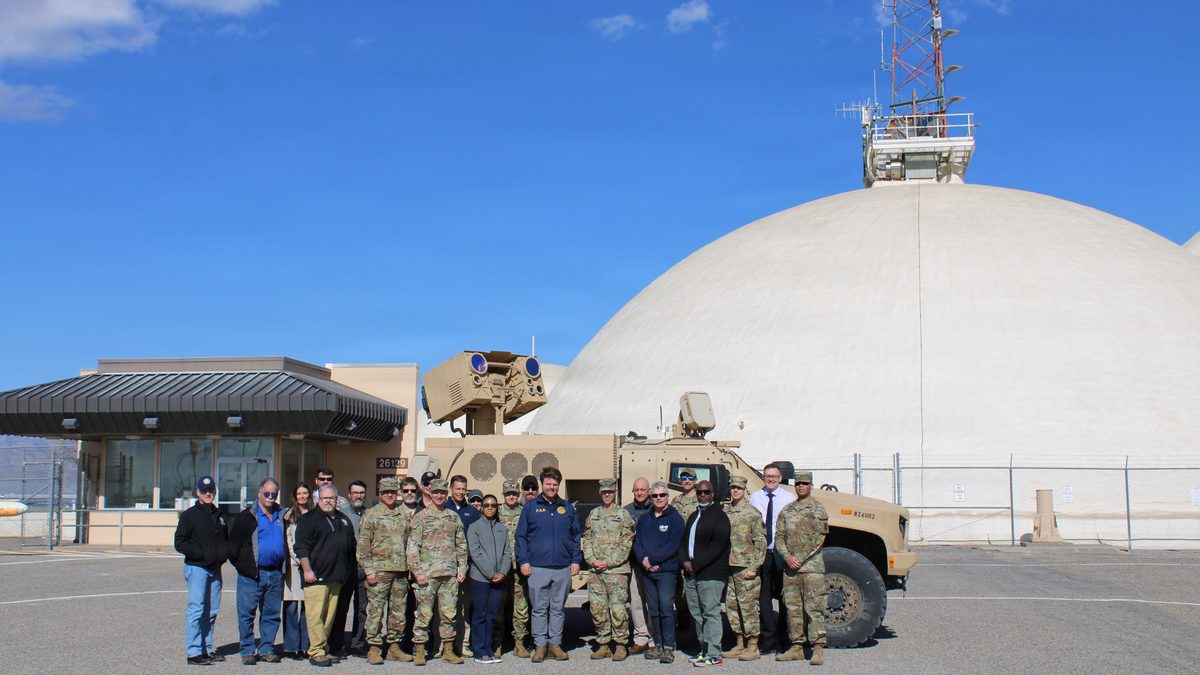
A high-energy laser counter-drone test using the AMP-HEL system at White Sands Missile Range, New Mexico, 7 March 2026. U.S. Air Force / DVIDS (VIRIN 260307-F-F3202-5691), public domain. Illustrative of the AMP-HEL system fired during the 23 June 2026 demonstration; not an image of that event.
Pentagon Fires Five Directed Energy Weapons for Hegseth at White Sands
Technical Summary
The United States Defense Secretary Pete Hegseth watched five directed energy weapons engage live targets at the United States Army's White Sands Missile Range in New Mexico on 23 June 2026. Reporting by Laser Wars, the specialist publication that broke the story, describes it as the first publicly known instance of a sitting Defense Secretary observing a live directed energy firing. Hegseth was accompanied by Emil Michael, the Under Secretary of Defense for Research and Engineering, whose office is steering an expansion of directed energy investment.
Directed energy weapons fall into two technical families, and both were represented. High energy lasers, abbreviated HEL, concentrate optical power onto a target to burn through structure or sensors. High power microwave systems, abbreviated HPM, radiate radio-frequency energy to disrupt or destroy the electronics inside a target. The systems fired spanned a wide power band, from a 20-kilowatt laser to a 300-kilowatt laser, with two microwave systems alongside them. Power on target, beam dwell time and atmospheric attenuation figures were not released, so the kilowatt ratings quoted below are nameplate device classes rather than measured effects.
The Five Systems
Each system maps to a distinct power class and a distinct point on the counter-air problem, from cheap drones at the low end to more demanding threats at the high end. The table below sets out the open-source detail.
| System | Type / class | Prime | Programme status |
|---|---|---|---|
| AMP-HEL | 20 kW laser (on the LOCUST laser weapon) | AeroVironment (AV) | E-HEL contender |
| P5 DE-MSHORAD | 50 kW laser | nLight | E-HEL contender |
| IFPC-HEL "Valkyrie" | 300 kW laser | Lockheed Martin | No transition planned |
| IFPC-HPM (Leonidas) | High power microwave | Epirus | No further procurement |
| Coyote non-kinetic | HPM variant of Coyote interceptor (likely Block 3) | Raytheon | Development |
Expanded on first use: AMP-HEL is the Army Multi-Purpose High Energy Laser; DE-MSHORAD is Directed Energy Maneuver-Short Range Air Defense; IFPC-HEL is Indirect Fire Protection Capability-High Energy Laser; IFPC-HPM is the microwave variant of the same family. The presence of these systems on one range, firing for the senior civilian leader of the Department, is the signal. The hardware itself is mostly already known.
Scaling directed energy enables our warfighters to fight beyond the limits of magazine capacity and no longer limited by how many bullets are in the chamber. Senior Pentagon official, quoted by Laser Wars
Analysis of Effects
The case for directed energy rests on cost-exchange, and the drone war has made that case impossible to ignore. A conventional interceptor missile costs from tens of thousands to hundreds of thousands of dollars. The one-way attack drones it is asked to destroy often cost a few hundred dollars each. Fire enough cheap drones at an air defence battery and the defender either runs the magazine dry or spends munitions worth far more than the targets they kill. A laser inverts that arithmetic: cost per shot is measured in the dollars of electricity needed to fire it, and the magazine is bounded only by the power supply feeding the beam. There is no propellant, no warhead and no net explosive quantity to store, transport or dispose of, which removes an entire logistics and explosive-safety tail that conventional interceptors carry.
Power class maps directly to the threat the weapon can address. A 20-kilowatt to 50-kilowatt laser is a counter-drone tool, suited to small unmanned aerial systems and the one-way attack munitions now common on the battlefield. The 150-kilowatt class steps up to cruise missiles, and the 300-kilowatt Valkyrie reaches toward the most demanding short-range threats. The microwave systems work differently. Rather than burning a single target, an HPM emitter floods a volume of sky with radio-frequency energy that couples into the electronics inside each airframe, through antennas and other apertures, to upset or burn out the flight controller. That gives it an area effect against many drones at once, which makes it the natural answer to a saturating swarm rather than a single inbound. The spread of systems on the range was a deliberate demonstration of the full span, from single-target precision to area effect.
Personnel and Safety Considerations
Directed energy carries no explosive hazard, but it introduces electro-optical and radio-frequency hazards in its place. A high energy laser presents an eye and skin hazard out to its Nominal Ocular Hazard Distance, which is why open-air firings are run on instrumented ranges under range safety control. The White Sands trials illustrate the point: the March 2026 AMP-HEL test shown above was coordinated by Joint Interagency Task Force 401 and the Federal Aviation Administration specifically to confirm safety measures for engaging unmanned targets in managed airspace. Target identification is the other live concern. The first acknowledged United States laser kill, by the LOCUST system near the southern border with Mexico in February 2026, destroyed what was later identified as a friendly asset, a combat-identification failure that any defensive system engaging fast, small, low-signature targets must contend with.
Data Gaps
Several load-bearing technical parameters remain unreleased and are flagged here rather than inferred. Power on target as distinct from nameplate device power was not disclosed for any of the five systems. Beam dwell time to kill, effective engagement range, and the atmospheric conditions at the time of firing are not in the public record. The exact configuration of the Raytheon Coyote non-kinetic variant is reported only as "likely" Block 3. Whether any of the five achieved a hard kill on the day, as opposed to a demonstration firing, is not stated in the source reporting. These gaps do not undercut the procurement signal, but they do mean the kilowatt figures should be read as system classes rather than verified performance.
Procurement: the Real Story
The demonstration matters less for the hardware than for the money and the institutional intent behind it. Hegseth told the House Armed Services Committee in late April that the Department intends to buy "tens to hundreds" of directed energy weapons in the coming years, framed as a deliberate demand signal to an industrial base currently tooled to build only a handful of prototypes. The programme that will test whether this cycle differs from decades of directed energy enthusiasm is the Enduring High Energy Laser, or E-HEL: a modular 30-kilowatt counter-drone laser described as the Army's first directed energy programme of record, with a first prototype expected in the second quarter of fiscal year 2026 and production units by the end of fiscal year 2027. The Army plans to field up to 24 E-HEL systems over five years. Two of the systems that fired at White Sands, the AMP-HEL and the P5 DE-MSHORAD, are competing contenders for that contract, which gave the demonstration a live procurement edge.
Above the counter-drone tier sits the Golden Dome homeland missile defence architecture. The fiscal year 2027 budget request carries 452 million US dollars in dedicated directed energy research and development for Golden Dome, more than triple the previous year's enacted level, within a total directed energy research request exceeding 2 billion US dollars. The Army and Navy plan to spend 676 million US dollars over five years on the Joint Laser Weapon System, a containerised 150-kilowatt laser intended to defeat incoming cruise missiles, with a commitment to include directed energy in a Golden Dome demonstration by summer 2028. Notably, the Lockheed Martin Valkyrie and the Epirus Leonidas systems that fired at White Sands are not planned to transition into programmes of record, according to Congressional Research Service and Army statements cited by Laser Wars; their single prototypes will instead feed lessons into the Joint Laser Weapon System effort.
References
Source-evaluated under NATO STANAG 2022 (Reliability A–F / Accuracy 1–6). Tier 1 = government primary source; Tier 2 = quality news / specialist defence media; Tier 3 = authoritative aggregator / encyclopaedia.
- T1U.S. Air Force / Defense Visual Information Distribution Service – JIATF-401 and FAA conduct high-energy laser test at White Sands Missile Range (AMP-HEL), 7 March 2026. (Reliability A / Accuracy 1)
- T2Axios – Pentagon leaders observe laser-weapon tests in New Mexico, 23 June 2026. (Reliability B / Accuracy 2)
- T2The Defence Blog – Pentagon demos laser weapons for Hegseth at White Sands, 26 June 2026. (Reliability B / Accuracy 2)
- T2Defense News – What we know about the US military's new joint laser weapon system, 28 April 2026. (Reliability B / Accuracy 2)
- T2Breaking Defense – Give 'em E-HEL: Army seeks industry ideas for counter-drone laser systems, 3 November 2025. (Reliability B / Accuracy 2)
- T2Laser Wars – EXCLUSIVE: Pentagon Demonstrates Laser Weapons for Hegseth, June 2026. (Reliability B / Accuracy 2)
Corrections & updates welcome. If you hold open-source data that refines or corrects any parameter in this article, please contact [email protected] citing the specific claim and your source. Verified corrections will be incorporated and credited in the revision history. AI-assisted technical assessment based on open-source material. Not a formal intelligence product.