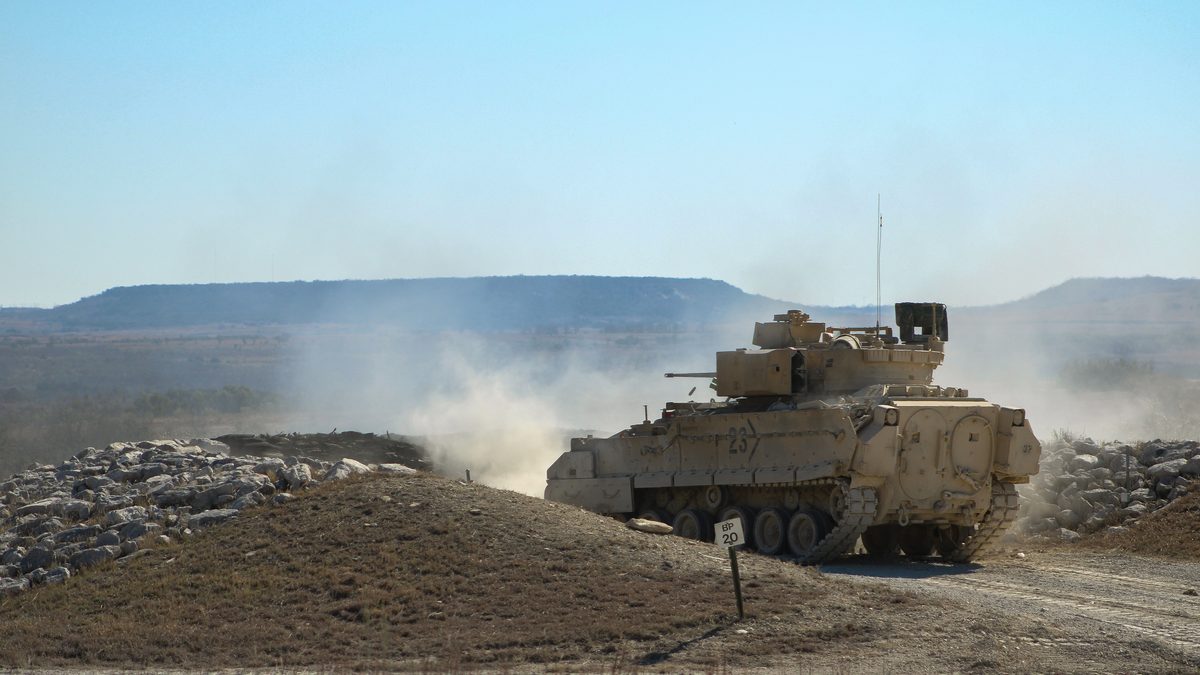
An M3A2 Bradley Fighting Vehicle engages targets with its M242 Bushmaster 25mm chain gun, one of the five calibre families covered by the contract. U.S. Army photo by Maj. Brian Sutherland (DVIDS, public domain).
US Army Opens $83.6m Three-Way Competition for Interoperable 20mm to 50mm Cannon Ammunition
Technical Summary
On 24 June 2026 the United States Army placed a three-way, multiple-award engineering contract for medium-calibre cannon ammunition, with a combined ceiling of 83.6 million US dollars. Northrop Grumman Systems Corporation (contract W15QKN-26-D-0013), General Dynamics Ordnance and Tactical Systems (W15QKN-26-D-0014) and AMTEC Corporation (W15QKN-26-D-0015) will compete order by order for non-recurring engineering (NRE), manufacturing, design and testing work covering ammunition interoperable with 20mm, 25mm, 30mm by 113mm, 30mm by 173mm and 50mm weapon systems. Army Contracting Command at Newark, New Jersey, received five bids and set an estimated completion date of 23 June 2031.
The award is an engineering and qualification vehicle rather than a production buy, so no round quantities or unit prices were disclosed. Its significance for the Weapons, Ordnance, Munitions and Explosives (WOME) community lies in its scope. A single instrument now spans almost the entire fielded medium-calibre family, from the 20mm by 102mm rotary-cannon nature up to the 50mm by 228mm round of the emerging XM913 Bushmaster III. Spreading that work across three primes, with task orders competed individually, is a deliberate move to widen the medium-calibre industrial base rather than concentrate it on a single source.
Three primes will compete order by order against an 83.6 million dollar ceiling to engineer ammunition that must function across five distinct cannon families, from the 20mm Vulcan to the 50mm Bushmaster III destined for the XM30 fighting vehicle. ISC open-source technical assessment, 26 June 2026
Analysis of Effects
Each calibre band in the contract maps to a distinct in-service or near-term weapon and its own family of natures. The 20mm by 102mm feeds the M61 Vulcan and M197 rotary cannon and the Phalanx close-in weapon system (CIWS), typically as high-explosive incendiary (HEI), armour-piercing and target-practice loadings. The 25mm by 137mm is the M242 Bushmaster nature of the M2 and M3 Bradley, fired as armour-piercing fin-stabilised discarding-sabot tracer (APFSDS-T), high-explosive incendiary tracer and target practice. The 30mm by 113mm is the low-pressure M230 chain-gun nature of the AH-64 Apache, dominated by the M789 high-explosive dual-purpose (HEDP) shaped-charge-and-fragmentation round. The 30mm by 173mm is the higher-velocity Mk44 Bushmaster II nature used on the Stryker Dragoon and on naval mounts, and is the calibre in which programmable air-burst munitions (ABM) have matured. The 50mm by 228mm is new to service: the XM913 cannon and its developmental XM1204 high-explosive air-burst and XM1203 armour-piercing natures are intended for the XM30 Mechanized Infantry Combat Vehicle.
| Calibre | Primary weapon and platform | Representative natures | Status |
|---|---|---|---|
| 20mm × 102mm | M61 Vulcan and M197 rotary cannon; Phalanx close-in weapon system | High-explosive incendiary, armour-piercing, target practice | In service |
| 25mm × 137mm | M242 Bushmaster on the M2 and M3 Bradley | Armour-piercing fin-stabilised discarding-sabot tracer, high-explosive incendiary tracer, target practice | In service |
| 30mm × 113mm | M230 chain gun on the AH-64 Apache | M789 high-explosive dual-purpose | In service |
| 30mm × 173mm | Mk44 Bushmaster II on the Stryker Dragoon and naval mounts | Programmable air-burst, high-explosive incendiary tracer, armour-piercing | In service |
| 50mm × 228mm | XM913 Bushmaster III on the XM30 fighting vehicle | XM1204 air-burst, XM1203 armour-piercing, XM1202 target practice | Emerging |
The 50mm band is the clearest signal of intent. In January 2026 the Army ordered an initial batch of 16 XM913 cannons from Northrop Grumman and began issuing them as Government Furnished Equipment to the two industry teams competing for the XM30, namely General Dynamics Land Systems and American Rheinmetall Vehicles. The XM913 fires the 50mm by 228mm round, roughly twice the projectile diameter of the 25mm Bradley nature, and its developmental family runs to the XM1204 programmable high-explosive air-burst, the XM1203 armour-piercing fin-stabilised discarding-sabot tracer and the XM1202 target-practice round. Qualifying ammunition for that gun is therefore not a side issue. It is the lethality baseline for the vehicle that is meant to replace the Bradley.
The word interoperable in the award describes commonality across these United States weapon systems, not a NATO Standardization Agreement obligation, because the contracting authority is national. The hardest engineering inside the non-recurring work is almost certainly the fuzing and the air-burst function. A programmable air-burst round depends on a precise electronic time or proximity fuze, a muzzle-velocity measurement and an inductive or contact programming interface that sets each round as it leaves the barrel, and proving that chain across calibres from 25mm to 50mm is far from trivial. A common fuze-setting and fire-control architecture across the family would cut training, logistics and integration cost, which is the most plausible reason for treating five calibres under one engineering instrument. High-explosive natures in this class carry only small bursting charges, on the order of tens of grams of an RDX-based composition per round, so the technical risk sits in precision and reliability rather than in raw explosive output.
Scaling one fuzing and air-burst architecture across the family is harder than it looks. Chamber pressure, barrel length and muzzle velocity differ sharply between a low-pressure 30mm by 113mm helicopter gun and the high-velocity 50mm, so the setback, spin and time-of-flight conditions a programmable fuze has to survive change with every nature. The inductive or contact setter and its data link must stay reliable across that span while talking to different fire-control systems on each platform. Larger 50mm bursting charges also raise the bar on insensitive-munitions testing, because fast and slow cook-off, fragment impact and shaped-charge threats all scale with the energetic fill.
Personnel and Safety Considerations
Medium-calibre development of this kind runs through proof firing, energetic-material handling and lot-acceptance testing at instrumented ranges, all conducted to the as-low-as-reasonably-practicable (ALARP) principle. The non-recurring scope will almost certainly include insensitive-munitions characterisation against United States standards such as MIL-STD-2105, and fuze-safety qualification under the MIL-STD-1316 and MIL-STD-331 series, since any new or modified nature must demonstrate controlled response to fast and slow heating, impact and shaped-charge threats before type classification. For storage and transport, fixed high-explosive cannon cartridges of this class are typically assessed at Hazard Division 1.2, where the hazard is non-mass-explosion projection rather than mass detonation, with a compatibility group reflecting a bursting charge and propellant combined in a single cartridge. The specific hazard classification depends on the final nature and packaging configuration and is not derivable from the contract notice.
Data Gaps
Several technical parameters cannot be recovered from the contract announcement and are recorded here as open. They include the specific natures to be developed (high-explosive, armour-piercing, air-burst or training); whether the 50mm XM1204 and XM1203 rounds and the XM913 cannon are formally inside this scope; the fuze and fire-control programming architecture to be standardised; net explosive quantity (NEQ) and hazard classification per nature; the insensitive-munitions compliance target; and the division between development, qualification and any low-rate manufacturing. Quantities and unit costs are absent because this is a non-recurring engineering vehicle rather than a production order.
References
Source-evaluated under NATO STANAG 2022 (Reliability A–F / Accuracy 1–6). Tier 1 = government primary source; Tier 2 = quality news / specialist defence media; Tier 3 = authoritative aggregator / encyclopaedia.
- T1US Department of War – Contracts for June 24, 2026, 24 June 2026. (Reliability A / Accuracy 1)
- T2GlobalSecurity.org – Contracts for June 24, 2026 (Department of Defense mirror), 24 June 2026. (Reliability B / Accuracy 2)
- T2Northrop Grumman – The XM913 Bushmaster Chain Gun developed for the US Army XM30, accessed 26 June 2026. (Reliability B / Accuracy 2)
- T2Defence Industry Europe – US Army orders first batch of XM913 Bushmaster chain guns from Northrop Grumman, January 2026. (Reliability B / Accuracy 2)
- T1US Army – The Army and AMTEC unveil new production line and testing range in Wisconsin, January 2026. (Reliability A / Accuracy 1)
- T2European Security & Defence – The NATO ammunition interchangeability challenge in the land domain, January 2026. (Reliability B / Accuracy 2)
- T3Wikipedia – XM913 chain gun (XM1202, XM1203 and XM1204 natures), accessed 26 June 2026. (Reliability C / Accuracy 3)
Revised 26 June 2026 to add a calibre reference table, XM30 programme context, expanded fuzing analysis and additional sources following an independent technical review. Corrections & updates welcome. If you hold open-source data that refines or corrects any parameter in this article, please contact [email protected] citing the specific claim and your source. Verified corrections will be incorporated and credited in the revision history. AI-assisted technical assessment based on open-source material. Not a formal intelligence product.