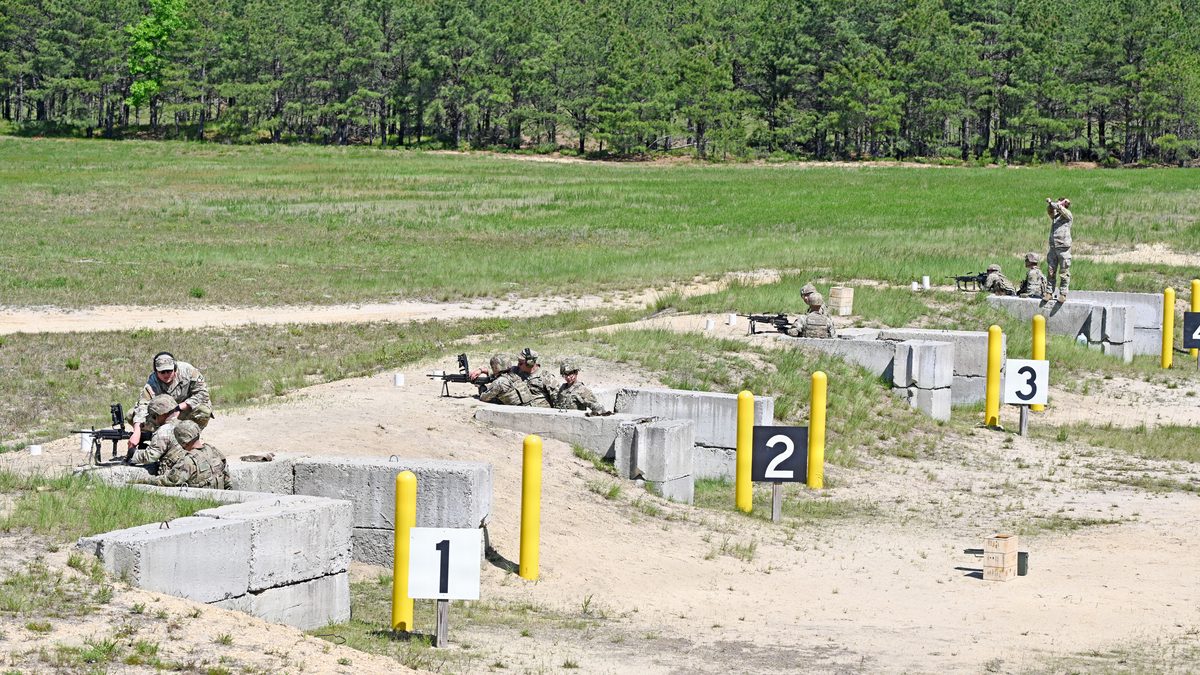
Photo: Daniel Amburg, U.S. Army, via DVIDS (public domain). Machine-gun qualification, 29 May 2026. Illustrative; use does not imply endorsement.
The 6.5 x 43 mm LICC: Vignette-Driven Selection and the One-Cartridge Solution NATO Never Built
Technical Summary
A vignette is a defined tactical scenario: a stated terrain, threat, force type, mission, engagement-range band and level of enemy protection. Vignette-driven selection means writing those use cases down first, modelling each one, and only then trialling candidate weapons and cartridges against them in live field firing or a synthetic environment. Most calibre arguments skip that discipline and fight over a single number. The harder and more useful question is whether one cartridge can cover the widest set of vignettes at acceptable cost, because that is where the real prize sits. Not a marginally better bullet, but a single round that feeds both the rifle and the machine gun, collapsing two supply chains into one.
One contemporary round is built around exactly that ambition. The 6.5 x 43 mm Lightweight Intermediate Caliber Cartridge (LICC) grew from the United States Army Marksmanship Unit (AMU) .264 USA of 2014 and is now carried by FN America for the United States Irregular Warfare Technical Support Directorate (IWTSD), with Canadian Special Operations Forces Command (CANSOFCOM) co-sponsoring a NATO Standardization Agreement (STANAG) 4884 for the round. FN has built it into a modular rifle family, the LICC Individual Weapon System (IWS) in close-quarters, carbine and marksman forms, and into a belt-fed light machine gun (LMG), the LICC Assault Machine Gun (AMG), adapted from the EVOLYS. One cartridge, the rifle and the section automatic weapon both. That is the configuration the calibre debate keeps overlooking, and it is the pillar this assessment is built around.
FN America says the LICC rifle groups about twice as tightly as the M4A1, roughly one to two minutes of angle, while its belt-fed LICC machine gun was more accurate than the 7.62 mm Mk 48 in automatic fire. One 6.5 mm round, serving both roles. FN America performance claims, ISC assessment
| Vignette | Dominant demand | Incumbent answer | 6.5 x 43 mm LICC fit |
|---|---|---|---|
| Dismounted patrol, special forces small team | Low carried weight, ammunition endurance on foot | 5.56 mm carbine | Covered LICC carbine, more reach at near 5.56 mm load |
| Urban close quarters | Manoeuvrability, controllability, low signature | 5.56 mm CQB carbine | Covered LICC CQB upper, 12.5 in, suppressed |
| Designated marksman, 300 to 800 m | Reach, retained energy, accuracy | 7.62 mm DMR | Covered LICC RECCE upper, 18.0 in, armour to 800 m |
| Section support by fire | Sustained automatic fire, barrel endurance | 5.56 mm or 7.62 mm LMG | Covered LICC-AMG belt-fed, EVOLYS-derived |
| Armour overmatch beyond 600 m | Defeat hard body armour at range | 6.8 x 51 mm NGSW | Partial trades peak armour reach for lower weight and wear |
| Sustained-fire GPMG role | High volume, tripod, long bursts | 7.62 mm GPMG | Not yet no 6.5 x 43 mm GPMG in open source |
Why the Vignette Test Matters
A specification is a proxy. It states what a weapon must be: a weight, a group size at a fixed distance, a mean number of rounds between stoppages. A vignette states what a soldier must achieve: clear this trench, hold this treeline, put a round into an armoured man at 400 m after a loaded approach march, at night, under drone observation. Systems engineering keeps formal language for the difference. Specification lines are measures of performance. Mission outcomes are measures of effectiveness, and the founding literature is blunt that one cannot substitute for the other. A rifle is not a capability. A rifle in the hands of a tired soldier, under load, inside a specific tactical problem, is the capability, and that version of the weapon is the only one the enemy ever meets.
The evidence for the distinction is 74 years old. In 1952 the Operations Research Office at Johns Hopkins examined how rifle engagements had actually unfolded in the Second World War and Korea. Hit probability with the M1 collapsed beyond 100 yd, battlefield engagements rarely stretched past 300 yd, and human aiming error swamped the ballistic refinement the specification sheets of the day prized. That study, ORO-T-160, redirected American rifle development toward the intermediate-calibre logic every NATO army now takes for granted, and it reached the same conclusion British .280 analysts had drawn from their own combat data in the same year the Alliance overrode them.
The cost of ignoring the distinction is documented with equal precision. The L85A1 passed its acceptance trials and then failed its soldiers in the Gulf; the leaked LANDSET report recorded that infantrymen “did not have confidence in their personal weapon”, and the fleet needed a Heckler & Koch rebuild fifteen years later. The G36 met its contracted specification for two decades while, per the German government study of 2015, first-hit probability at 100 m fell to 7 percent in a hot rifle against a 90 percent requirement. Berlin’s conclusion was exact: the rifle had to go because it failed military requirements, whatever the contract said. Specification compliance and tactical capability are different tests, and only one of them is set by the enemy.
Programme status (official record)
The 6.5 x 43 mm is not a paper concept. It traces to the United States Army Marksmanship Unit .264 USA of around 2014, was formalised through a 2018 Combating Terrorism Technical Support Office (now Irregular Warfare Technical Support Directorate, IWTSD) Broad Agency Announcement, and on 19 August 2019 IWTSD awarded FN America a competitive research, development, test and evaluation (RDT&E) contract as prime integrator, with Canadian Special Operations Forces Command (CANSOFCOM) a full co-sponsoring partner and Colt Canada’s C8 used as the design baseline. On 8 October 2025 FN delivered LICC-IWS and LICC-AMG test samples with ammunition to IWTSD, and three rifle variants, a 12.5 in close-quarters, a 14.5 in carbine and an 18.0 in marksman, now hold National Stock Numbers (NSNs) available for requisition across the United States services and Special Operations Command. CANSOFCOM is pursuing NATO Standardization Agreement (STANAG) 4884 for the interchangeability of 6.5 x 43 mm ammunition with at least one further NATO member.
Analysis of Effects
The 6.5 x 43 mm sits deliberately between the two NATO rounds. Its 6.5 mm projectile has a high ballistic coefficient, so it holds velocity, resists wind and shoots flat, giving more range, retained energy and penetration than 5.56 x 45 mm while staying far lighter and softer in recoil than 7.62 x 51 mm. The military load pairs that bullet with a two-piece steel case that FN America says is about 20 percent lighter than an equivalent brass round, and the published requirement asks the cartridge to defeat individual body armour out to 800 m. The point that matters for the matrix is commonality. The same round feeds the LICC rifle and the LICC machine gun, so a section that adopts it carries one nature of ammunition instead of two. That is the logistical advantage a mixed 5.56 mm and 7.62 mm fleet can never offer.
The single-cartridge idea is old, and it was beaten once before by politics rather than evidence. In the early 1950s Britain fielded the EM-2 rifle around the intermediate .280 British, a round meant to serve both the rifle and the support weapon. In January 1952 the NATO military committee chose the more powerful United States T65, later standardised as 7.62 x 51 mm NATO, and the .280 was dropped. The archival record is unambiguous about the mechanism: Churchill accepted the technical conclusions presented to him and overrode them for the sake of an Atlantic pool of weapons, a decision the peer-reviewed record treats as the canonical case of alliance politics beating operational analysis. The Alliance then spent three decades discovering that the 7.62 round was too heavy and too fierce for automatic fire, and bolted on a second standard, the 5.56 x 45 mm, under STANAG 4172 in 1980. NATO has run two cartridges ever since because it declined one good intermediate. The 6.5 x 43 mm is a direct attempt to reopen that decision. It also sidesteps the cost the United States accepted with its Next Generation Squad Weapon (NGSW) programme: the 6.8 x 51 mm round runs at roughly 80,000 pounds per square inch and wears barrels faster, whereas the LICC runs at a far lower chamber pressure, and a field-test account reported in our companion piece puts its barrel life on a par with a 5.56 mm barrel.
Baseline ballistics, open sources
| 5.56 x 45 mm SS109 | ~4 g, ~930 m/s, ~1,730 J muzzle energy |
| 6.5 x 43 mm LICC (.264 USA parent) | ~7 g (108 gr), ~2,650 to 2,750 fps (~810 to 840 m/s), ~2,300 to 2,700 J (load and barrel dependent) |
| 6.8 x 51 mm (.277 Fury, commercial) | ~9 g, ~900 m/s, ~3,660 J muzzle energy |
| 7.62 x 51 mm M80 | ~9.5 g, ~830 m/s, ~3,270 J muzzle energy |
The Process the Tender Deletes
If the method is proven, why do Western tenders keep reducing selection to a compliance matrix? The answer is structural rather than careless, and it has four working parts.
The law prefers what it can score. The European defence procurement directive requires award criteria that are objective, published in advance and tied to the subject-matter of the contract. NATO’s two standard award routes, Lowest Compliant Bid and Best Value, are paper evaluations; the UK government’s guide to NATO procurement states that under standard competitive bidding the technical portions of a bid are evaluated “only to determine compliance with the technical requirements”. A vignette trial produces a comparative judgement. A specification produces a score. Scores survive bid protests and judgements invite them, so the tender drifts toward whatever can be defended before a review body rather than whatever predicts performance in front of the enemy. The live example is close to home: the January 2026 pipeline notice for Project Grayburn, the SA80 replacement, frames a 17-year commitment as seven high-level characteristics. Armour defeat, optics, signature reduction, reliability in all climates. Not one terrain, threat, mission or range band appears in it.
Compliance also shields every signature in the chain. The G36 litigation demonstrated it: the manufacturer prevailed at Koblenz in 2016 while the court, as the German defence ministry itself recorded, expressly declined to examine whether the rifle shot straight. The ministry withdrew the weapon anyway for failing military requirements. Both outcomes stood at once, because the specification had quietly become the thing under contract while the capability had no contractual existence at all.
Third, capability has no institutional owner at the selection layer. NATO’s dismounted-soldier body runs ammunition interchangeability and soldier capability analysis as separate working groups. The standards a tender can invoke, STANAG 4172 and the EPVAT proof regime, verify that ammunition functions safely and interchangeably in a reference weapon across temperature extremes. No NATO standard asks whether a candidate wins its vignettes. Questions without owners do not get asked, a pattern readers of our NATO quality assurance analysis will recognise: the compliance lane and the capability lane run parallel and never meet.
Fourth, the incentives all point one way. Nobody is dismissed for buying the compliant rifle. The US Individual Carbine competition spent a reported 14 million dollars, found nothing that cleared its scoring threshold, and changed nothing; every signature was covered. France shows the alternative is affordable. The HK416F was selected after weeks of comparative trials and roughly 190,000 rounds fired by the users themselves, and no SA80-class scandal has followed it into service. The vignette is not the expensive option. The rebuilds are.
Personnel and Safety Considerations
Two practical points carry safety weight. First, barrel and pressure. A lower chamber pressure is easier on the throat and bore, which is the structural reason a 6.5 x 43 mm barrel can wear like a 5.56 mm one rather than faster, and it eases the cook-off risk, the unintended firing of a chambered round from an overheated chamber, in sustained automatic fire. The 6.8 x 51 mm buys armour defeat at the opposite end of that trade. Second, soldier load and round count. The LICC sits between 5.56 mm and 7.62 mm in cartridge weight, and its dedicated 25-round magazine holds fewer rounds than a 30-round 5.56 mm magazine, so the rifleman trades some carried rounds for reach. The hazard classification of the fielded LICC load is not in open sources; small-arms ammunition is normally low-hazard, but the specific hazard division (HD) and compatibility group (CG) for this cartridge are not confirmed here.
Data Gaps
Several parameters cannot be confirmed from open sources and are flagged rather than asserted. FN America has not released official LICC muzzle velocity or energy figures, so the ballistic values here are drawn from the .264 USA parent round and the published requirement. The second NATO STANAG 4884 partner nation alongside Canada has not been named, and the United States remains committed to 6.8 x 51 mm. No 6.5 x 43 mm general purpose machine gun (GPMG) exists in open source, so the sustained-fire role is concept only. No low-rate initial production date is public. The hazard classification of the cartridge, and the split of any future order across calibres, are likewise unconfirmed. A round without a ratified NATO standard remains, for now, a supply liability rather than the supply asset a single common cartridge promises.
References
Source-evaluated under NATO STANAG 2022 (Reliability A–F / Accuracy 1–6). Tier 1 = government primary source; Tier 2 = quality news / specialist defence media; Tier 3 = authoritative aggregator / encyclopaedia.
- T1GOV.UK – British Army experiments with Dstl study on urban combat (vignette and operational-analysis method), 31 March 2023. (Reliability A / Accuracy 1)
- T2FN America – FN Delivers Weapon System Test Samples to DoD’s Irregular Warfare Technical Support Directorate (official press release: LICC-IWS and LICC-AMG delivery, NSNs, variants), 8 October 2025. (Reliability B / Accuracy 2)
- T2FN America – FN LICC-IWS product page (6.5 x 43 mm specifications, ammunition family, STANAG effort; manufacturer primary source), 2025. (Reliability B / Accuracy 2)
- T2The Armourer’s Bench (M. Moss) – FN’s Individual Weapon System in .264 USA (2018 CTTSO BAA, 19 August 2019 award, Colt Canada C8 baseline, loads), 12 March 2023. (Reliability B / Accuracy 2)
- T2Soldier Systems Daily (E. Graves) – Canada Pursues NATO STANAG of 6.5 x 43mm, 2 June 2025. (Reliability B / Accuracy 2)
- T2The War Zone (J. Trevithick) – FN America Delivers Guns Chambered In 6.5mm LICC For U.S. Military Testing, 8 October 2025. (Reliability B / Accuracy 2)
- T2Wavell Room (Duncan Stewart) – NATO and the Next Generation Squad Weapon, 17 September 2024. (Reliability B / Accuracy 2)
- T2ISC Defence Intelligence – Ballistic Goldilocks: the 6.5 x 43 mm LICC and the weapons built around it (companion piece), 17 June 2026. (Reliability B / Accuracy 2)
- T3Wikipedia – .280 British and the EM-2 (1952 NATO T65 / 7.62 mm standardisation decision), accessed June 2026. (Reliability C / Accuracy 3)
- T1Operations Research Office, Johns Hopkins – Hitchman, Operational Requirements for an Infantry Hand Weapon, ORO-T-160 (combat engagement-range and hit-probability analysis; DTIC AD0000346), 19 June 1952. (Reliability A / Accuracy 2)
- T1Bundesministerium der Verteidigung – G36: Landgericht Koblenz urteilt zu Feststellungsklage des Herstellers (court expressly did not rule on precision; rifle withdrawn for failing military requirements), 2 September 2016. (Reliability A / Accuracy 1)
- T1GOV.UK – Navigating NATO procurement (Lowest Compliant Bid and Best Value award mechanics), accessed July 2026. (Reliability A / Accuracy 1)
- T1Defence Equipment & Support – Project GRAYBURN pipeline notice 2026/S 000-002873 (seven high-level characteristics; contract dates 2028–2045), Find a Tender, 13 January 2026. (Reliability A / Accuracy 1)
- T1EUR-Lex – Directive 2009/81/EC on defence and security procurement (award criteria rules), 2009. (Reliability A / Accuracy 1)
- T1US Army – Individual Carbine competition concludes with no winner, 13 June 2013. (Reliability A / Accuracy 1)
- T1NATO Allied Land Command – LCG Dismounted Soldier Systems conference (ammunition interchangeability and soldier capability analysis as separate working groups), 2022. (Reliability A / Accuracy 2)
- T2Forces News – L85A1 to A2: how Heckler & Koch fixed the SA80 family’s problem child (LANDSET findings and the A2 rebuild). (Reliability B / Accuracy 2)
- T2Systems Engineering – Sproles, Coming to Grips with Measures of Effectiveness, 3(1) 50–58, 2000 (measures of performance vs measures of effectiveness). (Reliability B / Accuracy 2)
- T2War on the Rocks (M. Moss) – How Churchill Paved the Way for NATO’s Standard Ammunition (Barlow report, UK National Archives; Hansard 1951), 27 October 2016. (Reliability B / Accuracy 2)
- T3Journal of Strategic Studies – Ford, Operational Research, Military Judgement and the Politics of Technical Change in the British Infantry, 1943–1953, 32(6) 871–897, 2009. (Reliability B / Accuracy 2)
Corrections & updates welcome. If you hold open-source data that refines or corrects any parameter in this article, please contact [email protected] citing the specific claim and your source. Verified corrections will be incorporated and credited in the revision history. AI-assisted technical assessment based on open-source material. Not a formal intelligence product.