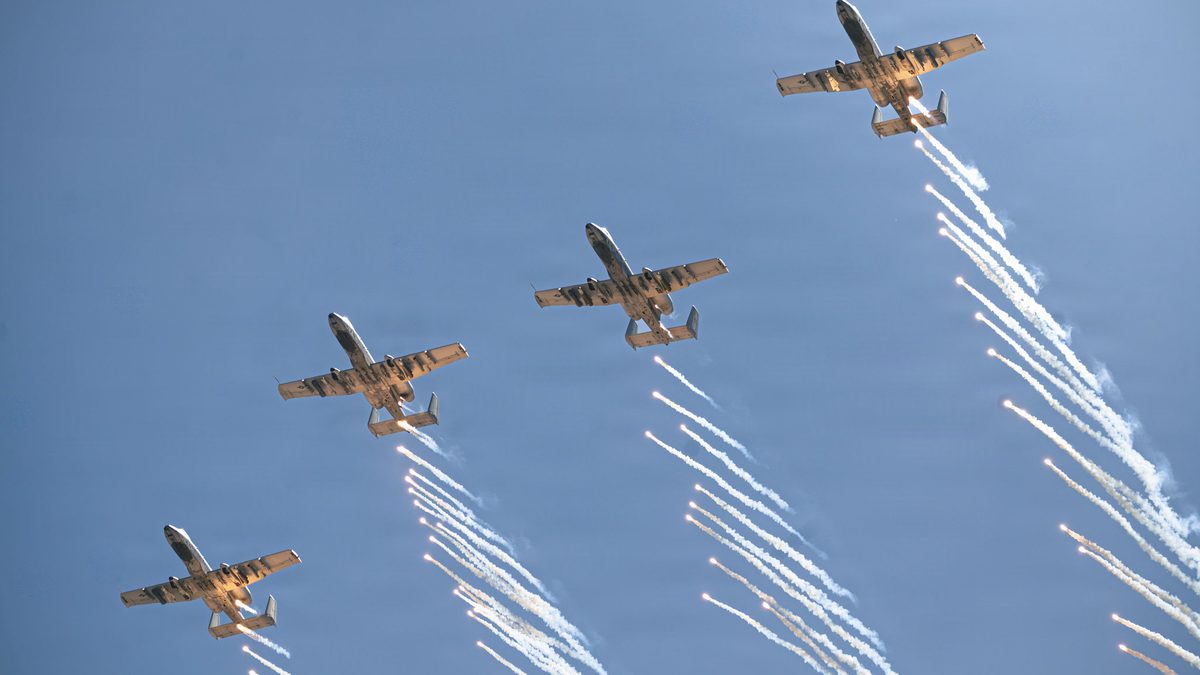
U.S. Air Force A-10C Thunderbolt IIs dispense defensive flares over a range near Gila Bend, Arizona, 1 May 2026. U.S. Air Force photo by Airman 1st Class Samantha Melecio / DVIDS (public domain). Use does not imply endorsement.
Pyrophoric, not pyrotechnic: the $300m decoy-flare buy defending US aircraft
Technical Summary
The United States Department of War's 12 June 2026 contract listing records a $300,000,000 modification, placed by United States Army Contracting Command at Newark, New Jersey, to Alloy Surfaces Company of Aston, Pennsylvania, a Chemring Group subsidiary, for the production, testing, inspection, packaging and delivery of M211, MJU-49, MJU-50A/B, MJU-51A/B, MJU-52A/B, MJU-64/B, MJU-66/B and XM-219 decoys. The modification raises the contract's cumulative value to $328,823,677 and runs to March 2031. These are expendable aircraft infrared countermeasures (IRCM): the small cartridges a fixed-wing or rotary-wing aircraft ejects to seduce a heat-seeking missile away from its engines.
The order spans two distinct decoy technologies that are often wrongly grouped together. The MJU-series cartridges are conventional pyrotechnic flares built on a magnesium, polytetrafluoroethylene (PTFE, sold as Teflon) and Viton fluoroelastomer composition, known as MTV, that burns at high temperature and radiates across the infrared band. The M211 contains no pyrotechnic at all. It is a special-material or pyrophoric decoy: a high-surface-area metal foil expelled by a BBU-35/B or M796 impulse cartridge that ignites on contact with air and burns at a spectrum closer to a real jet exhaust. That distinction is the whole point of the modern countermeasure problem. Alloy Surfaces is the special-material decoy specialist rather than the classic MTV house, so this particular buy is weighted toward special-material natures even where an MJU designation might suggest a conventional flare.

A 1990s heat-seeker chased the hottest thing in the sky. A 2026 imaging seeker compares shape, motion and spectrum, so the decoy now has to look like an engine, not just burn hotter than one. ISC open-source assessment, 25 June 2026
Analysis of Effects
First-generation infrared seekers used a single detector and tracked the strongest infrared source, so a hot MTV flare a few hundred Kelvin above the target was enough to break lock. Modern imaging infrared (IIR) seekers resolve a two-dimensional scene and apply kinematic and spectral discrimination: they reject a decoy that decelerates away from the aircraft, that sits in the wrong part of the image, or whose spectral signature does not match a turbine exhaust. That is why the contract pairs bulk MTV flares for legacy threats with pyrophoric special-material decoys, whose lower, engine-matched temperature and gentler deceleration are far harder for an imaging seeker to reject. The XM-219 development designation in the same buy indicates a next-increment decoy still being qualified.

The operational driver is consumption. Operations over Ukraine and in the Red Sea air-defence fight have shown that aircraft and helicopters working near man-portable air-defence systems (MANPADS) and infrared-guided weapons expend countermeasures heavily, and that a single sortie under threat can dispense dozens of cartridges. A $300m delivery order against a five-year window is a stockpile-replenishment and surge-capacity signal as much as a technology one. Each cartridge is a single-use energetic store, so higher dispense rates translate directly into magazine depth, production throughput and the explosive-licensed quantities held at depots and on airfields.
The producer's own position makes the dependency concrete. Alloy Surfaces is the principal United States source of these special-material pyrophoric decoys, and its parent Chemring announced in November 2025 that it would exit the business after failing to secure enough orders to sustain continuous manufacturing. In its half-year results to 30 April 2026 Chemring reported that disposal was no longer likely, that the operation had been closed and manufacturing had ceased, and that only the land and buildings remained held for sale, against an impairment of about £8.3 million. A $300m production order placed in June therefore lands on a line its owner had already written down, which turns the single-point-of-failure reading from a caution into a live capacity question.
Personnel and Safety Considerations
Both decoy families are energetic stores with real handling hazards. MTV pyrotechnic compositions are sensitive to heat, friction and electrostatic discharge and burn at temperatures that readily ignite secondary fires; pyrophoric special-material decoys ignite spontaneously in air, so a breached or damaged M211 cartridge is a fire risk on contact. Expendable countermeasures are typically assigned to the lower mass-fire hazard divisions, commonly Hazard Division 1.3 or 1.4, with the precise classification and net explosive quantity (NEQ) set per packaging configuration. Storage, transport and airfield loading fall under DESR 6055.09 in United States service and AASTP-1 for NATO interoperability. Open sources do not give the hazard division, compatibility group (CG) or NEQ per cartridge for the specific natures in this buy.
Data Gaps
The contract does not disclose cartridge quantities, the split between MTV and pyrophoric natures, unit costs, the M211 special-material chemistry (proprietary to Alloy Surfaces), or the qualification status of the XM-219. Hazard classification and NEQ per nature are absent from open sources, as are the precise infrared bands each decoy is tuned to.
References
Source-evaluated under NATO STANAG 2022 (Reliability A–F / Accuracy 1–6). Tier 1 = government primary source; Tier 2 = quality news / specialist defence media; Tier 3 = authoritative aggregator / encyclopaedia.
- T1U.S. Department of War – Contracts for June 12, 2026 (Army; Alloy Surfaces decoy production modification), 12 June 2026. (Reliability A / Accuracy 1)
- T2U.S. Army (Picatinny Arsenal) – Countermeasure flares (M211, M212, M206), accessed 25 June 2026. (Reliability B / Accuracy 2)
- T2Chemring / Alloy Surfaces – Special Material Decoys (M211 family), accessed 25 June 2026. (Reliability B / Accuracy 2)
- T2Defence Blog – Pentagon drops $300M on tiny decoys that trick missiles, June 2026. (Reliability B / Accuracy 2)
- T2Chemring Group PLC – Chemring to exit Alloy Surfaces; operations closed by 30 April 2026 (half-year results), 2026. (Reliability B / Accuracy 2)
- T3GlobalSecurity.org – Flares: Infrared Countermeasures, accessed 25 June 2026. (Reliability C / Accuracy 3)
- T3Wikipedia – Flare (countermeasure): MTV composition and seeker discrimination, accessed 25 June 2026. (Reliability C / Accuracy 4)
- T1DVIDS asset 9660898 (VIRIN 260501-F-AD704-1417) – A-10 Range Day, Samantha Melecio / 355th Wing, 4 May 2026. U.S. Government work, public domain. (Reliability A / Accuracy 1)
- T1DVIDS asset 9540691 (VIRIN 260226-Z-PB391-1345) – Flares Illuminate Sky During A-10 Maneuver, Albert Valladares / 152nd Airlift Wing, 16 March 2026. U.S. Government work, public domain. (Reliability A / Accuracy 1)
- T1DVIDS asset 9524511 (VIRIN 260213-F-CJ792-1072) – Sparking Readiness: 9th and 3rd AS Flare Operations, Master Sgt. J.D. Strong II / 436th Airlift Wing, 17 February 2026. U.S. Government work, public domain. (Reliability A / Accuracy 1)
Corrections & updates welcome. If you hold open-source data that refines or corrects any parameter in this article, please contact [email protected] citing the specific claim and your source. Verified corrections will be incorporated and credited in the revision history. AI-assisted technical assessment based on open-source material. Not a formal intelligence product.