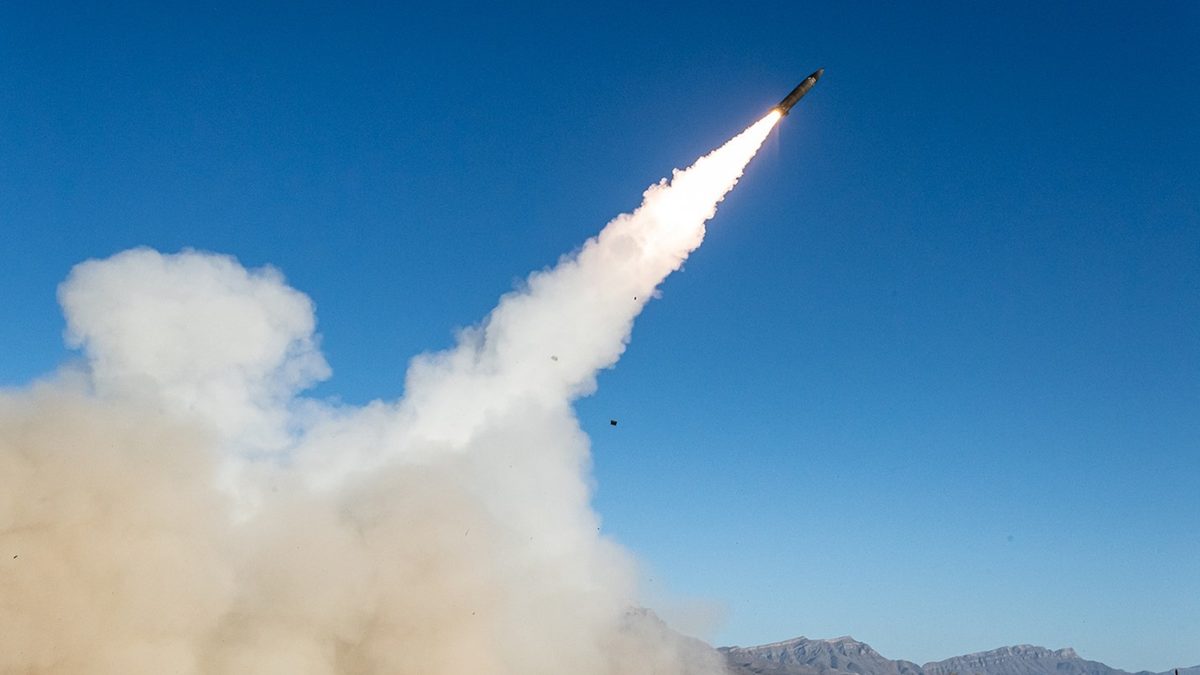
A Precision Strike Missile is fired from a U.S. Army M270A2 at White Sands Missile Range, New Mexico. U.S. Army photo by Christopher Bohn / DVIDS (public domain).
US Army Lifts Precision Strike Missile Production Ceiling to $13.3 Billion in $8.4bn Lockheed Modification
Technical Summary
On 23 June 2026 the United States Army awarded Lockheed Martin Corporation a $8,402,489,648 modification (P00007) to contract W31P4Q-25-D-0010, raising the ceiling and extending the ordering period for the Precision Strike Missile (PrSM) Increment 1. The action carries the cumulative face value of the contract to $13,339,535,048 and funds increased production capacity, Early Operational Capability assets, follow-on production, development and obsolescence management through fiscal year 2032. Army Contracting Command at Redstone Arsenal, Alabama is the contracting activity.
PrSM Increment 1 is a surface-to-surface guided missile fired from the wheeled M142 High Mobility Artillery Rocket System (HIMARS) and the tracked M270A2 Multiple Launch Rocket System (MLRS). Its reduced body diameter relative to the 610mm MGM-140 Army Tactical Missile System (ATACMS) it replaces allows two rounds per launch pod rather than one, doubling the ready missile load per launcher. The baseline round pairs a solid propellant rocket motor with an inertial navigation system aided by Global Positioning System (GPS) guidance and a unitary blast-fragmentation warhead reported at approximately 91kg.
The modification carries the Precision Strike Missile Increment 1 contract to a $13.3 billion cumulative ceiling, the financial expression of a March 2026 framework intended to quadruple annual output. ISC open-source assessment, 24 June 2026
Analysis of Effects
The modification is the contractual realisation of a framework agreement announced on 25 March 2026 under which Lockheed Martin and the Department of War committed to quadruple PrSM output. Where the original award sat near $4.94 billion, the new $13.3 billion ceiling provides the contract headroom to sustain that ramp through fiscal year 2032 without re-competition. The build-up rests on tooling, facility modernisation and test equipment investment rather than a new missile design, so the energetic fill and warhead configuration of the round remain those of the qualified Increment 1 baseline.
For the munition itself, the operationally relevant figures are range and magazine depth. Increment 1 holds a published range in excess of 400km against fixed targets in all-weather, day and night conditions, bounded by the 500km class limit of the former Intermediate-Range Nuclear Forces (INF) Treaty. Doubling the per-pod load means a single HIMARS carries two ready PrSM rather than one ATACMS, and a tracked M270A2 carries four. The combination of longer reach and deeper magazines is the capability the production ceiling is meant to scale.
Personnel and Safety Considerations
PrSM is a solid rocket motor munition, so the dominant bulk-handling hazards are those of a mass-detonating store in storage and transport, alongside the electro-explosive initiation risks common to guided missiles. The specific Hazard Division (HD) and Compatibility Group (CG) for the all-up round in its container are not stated in the open contract notice and are recorded here as a data gap. A production scale-up of this magnitude raises throughput at load, assemble and pack lines and at proof and acceptance ranges, where net explosive quantity (NEQ) limits, quantity-distance separation and electro-magnetic radiation hazard controls govern facility licensing under the applicable explosives safety regime.
Data Gaps
Open sources do not disclose the Hazard Division and Compatibility Group of the packaged all-up round, the precise net explosive quantity of the warhead and rocket motor, the annual unit production rate the new ceiling supports, the split of the $8.4 billion between Early Operational Capability assets, follow-on production and obsolescence management, or the delivery schedule against the fiscal year 2032 completion date. The warhead mass of approximately 91kg and the sub-500km range are drawn from secondary technical reporting rather than the contract notice and are not independently confirmed.
References
Source-evaluated under NATO STANAG 2022 (Reliability A–F / Accuracy 1–6). Tier 1 = government primary source; Tier 2 = quality news / specialist defence media; Tier 3 = authoritative aggregator / encyclopaedia.
- T1U.S. Department of War – Contracts for June 23, 2026, 23 June 2026. (Reliability A / Accuracy 1)
- T2DefenseScoop – DOD inks agreement with Lockheed Martin aimed at accelerating Precision Strike Missile production, 25 March 2026. (Reliability B / Accuracy 2)
- T2Lockheed Martin – Lockheed Martin Answers the Nation's Call and Quadruples Precision Strike Missile Production, 25 March 2026. (Reliability B / Accuracy 2)
- T2The Defense Post – Precision Strike Missile (PrSM): A New Era in Long-Range Fires, 6 March 2026. (Reliability B / Accuracy 2)
- T3Wikipedia – Precision Strike Missile, accessed 24 June 2026. (Reliability C / Accuracy 3)
Corrections & updates welcome. If you hold open-source data that refines or corrects any parameter in this article, please contact [email protected] citing the specific claim and your source. Verified corrections will be incorporated and credited in the revision history. AI-assisted technical assessment based on open-source material. Not a formal intelligence product.