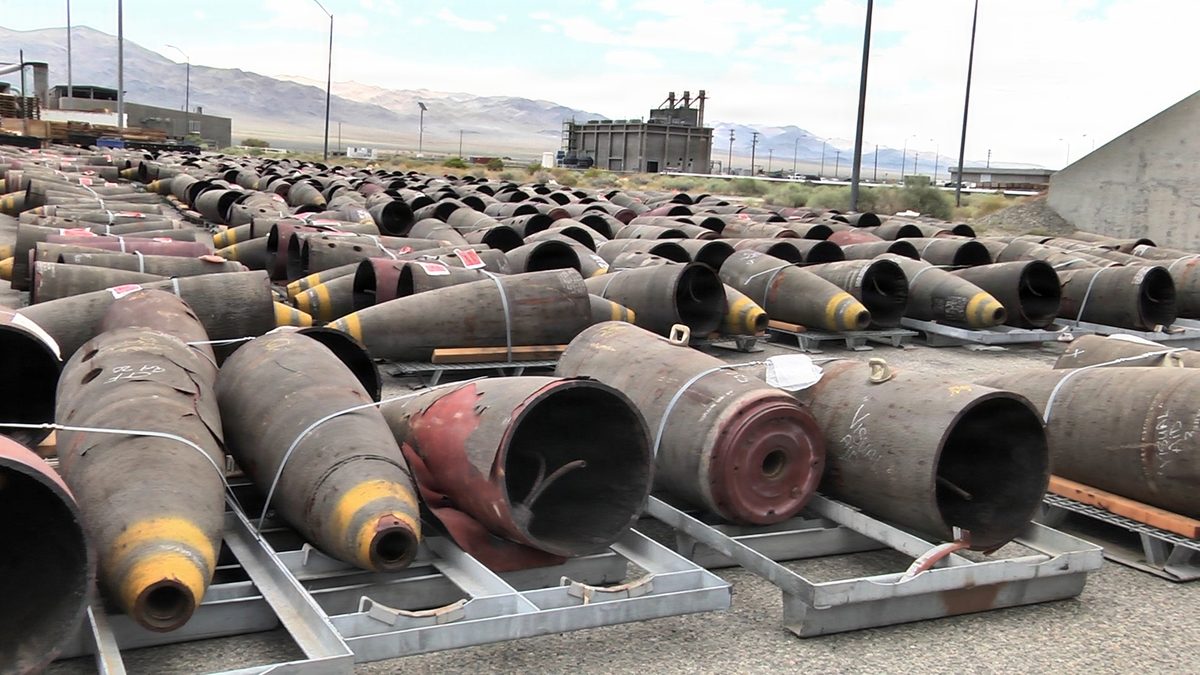
Ordnance staged for demilitarisation at Hawthorne Army Ammunition Plant, Nevada, 29 May 2023. U.S. Army Sustainment Command courtesy photo (VIRIN 230529-D-A4479-2830) via DVIDS, public domain. Use does not imply endorsement by the U.S. Department of Defense.
US Army Awards $14m to Clear and Rebuild Hawthorne Army Depot Open Detonation Range
Technical Summary
On 23 June 2026 the United States Army awarded Tepa-Weston Joint Venture a $14,060,476 firm-fixed-price contract to rehabilitate the New Bomb Open Detonation Range at Hawthorne Army Depot, Nevada. The scope covers removal of all material potentially presenting an explosive hazard (MPPEH) and munitions and explosives of concern (MEC), including unexploded ordnance (UXO), and the redesign of stormwater detention basins to withstand a 500-year flood event while controlling off-site discharge from a 100-year event or the worst storm of record. Work runs to an estimated completion of 31 May 2028, funded from fiscal year 2026 Other Procurement, Army appropriations. Army Contracting Command at Rock Island Arsenal, Illinois is the contracting activity under contract W519TC-26-C-A042.
Hawthorne Army Depot is the United States' largest ammunition storage installation and the Organic Industrial Base's largest demilitarisation site. Open detonation (OD) and open burning (OB) are core demilitarisation methods there, alongside washout, steam-out, rotary kiln incineration and munition sawing. An open detonation range is the controlled ground where surplus, obsolete or unserviceable ordnance is destroyed by initiating it with a donor charge, a process that disperses unexploded items, fragmentation and energetic residues across the working area over years of use.
An open detonation range accumulates unexploded ordnance and energetic residues over decades of demilitarisation; clearing it before earthworks is the explosive-safety precondition, not an afterthought. ISC open-source assessment, 24 June 2026
Key terms: MPPEH, MEC and UXO
MPPEH (material potentially presenting an explosive hazard) is range or demilitarisation debris that may contain energetics and must be assessed by qualified personnel before it can be reclassified as material documented as safe (MDAS) or material documented as an explosive hazard (MDEH), under Department of Defense Instruction 4140.62 and Department of Defense Manual 4140.72. MEC (munitions and explosives of concern) is the wider category, covering unexploded ordnance, discarded military munitions and munitions constituents present at concentrations that pose an explosive hazard. UXO is ordnance that has been fuzed, armed, fired or otherwise readied yet failed to function as intended, and is treated as live until proven otherwise.
Analysis of Effects
The contract sequence is dictated by explosive safety. Earthmoving on a former and continuing open detonation range cannot begin until the ground has been cleared of unexploded ordnance and explosive hazard material, because excavation otherwise risks initiating a buried item. The clearance element is therefore the controlling task: only once the working area is certified can the stormwater basins be regraded. The single bid received reflects how few contractors hold the combined UXO clearance and civil engineering competence this kind of work demands.
Tepa-Weston is a joint venture that pairs munitions-response and environmental-remediation work with geophysical survey and civil engineering, the two competences this contract requires in one bidder. That pairing is itself a barrier to entry, which helps explain why only one bid was returned for a project that joins live-range explosive-safety certification to heavy earthworks.
The flood-resilience requirement is the less obvious driver. A detonation range holds energetic residues and metal contamination in its soil, so uncontrolled stormwater run-off can carry heavy metals and explosive compounds off site into the surrounding watershed. Designing the basins to a 500-year flood standard, with controlled discharge at the 100-year event, is an environmental containment measure as much as a hydraulic one. It reflects the depot's long contamination history, where past open burning and detonation have left heavy metals, polychlorinated biphenyls and related compounds in soil and water.
Personnel and Safety Considerations
The dominant hazard is buried or surface unexploded ordnance in an unknown fuze state, which must be treated as armed until proven otherwise. Clearance teams work to recognised explosive ordnance disposal (EOD) procedures, locating items by geophysical survey and disposing of those that cannot be moved by detonation in place with a demolition charge. The net explosive quantity at the range and the categories of ordnance historically detonated there are not stated in the contract notice and are recorded as data gaps. Quantity-distance separation, exclusion zones and access control during clearance operations are governed by the applicable explosives safety regime.
Clearance on a range of this kind follows a recognised sequence. Teams first sweep the surface to remove visible debris and ordnance, then map subsurface anomalies by geophysical survey using magnetometer and electromagnetic sensors. Each anomaly is reacquired and investigated by controlled excavation. Items that cannot be moved are disposed of by detonation in place with a donor charge, and the cleared ground is then certified and documented. The work is carried out by unexploded-ordnance-qualified personnel meeting the minimum standards in Department of Defense Explosives Safety Board Technical Paper 18, operating inside approved quantity-distance arcs and exclusion zones.
Data Gaps
Open sources do not disclose the area of the range to be cleared, the density, types or fuze states of the unexploded ordnance present, the net explosive quantity historically detonated, the volume of contaminated soil to be handled, or the specific explosives-safety and environmental standards cited in the statement of work. The depot's broad demilitarisation methods and contamination history are drawn from secondary reporting and are not confirmed against the contract notice.
References
Source-evaluated under NATO STANAG 2022 (Reliability A–F / Accuracy 1–6). Tier 1 = government primary source; Tier 2 = quality news / specialist defence media; Tier 3 = authoritative aggregator / encyclopaedia.
- T1U.S. Department of War – Contracts for June 23, 2026, 23 June 2026. (Reliability A / Accuracy 1)
- T2U.S. Army – Hawthorne Army Depot: Providing Lethality That Wins, accessed 24 June 2026. (Reliability B / Accuracy 2)
- T2U.S. Army – Marines clear range at HWAD for warfighter training, 2025. (Reliability B / Accuracy 2)
- T2Nevada Legislature – Hawthorne Army Depot: World's Largest Ammunition Depot (briefing), accessed 24 June 2026. (Reliability B / Accuracy 2)
- T1U.S. Department of Defense – DoD Manual 4140.72, Management of Material Potentially Presenting an Explosive Hazard (MPPEH), 7 May 2021. (Reliability A / Accuracy 1)
- T1Department of Defense Explosives Safety Board – Technical Paper 18, Minimum Qualifications for Personnel Conducting Munitions and Explosives of Concern Related Activities, accessed 29 June 2026. (Reliability A / Accuracy 1)
- T3Wikipedia – Hawthorne Army Depot, accessed 24 June 2026. (Reliability C / Accuracy 3)
Corrections & updates welcome. If you hold open-source data that refines or corrects any parameter in this article, please contact [email protected] citing the specific claim and your source. Verified corrections will be incorporated and credited in the revision history. Revised 29 June 2026 to add explosive-safety terminology, clearance-sequence detail, contractor context and primary standards references. AI-assisted technical assessment based on open-source material. Not a formal intelligence product.