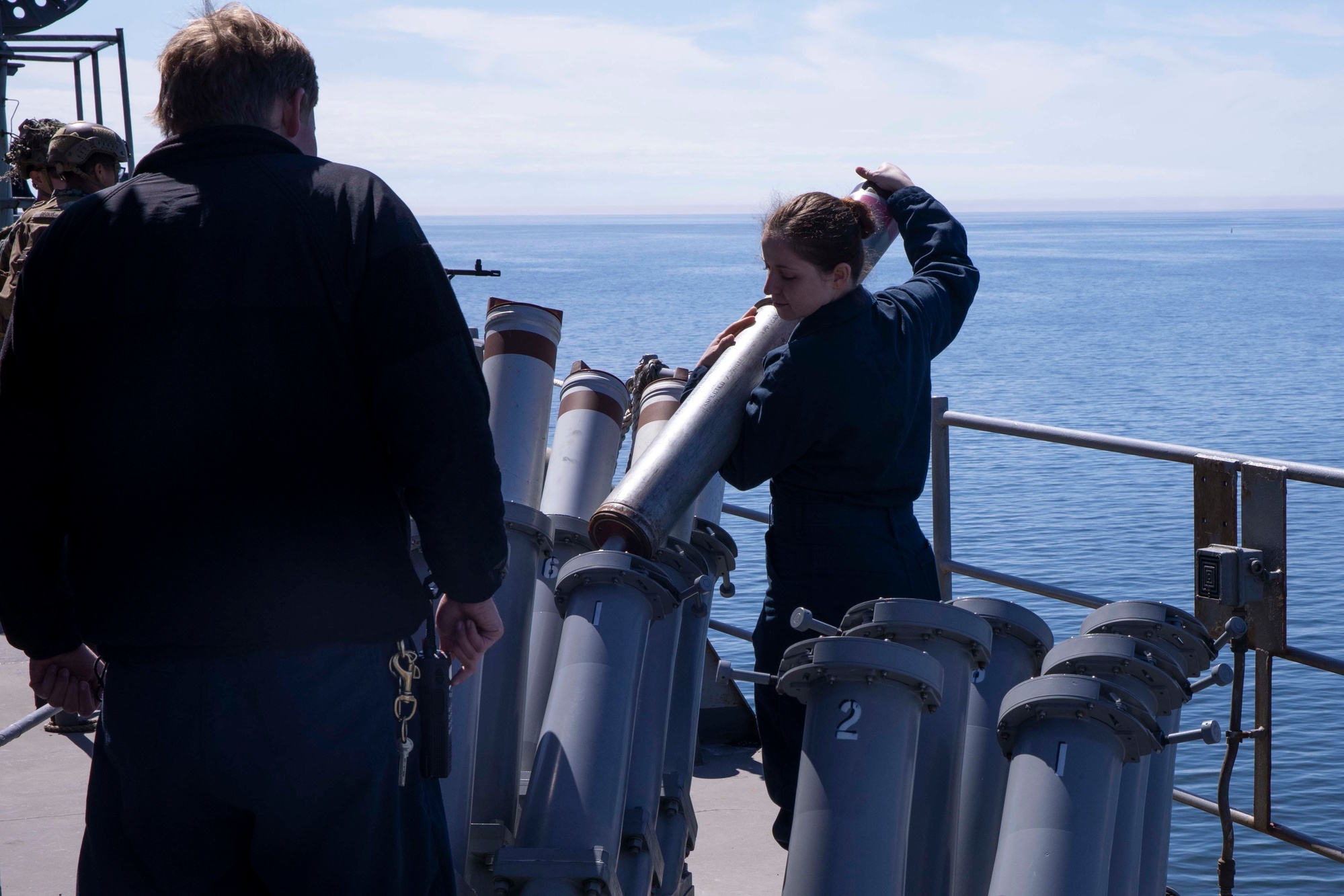
A U.S. Navy sailor loads a Mk 36 Super Rapid Bloom Offboard Countermeasures (SRBOC) launcher aboard USS Gunston Hall, Baltic Sea, 1 June 2022. The 130 mm Bullfighter is one of the rounds this launcher family fires. Photo: MCS Seaman Keith Nowak / U.S. Navy / DVIDS, public domain (VIRIN 220601-N-PS818-1492). The appearance of U.S. Department of Defense visual information does not imply or constitute DoD endorsement.
One Supplier, an Open Tender: Why NSPA Competes a Sole-Source Naval Decoy
Technical Summary
In June 2026 the NATO Support and Procurement Agency (NSPA) published Future Business Opportunity (FBO) 26LBS048, advance notice of a requirement for 100 units of a 130 mm radio frequency (RF) plus infrared (IR) naval decoy cartridge. The notice identifies the item by a single NATO Stock Number (NSN), 1320-12-368-4278, which corresponds to the Rheinmetall Bullfighter. It then qualifies that stock number with the two words that carry most of the procurement logic: "or Interchangeable." The round is used on the Mk 36 Super Rapid Bloom Offboard Countermeasures (SRBOC) launcher, and the notice sets the quality assurance level at Allied Quality Assurance Publication (AQAP) 2110.
The Bullfighter (German designation DM39, also referenced as DS36) is a soft-kill countermeasure from Rheinmetall Waffe Munition GmbH. It deploys a collocated RF and IR payload that blooms simultaneously, seducing or distracting anti-ship missile seekers, including imaging infrared (IIR) seekers with a reduced field of view and RF seekers that rely on range gating. It is in service with the German, Polish, Malaysian, Portuguese and Spanish navies. On paper the item reads like a textbook sole-source buy. The way NSPA has written the notice says something more interesting.
FBO 26LBS048 names the Bullfighter by stock number, but leaves the CAGE Code and Part Number fields blank and adds "or Interchangeable." NSPA is describing a capability, not ordering a brand. NSPA Future Business Opportunity 26LBS048, June 2026
The munition: Bullfighter (DM39)
The Bullfighter is a current-generation 130 mm decoy for the Mk 36 family and other 130 mm naval dispensers. Its RF and IR payload is collocated and blooms as a single event rather than in stages. The deployment method Rheinmetall calls the "Bullfighter principle" is what the company credits for a radar cross-section (RCS) cloud roughly six times denser than standard chaff, a manufacturer claim, paired with a ship-like spectral IR signature across the wavebands used by two-colour and imaging seekers and omni-polarisation against RF threats. That combination matters because most current anti-ship missiles carry dual-mode or multi-spectral seekers with electronic counter-countermeasures (ECCM), so a credible soft-kill layer now has to defeat radar and infrared at the same time. Rheinmetall states the round has been successfully seeker-tested against modern RF and IIR seekers fitted with sophisticated ECCM. The same family includes the pure-IR Giant (DM19), which trades the combined effect for a longer IR burn time. The figures below are drawn from the manufacturer brochure and open NSN references.
Baseline specification (open sources, Rheinmetall brochure D009e0222)
| NATO Stock Number | 1320-12-368-4278 |
| Designation | DM39 / DS36 |
| Calibre | 130 mm |
| Overall length | 1,208 mm |
| Total weight | approx. 21 kg |
| Submunitions | 5 |
| Reaction / blooming time | under 3 seconds |
| Hazard classification | HD 1.3 G |
| Primary launcher | Mk 36 SRBOC, Terma C-Guard and other 130 mm dispensers |
| Optional features | Auto-Sequencer, Auto-Walk-Off (AWO) or Load-Status-Indicator (LSE) |
| Manufacturer (CAGE) | Rheinmetall Waffe Munition GmbH (D3830) |

The sole-source question
Read as a WOME technical consultant would read it, the exact NSN is effectively sole source. Every open NSN and FLIS reference, every manufacturer brochure and database listing ties 1320-12-368-4278 to Rheinmetall's DM39, and no competing CAGE code appears against it. Where a requirement is written around that stock number, existing inventory compatibility and proven seeker performance, a single-source justification to Rheinmetall is defensible and low risk.
The capability behind the stock number is where a common assumption breaks down. Under the NATO Codification System a single NSN identifies an item, or a group of functionally interchangeable items, by form, fit and function, and the "or Interchangeable" wording invokes that group. For this requirement, the group is effectively empty. The closest conceptual peer was Chemring Countermeasures' Chimera, a 130 mm cartridge that combined centre-burst chaff with sequential multispectral IR submunitions, but it was never an interchangeable substitute for the Bullfighter, and Chemring no longer lists it among its current naval rounds. The two worked by different methods: Chimera walked a seeker off with a chaff cloud followed by IR submunitions fired in sequence, while the Bullfighter blooms a single collocated RF and IR cloud in under three seconds. Different deployment physics means a different seeker-defeat profile, different ballistics and a separate safety and seeker-test qualification. Chemring's current 130 mm naval line is modular: individual chaff and IR rounds, plus variable-range multi-payload options, rather than a single combined cartridge. So even the Royal Navy's prime decoy supplier offers no current drop-in equivalent, which is why the Bullfighter is effectively sole source at the capability level and not only at the stock number.
| Attribute | NSPA requirement (FBO 26LBS048) | Bullfighter (DM39) | Chemring Chimera (legacy) |
|---|---|---|---|
| Calibre | 130 mm | 130 mm | 130 mm |
| Effect | Combined RF + IR | Simultaneous, collocated RF + IR | Sequential RF + IR (centre-burst chaff + IR submunitions) |
| Seduction mode | Dual-mode seeker defeat | Immediate high-density seduction | Progressive walk-off |
| Launcher | Mk 36 SRBOC | Mk 36 SRBOC and others | Compatible with 130 mm launchers (Mk 36 chaff base) |
| Exact NSN match | 1320-12-368-4278 | Yes | No |
| Interchangeable substitute | Sought ("or Interchangeable") | Baseline item | No: different method, separate qualification |
The two rounds reach the same dual-mode goal by different physics. The Bullfighter blooms its RF and IR payload together as one dense, collocated cloud. Chemring's now-legacy Chimera, built on Mk 36 chaff and the Thermal Anti-missile Launched Offboard Seduction (TALOS) technique, paired a centre-burst chaff cloud with multispectral IR submunitions launched in sequence to walk the seeker off. Both defeat RF and IR seekers, but the timing, the way the cloud forms, the ballistics and the seeker-test qualification all differ, and Chimera is in any case no longer in Chemring's current range. They are peers at best, not substitutes, so although the FBO asks for the Bullfighter "or Interchangeable," there is no current 130 mm cartridge to put against it.
Why an open FBO, not a single-source award
The answer starts with the default rule, and a brief word on sourcing. This is an NSPA procurement, governed by NSPA's own framework, the NATO Support and Procurement Organisation (NSPO) Procurement Regulations and the Procurement Operating Instructions beneath them, not by UK or any single nation's procurement law. For an accessible open-source account of how that framework works, this section draws on the UK Government's published "Navigating NATO procurement" guidance. That guidance sets out the NATO procurement methods, from international competitive bidding (ICB) and Best Value as the competitive defaults, through National and Limited Competition, to Sole or Single Source as the exception, and it records that NSPA procures, in principle, through ICB in compliance with NSPO's Procurement Regulations, aiming to maximise the participation of qualified firms. Sole source has to be justified and approved on a compelling case, typically extreme operational urgency or commonality with previously supplied equipment, rather than assumed. A routine resupply of 100 decoy rounds does not clear that bar on its own.
This is also why a buyer cannot simply declare an item sole source. Even when the incumbent is plainly the only realistic option, procurement rules put the burden on the Agency to test that claim rather than assert it, and the FBO is the instrument that does it. Published for information only under NSPA Procurement Operating Instruction 4200-01, the FBO is a market survey, not a contract and not a commitment to buy. It invites any firm that believes it holds a qualifiable equivalent to register in the NSPA Source File and to respond when the Request for Proposal (RFP) follows. If none does, the test itself becomes the evidence.
The formal RFP is the next step, issued once the requirement is ready and normally directed to firms registered in the Source File. If that RFP draws a single compliant bid, the contracting officer does not treat it as a failed competition. The bid is evaluated on its published merits: technical compliance, AQAP 2110 quality, hazard classification, delivery and price reasonableness, with room to negotiate terms even against one bidder. A single response forces a re-tender only where that bid is non-compliant, or where the specification looks to have been drawn so tightly that it artificially narrowed the field. Routine munitions resupply rarely meets either condition, so a compliant single bid is normally evaluated and awarded.
How NSPA handles a single-bid resupply
Test the market openly through the FBO, issue the RFP to qualified sources, evaluate whatever compliant bids arrive, award where the bid meets the requirement and represents value, then use the result of that open process to support limited-competition or single-source treatment for the next identical buy. A single-bid outcome is evidence that the market was tested, not proof that competition failed.
Run that logic forward and the apparent contradiction dissolves. Testing the requirement openly is how NSPA earns the right to award it narrowly: the market survey is what makes a single-source award defensible on the record rather than asserted. Here that is the likely destination, an open FBO that surfaces no qualified interchangeable round, then a single-source award documented as the proper outcome of a test rather than a shortcut around one. Supply resilience pushes the same way. After the post-2022 ammunition crunch exposed how thin some Western production lines had become, the incentive to qualify a second source over time is real, which is one more reason to keep testing the market openly rather than certify a monopoly by assertion.
Why not a framework agreement?
There is a larger question behind the single buy. NSPA acquires this nature periodically, yet a standing vehicle for exactly this kind of pooled demand already sits inside the Agency. NSPA's Ammunition Support Partnership (ASP) is a proven multi-year mechanism to convene nations, pool requirements and place framework contracts at scale. Established in 1993, it now spans 27 participating nations after Slovenia joined in March 2026, covers more than 2,000 ammunition types across the land, air and maritime domains, and is credited with roughly 30 million euro a year in savings from aggregated demand. NSPA already runs major natures through it: the 1.1 billion euro 155 mm artillery framework signed in 2024 and a 120 mm tank-ammunition framework both sit under the partnership model. The vehicle for consolidating a 130 mm naval decoy requirement is therefore already in place and proven.
The policy direction reinforces the point. Since 2019 NATO has run a Maritime Battle Decisive Munitions (MBDM) project, one of three Battle Decisive Munitions high-visibility projects alongside the land and air strands. MBDM is a multinational memorandum of understanding, signed by seven Allies plus the partner nation Finland and drawn on more widely since, that lets participants jointly acquire maritime munitions, aggregate their requirements and ease the sharing of stockpiles, with cost savings and faster delivery as stated aims. Three of the Bullfighter's NATO operators, Poland, Portugal and Spain, are among the participants. MBDM's headline categories are kinetic, surface-to-air and surface-to-surface missiles, torpedoes and gun shells, so a soft-kill decoy sits just outside them, but the Ammunition Support Partnership that NSPA places at the forefront of the wider BDM effort already spans the full maritime ammunition portfolio. The machinery, the membership and the policy intent for consolidating maritime munitions all exist; a 130 mm naval decoy is one of the few maritime natures still bought a batch at a time.
A Bullfighter framework under the ASP would do for soft-kill what the Agency already does for shells. Pooling several navies' 130 mm decoy demand into one multi-year agreement would lift order volumes and bargaining power on unit price, give the manufacturer the production-line visibility that matters after the post-2022 industrial-base squeeze, standardise the round, its safety case and its logistics across allied magazines, and strip out the cost of running a fresh FBO and RFP every few years. The Bullfighter's user navies, German, Polish, Portuguese, Spanish and Malaysian, already overlap with the partnership's membership.
There are honest reasons it may not have happened. Naval expendables are a low-volume, lumpy requirement next to artillery, and a buy of 100 rounds sits well below the scale at which a dedicated framework obviously pays for itself. A multi-year sole-source framework also cuts against price discipline, handing one supplier guaranteed volume and foreclosing the second-source qualification that the repeated open test keeps alive. The partnership's remit already spans the maritime domain alongside land and air, but its highest-profile recent contracts have been land artillery, and a niche naval decoy may simply not have been pulled under a framework yet. The mechanism and the savings case both exist, though. What is missing is the decision to treat a niche naval decoy the way NSPA already treats its artillery.
The signal an open tender sends
There is also an intelligence cost to buying this way, and it is particular to weapons, ordnance, munitions and explosives (WOME). An unrestricted FBO is a public document. By naming a specific munition, a quantity and the launcher it serves, it broadcasts a demand signal: somewhere in the Alliance, stocks of that nature are being topped up. For WOME, a demand signal is a readiness signal. It points to a shortfall in the munitions holdings behind NATO's order of battle (ORBAT), and where the requesting nation can be identified, from delivery details, customer references or simple correlation, it points to a national shortfall and gives a sense of its scale. For a soft-kill decoy, that is a hint about how well a navy is currently placed to defend against anti-ship missiles.
The cost should not be overstated. FBO 26LBS048 does not name its customer, so the signal here is Alliance-level rather than attributable, and routine stock rotation generates the same notices as genuine depletion, which blunts what any single advertisement reveals. The tension is real, though, and it cuts the same way as the framework argument. A standing ASP framework is called off against quietly and does not re-advertise the requirement to the open market every few years. Restricted competition and government-to-government routes are less revealing again. The more sensitive the nature, the stronger the case for a procurement path that tests the market once and then draws on it discreetly, rather than re-posting the shortfall on a public portal each cycle.
Personnel and safety note
For magazine and handling staff the round is a Hazard Division 1.3, Compatibility Group G store: an item containing a pyrotechnic substance, presenting a mass fire rather than a mass explosion hazard. Stowage, segregation and net explosive quantity accounting follow the platform's explosives safety case for 130 mm countermeasures. Any interchangeable alternative offered against the FBO has several practical hurdles to clear before it counts as a true second source: confirmation of its own hazard classification, full Mk 36 mechanical, electrical and sequencing integration plus live-fire compatibility, seeker-defeat validation against the relevant RF and IIR threats and their ECCM, an update to the platform's explosives safety case, and a through-life logistics and maintainability assessment. None of that is automatic, which is why a strong concept on paper is not yet a qualified round in the magazine.
Data gaps
Exact deployment altitude, cloud persistence, measured RCS or IR radiant-intensity values, detailed seeker-test results and ECCM performance envelopes are not in open sources, which is normal for an in-service soft-kill countermeasure. The FBO does not name the customer nation, the unit price or the delivery schedule. Rheinmetall's "approximately six times" RCS-density figure is a manufacturer claim and is not independently verified here. Chemring's published materials describe the Chimera in a 2017-era brochure but no longer list it among current naval rounds, and there is no public datasheet for a current standalone Chemring dual-mode 130 mm cartridge; the non-interchangeability assessment here rests on the documented difference in deployment method between the rounds rather than on a qualification database. Because 26LBS048 is an advance notice rather than the live RFP, the field of responses is not yet closed on the record, and the formal solicitation is where any claim to an interchangeable equivalent would be tested.
References
Source-evaluated under NATO STANAG 2022 (Reliability A–F / Accuracy 1–6). Tier 1 = primary source (government document or manufacturer original publication); Tier 2 = quality news / specialist defence media; Tier 3 = authoritative aggregator / encyclopaedia.
- T1NATO Support and Procurement Agency – Future Business Opportunity 26LBS048, "CART,130MM, DECOY, RF + IR", NSN 1320-12-368-4278 or Interchangeable (eProcurement portal), June 2026. (Reliability A / Accuracy 1)
- T1UK Government, Department for Business and Trade – Navigating NATO procurement, accessed June 2026. (Reliability A / Accuracy 1)
- T1NATO Support and Procurement Agency – Procurement: Industry Info (Future Business Opportunities, Source File registration and market engagement under Procurement Operating Instruction 4200-01), accessed June 2026. (Reliability A / Accuracy 1)
- T1NATO Support and Procurement Agency – NSPA supports a coalition of NATO nations with 1.1 BEUR multinational contracts for 155 mm ammunition (Ammunition Support Partnership framework), 2024. (Reliability A / Accuracy 2)
- T2Defence Industry Europe – NSPA: 30 years of the Ammunition Support Partnership (established 1993; 26 nations; demand aggregation and economies of scale), 22 November 2023. (Reliability B / Accuracy 2)
- T2NSPA press release (via GlobalSecurity.org) – Slovenia joins NSPO Ammunition Support Partnership (27 participating nations; land, air and maritime domains), 26 March 2026. (Reliability B / Accuracy 2)
- T1NATO – Maritime Battle Decisive Munitions (MBDM) factsheet (one of three Battle Decisive Munitions High Visibility Projects; multinational acquisition of maritime munitions), October 2021. (Reliability A / Accuracy 1)
- T1Rheinmetall – Bullfighter 130 mm combined RF/IR naval decoy brochure (D009e0222), 2022. (Reliability A / Accuracy 2)
- T1Chemring Countermeasures – Countermeasures brochure (c.2017; names the legacy Chimera dual RF/IR 130 mm naval decoy: Mk 36 chaff + TALOS, sequential radar and IR effects), accessed June 2026. (Reliability A / Accuracy 2)
- T2Chemring Countermeasures – Advanced Naval Countermeasures (current 130 mm range: TALOS, PIRATE and Mk245 IR rounds, Mk 36 and Seagnat chaff, CCM216 distraction; Chimera not listed), accessed June 2026. (Reliability B / Accuracy 2)
- T2Defense Media Network (Edward H. Lundquist, Capt. USN Ret.) – Naval Self-protection Solutions Rely on Interoperable Launchers and Ammunition, 13 September 2017. (Reliability B / Accuracy 2)
Corrections & updates welcome. If you hold open-source data that refines or corrects any parameter in this article, please contact [email protected] citing the specific claim and your source. Verified corrections will be incorporated and credited in the revision history. AI-assisted technical assessment based on open-source material. Not a formal intelligence product.