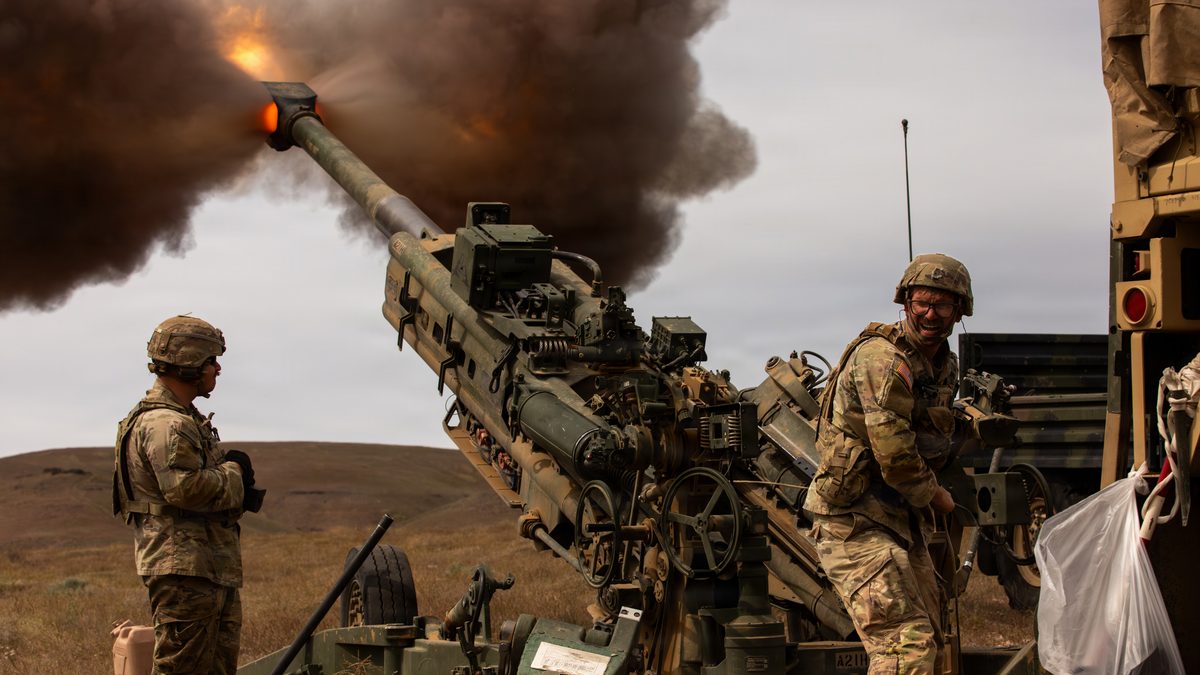
A US Army M777 towed 155mm howitzer fires during a live-fire exercise, 19 April 2026. Illustrative of the 155mm artillery context; not Vektrex. US Army photo by Sgt. Matthew Sprowl / DVIDS (public domain).
Transatlantic Bet on Guided Artillery: Rheinmetall and General Atomics Explore Vektrex 155mm Co-Production
Technical Summary
On 18 June 2026, at the Eurosatory 2026 land-defence exhibition in Paris, Rheinmetall AG and General Atomics Electromagnetic Systems (GA-EMS) signed a Memorandum of Understanding (MoU) to explore cooperative production of Vektrex, a manoeuvring 155 millimetre (mm) precision-guided munition (PGM) developed by GA-EMS. The agreement was signed by GA-EMS President Scott Forney and the Chief Executive Officer (CEO) of Rheinmetall's Weapon and Ammunition Division, Roman Koehne. It positions the projectile for large-scale series production on Rheinmetall's North Atlantic Treaty Organisation (NATO) compliant manufacturing base.
Vektrex is a glide-extended, course-correcting artillery projectile compatible with fielded 39-calibre (L39) and 52-calibre (L52) 155mm gun systems without modification to launchers, loaders, propelling charges or logistics. Deployable wings generate lift for an aerodynamic glide phase that, GA-EMS states, extends engagement range by two to three times over conventional projectiles. GA-EMS product literature places the achievable reach at approximately 120 kilometres (km), depending on the calibre of cannon and propellant load; the two co-production releases do not themselves restate the figure.
Vektrex delivers manoeuvring strike capability in contested and GPS-degraded environments, extending engagement range two to three times beyond conventional artillery projectiles while reducing integration risk for fielded artillery formations. GA-EMS and Rheinmetall joint statement, 18 June 2026
Flight Profile and Test Heritage
GA-EMS describes a phased flight. The projectile separates from its sabot at muzzle exit, de-spins and stabilises, deploys its aerodynamic wings, enters an extended-range glide, and manoeuvres onto the target in a terminal phase. The design is under-calibre and sabot-discharging rather than rocket-assisted, so the range gain comes from aerodynamic glide and active control rather than auxiliary propulsion. Programmable flight paths and a steep terminal dive allow the round to optimise its approach angle against defended or obscured targets.
Vektrex is the productised designation of the round GA-EMS has demonstrated under the working name Long-Range Maneuvering Projectile (LRMP). GA-EMS reports test firings of the LRMP from an M777 towed howitzer at the United States Army Yuma Proving Ground in 2025, fired on M231 propelling charges and demonstrating sabot separation, de-spin, wing deployment and controlled flight. The projectile is GA-EMS's contender in the United States Army Extended Range Artillery Projectile (ERAP) effort, which seeks a next-generation manoeuvring 155mm round. The Rheinmetall MoU is a separate, parallel move to position the same projectile for allied series production rather than a US Army programme milestone.
Analysis of Effects
A conventional 155mm high-explosive (HE) projectile such as the L15 reaches roughly 24km from an L39 barrel and around 30km with a base-bleed unit; rocket-assisted natures extend this further. A two-to-three-times multiplier therefore implies a band of approximately 60km to 120km, placing Vektrex in the operational space between tube artillery and the Guided Multiple Launch Rocket System (GMLRS, roughly 70km to 150km). The table below sets the claimed reach against the established 155mm range bands for context.
| 155mm projectile class | Indicative range | Guidance |
|---|---|---|
| Conventional HE (L39, e.g. M777) | ~20–24km | Unguided |
| Base-bleed HE (L52) | ~30–40km | Unguided |
| Rocket-assisted (RAP) | ~50–60km | Unguided or course-corrected |
| Vektrex (glide-extended) | ~120km class | Manoeuvring; GPS-degraded capable |
| GMLRS (rocket, for context) | ~70–150km | Guided |
Indicative open-source figures; actual range varies by propelling charge, barrel length and projectile lot. The Vektrex figure is GA-EMS product-literature, not an independently verified by-charge maximum.
The value proposition is not raw range but accuracy at range. GA-EMS describes guided engagement of stationary, moving and obscured targets, and explicitly claims performance where the Global Positioning System (GPS) is degraded or denied, implying an inertial or seeker-aided terminal solution rather than GPS-only correction. GA-EMS also describes a modular payload architecture, with options beyond standard HE extending to intelligence, surveillance and reconnaissance (ISR) and electronic warfare (EW) mission packages; ISC treats the multi-role payload claim as manufacturer-stated and unconfirmed at this stage.
Because Vektrex fires from unmodified 39 and 52-calibre systems, the round is a projectile-and-software upgrade to existing gun lines rather than a new weapon system. For artillery formations this lowers integration risk and preserves the established ammunition logistics chain across fleets from the PzH 2000 to towed L52 howitzers. The companies frame the round as a lower cost-per-effect alternative to tactical missiles for survivable standoff fires, the recurring lesson of high-intensity attrition warfare in which guided-munition demand consistently outpaces manufacturing output.
Personnel and Safety Considerations
As a guided projectile, Vektrex couples a conventional 155mm HE warhead and propelling-charge stack with onboard guidance electronics and, for any course-correcting fuze or canard actuation, an internal power source. Open sources do not disclose the warhead fill, the net explosive quantity (NEQ) in kilograms of trinitrotoluene (TNT) equivalent, the fuzing architecture, or the United Nations (UN) hazard classification (Hazard Division and Compatibility Group) for the all-up round or its guidance section. Until a hazard classification is assigned, storage and transport authorities cannot finalise quantity-distance and segregation rules, and energetic devices in the guidance and actuation train (thermal batteries and initiators) carry their own compatibility-group considerations alongside the projectile body. These are routine certification questions for any new guided nature, not specific concerns, but they are unresolved at MoU stage.
Data Gaps
Open sources do not yet establish a confirmed maximum range by host system and charge; the warhead type and NEQ; the guidance and seeker architecture (inertial, semi-active laser, radar or multimode); the fuze type and arming logic; the UN hazard classification (Hazard Division and Compatibility Group) of the complete round; unit cost; the production split, sites and timeline under the MoU; or whether any launch customer or NATO Design Number (NDN) is in prospect. The two-to-three-times range claim is the manufacturers' own; the approximately 120km figure derives from GA-EMS product literature rather than the two co-production releases.
References
Source-evaluated under NATO STANAG 2022 (Reliability A–F / Accuracy 1–6). Tier 1 = primary source (government, or a manufacturer announcing its own action); Tier 2 = quality news or specialist defence media; Tier 3 = authoritative aggregator or encyclopaedia.
- T1General Atomics Electromagnetic Systems (GA-EMS) – General Atomics, Rheinmetall Explore Transatlantic Co-Production of Vektrex for Allied Artillery Modernization, 18 June 2026. (Reliability B / Accuracy 2)
- T1General Atomics Electromagnetic Systems (GA-EMS) – Precision Guided Munitions (Vektrex product page), accessed 21 June 2026. (Reliability B / Accuracy 2)
- T1Rheinmetall AG – Rheinmetall and General Atomics explore transatlantic co-production of Vektrex for allied artillery modernisation, 18 June 2026. (Reliability B / Accuracy 2)
- T1General Atomics Electromagnetic Systems (GA-EMS) – General Atomics Advances Artillery Modernization with LRMP Testing, 2025. (Reliability B / Accuracy 2)
- T1United States Army – Long-Range Maneuvering Projectile, 2025. (Reliability B / Accuracy 2)
- T2Defense News – General Atomics successfully tests next-gen artillery round, 15 October 2025. (Reliability B / Accuracy 2)
- T2Army Technology – Rheinmetall, GA-EMS to partner on Vektrex 155mm munition production, 18 June 2026. (Reliability B / Accuracy 2)
- T2European Security & Defence – Rheinmetall and General Atomics explore transatlantic co-production, June 2026. (Reliability B / Accuracy 2)
- T2Defence Industry Europe – Rheinmetall and General Atomics explore Vektrex co-production to support allied long-range artillery modernisation, June 2026. (Reliability B / Accuracy 3)
Corrections & updates welcome. If you hold open-source data that refines or corrects any parameter in this article, please contact [email protected] citing the specific claim and your source. Verified corrections will be incorporated and credited in the revision history. Updated 29 June 2026: added a phased flight-profile description, the LRMP test heritage and ERAP linkage, a range-comparison table and a modular-payload note. AI-assisted technical assessment based on open-source material. Not a formal intelligence product.