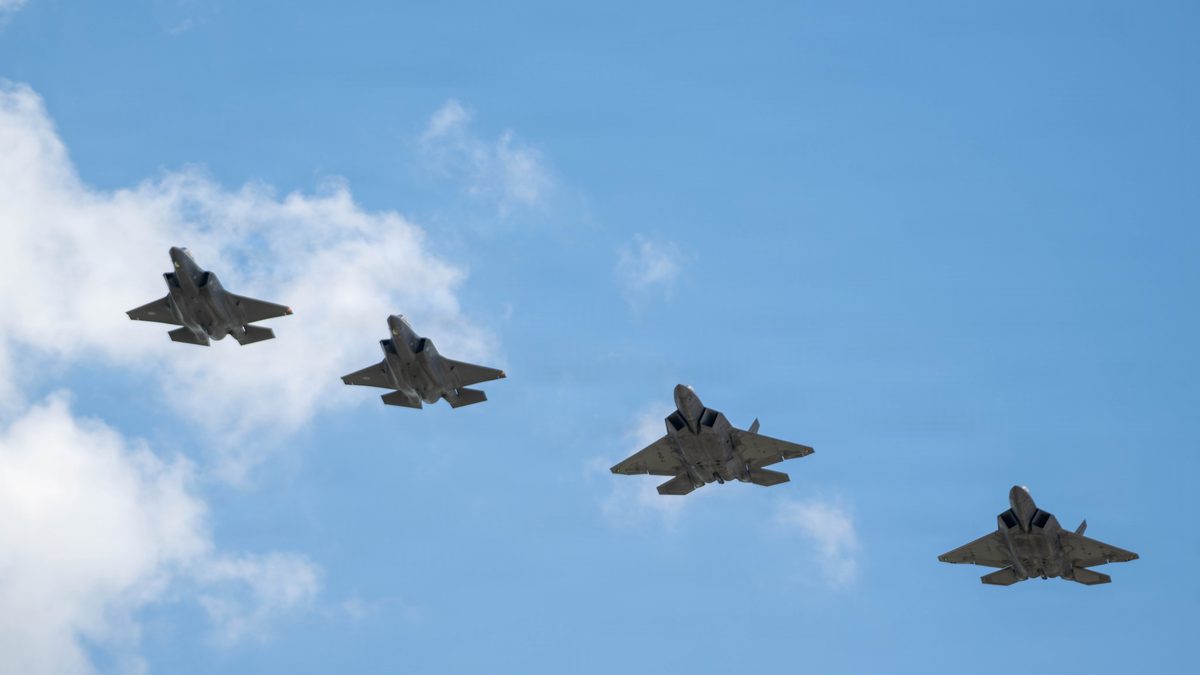
Finnish Air Force F-35 Lightning II jets fly in formation with US Air Force F-22 Raptors at Ebbing Air National Guard Base, Arkansas, 16 June 2026. Illustrative; not the StormBreaker procurement event. US Air National Guard photo by Tech. Sgt. Patricia Teare / DVIDS (public domain).
Finland Expands Its F-35 Magazine: The GBU-53/B StormBreaker (SDB II) Supplementary Buy Explained
Technical Summary
Finland has authorised a supplementary procurement of the GBU-53/B Small Diameter Bomb II (SDB II), marketed by RTX (Raytheon) as StormBreaker, for its incoming Lockheed Martin F-35A Lightning II fleet. Defence Minister Antti Häkkänen authorised the Finnish Defence Forces Logistics Command to place the order with the United States (US) on 18 June 2026. The buy supplements a Foreign Military Sales (FMS) contract first concluded in 2023, itself drawn from a 2020 US Congressional clearance for up to 500 SDB II rounds tied to Finland's HX fighter programme. The Ministry did not publish a value for the new tranche.
The GBU-53/B is a precision-guided glide weapon in the 250-pound (113 kilogram, kg) class, with an all-up mass reported at around 93kg (204 pounds). Its defining feature is a tri-mode seeker that combines millimetre-wave (MMW) radar, imaging infrared (IIR) and semi-active laser (SAL), backed by Global Positioning System (GPS)-aided inertial navigation and a two-way datalink. Folding wings give a glide reach reported at up to roughly 111km (60 nautical miles) against fixed targets, falling to about 74km (40 nautical miles) against moving targets as energy is expended in manoeuvre.
The ability of the glide bomb to strike moving targets also in challenging weather conditions will allow using the F-35 effectively when contributing to Multi-Domain Operations across all defence branches. Colonel (retired) Henrik Elo, Director, Finnish F-35 Programme
Analysis of Effects
The tri-mode seeker is what separates SDB II from GPS and inertial-only glide weapons. MMW radar acquires and tracks targets through cloud, smoke and dust; IIR refines recognition; and SAL allows third-party or self-laser designation. Combined with the two-way datalink, the weapon supports in-flight retargeting and the engagement of moving targets at standoff, a fire-and-forget profile RTX describes as effective in rain, smoke, dust or darkness. For a northern operator facing long periods of poor visibility, all-weather moving-target capability is the operational point.
The warhead is a multi-effect design integrating a shaped-charge jet, fragmentation and blast effects, with a selectable and delayed fuzing option, so a single store can address armour, materiel and soft targets while limiting collateral effect. At roughly the 113kg class the weapon trades absolute blast for magazine depth: the F-35A carries several rounds internally, so one sortie can prosecute multiple dispersed targets. This favours the distributed, target-rich engagements that define current high-intensity scenarios, and preserves the aircraft's low-observable configuration by keeping weapons in the internal bays.
Personnel and Safety Considerations
The all-up round combines an energetic warhead fill, a rocket-free glide airframe, and a thermal-battery-powered guidance section. Open sources do not disclose the warhead NEQ in kilograms of TNT equivalent, the explosive fill type, or the UN hazard classification (Hazard Division and Compatibility Group) Finland will apply for national storage and transport. US carriage on the F-35 is already certified, so a baseline classification exists, but national storage licensing follows Finnish and NATO rules. As an air-carriage guided weapon, the SDB II also involves arming, jettison and fuze-safety states that govern flightline handling. None of these is a specific concern; they are the standard certification set for an air-delivered guided munition entering a new national inventory.
Data Gaps
Open sources do not establish the number of rounds in the supplementary tranche or its value; the warhead NEQ and fill; the UN hazard classification (Hazard Division and Compatibility Group) Finland will assign; the delivery schedule against the F-35A induction (first aircraft 2026, full operational capability targeted for 2030); or whether this order draws down or adds to the 500-round Congressional ceiling. Published range figures vary by source and are quoted for US test conditions rather than Finnish carriage, so the roughly 111km fixed and 74km moving values should be treated as indicative.
References
Source-evaluated under NATO STANAG 2022 (Reliability A–F / Accuracy 1–6). Tier 1 = government primary source; Tier 2 = quality news / specialist defence media; Tier 3 = authoritative aggregator / encyclopaedia.
- T1Finnish Defence Forces Logistics Command (Puolustusvoimat) – SDB II Glide Bombs for Finnish Air Force F-35A Multirole Fighter Jets, 18 June 2026. (Reliability A / Accuracy 1)
- T1Naval Air Systems Command (NAVAIR) – Small Diameter Bomb Increment II (SDB II) programme page, accessed 21 June 2026. (Reliability A / Accuracy 2)
- T2The Defense Post – Finland Approves Additional GBU-53 StormBreaker Glide Bombs for F-35 Fleet, 18 June 2026. (Reliability B / Accuracy 2)
- T2Air & Space Forces Magazine – GBU-53 StormBreaker weapon reference, accessed 21 June 2026. (Reliability B / Accuracy 2)
- T3Wikipedia – GBU-53/B StormBreaker, accessed 21 June 2026. (Reliability C / Accuracy 3)
Corrections & updates welcome. If you hold open-source data that refines or corrects any parameter in this article, please contact [email protected] citing the specific claim and your source. Verified corrections will be incorporated and credited in the revision history. AI-assisted technical assessment based on open-source material. Not a formal intelligence product.