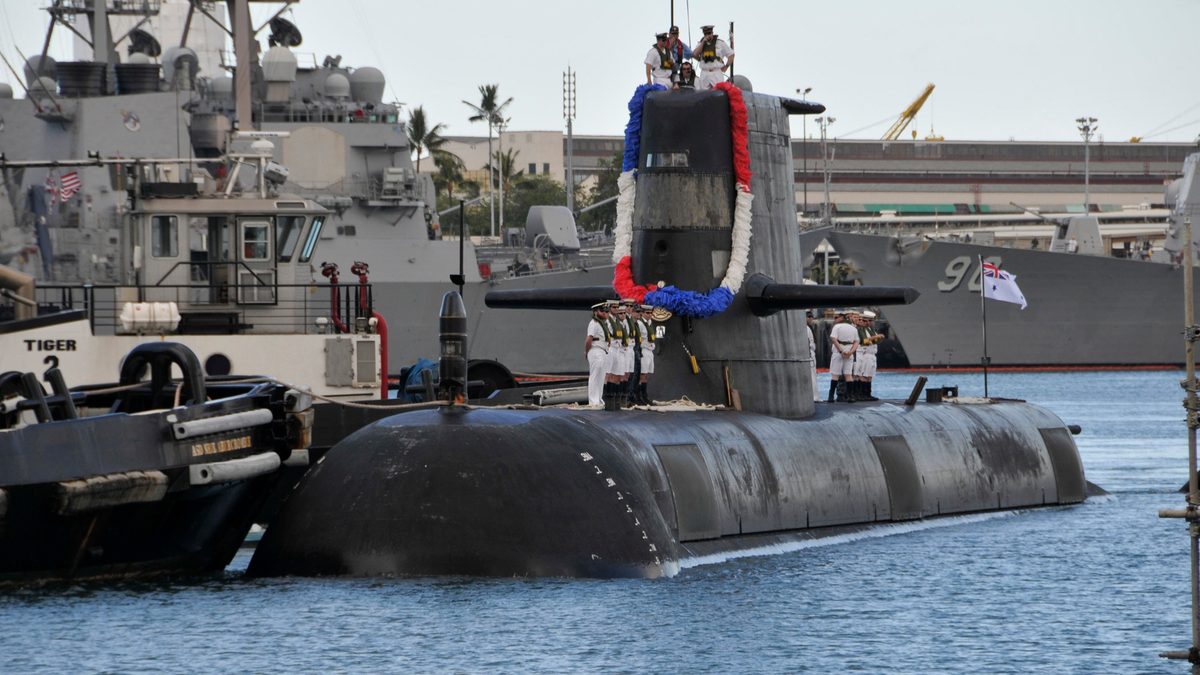
HMAS Farncomb (SSG 74), a Royal Australian Navy Collins-class submarine, arrives at Joint Base Pearl Harbor-Hickam for RIMPAC 2012. U.S. Navy photo by Mass Communication Specialist 1st Class Ronald Gutridge / DVIDS. Public domain (VIRIN 120630-N-UK333-032).
Collins Class at the Crossroads: Australia's A$11 Billion Submarine Bridge to AUKUS
On 19 May 2026 Australia's Deputy Prime Minister and Defence Minister, Richard Marles, confirmed that the Royal Australian Navy will spend up to A$11 billion (around US$7.8 billion) keeping its six Collins-class submarines in service into the 2040s. The decision launches the long-delayed Life of Type Extension (LOTE), and it does something remarkable for a fleet once mocked as the "dud subs": it makes them the single most important platform in Australia's path to nuclear power.
That path is AUKUS, and AUKUS runs through Britain. The boats that will eventually replace Collins, the SSN-AUKUS class, are based on a United Kingdom design, powered by a Rolls-Royce reactor, and will be built in parallel at Barrow-in-Furness and Adelaide. Until the first of them arrives in the early 2040s, ageing diesel-electric Collins boats have to hold the line. How Australia reached this point is a thirty-year lesson in what happens when submarine programmes slip.
A boat built to prove a point
The Collins class was an act of national ambition. In the mid-1980s Australia chose not to buy a submarine off the shelf but to build one at home, to a bespoke design, in a shipyard that did not yet exist. In May 1987 the contract went to a consortium built around the Swedish designer Kockums and a newly created Australian Submarine Corporation (ASC). The design, originally designated Type 471, was an enlarged derivative of Kockums' Vastergotland class, stretched into the largest conventional submarine of its generation.
Six boats followed: HMAS Collins, Farncomb, Waller, Dechaineux, Sheean and Rankin, assembled at Osborne in South Australia between 1990 and 2003. Almost nothing about the early programme went smoothly. Welding defects appeared in the hull sections fabricated in Sweden; the combat system, contracted separately, fell years behind the platform; the boats were noisy when they were meant to be silent. HMAS Collins commissioned in mid-1996, around eighteen months late, and was not cleared for operational deployment until 2000. A 2011 study by the RAND Corporation and a shelf of parliamentary inquiries would later dissect every fault.
Yet the underlying design was sound. Once debugged, the Collins boats proved fast, long-ranged and, when properly maintained, genuinely quiet. The problem was rarely the submarine itself. It was the system around it.
Collins class: baseline specification (open sources)
| Type | Diesel-electric attack submarine (Type 471), enlarged Vastergotland derivative |
| Displacement | About 3,100 t surfaced, 3,407 t submerged |
| Dimensions | Length 77.4 m, beam 7.8 m |
| Speed | 10 knots surfaced or snorkelling, more than 20 knots submerged |
| Range and endurance | 11,500 nautical miles at 10 knots surfaced; around 70 days on patrol; no air-independent propulsion |
| Propulsion | Three Hedemora V18b diesels, three Jeumont-Schneider generators, one DC main motor (about 7,200 hp) |
| Complement | 58 (originally 42 plus trainees) |
| Armament | Six 533 mm bow tubes, 22 weapons: Mk 48 Mod 7 CBASS torpedoes, UGM-84C Sub-Harpoon, mines |
| Combat system | AN/BYG-1, co-funded with the United States and shared with the US Virginia class |
From national embarrassment to exemplar
By the end of the 2000s the fleet was in crisis. Maintenance had fallen so far behind that in December 2009 the Navy could expect fewer than one boat in six to be available at any time; two-submarine material availability dropped below 10 per cent. For a country that had spent billions to build a sovereign capability, having almost none of it at sea was politically toxic.
The turnaround came through scrutiny rather than spending. In 2012 the government commissioned the British naval engineer John Coles to examine Collins sustainment. His report set out, in unsentimental detail, why the boats spent so long alongside and what world-class submarine support actually looked like. Reorganised maintenance, clearer accountability between the Navy, the Capability Acquisition and Sustainment Group and industry, and a disciplined docking cycle did the rest. By the 2016/17 financial year Collins was meeting the Navy's availability benchmark, and Coles, reviewing his own work, called the improvement a "remarkable turnaround". A programme that had been a byword for failure was, briefly, held up as an exemplar.
The replacement that never came
Submarines wear out, and by the 2010s Australia was planning the successor. The SEA 1000 Future Submarine Program, awarded to France's Naval Group in 2016, was meant to deliver twelve conventionally powered Attack-class boats, a commitment that grew towards A$90 billion and became the largest defence acquisition in the nation's history. It never reached steel-cutting.
On 16 September 2021 the Attack class was cancelled at a stroke, as Australia, the United States and the United Kingdom announced AUKUS. Australia would instead acquire nuclear-powered attack submarines with American and British help. Naval Group, blindsided, called the decision a deep disappointment, and the rupture with Paris took months to repair. For the Collins fleet the consequence was immediate and unforgiving. The boats that were supposed to retire as the Attack class arrived would now have to soldier on for an extra decade or more, because their nuclear replacement would not appear until the 2040s.
Government discussions: keeping Collins alive
Extending Collins had always been a contingency, but AUKUS turned an option into a necessity. A LOTE system and detailed-design contract had been let in February 2022, originally scoped around the assumption that the Attack class would soon take over. When that assumption collapsed, the extension became the only thing standing between Australia and a submarine gap.
The government moved in stages. In June 2024 it approved the next phase of the LOTE. On 27 July 2024 it signed a four-year, A$2.2 billion sustainment contract with ASC, work it said would secure more than 1,100 skilled jobs at Osborne in South Australia and Henderson in Western Australia, with around 90 per cent of the platform sustainment budget spent in Australia. The 2026 National Defence Strategy then locked in funding for Collins sustainment and upgrades into the 2040s. Each decision was framed the same way: Collins is the bridge, and the bridge must not fail.
| Stage | When | Lead / funding owner |
|---|---|---|
| Design contract (Type 471) | May 1987 | Kockums / ASC |
| Six boats built at Osborne | 1990 to 2003 | ASC |
| Availability crisis | Dec 2009 | Royal Australian Navy |
| Coles sustainment review | 2012 to 2016 | Australian Government |
| Attack class cancelled, AUKUS announced | Sep 2021 | Australian Government |
| LOTE system and design contract | Feb 2022 | ASC / Defence |
| Four-year sustainment contract | Jul 2024 | ASC (A$2.2bn) |
| Enhanced-sustainment LOTE launched | May 2026 | ASC / Defence (up to A$11bn) |
The 2026 scale-back
The version of the LOTE announced in May 2026 is not the one Defence set out to deliver. The original plan was a deep, fleet-wide modernisation: new diesel engines and generators in every boat, new optronic masts in place of traditional periscopes, and the integration of Tomahawk land-attack missiles to give Collins a long-range strike punch. One by one, those ambitions were trimmed.
The optronics upgrade was dropped in 2024 as adding complexity and risk. The Tomahawk plan was abandoned after consultation with Washington concluded it was not viable and did not represent value for money for a tube-launched fit on boats that lack vertical-launch cells and are due to leave service within fifteen years. Then, in May 2026, came the biggest cut. Defence advised that the design work needed to re-engine the boats was incomplete and could not be installed within a standard two-year full-cycle docking. Rather than hold the whole fleet hostage to that one workstream, the government switched to what it calls "conditions-based sustainment": each submarine is assessed individually as it enters dock, and major systems are replaced only where strictly necessary, with priority given to combat systems, sensors and weapons.
Work begins with HMAS Farncomb at Osborne at the end of May 2026. Every boat is still expected to gain roughly a decade of additional service, with the oldest now due to retire in the early 2040s. On the audit office's reckoning, the first Collins will leave service in 2038 and the last in 2048.
Since the life-of-type extension design contract was awarded in February 2022 it has been varied 53 times and has grown by A$688 million, and four of the five key design reviews were missed. The Auditor-General judged Defence's handling only "partly effective". Australian National Audit Office, 2026
What the auditors and analysts say
Independent scrutiny has been sharp. In a performance audit published in 2026 the Australian National Audit Office (ANAO) judged Defence's planning and implementation of the LOTE only "partly effective", and concluded that the department was not well placed to demonstrate that the project would achieve its intended capability or represent value for money. The audit found the design contract had been varied 53 times and had grown by A$688 million since 2022, and that four of the five key design reviews had slipped. Most damningly, it found that aligning the LOTE to the Attack-class timetable had been adopted without robust options analysis, and that when the Attack class was cancelled Defence did not systematically reassess the extension or warn government of the risks in good time.
Specialist commentators have been blunter still. Defense News described the programme as "high-risk"; analysts at Strategic Analysis Australia have written of a decade of mismanagement; and the repeated trimming of scope has fed a wider argument that public confidence in AUKUS is eroding under a run of submarine U-turns. The government's counter is that a smaller, conditions-based extension delivered on time is worth more than an ambitious one that arrives late, because the only outcome that truly matters is keeping boats in the water until the nuclear fleet exists.
Industry responds
For Australian industry, the LOTE is less a controversy than a lifeline, and a rehearsal. ASC, the descendant of the original builder, is the Collins design authority and sustainment partner, and it has now been named Australia's sovereign submarine partner for the nuclear era, forming a joint venture with BAE Systems to build SSN-AUKUS at Osborne. Every full-cycle docking the company performs on a Collins boat keeps a skilled submarine workforce intact and growing, the same workforce that will be asked to build nuclear submarines later this decade.
Saab Kockums, the Swedish design lineage behind the original boats, remains engaged: in June 2023 it signed an agreement with ASC to support the extension, focused on sensors, combat systems and propulsion efficiency, with Sweden clearing the export of the necessary technology. The through-line is people. Australia learned the hard way, with Collins, that a submarine enterprise is only as good as the workforce sustaining it, and the entire AUKUS effort now rests on not repeating that mistake.
The long-term solution runs through Britain
The destination for all of this is a nuclear-powered fleet delivered under AUKUS Pillar I, and the British thread is unmistakable. Under the Optimal Pathway announced in March 2023, the United States will sell Australia at least three Virginia-class submarines from the early 2030s, in 2032, 2035 and 2038, with an option for two more later, as an interim capability while Australia builds its own. The boats Australia builds will be SSN-AUKUS, a class based on the United Kingdom's next-generation submarine design, fitted with the Rolls-Royce PWR3 reactor and built to a manufacturing system replicated from BAE Systems' yard at Barrow-in-Furness. Britain will commission the first SSN-AUKUS in the late 2030s; Australia's first, from the Osborne joint venture, is expected in the early 2040s. There is continuity below decks too: the Collins combat system, the AN/BYG-1, is co-funded with the US Navy and shared with the Virginia class, and an advanced version of it has been selected for SSN-AUKUS, carrying crew and engineering familiarity straight into the nuclear era.
The agreements underpinning that solution have come quickly. The trilateral AUKUS Naval Nuclear Propulsion Agreement entered into force in January 2025. On 26 July 2025 Australia and the United Kingdom signed the bilateral Geelong Treaty, a 50-year commitment covering the design, build, operation, sustainment and disposal of SSN-AUKUS and the rotation of a UK Astute-class boat through HMAS Stirling. In December 2025 a Pentagon review of AUKUS concluded by endorsing the existing pathway, lifting a significant cloud of uncertainty. From 2027, Submarine Rotational Force West will base UK and US submarines at HMAS Stirling near Perth, letting Australia learn to operate and regulate nuclear boats before it owns any.
The money is on a scale to match. Australia has costed its nuclear-submarine enterprise at between A$268 billion and A$368 billion over three decades. Within that, Canberra has agreed to contribute around A$4.6 billion to modernise the United Kingdom's submarine industrial base, including the Rolls-Royce reactor enterprise, alongside roughly US$3 billion towards the American submarine industrial base. In early 2026 it began paying for long-lead British components, starting with an initial A$310 million tranche. The Collins LOTE, at up to A$11 billion, is the smallest of these numbers and the most urgent. It is the hinge on which the entire, far larger, transition swings.
Why this matters from London
The Collins programme is not a distant Pacific story. Australia's ability to bridge to AUKUS protects the order book that is reindustrialising Barrow-in-Furness and Derby. Around A$4.6 billion of Australian money is flowing into the UK submarine enterprise, the Geelong Treaty binds the two countries for 50 years, and a Royal Navy Astute-class boat will rotate through Western Australia from 2027. If the Collins bridge holds, British yards gain a partner and a parallel production line. If it fails, the pressure falls back onto the same UK industrial base.
References
Source-evaluated under NATO STANAG 2022 (Reliability A–F / Accuracy 1–6). Tier 1 = government primary source; Tier 2 = quality news / specialist defence media; Tier 3 = authoritative aggregator / encyclopaedia.
- T1Australian Government, Minister for Defence – Albanese Government to commence Collins class life of type extension, 19 May 2026. (Reliability A / Accuracy 1)
- T1Australian Government, Minister for Defence – Investment in Collins class submarines sustainment to support more than 1,600 jobs, 27 July 2024. (Reliability A / Accuracy 1)
- T1Australian National Audit Office – Defence's Collins Class Submarines Life of Type Extension: Planning and Implementation, 2026. (Reliability A / Accuracy 1)
- T1Australian Submarine Agency – Bilateral Nuclear-Powered Submarine Partnership and Collaboration Treaty (Geelong Treaty), 26 July 2025. (Reliability A / Accuracy 1)
- T2ABC News – Federal government signs $2b contract to keep Collins subs, 27 July 2024. (Reliability B / Accuracy 2)
- T2ABC News – Planned upgrades to Collins Class submarines scaled back, 19 May 2026. (Reliability B / Accuracy 2)
- T2Naval News – Australia spends big on LOTE life extension for Collins submarines, May 2026. (Reliability B / Accuracy 2)
- T2Breaking Defense – UK invests over $8 billion to support SSN-AUKUS build plan, June 2025. (Reliability B / Accuracy 2)
- T3Wikipedia – Collins-class submarine (build history and technical background; cross-checked against primary sources). (Reliability C / Accuracy 3)
- T1DVIDS (US Defense Visual Information Distribution Service) – RIMPAC 2012: HMAS Farncomb arrives at Pearl Harbor (hero image; US Navy, public domain), 30 June 2012. (Reliability A / Accuracy 1)
The appearance of U.S. Department of Defense visual information in this article does not imply or constitute DoD endorsement. Hero image sourced from DVIDS, public domain.
Corrections & updates welcome. If you hold open-source data that refines or corrects any figure in this article, please contact [email protected] citing the specific claim and your source. Verified corrections will be incorporated and credited in the revision history. AI-assisted technical assessment based on open-source material. Not a formal intelligence product.