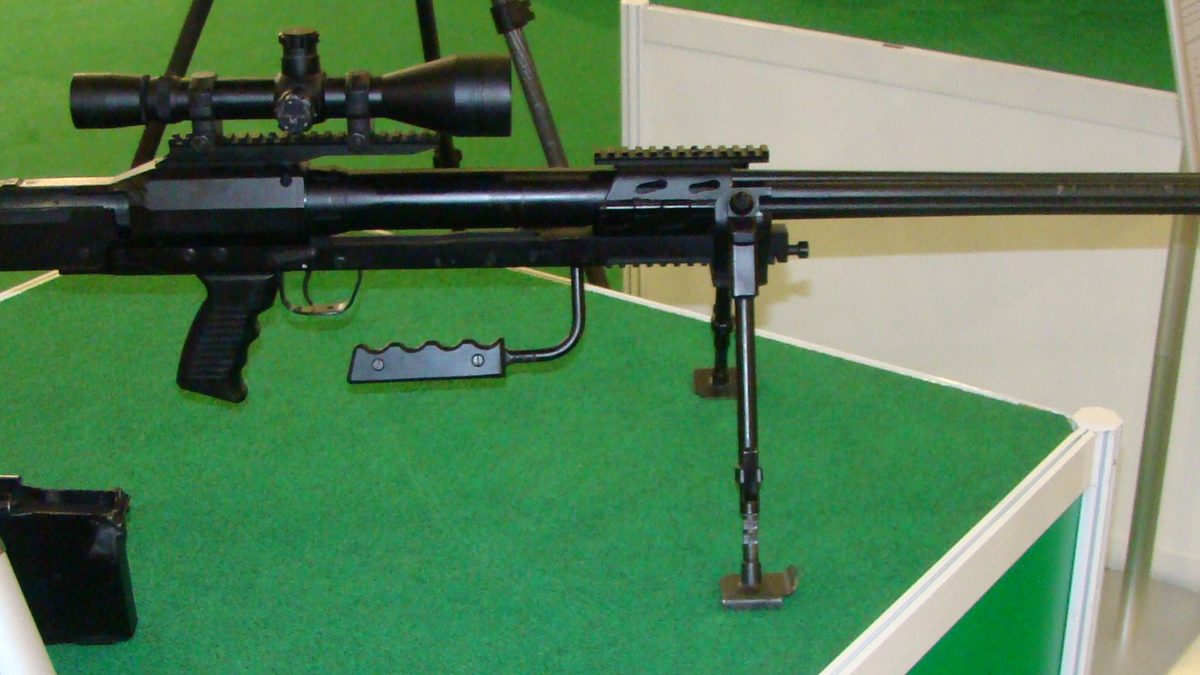
ZMT's bullpup WKW Tor, the in-service .50 BMG predecessor to the new SR-50M. Photo: Michał Derela, CC BY-SA 4.0, via Wikimedia Commons.
Tarnow's SR-50M Goes to Production: Poland Fields a Home-Grown .50 Anti-Materiel Rifle
Technical Summary
At the Eurosatory 2026 exhibition in Paris, the Polish state manufacturer Zaklady Mechaniczne Tarnow (ZMT), part of the Polska Grupa Zbrojeniowa (PGZ, the Polish Armaments Group), declared its SR-50M large-calibre anti-materiel and sniper rifle ready to enter serial production. The weapon, which earlier appeared at the Black Sea Defense and Aerospace (BSDA) 2026 exhibition in Bucharest on 13 to 15 May, has completed its development and qualification phase and is offered to special forces and airborne units. The SR-50M is chambered for the 12.7×99 mm NATO cartridge, better known as the .50 Browning Machine Gun (.50 BMG) round.
The SR-50M is a manually operated, bolt-action rifle built around a Remington 700 pattern trigger mechanism and fed from a five-round detachable McMillan-pattern box magazine. ZMT offers two free-floating barrel lengths, a 559 mm (22 inch) barrel and a 736 mm (29 inch) barrel, interchangeable in the field with a single hook key and so allowing a trade between portability and muzzle velocity; trade-show reporting puts the weight at about 12 kg for the 29 inch configuration. The design is also engineered to accept other long-range natures in future, namely the Western .416 Barrett and .408 CheyTac cartridges and the Russian-standard 12.7×108 mm round, which would let a single platform serve customers across differing ammunition ecosystems.
An anti-materiel rifle is defined by what its ammunition does on impact, not by the rifle. The SR-50M's value rests on the .50 BMG nature mix, from inert armour-piercing cores to the explosive-incendiary Mk 211 multipurpose round. ISC Defence Intelligence technical assessment
Analysis of Effects
As an anti-materiel rifle (AMR), the SR-50M's effect on target is a function of the 12.7×99 mm nature selected rather than the rifle itself. The .50 BMG family spans inert and energetic natures: ball (M33), armour-piercing (M2 AP, a hardened steel core), armour-piercing incendiary (M8 API), the saboted light armour penetrator (SLAP), and the Raufoss Mk 211 high-explosive incendiary armour-piercing (HEIAP) multipurpose round, which combines a tungsten-carbide penetrator with an explosive-incendiary charge. Against materiel targets this lets one weapon defeat light-skinned and lightly armoured vehicles, parked aircraft, radar and communications equipment, fuel and ammunition stores, and optical and observation devices at ranges commonly cited beyond 1,500 m. The longer 736 mm barrel raises muzzle velocity and so extends the effective anti-materiel envelope; the shorter 559 mm barrel favours vehicle stowage and dismounted carriage.
Bringing the SR-50M to serial production gives Poland a domestically controlled anti-materiel capability rather than reliance on an imported platform, consistent with the wider PGZ drive for small-arms sovereignty. ZMT is not new to the role: it already produces the bullpup WKW Tor (also designated WKW Wilk), Poland's first indigenous .50 BMG anti-materiel rifle, in service since the mid-2000s at about 16 kg. That predecessor is combat-experienced and exported: open sources record operational use in Afghanistan, supply to Ukraine, and foreign sales to customers including Saudi Arabia and Vietnam. The SR-50M is the lighter, conventional-layout and field-reconfigurable successor to that design. The multi-calibre provision is the commercially significant feature: a customer holding Eastern-bloc 12.7×108 mm stocks, or a Western user committed to .50 BMG, can in principle adopt the same base weapon. That breadth matters most for export, where ammunition commonality with a buyer's existing inventory is often the decisive factor.
Personnel and Safety Considerations
The .50 BMG cartridge generates substantial recoil and muzzle blast, so an effective muzzle brake is essential and the resulting side-blast overpressure dictates crew spacing and firing-position discipline. Storage and transport classification depends on the nature: inert ball, armour-piercing and armour-piercing incendiary small-arms cartridges fall under Hazard Division (HD) 1.4, Compatibility Group (CG) S, whereas the Mk 211 multipurpose round carries an explosive-incendiary fill and is handled as an energetic nature with a higher hazard classification and its own net explosive quantity (NEQ) accounting. Units adopting the rifle should hold the relevant proof and lot data for every nature in use, and confirm fuzing and self-destruct behaviour where energetic natures are carried.
Data Gaps
ZMT has not published a declared muzzle velocity or a quoted effective range for either barrel, and the figures cited above, including the approximate 12 kg weight and the five-round magazine, come from trade-show reporting rather than a formal ZMT specification sheet. No confirmed serial-production order from the Polish Ministry of National Defence or an export customer had surfaced at the time of writing. The phrase "ready for serial production" is a manufacturer statement made at a trade exhibition, not a contract award. The future .416 Barrett, .408 CheyTac and 12.7×108 mm chamberings are described as planned options rather than confirmed in-production variants. These points should be verified against a primary ZMT specification sheet or a Polish procurement notice before use.
References
Source-evaluated under NATO STANAG 2022 (Reliability A–F / Accuracy 1–6). Tier 1 = government or manufacturer primary source; Tier 2 = quality news / specialist defence media; Tier 3 = authoritative aggregator / encyclopaedia.
- T1Zaklady Mechaniczne Tarnow (ZMT) – ZMT's SR-50M anti-materiel rifle (manufacturer statement), 2026. (Reliability A / Accuracy 2)
- T2MILMAG – Eurosatory 2026: Tarnow SR-50M rifle ready for production, 16 June 2026. (Reliability B / Accuracy 2)
- T2Janes – ZMT's SR-50M anti-materiel rifle breaks cover at sniper conference, 2026. (Reliability A / Accuracy 2)
- T2SOFREP – This Polish-built SR-50M is redefining sniper rifles for modern battlefields, 2026. (Reliability B / Accuracy 3)
- T2Kurier Tarnowski (kt24.pl) – SR-50M from Tarnow ready for serial production, shown at Eurosatory 2026, 16 June 2026. (Reliability C / Accuracy 3)
- T3Wikipedia – .50 BMG (12.7x99mm NATO) nature and terminal-effects background, accessed June 2026. (Reliability C / Accuracy 3)
- T3Wikipedia – WKW Tor / Wilk: service history, operators and exports (Afghanistan, Ukraine, Saudi Arabia, Vietnam), accessed June 2026. (Reliability C / Accuracy 3)
Corrections & updates welcome. If you hold open-source data that refines or corrects any parameter in this article, please contact [email protected] citing the specific claim and your source. Verified corrections will be incorporated and credited in the revision history. AI-assisted technical assessment based on open-source material. Not a formal intelligence product.