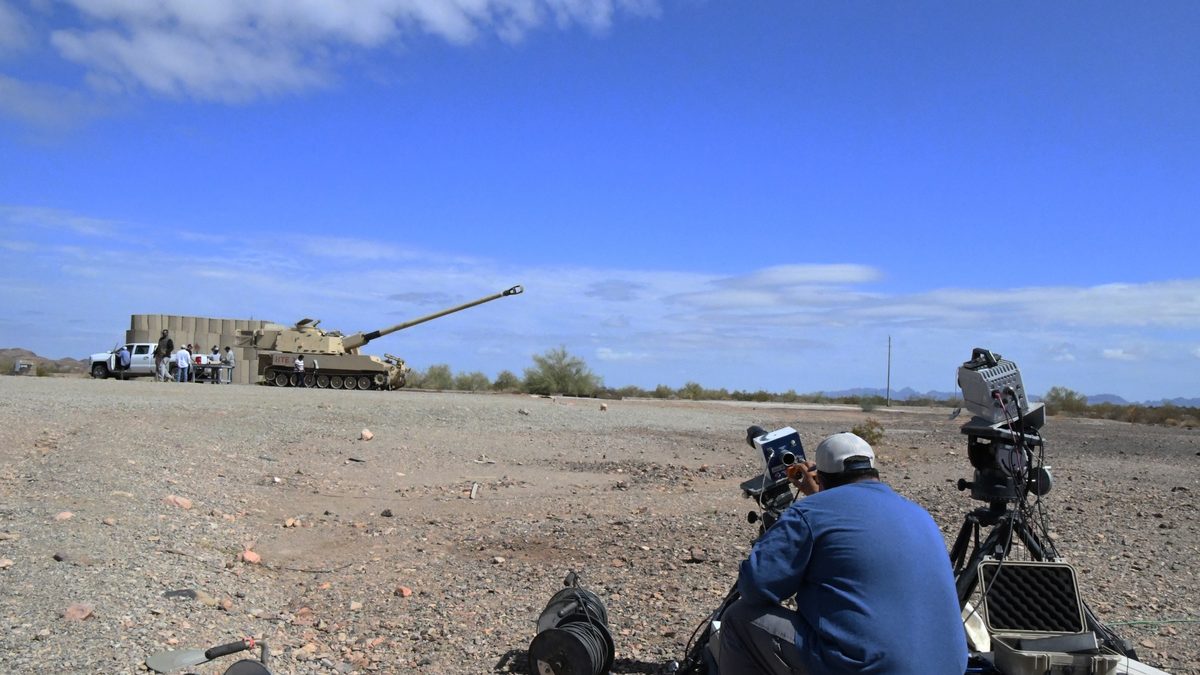
Extended Range Cannon Artillery test bed firing at Yuma Proving Ground, 2021. U.S. Army photo by Ana Henderson, Yuma Proving Ground, via DVIDS (Public Domain). Illustrative of the ERCA lineage and Yuma test site; predates the GA-EMS ERAP award.
General Atomics Joins the US Army's ERAP 155mm Maneuvering-Projectile Race
Technical Summary
General Atomics Electromagnetic Systems (GA-EMS) has been awarded a US Army contract to demonstrate a long-range maneuvering 155 mm projectile under the Extended Range Artillery Projectile (ERAP) programme, also designated XM1155. The award, announced on 12 June 2026, funds flight demonstrations of a guided round designed to reach significantly greater range than conventional 155 mm natures while retaining precision in Global Positioning System (GPS) degraded or denied conditions. The Army is targeting Initial Operational Capability (IOC) by Fiscal Year 2030.
The GA-EMS design rests on three distinguishing technical claims: extended range achieved without rocket assist, retained compatibility with legacy cannons and loaders, and a guidance architecture built around deployable wings and redundant guidance systems. The company has stated the projectile supports both strike and intelligence, surveillance and reconnaissance (ISR) tasks. In a demonstration at Yuma Proving Ground in 2025, a version of the round was fired from an M777 lightweight 155 mm howitzer and struck targets reported at more than 74 miles, roughly 119 km.
Range without rocket assist is the headline claim: a glide-extended round that reaches past 110 km from a towed M777 trades chemical propulsion volume for aerodynamic lift, and keeps the payload bay free for guidance and effect. ISC technical assessment
Analysis of Effects
The technical interest sits in how the range is generated. Conventional reach extension uses base bleed or a rocket-assisted projectile (RAP) motor, both of which consume internal volume and, in the RAP case, introduce dispersion. GA-EMS instead describes a glide-extended approach using deployable wings, the same broad principle behind cannon-launched glide munitions, where aerodynamic lift rather than added propellant carries the round downrange. Glide-extended cannon rounds typically follow a set flight sequence after launch: sabot separation, de-spin from the gun-imparted spin, wing deployment near apogee, then a controlled glide that stretches range while leaving the payload bay free for guidance and effect. The 119 km figure is a company-reported 2025 demonstrator result, not a validated ERAP-configuration specification, so it should be read as an indicator of potential rather than a fielded number. If it holds for the ERAP round, it places the design near double the unassisted reach of standard 155 mm high-explosive natures.
| 155mm nature | Approximate maximum range (open sources) |
|---|---|
| M795 high-explosive (unassisted) | ~22–30 km |
| M982 Excalibur (GPS-guided glide) | ~40–50 km |
| Vulcano 155 GLR (GD-OTS) | ~55 km (39-cal) to 70 km (52-cal) |
| GA-EMS glide demonstrator (M777) | >119 km reported (2025 trial) |
The "redundant guidance" language matters as much as the range. The Army requirement is explicitly framed around GPS-contested fires and moving targets at distance, including self-propelled howitzers, infantry fighting vehicles, rocket launchers, tanks and maritime targets. Redundancy in this context normally means an anti-jam Global Navigation Satellite System (GNSS) receiver backed by an inertial measurement unit, and potentially a terminal seeker, though GA-EMS has not disclosed the seeker arrangement. Legacy cannon and loader compatibility is the quiet strategic feature: it means the capability can field across the existing M109-series and M777 fleet without a new gun, sidestepping the barrel-life problems that helped end the Extended Range Cannon Artillery (ERCA) programme from which XM1155 emerged.
Programme Context
ERAP is a competitive demonstration, not a single award. GA-EMS joins two vendors already contracted. General Dynamics Ordnance and Tactical Systems (GD-OTS) is offering a US-produced version of the Leonardo and Diehl Vulcano 155 Guided Long Range round, quoting up to 70 km with a semi-active laser and optional far-infrared terminal seeker. BAE Systems is offering Scorpio-XR, formerly designated XM1155-SC, a low-drag precision munition that BAE test-fired from a 155 mm 52-calibre howitzer in October 2025 against a beyond-70 km requirement. The Army kicked the effort off in 2024 and is seeking low-rate production from the second quarter of FY29, with all entrants required to work with existing and future howitzers, the latter pointing at the Army's separate self-propelled howitzer competition.
Personnel and Safety Considerations
For ammunition technicians and fire-support staff, a winged guided 155 mm nature introduces handling, storage and fuzing considerations beyond a standard high-explosive shell, including the safe state of the guidance and wing-deployment mechanisms and any associated energetics. The qualification challenge for any glide round is reliability of wing deployment and de-spin after a high-g, high-spin gun launch, a stress regime that does not apply to a conventional ballistic shell. None of the relevant figures, the Net Explosive Quantity (NEQ), warhead fill, fuze type, Hazard Division or Compatibility Group, are in the open record at this stage. Treat all such parameters as undetermined until a qualified data sheet is published.
Data Gaps
The following are not disclosed and should not be inferred: contract value and duration; the specific range, payload and accuracy of the GA-EMS round in its ERAP configuration as distinct from the 2025 Yuma demonstrator; the terminal seeker type; warhead and fuzing detail; NEQ and hazard classification; and the production split or down-select timeline across the three vendors. The 119 km figure is a company-reported demonstration result, not an independently verified ERAP performance specification.
References
Source-evaluated under NATO STANAG 2022 (Reliability A–F / Accuracy 1–6). Tier 1 = government or company primary source; Tier 2 = quality news / specialist defence media; Tier 3 = authoritative aggregator / encyclopaedia.
- T1General Atomics – General Atomics Awarded US Army Extended Range Artillery Projectile Program, 12 June 2026. (Reliability B / Accuracy 2; vendor primary source)
- T2Breaking Defense – General Atomics wins contract for Army's ERAP program, joining two other vendors, 15 June 2026. (Reliability B / Accuracy 2)
- T2Army Times – General Atomics awarded US Army contract for extended-range artillery round, 15 June 2026. (Reliability B / Accuracy 2)
- T2Army Recognition – US Army Award Positions GD-OTS to Deliver Vulcano-Derived 155mm Projectile, June 2026. (Reliability B / Accuracy 2)
- T2The Defense Post – BAE, US Army Test Extended-Range Scorpio-XR Artillery Projectile, 15 October 2025. (Reliability B / Accuracy 2)
- T3Army Technology – XM1155-SC Precision Guided Munition, USA, accessed June 2026. (Reliability C / Accuracy 3; programme background)
Corrections & updates welcome. If you hold open-source data that refines or corrects any parameter in this article, please contact [email protected] citing the specific claim and your source. Verified corrections will be incorporated and credited in the revision history. AI-assisted technical assessment based on open-source material. Not a formal intelligence product.