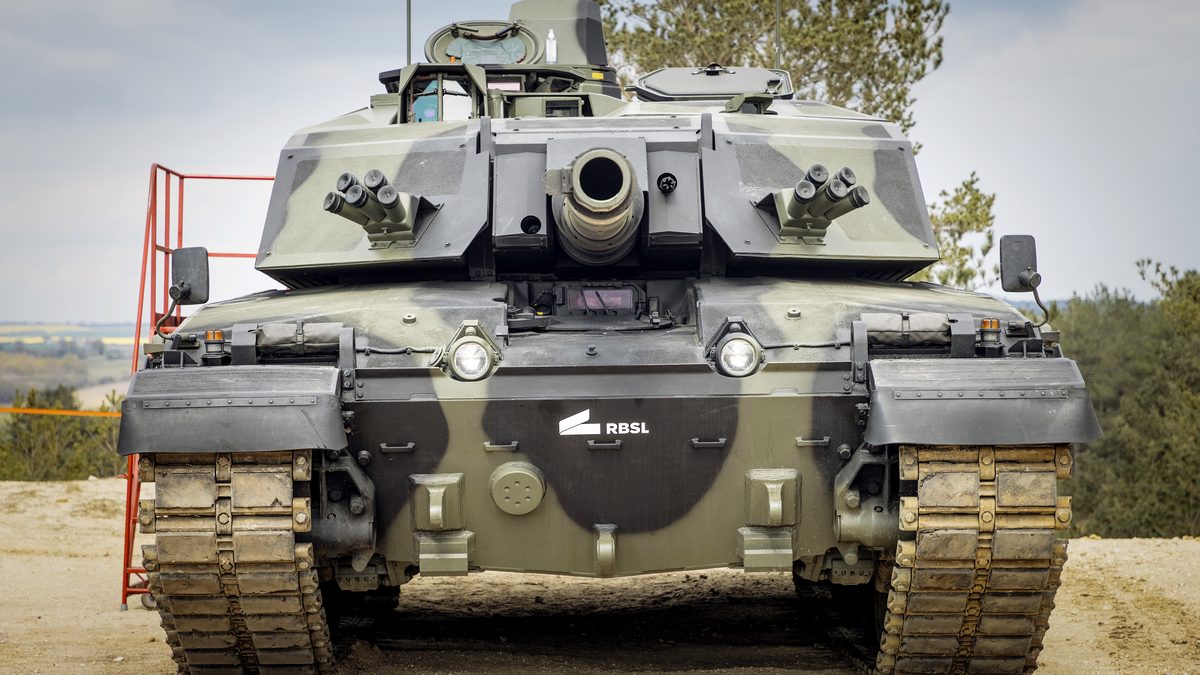
A British Army Challenger 3 main battle tank. Image: UK Ministry of Defence, via Wikimedia Commons, under the Open Government Licence v1.0.
Challenger 3 Is Reminding Britain That a Tank Is Not Just a Gun
Technical Summary
Britain's Challenger 3 main battle tank programme is reportedly facing new engineering problems linked to gearbox flaws, with some suppliers told to halt work while the issue is resolved. The Ministry of Defence has stated that the matter will not affect the 2027 Initial Operating Capability (IOC) or the cost to taxpayers. Reporting in The Daily Telegraph cites sources who warn that the resulting delay could reach two years. ISC has not independently verified the gearbox-specific reporting, and treats the two-year figure as a sourced claim rather than a confirmed schedule.
Challenger 3 is the upgrade of 148 in-service Challenger 2 hulls to a modern standard under an £800 million contract placed with Rheinmetall BAE Systems Land (RBSL) in May 2021. The visible changes are the headline: a Rheinmetall 120 mm L55A1 smoothbore main gun in place of the legacy L30A1 rifled weapon, a new turret, a digital electronic architecture, improved survivability, and the ability to fire NATO-standard 120 mm smoothbore ammunition. The drivetrain is far less glamorous. The vehicle retains the Perkins CV12 V12 diesel powerpack of Challenger 2 and a David Brown Santasalo TN54E epicyclic transmission with new components. It is the unglamorous half of the tank that now appears to be setting the pace.
The most dangerous part of a tank delay is not the gearbox. It is the time a force does not have. ISC open-source assessment, 16 June 2026
Challenger 3 baseline (open sources)
| Programme | 148 Challenger 2 hulls rebuilt to Challenger 3 standard |
| Prime contractor | Rheinmetall BAE Systems Land (RBSL) |
| Contract | Circa £800 million, awarded May 2021 |
| Main gun | Rheinmetall 120 mm L55A1 smoothbore (NATO-standard ammunition) |
| Powerpack | Perkins CV12 V12 diesel, rated at roughly 1,200 brake horsepower |
| Transmission | David Brown Santasalo TN54E epicyclic, six forward and two reverse gears |
| IOC target | 2027 (Full Operating Capability expected around 2030) |
Analysis of Effects
Modernising a legacy tank is not a shortcut around complexity. It can be harder than building new, because every added subsystem has to work inside a platform architecture that was never designed for the full weight of today's digital, protection and lethality upgrades. A gearbox problem is rarely a problem with one part. It is a system-integration problem: the transmission has to mate to an existing powerpack, manage the torque of a heavier vehicle, share a cooling and electrical envelope with new electronics, and do all of that across hulls that have spent years in service. Challenger 3 rebuilds existing Challenger 2 hulls rather than rolling new ones off a line, so individual hulls carry their own wear, tolerances and small differences in fit. That is precisely the environment in which a drivetrain fault can ripple outward and stop adjacent supplier work.
This is why the gearbox issue is more than a technical footnote. A tank programme is not only a prime contractor, a turret and a firing trial. It is transmissions, spares, test rigs, suppliers, tolerances, production flow, and the ability to fix a fault without collapsing the delivery schedule around it. As of late 2025, parliamentary disclosure indicated that only eight vehicles had been committed to the design, build and test phase, and that series conversion of the remaining fleet had not begun. A programme at that stage has limited slack: a pause that ripples through the supply chain early is cheaper than one that hits during series production, but it also signals how thin the industrial margin for error has become.
Personnel and Sustainment Considerations
For the British Army, the cost of a drivetrain delay is measured in readiness, not just in pounds. Crew training pipelines, regimental conversion and the formation of a credible armoured reserve all depend on fielded vehicles, not on prototypes under trial. A tank that cannot move and sustain itself reliably is a sustainment liability rather than a combat asset, which is why drivetrain confidence matters as much as gun performance. The wider context sharpens the point. Only 148 tanks are planned, the Ajax reconnaissance programme has already damaged confidence in United Kingdom armoured procurement, and Europe is relearning that heavy armour still matters on a battlefield now shaped by artillery, drones, mines and long-range fires.
Data Gaps
Several elements remain unconfirmed in open sources, and confidence is calibrated accordingly. The precise nature and location of the reported gearbox fault has not been independently established, and it is not confirmed whether it sits in the TN54E transmission itself or elsewhere in the drivetrain. The suppliers told to halt work have not been named. The two-year delay figure is attributed to Telegraph sources and is not a published programme schedule, so it should be read as a worst-case warning rather than a fixed forecast. The Ministry of Defence position that IOC and taxpayer cost are unaffected has not been tested against an independent schedule. ISC assesses the underlying programme-delay picture as well supported (NATO STANAG 2022: Reliability B, Accuracy 2) and the gearbox-specific detail as reported but not yet corroborated (Reliability C, Accuracy 3).
References
Source-evaluated under NATO STANAG 2022 (Reliability A–F / Accuracy 1–6). Tier 1 = government primary source; Tier 2 = quality news / specialist defence media; Tier 3 = authoritative aggregator / encyclopaedia.
- T1UK Ministry of Defence, Defence Equipment & Support – Challenger 3 reaches key milestone with first-ever crewed live-firing trials, January 2026. (Reliability A / Accuracy 1)
- T2Army Technology – British Army’s Challenger 3 programme “impacted” by delays, 2025. (Reliability B / Accuracy 2)
- T2Breaking Defense – UK’s Challenger 3 tank hits milestone with crewed live fire, January 2026. (Reliability B / Accuracy 2)
- T2Army Recognition – First operational delivery of Challenger 3 slated for 2027 following supply-chain delays, 2025. (Reliability B / Accuracy 2)
- T2The Daily Telegraph – reporting on Challenger 3 gearbox problems and supplier work pause, June 2026 (referenced; ISC has not independently verified). (Reliability C / Accuracy 3)
- T3Wikipedia – Challenger 3 (powerpack and transmission specification corroboration), accessed June 2026. (Reliability C / Accuracy 3)
Corrections & updates welcome. If you hold open-source data that refines or corrects any parameter in this article, please contact [email protected] citing the specific claim and your source. Verified corrections will be incorporated and credited in the revision history. AI-assisted technical assessment based on open-source material. Not a formal intelligence product.