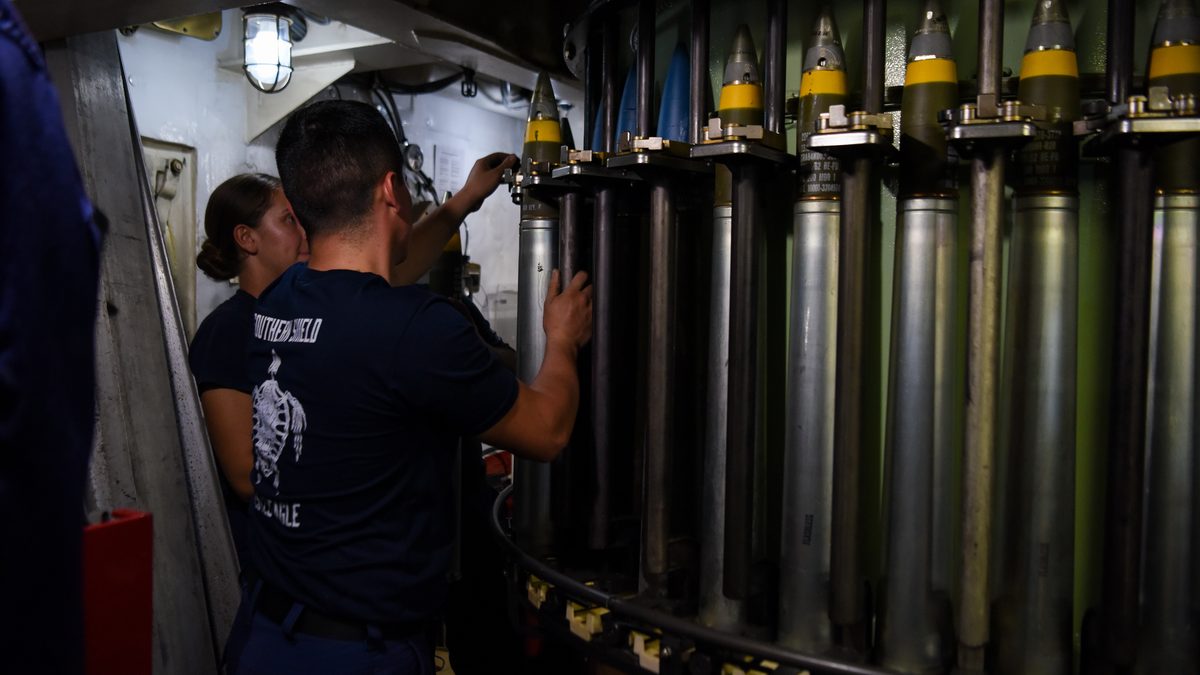
A U.S. Coast Guard sailor loads 76mm rounds into the Mark 75 gun aboard USCGC Mohawk (WMEC 913), underway in the Atlantic, 1 September 2022. The Mark 75 is the US variant of the OTO Melara 76/62. U.S. Coast Guard photo by Petty Officer 3rd Class Jessica Fontenette (DVIDS, public domain). Use does not imply endorsement by the U.S. Department of Defense.
NSPA’s 76mm HE-PFF Opportunity: Why The 4AP Fuze Decides The Field, Not The Round
Technical Summary
The NATO Support and Procurement Agency (NSPA) has published Future Business Opportunity (FBO) 26LBS050 for approximately 4,000 rounds of 76mm L62 High Explosive Pre-Formed Fragment (HE-PFF) cartridge, supplied without fuze. The opportunity is issued for information under NSPA Procurement Operating Instruction 4200-01 and carries no commitment to a Request for Proposal (RFP). It is, in effect, the agency taking the temperature of a very narrow supplier pool before it commits to a solicitation.
The round is intended for the OTO Melara / Leonardo 76/62mm naval gun in all its variants, the most widely fielded medium-calibre naval gun in NATO and partner navies. Three conditions in the synopsis do almost all the work in deciding who can credibly bid: the cartridge must be compatible with the Leonardo Electronics 4AP fuze (a hard, mandatory interface requirement); it should preferably carry an Insensitive Munition (IM) explosive fill in accordance with Allied Ordnance Publication 39 (AOP-39), expressed as a soft criterion; and the quality assurance level is Allied Quality Assurance Publication 2110 (AQAP-2110). The pre-formed fragments are specified as tungsten or comparable alloy, spherical or cubical. No NATO Stock Number (NSN) or part number is published; both fields read “UNK”.
A round without a fuze is half a weapon. By naming the 4AP as a mandatory interface, NSPA has already drawn the boundary of the competition around the small number of suppliers who have validated their projectile against that specific fuze. ISC assessment of FBO 26LBS050
Round Performance In Context
The HE-PFF is a fixed 76 x 636mmR cartridge for the 76/62 gun. Open sources put the complete round at roughly 12.4 kg, of which about 2.35 kg is propellant, with the HE-PFF projectile near 5.4 kg before the fuze is fitted (the FBO procures the round without fuze). Muzzle velocity is commonly cited at about 915 m/s, with some load variants quoted higher, and the maximum range for the HE-PFF nature is around 16 km. Effective engagement ranges against air and surface targets are shorter, and depend on the fire-control solution and the selected fuze mode.
76mm HE-PFF round: open-source ballistic context
| Cartridge | 76 x 636mmR, fixed |
| Complete round mass | ~12.4 kg (propellant ~2.35 kg) |
| HE-PFF projectile mass | ~5.4 kg (without fuze, as procured) |
| Muzzle velocity | ~915 m/s (load-dependent) |
| Maximum range (HE-PFF) | ~16 km |
| Fragmentation | Pre-formed tungsten or comparable alloy (spherical or cubical) |
The point of the pre-formed fragment sleeve is repeatability. Instead of relying on variable natural fragmentation, the round throws a known number of tungsten-class fragments in a controlled pattern, which is exactly what a proximity or height-of-burst fuze needs to deliver a predictable lethal radius. Paired with the 4AP in proximity or automatic mode, the HE-PFF becomes the cost-effective volume nature for close-in defence against fast inshore attack craft (FIAC) and Class 1 uncrewed aerial and surface systems, the role increasingly emphasised for 76/62 mountings and the one this NSPA requirement is feeding. It sits apart from the guided and extended-range members of the family: DART is a sub-calibre guided nature for anti-air and anti-missile work, Vulcano 76 is an extended-range precision round, and conventional HE trades the fragment sleeve for simpler blast effect.
The 4AP Interface: The Real Gatekeeper
The 4AP (“4 Actions Plus”) is a programmable multi-function electronic fuze from Leonardo Electronics, developed from the technology base of the Vulcano guided-projectile family. Per the manufacturer datasheet (MM08878, October 2025) it is an electronic fuze built around a microwave radio-frequency (RF) sensor, programmed either in the gun through two electrical contacts or by a portable fuze setter, and powered by a reserve battery activated at firing. It offers five selectable engagement modes plus an automatic default: target proximity, height of burst (HOB), time, point detonation (impact), and delayed point detonation, with point detonation always active as a back-up except in delayed-impact mode. In the default Automatic Mode the fuze runs proximity and height-of-burst together, with the proximity and HOB algorithms providing both optimal detonation instant and electronic counter-countermeasures (ECCM) capability. Leonardo states the proximity mode has initiated the kill chain while passing two to three metres from a target, which is the mode that gives a 76mm round genuine utility against fast inshore attack craft and uncrewed aerial and surface systems. The fuze is safe to STANAG 4187, with an interrupted explosive train and two independent safety features keyed to two post-firing stimuli (set-back acceleration and in-flight spin), and it carries an insensitive PBX booster and a stated 10-year, maintenance-free life.
Crucially, the fuze’s external layout follows the standard profile defined in STANAG 2916 Edition 2, with a 61mm maximum diameter and a 2-12 UN thread, so it can be fitted across calibres with a standard cavity and thread (and mechanical or pyric adaptors for larger cavities). That detail matters for the competition, because it means the mechanical fit is not where the barrier sits: any competent ammunition house can cut a STANAG 2916 cavity. The differentiator is everything downstream of the thread. A bidder still has to survive the set-back and spin environment without disturbing the fuze safety logic, present a clean electrical programming interface to the two contacts, and, above all, deliver a fragmentation pattern that the RF proximity and HOB algorithms were characterised against. A manufacturer cannot simply declare 4AP compatibility on paper; it has to have fired the combination, characterised the fragment dispersion against the sensor’s behaviour, and ideally hold a national qualification that records the result. That body of evidence is expensive to build and slow to acquire, and it is the single biggest barrier to entry in this opportunity.
Leonardo 4AP fuze: key parameters (manufacturer datasheet MM08878, 2025)
| Type | Electronic fuze with microwave RF sensor |
| Modes | Proximity, height of burst, time, point detonation (back-up), delayed point detonation, Automatic (proximity + HOB) |
| Safety / SAD | STANAG 4187; interrupted explosive train; two stimuli (set-back, spin) |
| Booster | Insensitive PBX |
| Programming | In-gun via two electrical contacts, or portable fuze setter |
| Power | Reserve battery, activated at firing |
| External profile | STANAG 2916 Ed.2; max diameter 61mm; thread 2-12 UN |
| Length / weight | 151.6mm; ~900g (to be confirmed) |
| Service life | 10 years, no maintenance |
FBO 26LBS050 at a glance (open sources)
| Product | CART 76MM L62 HE-PFF without fuze |
| Platform | OTO Melara / Leonardo 76/62mm naval gun, all variants |
| Fuze interface | Mandatory compatibility with Leonardo 4AP |
| Explosive fill | Preferably IM per AOP-39 (soft criterion) |
| Fragments | Tungsten or comparable alloy; spherical or cubical |
| Quantity | ~4,000 each |
| Quality | AQAP-2110 |
| NSN / part number | Not published (“UNK”) |
The IM Criterion Is Softer In Wording Than In Practice
The preference for an IM fill under AOP-39 is written as a soft criterion, but it functions as a quiet second gate. AOP-39 is the NATO development and assessment guide for munitions designed to resist unplanned stimuli (fast and slow heating, bullet and fragment impact, shaped-charge jet, and sympathetic reaction). Qualifying an explosive fill to it is a multi-year test campaign, not a procurement-cycle activity. A supplier that already holds an IM-qualified 76mm fill can offer it at marginal cost; a supplier that does not cannot conjure one inside an RFP timeline. So even as a stated preference, the IM line further narrows the field to manufacturers who made that investment years earlier for their own national or export programmes. Diehl, for example, markets its 76mm family explicitly on the basis that it uses insensitive explosives to prevent self-detonation if the magazine is hit, which is precisely the property AOP-39 sets out to assure. In practice, AOP-39 sits over the STANAG 4439 family of IM threat tests (fast and slow cook-off, bullet and fragment impact, sympathetic reaction, shaped-charge jet), and a fill that already holds those results behind it can be offered at marginal cost. A bidder designed around IM fills from the outset, as Diehl positions its naval programme, therefore meets the “soft” preference for free, while one without that history meets it not at all inside an RFP timeline.
Why “Lowest Technically Compliant” Is An Organisational Contest
NSPA, like most NATO procurement bodies, awards on a lowest-price-technically-compliant or best-value basis. On the surface that reads as a purely technical and commercial test. In a niche like this it is mostly organisational. By the time a supplier can submit a compliant offer, it has had to clear four hurdles that have nothing to do with the price of the round on the day: a validated 4AP interface; ideally an IM fill already qualified under AOP-39; an AQAP-2110 quality system accepted by a national Government Quality Assurance Representative; and an existing production line for 76mm x 636 ammunition with the supply-chain relationships (tungsten fragment supply, energetic fills, cartridge cases) that let it price competitively at modest volume.
Each of those is a fixed cost a competitor has either already absorbed or has not. A manufacturer who carries all four can quote a sharp marginal price and win on cost; a manufacturer who carries none of them is not really in the same competition, regardless of engineering talent. The phrase “lowest technically compliant” therefore describes the last step of a race whose result was largely settled by which firms made the qualification investments in prior years. The technical specification is real, but it acts as a filter on organisational readiness rather than a live engineering contest.
Leonardo And Diehl: The Two Credible Positions
Within the Ammunition Support Partnership (ASP) supplier base, two manufacturers hold a credible position for this specific round. Leonardo is the platform original equipment manufacturer (OEM) and the owner of the 4AP fuze, and its current-generation 76mm natures are natively matched to it. Diehl Defence has developed a complete 76mm x 636 programme for all OTO Melara / OTO Breda 76/62 guns, including an HE-PFF nature, built around insensitive explosives and NATO standards. No other manufacturer in the ASP nations is presently a significant producer of this exact round.
| Factor | Leonardo (Italy) | Diehl Defence (Germany) |
|---|---|---|
| 4AP interface | Owns the fuze; native compatibility Strongest | Must demonstrate compatibility with a third-party fuze Achievable |
| HE-PFF nature | Current-generation 76mm HE family | Established 76mm x 636 HE-PFF in catalogue |
| IM / AOP-39 fill | IM lineage via Vulcano-era development | Markets IM fill as a core selling point |
| Platform position | Gun OEM; controls fuze and interface data | Independent ammunition house |
| Likely posture | Incumbent advantage on interface assurance | Price-led challenger; second-source value to NSPA |
The structural tension here is the one that runs through most European and NATO ammunition procurement: mutual recognition of qualification versus national sovereignty over testing. Leonardo’s control of the 4AP interface data is a commercial asset; Diehl’s route to a compliant bid depends partly on how much interface information is available, and on whether prior national qualifications are accepted rather than repeated. NSPA has an institutional interest in a genuine second source to avoid single-supplier dependency, which is one reason a competition is worth running at all for a quantity this small.
Who Is Buying, And Is 4,000 Rounds Low?
The opportunity is restricted to nations participating in the NSPA ASP, a framework established in 1993 that, following Slovenia’s accession in March 2026, now counts around 27 participating nations plus partner associates. Several members operate the 76/62 gun and are plausible drivers of the requirement.
| Nation | Driver | Probability |
|---|---|---|
| Denmark | Already holds 4AP 76mm ammunition contracts (2022) for its frigate and patrol fleets after gun-mount modernisation | High |
| Italy | Operates the gun fleet-wide; home of the OEM | Moderate |
| Poland | New Miecznik-class frigates entering service | Moderate |
| Canada | New River-class / Canadian Surface Combatant programme | Possible |
Denmark is the standout candidate. It placed a 76mm 4AP ammunition contract in November 2022 to support testing, certification, and standby stocks across its Iver Huitfeldt-class frigates and patrol vessels following weapon-system modernisation, so it already has the platform, the fuze, and a procurement track record pointing the same way. On volume, 4,000 rounds looks modest only if it is read against bulk land-artillery buys. For a high-specification IM and 4AP-compatible naval nature, shared across several navies through a partnership mechanism, it is a realistic batch: enough to justify a production run, small enough that fixed qualification costs dominate the unit price, which again rewards the supplier who already carries those costs.
Data Gaps
Several parameters cannot be resolved from open sources and should be treated as gaps rather than assumptions: the identity of the requesting nation or nations behind the FBO; the published NSN and any Leonardo internal part number for the current 4AP-compatible HE-PFF nature (both shown as UNK); the precise IM signature thresholds NSPA will accept against AOP-39; the fragment material and count tolerance bands; and the eventual delivery schedule and whether the RFP will be issued at all. Readers should also note this is an information-only FBO; absence of a response does not bar a later bid, and publication does not commit NSPA to procure.
References
Source-evaluated under NATO STANAG 2022 (Reliability A–F / Accuracy 1–6). Tier 1 = government primary source; Tier 2 = quality news / specialist defence media; Tier 3 = authoritative aggregator / encyclopaedia.
- T1NATO Support and Procurement Agency – Procurement: Vendor / Source File registration, accessed 13 June 2026. (Reliability A / Accuracy 1)
- T1Leonardo Electronics – 4AP Fuze (SPELTTA 4AP) product page, accessed 13 June 2026. (Reliability A / Accuracy 2)
- T1Leonardo Electronics – 4AP Fuze technical datasheet (MM08878), October 2025. (Reliability A / Accuracy 1)
- T1NATO Support and Procurement Agency – Support Partnerships (Ammunition Support Partnership), accessed 13 June 2026. (Reliability A / Accuracy 2)
- T2Euro-SD / European Security & Defence – Denmark Contracts 76mm Ammunition, November 2022. (Reliability B / Accuracy 2)
- T2EDR Magazine – Leonardo’s 76/62 mm Super Rapido: the full spectrum medium artillery, accessed 13 June 2026. (Reliability B / Accuracy 2)
- T2Naval Technology – Diehl to deliver new naval ammunition (76mm x 636 family), accessed 13 June 2026. (Reliability B / Accuracy 2)
- T3GlobalSecurity.org – Slovenia joins NSPA Ammunition Support Partnership, March 2026. (Reliability C / Accuracy 3)
- T3Wikipedia – OTO Melara 76 mm (ammunition natures and ballistics summary), accessed 13 June 2026. (Reliability C / Accuracy 3)
Corrections & updates welcome. If you hold open-source data that refines or corrects any parameter in this article, please contact [email protected] citing the specific claim and your source. Verified corrections will be incorporated and credited in the revision history. AI-assisted technical assessment based on open-source material. Not a formal intelligence product.