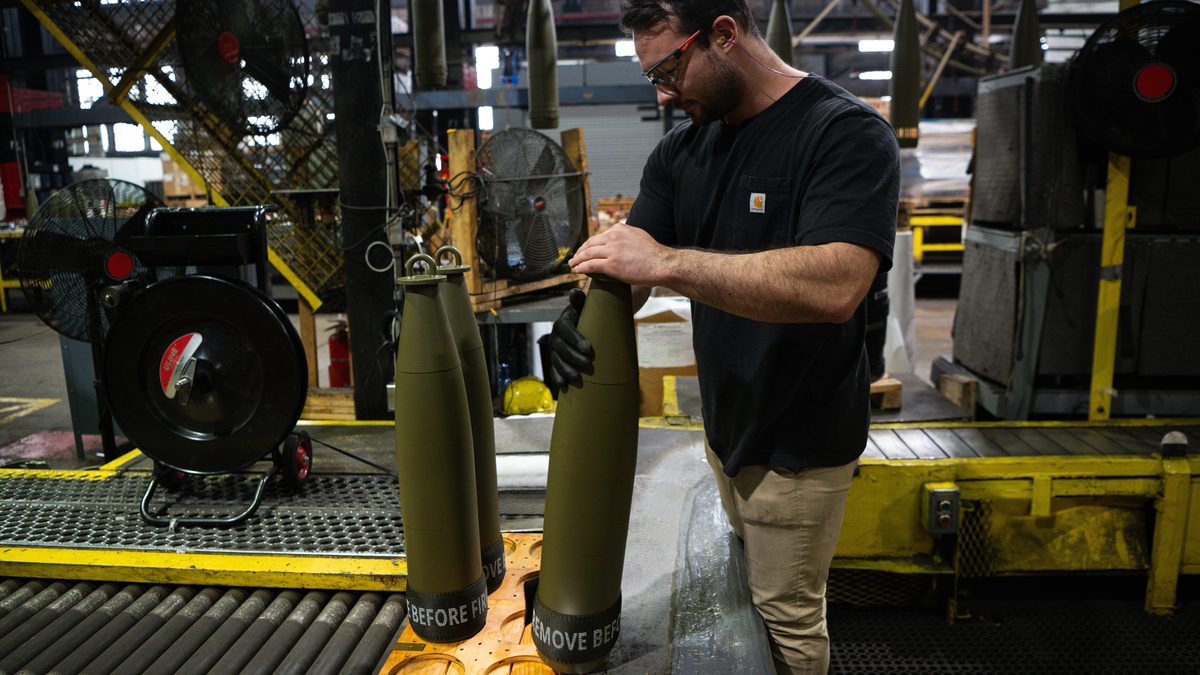
An employee prepares 155mm M795 projectiles on the production line at the US Army's Scranton Army Ammunition Plant, Pennsylvania, March 2024. Photo: Henry Villarama / Scranton Army Ammunition Plant / US Army / DVIDS / Public Domain. The appearance of US Department of Defense visual information does not imply or constitute DoD endorsement.
One Line, One Weapon: The Dedicated-Production Trap Behind America's Munitions Surge Failure
The argument in brief
In the June edition of National Defense Magazine, Christine Michienzi sets out a deceptively simple proposition. The United States cannot surge its key munitions because, for the better part of a century, the Defense Department has paid industry to build production lines that can make exactly one thing. When demand for that one thing spikes, the line is already at capacity and nothing else in the estate can help. Michienzi, formerly chief technology officer and senior technology advisor to the Under Secretary of Defense for Acquisition and Sustainment, and previously embedded in the Industrial Base Policy office, is describing the structural problem from the inside. Her fix is twofold: fund flexible, agile production lines that can be reconfigured to make several systems, and build shared scale-up facilities, co-funded by government and private capital, that smaller innovative firms can use until a surge is needed.
For Weapons, Ordnance, Munitions and Explosives (WOME) readers the diagnosis lands cleanly, and so does most of the prescription. This article tests both. It accepts the core finding, that dedicated single-weapon lines are a poor architecture for a contested-supply era, and then asks the question the Policy Points format has no room for: how far does flexibility actually reach once a line stops handling metal and electronics and starts handling energetic materials? That boundary is where Michienzi's argument meets the part of the industrial base ISC tracks most closely, and it is where the surge problem is hardest to solve with capital alone.
Before 2022 the United States made roughly 14,000 155mm rounds a month, a rate optimised for training rather than war. Ukrainian guns have at times consumed that entire monthly output in about three days. ISC analysis of US Army 155mm production data, June 2026
The single-line inheritance
Michienzi's central observation is about how facilities get funded. The money that builds a production plant most often comes directly from a single weapon or platform program office's appropriation. A program office funded to deliver one system has neither the mandate nor the incentive to build a line that can pivot to a different system, so it does not. The result, repeated across decades, is an estate of dedicated lines, each optimised for one article, each sized to peacetime demand, and each a stranded asset the moment that article goes out of production. She notes that when demand falls too low, some of these facilities are simply lost.
This is not a new failure mode. Michienzi reaches back to the Civil War for shortages of weapons systems, and points to Operation Iraqi Freedom, when the military ran dangerously low on ammunition. She made the same case under oath in March 2025, telling the Senate Armed Services Committee that the department and the base had prioritised efficiency over resiliency until production lines went cold, parts went obsolete and sub-tier suppliers consolidated or closed, with industry right-sizing itself to peacetime demand. The pattern she describes is the same one ISC traced through the European arsenal in its 12 May study of procurement function inversion, and through the US lowest-price selection regime in the 11 May companion piece: a rule layer that optimises for unit cost and single-purpose efficiency will, over time, select against the resilience and surge capacity it was supposed to protect. Michienzi is naming the American expression of that inversion at the level of the physical plant.
Why capacity exists but cannot surge
The most useful insight in the Policy Points piece is counter-intuitive. Michienzi argues that production capacity is often available; it is simply not on the line that needs to surge. Because the base is built as dedicated lines tied to single systems, an underused line cannot absorb demand for a different munition without a costly reconfiguration. Spare capacity and the surge requirement sit in different buildings, and the wall between them is the way the line was funded and tooled, not a shortage of floor space or workers.
The US Army 155mm story, principally the M795 high-explosive family, makes the point in hard numbers. Pre-invasion output stood at about 14,000 rounds a month, a figure Army leaders have openly described as optimised for annual training consumption. By late 2024 the figure had climbed to roughly 40,000 a month, and the service has been pushing toward a target of 100,000 all-up rounds a month, a goal it has acknowledged slipping past its October milestone by a matter of months. The binding constraint, tellingly, was not shell-body machining. It was propellant and the upstream energetics supply chain. That detail matters for Michienzi's thesis, because it shows the surge bottleneck migrating to precisely the part of the process that flexible, reconfigurable tooling helps least.
The flexible-facility proposition
Michienzi's first remedy is to fund and build production lines that can be quickly reconfigured to make multiple systems. Crucially, she argues this may require a different kind of funding, money that does not flow from any single program office and therefore does not demand a dedicated line in return. This is the sharper half of her argument. The fix is not only a manufacturing-engineering choice; it is a budgeting choice. As long as the appropriation comes attached to one weapon, the line it builds will serve one weapon. Break that linkage, fund the line as shared national capacity, and reconfigurability becomes possible.
Her second remedy addresses the entry problem. Many innovative firms would supply the department but cannot afford to build capacity at the required scale without a contract, and cannot win a contract until they can build at scale. Michienzi describes this as a chicken-and-egg trap. Her answer is co-located, shared facilities, funded by both government and private capital, that smaller companies can use to scale their technologies until they generate enough revenue to build their own plant. Free of the capital burden of bricks and equipment, those firms can concentrate on innovation and throughput. The benefits she lists are a more diverse and agile base, more routes to becoming a defence supplier, new jobs and local economic activity.
| Facility model | How it is funded today | Surge value | Status |
|---|---|---|---|
| Dedicated single-weapon line | One program office appropriation, tied to one article | Low: cannot pivot without costly reconfiguration | Status quo |
| Reconfigurable multi-system line | Needs non-program, shared-capacity funding | High for assembly, integration, machining | Proposed |
| Shared scale-up facility (public plus private) | Government and private capital co-investment | Medium: lowers entry barrier for new suppliers | Concept |
The proposition is coherent and, for large parts of a munition, correct. A modern guided round is mostly machining, electronics, sensors, seekers, structures and final integration. Those operations genuinely do reconfigure. A flexible line can switch between related fuze families, between guidance kits, between airframe and structural work, in a way a fixed line cannot. For everything outside the energetic core, Michienzi's model is the right answer to a real problem.
The energetics reality check
The boundary the Policy Points format cannot explore is the one between flexible manufacturing and energetic-materials production. Reconfigurability is cheap and fast where the hazard is low. It becomes slow, expensive and tightly regulated the moment a process handles Hazard Division 1.1 material, the mass-detonating class that covers most propellants, bulk explosives and filled rounds. Melt-pour fill lines, propellant extrusion and pressing, and the synthesis of base explosives such as RDX and HMX are not machine shops that can be re-tooled over a weekend. They are hazard-segregated, quantity-distance-bounded facilities whose layout, licensing and safety case are built around one process at one throughput.
The depth of that dependency is easy to understate. The United States has had no domestic production of TNT, the workhorse fill of large-calibre and aerial ordnance, since 1986, and imports roughly ninety per cent of its supply from a single Polish producer, Nitro-Chem. A contract placed in November 2024 to build the first new American TNT plant in nearly four decades, at Graham, Kentucky, is not expected to be in production until 2028. No quantity of reconfigurable assembly tooling closes that gap, because the gap is upstream of assembly, in the synthesis and fill of the energetic itself. The orders of magnitude tell the story: switching a machining or integration cell between related articles is a matter of days or weeks with modular tooling; standing up or re-tooling a melt-pour fill or propellant-grain line, and re-clearing it through safety and acceptance, runs to months at best, and for a genuinely new energetic process it approaches a new-plant timeline.
This is why the 155mm bottleneck moved to propellant rather than steel. It is also why a qualification regime sits on top of the manufacturing one. Under NATO practice, an energetic material and its production process are qualified together through STANAG 4170 and the AOP-7 (Allied Ordnance Publication 7) listing of qualified explosives, and quality conformance runs through STANAG 4107 and AQAP-2110 (Allied Quality Assurance Publication 2110). Move a qualified fill to a different building, or change the line that makes it, and the qualification does not travel automatically. The article can require re-test and re-acceptance before a single round ships. A flexible line that can swap between guidance kits cannot, by the same logic, swap between energetic fills without re-entering that qualification gate.
None of this refutes Michienzi. It bounds her. Flexible lines and shared facilities will deliver most of their surge value at the component and integration end of the munition, and progressively less of it as the process moves toward the energetic core. The hardest surge node, the one that failed in 2024 and the one ISC has repeatedly flagged in the single-source energetics chain, is the part that capital and reconfigurable tooling address last. Shared scale-up facilities help new entrants reach the qualification gate; they do not by themselves widen it.
The same caution applies to the sub-tier and to allied offsets. Michienzi has been consistent elsewhere that the deepest vulnerabilities sit two and three tiers down, in the precursors, chemicals and specialist equipment whose single points of failure never appear on a prime contractor's balance sheet. European producers are expanding energetic and propellant capacity, which eases the allied picture in aggregate, but allied supply is not free of the same chokepoints; it relocates dependency rather than removing it, and it introduces export-control and priority-of-supply questions of its own. Flexibility at the assembly end does not reach any of these unless the funding deliberately follows the bottleneck down the chain.
Where this sits in the policy current
Michienzi writes into a receptive moment. She notes that multiple recent executive orders focus on leveraging innovative companies and private capital to build a healthier, more resilient defence industry. The reference is unambiguous. The April 2025 executive order on modernising defence acquisitions and spurring innovation in the defence industrial base set a commercial-first preference and put major programmes running more than fifteen per cent behind schedule or over cost under threat of cancellation. The January 2026 order on prioritising the warfighter went further into capital behaviour, targeting contractors that decline to invest their own capital in production capacity and constraining stock buybacks and dividends where they come at the expense of throughput. Her shared-facility, co-funded model is a constructive way to operationalise that private-capital push at the level of the plant rather than the balance sheet.
Data gaps
Several quantities that would sharpen the assessment are not in the public record. The capital cost of converting a representative dedicated line to a reconfigurable one is not published, nor is the changeover time between dissimilar systems on such a line. The split of the 155mm bottleneck between nitrocellulose, single-base and multi-base propellant, and finished charge assembly is reported only in general terms. The funding mechanism Michienzi gestures toward, money not drawn from a single program office, is described as a need rather than a named appropriation, so its scale and source remain open. ISC has not seen the full text of the Policy Points piece beyond the version supplied, and has worked from it together with corroborating open sources on production rates and the executive orders.
References
Source-evaluated under NATO STANAG 2022 (Reliability A–F / Accuracy 1–6). Tier 1 = government primary source; Tier 2 = quality news / specialist defence media; Tier 3 = authoritative aggregator / analysis.
- T1The White House – Modernizing Defense Acquisitions and Spurring Innovation in the Defense Industrial Base (Executive Order), 9 April 2025. (Reliability A / Accuracy 1)
- T2National Defense Magazine (NDIA), C. Michienzi – Policy Points: Pentagon Needs Flexible, Agile Production Facilities, June 2026. (Reliability B / Accuracy 2)
- T1US Senate Committee on Armed Services, C. Michienzi (testimony) – Defense Mobilization in the 21st Century, 6 March 2025. (Reliability A / Accuracy 1)
- T2CNBC – How the explosives shortage could make everyday items more expensive (US TNT import dependence; Repkon Graham, KY plant), 10 November 2025. (Reliability B / Accuracy 2)
- T2National Defense Magazine (NDIA) – Army Falls Short of 155mm Production Goal, 14 August 2025. (Reliability B / Accuracy 2)
- T2Breaking Defense – Army 'hitting stride' with 155mm production, but key general worries over what's needed next, October 2025. (Reliability B / Accuracy 2)
- T2Defense News – Army races to widen the bottlenecks of artillery shell production, 14 October 2024. (Reliability B / Accuracy 2)
- T3War on the Rocks – The Pentagon Needs a Playbook for Munitions Surge Production, 2025. (Reliability C / Accuracy 3)
- T1DVIDS asset 8439288 (VIRIN 240326-A-AR102-2862), Scranton Army Ammunition Plant, photo by Henry Villarama, US Army / Joint Munitions Command, 26 March 2024. Source: dvidshub.net. Public domain (17 U.S.C. § 105); editorial reuse with DoD non-endorsement disclaimer. (Reliability A / Accuracy 1)
Corrections & updates welcome. If you hold open-source data that refines or corrects any parameter in this article, please contact [email protected] citing the specific claim and your source. Verified corrections will be incorporated and credited in the revision history. AI-assisted technical assessment based on open-source material. Not a formal intelligence product.