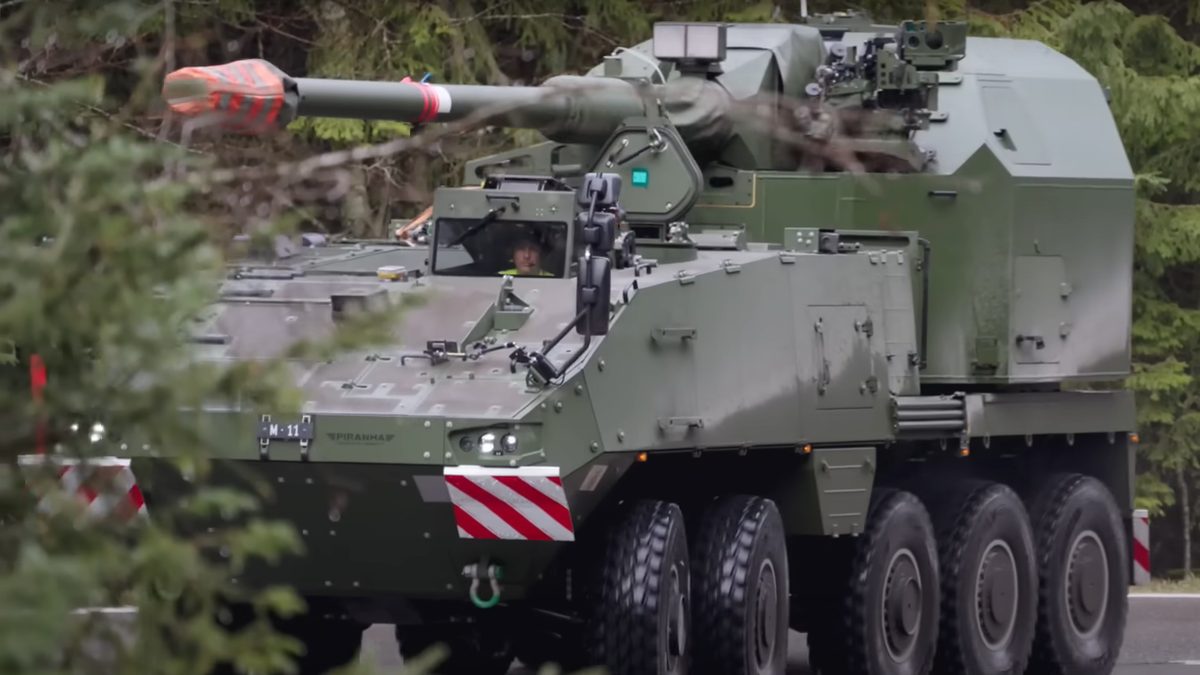
The Mowag Piranha IV 10×10 fitted with the KNDS Artillery Gun Module (Piranha Advanced Artillery Carrier), the configuration selected for Switzerland's Art WPWM. Illustration: Fabien Tremoulinas, CC0 (public domain dedication), via Wikimedia Commons.
Switzerland Signs with KNDS for the AGM 155mm Gun Module on the Swiss-built Piranha IV
Technical Summary
The Federal Office for Defence Procurement, armasuisse, has signed the procurement contract for the Swiss Armed Forces' new artillery system with KNDS Deutschland GmbH & Co. KG, the agency announced on 8 June 2026. The system pairs the KNDS Artillery Gun Module (AGM), a 155mm 52-calibre weapon, with the Piranha IV wheeled carrier built in Switzerland by GDELS-Mowag. It is the central acquisition within the project Artillery Weapons Platform and Ammunition (Art WPWM), funded through the Armed Forces Dispatch 2025 (Armeebotschaft 2025). The buy replaces the M109 self-propelled howitzer, a tracked design dating to the 1960s that is reaching the end of its service life.
The contract covers one prototype and 32 series systems, alongside ammunition logistics, training and simulation systems, spare parts, documentation and tools. An initial range of modern projectiles, fuzes (rendered as "detonators" in the official English release, a translation of the German Zunder) and propellant will also be purchased. armasuisse states these will improve terminal effect against the target and extend the range of artillery fire compared with current natures. The AGM on Piranha IV was selected in November 2024 after a shortlist decision in August 2022 and mobility, field and logistics trials in Switzerland and abroad. A prototype in final Swiss configuration is to be completed in 2027 and qualified in 2028, with series deliveries running from 2031.
One prototype and 32 series systems, with a prototype in final Swiss configuration due in 2027, qualification in 2028, and series deliveries from 2031. The competitive funding figure carried in the Armed Forces Dispatch 2025 was reported at CHF 725 million. armasuisse press release, 8 June 2026; funding figure per Janes / Army Technology reporting of Armeebotschaft 2025
The system: what the AGM on Piranha IV brings
The AGM is an unmanned, remotely operated gun module. A fully automated loader handles projectiles and modular charges, and the gun can fire and reload across its elevation and traverse arc, including while the vehicle is moving. Open sources credit the module with a 360-degree fire capability, real Multiple Rounds Simultaneous Impact (MRSI), and a Shoot and Scoot profile that lets the platform fire without deploying stabilising spades. Because the crew sits in the hull rather than around an open breech, the loading and laying cycle is mechanised end to end.
The Piranha IV in this fit is a 10-by-10 wheeled chassis from GDELS-Mowag, reported at around 40 tonnes with four steered axles for a tight turning radius. The wheeled, hull-crewed arrangement is the clearest break from the tracked M109: it favours road mobility, rapid repositioning between fire missions, and a small crew, in this case two with provision for a third. The following parameters are drawn from manufacturer and specialist-media descriptions of the AGM gun class and the Piranha IV; the figures contracted for the Swiss configuration have not been published in full and several should be treated as the system-class envelope rather than confirmed Swiss values.
Baseline specification (open sources, AGM on Piranha IV)
| Calibre / barrel length | 155mm, 52 calibres (NATO Joint Ballistics MoU compatible) |
| Carrier | GDELS-Mowag Piranha IV, 10x10 wheeled, approx. 40 t |
| Crew | 2, with provision for a 3rd |
| Gun module | Unmanned, remotely operated, fully automated loader |
| Onboard rounds | Reported up to 30 fused rounds with modular charges (gun-class figure) |
| Rate of fire | Reported up to 9 rounds/min (gun-class figure) |
| Traverse / elevation | 360 degrees; approx. -2.5 to +65 degrees (gun-class figure) |
| Range | Ammunition dependent; L52-class envelope roughly 40km base-bleed to 54km with rocket-assisted natures (not Swiss-confirmed) |
Analysis of Effects
The operational case for Art WPWM rests on survivability and responsiveness as much as on reach. A 1960s M109 must halt, lay and, in older fits, work a substantial manned loading drill before and after firing. An unmanned, auto-loaded gun on a fast wheeled chassis compresses that cycle and supports a genuine Shoot and Scoot posture, in which the system displaces before counter-battery radars can complete a firing solution. Against the drone-saturated, sensor-rich battlefield seen in Ukraine, where static artillery is hunted within minutes, that displacement time is arguably the single most valuable attribute on offer.
The 155mm 52-calibre gun keeps Switzerland inside the NATO Joint Ballistics Memorandum of Understanding (JBMoU) envelope, so the platform can in principle fire the wider family of standardised projectiles and modular charge systems used across European armies. The "initial range of modern projectiles, fuzes and propellant" named in the contract is the part that converts platform reach into effect: course-corrected or precision-guided natures, multi-mode fuzing and modern modular charges are what deliver the extended range and improved target effect armasuisse describes. The specific projectile, fuze and charge natures Switzerland has bought are not detailed in the release and are the most consequential open question for any effects assessment.
Procurement and industrial policy
The competition reduced, by 2022, to two suppliers and three candidate systems: the Archer wheeled howitzer from BAE Systems Bofors of Sweden, and from KNDS Deutschland the RCH 155 on the Boxer carrier and the AGM on the Piranha. The AGM on Piranha IV prevailed in November 2024. The choice of a Swiss-built carrier is not incidental. armasuisse frames the buy as an implementation of the Federal Council's Armament Policy Strategy of 20 June 2025, which seeks closer cooperation with suppliers in neighbouring and other European states while keeping a share of the value, and of the associated industrial core capability, inside Switzerland. Selecting the GDELS-Mowag Piranha IV as the platform does exactly that: a German gun on a Swiss chassis, integrated for a Swiss requirement.
| Programme stage | When | Detail |
|---|---|---|
| Shortlist decision | Aug 2022 | Complete Archer, RCH 155 (Boxer), AGM (Piranha) down-selected |
| Trials | 2022 to 2024 | Complete Mobility trials in Switzerland; field and logistics trials abroad |
| Type selection | Nov 2024 | Complete AGM on Piranha IV chosen |
| Funding | 2025 | Approved Carried in the Armed Forces Dispatch 2025 |
| Contract signature | 8 Jun 2026 | Signed armasuisse and KNDS Deutschland |
| Prototype | 2027 | Planned Final Swiss configuration completed |
| Qualification | 2028 | Planned Prototype qualification trials |
| Series delivery | from 2031 | Planned 32 series systems to the Swiss Armed Forces |
Personnel and Safety Considerations
An unmanned gun module changes the human-factors picture for the detachment. With laying and loading automated and the crew carried in the protected hull, exposure to the breech, to recoil and to muzzle and propellant blast falls, and the crew works the system through controls rather than by hand. Ammunition handling shifts toward magazine reload of projectiles and modular charges, with the attendant requirements for charge-handling discipline, fuze-state control and safe storage of energetics on the platform. None of these are unique to the AGM, but they are the areas where Swiss training, simulation and ammunition-logistics packages, all named in the contract, will have to build competence around new modular natures rather than the legacy M109 stockpile.
Data Gaps
Several parameters are not confirmed for the Swiss configuration and should be treated as open. The contract value is not stated in the 8 June release; the CHF 725 million figure widely associated with the buy derives from reporting of the Armed Forces Dispatch 2025 rather than from the signature announcement, and the split between platforms, ammunition and the logistics package is unclear. The specific projectile, fuze and propellant natures procured are not detailed. Performance figures for range, rate of fire and onboard capacity quoted here are gun-class values from manufacturer and specialist-media sources, not armasuisse-confirmed Swiss data. The total fleet figure is one prototype plus 32 series systems, which differs from earlier reporting that referred loosely to "32 systems"; readers tracking fleet size should note the prototype is additional.
References
Source-evaluated under NATO STANAG 2022 (Reliability A–F / Accuracy 1–6). Tier 1 = government primary source; Tier 2 = quality news / specialist defence media; Tier 3 = authoritative aggregator / encyclopaedia.
- T1armasuisse / DDPS – armasuisse signs contract for new artillery system, 8 June 2026. (Reliability A / Accuracy 1)
- T1Federal Office for Defence Procurement armasuisse – New artillery system: type selected, 5 November 2024. (Reliability A / Accuracy 1)
- T2Janes – Switzerland selects 10x10 Piranha IV with Artillery Gun Module to replace M109 SPHs, November 2024. (Reliability B / Accuracy 2)
- T2KNDS Group – AGM Artillery Gun Module product page, accessed 8 June 2026. (Reliability B / Accuracy 2)
- T2Army Technology – armasuisse selects Piranha IV HMC with 155mm AGM, 2024. (Reliability B / Accuracy 2)
- T3Wikipedia – Artillery Gun Module, accessed 8 June 2026. (Reliability C / Accuracy 3)
Corrections & updates welcome. If you hold open-source data that refines or corrects any parameter in this article, please contact [email protected] citing the specific claim and your source. Verified corrections will be incorporated and credited in the revision history. AI-assisted technical assessment based on open-source material. Not a formal intelligence product.