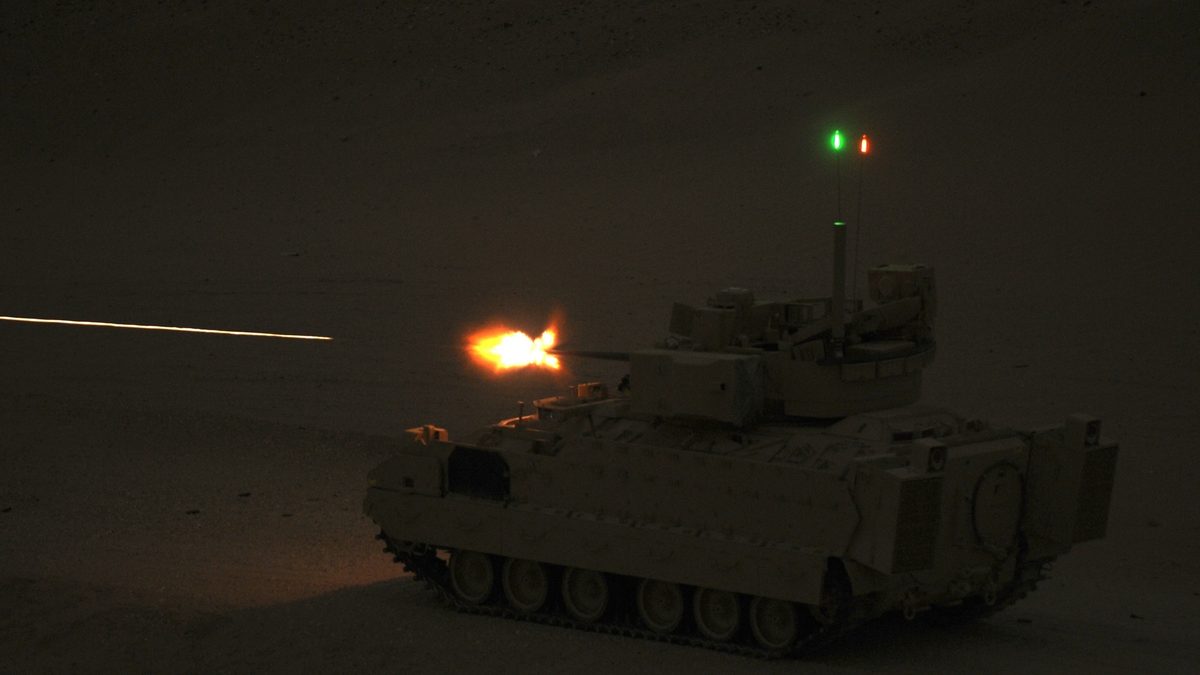
An M2A3 Bradley Fighting Vehicle fires its M242 Bushmaster 25mm chain gun, Udairi Range, Kuwait, 28 April 2015. The M242 shares the 25x137mm ammunition family with the Oerlikon KBA. U.S. Army photo by Staff Sgt. Grady Jones (DVIDS, public domain); illustrative, no U.S. Department of Defense endorsement implied.
NSPA Signals a 20,000-Round 25mm APFSDS-T Buy for the Oerlikon KBA
Technical Summary
The NATO Support and Procurement Agency (NSPA) has issued a Future Business Opportunity (FBO) flagging a potential buy of medium-calibre armour-piercing ammunition: 20,000 rounds of Cartridge, 25x137mm, Armour-Piercing Fin-Stabilised Discarding Sabot with Tracer (APFSDS-T), for the Oerlikon KBA 25mm automatic cannon. The nature is identified by NATO Stock Number (NSN) 1305-13-115-1056, or by an acceptable Fit-Form-Function (FFF) equivalent. The tentative Request for Proposal (RFP) date is 15 June 2026.
An FBO is a pre-solicitation signal, not a contract. It is published under NSPA Procurement Operating Instruction 4200-01, Paragraph 6.2, for information only. It does not commit NSPA to procure, a response is not mandatory, and an absent response does not bar a later bid against the formal RFP. Quality assurance is set at Allied Quality Assurance Publication (AQAP) 2131, with a Certificate of Conformity (CoC) signed by the Government Quality Assurance Representative (GQAR). Registration in NSPA's Source File is mandatory before any RFP response. The FBO lists 28 authorised supplier countries, a roster that repays close reading.
FBO at a glance (NSPA, open source)
| Opportunity ID | 26LBS047 (published ~2 June 2026) |
| Product | Cartridge, 25x137mm, APFSDS-T |
| Weapon | Oerlikon KBA 25mm automatic cannon |
| NSN / equivalence | 1305-13-115-1056, or FFF equivalent |
| Estimated quantity | 20,000 EA (each) |
| Tentative RFP date | 15 June 2026 |
| Quality assurance | AQAP 2131, CoC signed by GQAR |
| Legal basis | NSPA POI 4200-01, Para 6.2 (information only) |
| Authorised supplier countries | 28 listed (see analysis) |
Twenty-thousand rounds is a sustainment-scale order, not a fleet re-equipment. It reads as a top-up of war reserves and training stocks for an in-service medium-calibre fleet, routed through NSPA to aggregate demand across users of a single ammunition nature. ISC open-source assessment
The Round and the Gun
The 25x137mm cartridge is a NATO-standard medium-calibre family fired by both the Oerlikon KBA and the US M242 Bushmaster. That common chambering matters for this buy: a round qualified to the right specification can serve KBA and Bushmaster fleets alike, which is precisely the cross-fleet demand NSPA exists to aggregate. The APFSDS-T nature is the dedicated anti-armour round in the family. It uses a sub-calibre long-rod penetrator, typically a tungsten alloy, carried to the muzzle inside a discarding sabot that strips away in flight. The result is a high-velocity, fin-stabilised dart with a small frontal area and high sectional density. Open-source manufacturer data for 25mm tungsten APFSDS-T rounds describes defeat of modern armoured infantry fighting vehicles and armoured personnel carriers, with improved range and penetration over earlier APDS natures such as the M791. The tracer (the "T") supports observation of fire and burst correction.
A representative qualified round gives a sense of the performance class. The General Dynamics Ordnance and Tactical Systems (GD-OTS) 25x137mm Tungsten APFSDS-T, a publicly released datasheet item, fires a 134-gramme projectile carrying a 98-gramme tungsten sub-projectile at a muzzle velocity of 1,390 metres per second, with a maximum range of 17,289 metres at 45.5 degrees of elevation and tracer visibility to 2,000 metres. The manufacturer states the round is fully compatible with both the M242 Bushmaster and the KBA-B02 25x137mm gun systems, and that it draws on the common components of volume-produced 25mm Bushmaster ammunition. For comparison, the US M919 service round is cited at about 1,385 metres per second from the M242 barrel, with one difference of kind: the M919 uses a depleted-uranium penetrator, whereas the round in this FBO is the tungsten nature. Tungsten and depleted-uranium long rods give broadly similar kinetic-energy performance, but they carry different export, handling and environmental profiles, so the distinction is not cosmetic for a buyer or a bidder. The GD-OTS figures are a reference example only; the round codified under NSN 1305-13-115-1056, or an acceptable FFF equivalent, may differ in detail. Rheinmetall, the German successor to Oerlikon Contraves, publishes its own 25x137mm tungsten APFSDS-T in its medium-calibre portfolio, so NSPA has at least two qualified Western sources for the nature. That matters for the FFF clause: a real second source is what turns form-fit-function equivalence from a paper provision into genuine price competition.
The Oerlikon KBA is a 25x137mm gas and recoil-operated automatic cannon with a positively locked breech and dual feed. Open sources put its cyclic rate at up to 600 rounds per minute, electronically selectable down to roughly 100 to 175 rounds per minute and single shot, with an effective range to about 2,700 metres. The dual feed is the tactically important feature. It lets a gunner switch on the fly between an anti-armour nature such as APFSDS-T and an area or air nature such as High-Explosive Incendiary with Tracer (HEI-T), without breaking contact or re-loading. The wider 25x137mm family also includes Frangible Armour-Piercing Discarding Sabot with Tracer (FAPDS-T), a nature originally developed by Oerlikon Contraves that breaks up on impact to defeat light-armoured and air targets, frangible natures for reduced collateral in urban work, Penetrator with Enhanced Lateral Effect (PELE) fuseless rounds, and proximity-fuzed counter-UAS rounds for the drone fight. More than 6,000 KBA guns have been produced, fitted to tracked fighting vehicles, light reconnaissance platforms, air-defence mounts and naval systems.
Oerlikon KBA baseline (open sources)
| Calibre | 25x137mm |
| Operation | Gas and recoil, positively locked breech, dual feed |
| Cyclic rate | Up to ~600 rds/min, selectable to ~100–175 rds/min and single shot |
| Effective range | ~2,700 m |
| Ammunition family | APFSDS-T, HEI-T, frangible, counter-UAS natures |
| Production to date | 6,000+ guns (open-source figure) |
| 25x137mm nature | Primary role | Working principle | This FBO |
|---|---|---|---|
| APFSDS-T | Anti-armour | Tungsten long-rod dart, discarding sabot, kinetic kill | Subject of buy |
| HEI-T | Area, light vehicle, air | High-explosive incendiary, fuzed burst effect | Companion nature |
| FAPDS-T | Light armour, anti-air, C-UAS | Frangible core fragments on impact | Companion nature |
| TP-T | Training / practice | Inert, matched ballistics, tracer for observation | Training equivalent |
Indicative roles for the 25x137mm family. Only APFSDS-T is sought under FBO 26LBS047; the others are shown for fleet and dual-feed context.
Reference round: GD-OTS 25x137mm Tungsten APFSDS-T (public datasheet)
| Cartridge weight | 457 g |
| Cartridge length | 223 mm |
| Projectile | 134 g (98 g tungsten sub-projectile) |
| Propellant | 99 g |
| Muzzle velocity | 1,390 m/s |
| Chamber pressure (P+3SD, 21°C) | <454 MPa |
| Maximum range | 17,289 m at 45.5° elevation |
| Tracer visibility | 2,000 m |
| Dispersion | 0.44 × 0.44 mils |
| Gun compatibility | M242 Bushmaster and Oerlikon KBA-B02 |
Representative qualified round (GD-OTS public-release datasheet). Shown to illustrate the performance class; the FBO-codified nature or an FFF equivalent may differ.
Who Operates the KBA
The KBA arms a spread of NATO and international fleets. Open-source operator lists include Belgium, Denmark, Italy, the Netherlands and Türkiye among Alliance members, and Bahrain, Egypt, Japan and the Philippines beyond it. In Italian service the cannon appears on the Dardo and Freccia infantry fighting vehicles and the SIDAM 25 air-defence system. Belgium fielded the KBA on its AIFV-B family. Every one of those NATO operators sits inside the FBO's supplier roster, which is consistent with a demand-aggregation buy serving in-service KBA users rather than a single nation acting alone.
One detail in the NSN supports that reading. NATO Stock Numbers embed a two-digit National Codification Bureau (NCB) code in the second group of digits. In 1305-13-115-1056 that code is 13, the NCB code assigned to Belgium. The number indicates that the item was codified through the Belgian bureau, which points to Belgium as a likely sponsoring or originating nation for this nature. That is an inference from codification convention rather than a stated fact in the FBO, and is flagged as such below.
The Supplier List, and the Two Questions It Raises
The FBO names 28 authorised supplier countries: Albania, Belgium, Bulgaria, Canada, Czechia, Denmark, Finland, France, Germany, Greece, Hungary, Italy, Latvia, Lithuania, Luxembourg, the Netherlands, Norway, Poland, Portugal, Romania, Slovakia, Slovenia, Spain, Sweden, Switzerland, Türkiye, the United Kingdom and the United States. Two questions follow: are any Ammunition Support Partnership (ASP) nations missing, and why is Switzerland present at all.
Are Any ASP Nations Missing?
The ASP is a multinational framework established in 1993 and run by NSPA, through which participating nations aggregate demand and buy ammunition on common contracts. On the available open-source record, membership reached 27 nations when Slovenia joined in March 2026. Reconstructed from NSPA reporting, that roster is the long-standing group of 24 Allied members (Albania, Belgium, Bulgaria, Canada, Czechia, Denmark, France, Germany, Greece, Hungary, Italy, Latvia, Lithuania, Luxembourg, the Netherlands, Norway, Poland, Portugal, Romania, Slovakia, Spain, Türkiye, the United Kingdom and the United States), plus Finland and Sweden, plus Slovenia.
Set against that, the 27 Allied and associate names on the FBO supplier list match the ASP roster, with Switzerland added as the 28th. On that basis no ASP member appears to be missing: the supplier list reproduces the partnership and then adds one non-member. The more useful observation runs the other way. Several NATO members are absent because they are not ASP participants, on the available record this includes Croatia, Estonia, Iceland, Montenegro and North Macedonia. Their absence reflects partnership membership, not exclusion from NATO. The precise, currently published ASP nation-by-nation roster is not fully available in open sources, so the match is assessed as close rather than confirmed line by line. This is a data gap, not a finding.
Why Is Switzerland on the List?
Switzerland is neither a NATO member nor, on the available record, an ASP participant. Its presence is explained by industry, not membership. The Oerlikon KBA cannon and the 25x137mm Oerlikon cartridge family originate with the Swiss design house formerly known as Oerlikon Contraves AG, renamed Rheinmetall Air Defence AG in 2009 and based in the Oerlikon district of Zürich. The "Oe" that appears in collector and technical references to 25x137mm Oerlikon natures marks that Swiss lineage. Including Switzerland as an authorised supplier country lets the original design authority and its Swiss supply base compete for the round it created.
There is a partnership thread as well. Switzerland has worked with NSPA since 1996 and participates in support partnerships for AMRAAM and Stinger missiles, and in 2026 its Federal Council approved joining the NSPA Patriot Support Partnership. Bern's stated rationale for the Patriot step was to strengthen its security-relevant technology and industrial base by letting Swiss industry compete in NSPA tenders. The same logic applies to a 25mm APFSDS-T buy whose design authority is Swiss. Switzerland is on the list because the gun, the cartridge and the manufacturer are Swiss, and because there is an established channel for Swiss industry to bid into NSPA work.
Analysis of Effects
For industry, the FBO is an early-warning marker with a one-week fuse to the tentative RFP. Any supplier intending to bid must hold, or move quickly to obtain, NSPA Source File registration, because that registration is the gate to responding at all. The AQAP 2131 requirement, with a GQAR-signed Certificate of Conformity, sets the quality bar at final inspection and test under government quality assurance, which favours qualified medium-calibre producers with an existing AQAP footprint and a recognised national GQAR relationship. On the open-source record that points to a short list of likely contenders, among them Rheinmetall (as successor to Oerlikon Contraves), General Dynamics Ordnance and Tactical Systems, and Nammo, with national producers such as Romania's Romarm also active in the 25x137mm family. The FFF equivalence clause beside the NSN widens the field beyond the single codified item to any round that matches form, fit and function, which is where qualification evidence and ballistic data will decide competitiveness. Delivery schedule, contract value and any split across user nations are not in the FBO and should be expected only at the RFP stage.
For the Alliance, the buy is a small but telling data point on medium-calibre sustainment. A 20,000-round APFSDS-T order is consistent with replenishing anti-armour war reserves and training allocations across in-service KBA fleets rather than standing up a new capability. Routing it through NSPA aggregates that demand into one contract, which is the ASP model working as intended: common nature, common quality standard, common supplier pool, lower unit cost through scale.
Personnel and Safety Considerations
APFSDS-T is a kinetic-energy nature with a discarding sabot. Range safety must account for sabot petals, which separate close to the muzzle and create a lateral hazard area off the flanks of the gun-target line, on the order of 100 to 200 metres on typical ranges, distinct from the dart's own danger area downrange. Spent penetrators of tungsten alloy are dense and environmentally persistent, which raises range-clearance and recovery considerations during and after firing. Hazard Division and Compatibility Group, lot identity and Net Explosive Quantity for the tracer and propellant elements are governed by the relevant transport and storage regulations and the lotting data that will sit behind any contract. None of those parameters is given in the FBO, and none should be inferred from the open-source ballistic descriptions cited here.
Data Gaps
The following are not resolved in the FBO or in open sources and are flagged accordingly: the full, currently published ASP nation-by-nation roster; confirmation that the supplier list is identical to ASP membership rather than merely close; the sponsoring nation or nations behind the requirement (Belgian codification of the NSN is an inference, not a stated fact); the specific manufacturer, penetrator material grade and ballistic specification of the codified round and what will count as an acceptable FFF equivalent; whether Sweden and Finland are counted as full ASP members or associates in the current tally; the delivery schedule, contract value and whether deliveries split across more than one user nation. Switzerland's exact status relative to the ASP, as opposed to its confirmed AMRAAM, Stinger and Patriot partnerships, is also unconfirmed.
References
Source-evaluated under NATO STANAG 2022 (Reliability A–F / Accuracy 1–6). Tier 1 = government primary source; Tier 2 = quality news / specialist defence media; Tier 3 = authoritative aggregator / encyclopaedia.
- T1NATO Support and Procurement Agency – Support Partnerships (Ammunition Support Partnership), accessed June 2026. (Reliability A / Accuracy 2)
- T1NSPA – Source File registration / Become a vendor, accessed June 2026. (Reliability A / Accuracy 1)
- T2GlobalSecurity.org – Slovenia joins NSPO Ammunition Support Partnership (27 nations), March 2026. (Reliability B / Accuracy 2)
- T1Swiss Federal Council – Federal Council approves Switzerland's participation in the NSPA Patriot Support Partnership, 2026. (Reliability A / Accuracy 2)
- T2Rheinmetall – Oerlikon Cannon KBA 25mm automatic cannon (25x137), accessed June 2026. (Reliability B / Accuracy 2)
- T2General Dynamics Ordnance and Tactical Systems – 25mm x 137 Tungsten APFSDS-T technical datasheet (approved for public release; rev 2023.09), accessed June 2026. (Reliability B / Accuracy 1)
- T2GlobalSecurity.org – M919 Cartridge 25mm APFSDS-T (muzzle velocity, penetrator), accessed June 2026. (Reliability B / Accuracy 2)
- T2Rheinmetall – Medium-calibre ammunition portfolio (25x137mm APFSDS-T, FAPDS-T, FAP, PELE), accessed June 2026. (Reliability B / Accuracy 2)
- T3Wikipedia – Oerlikon KBA (specification and operators), accessed June 2026. (Reliability C / Accuracy 3)
Corrections & updates welcome. If you hold open-source data that refines or corrects any parameter in this article, please contact [email protected] citing the specific claim and your source. Verified corrections will be incorporated and credited in the revision history. AI-assisted technical assessment based on open-source material. Not a formal intelligence product.