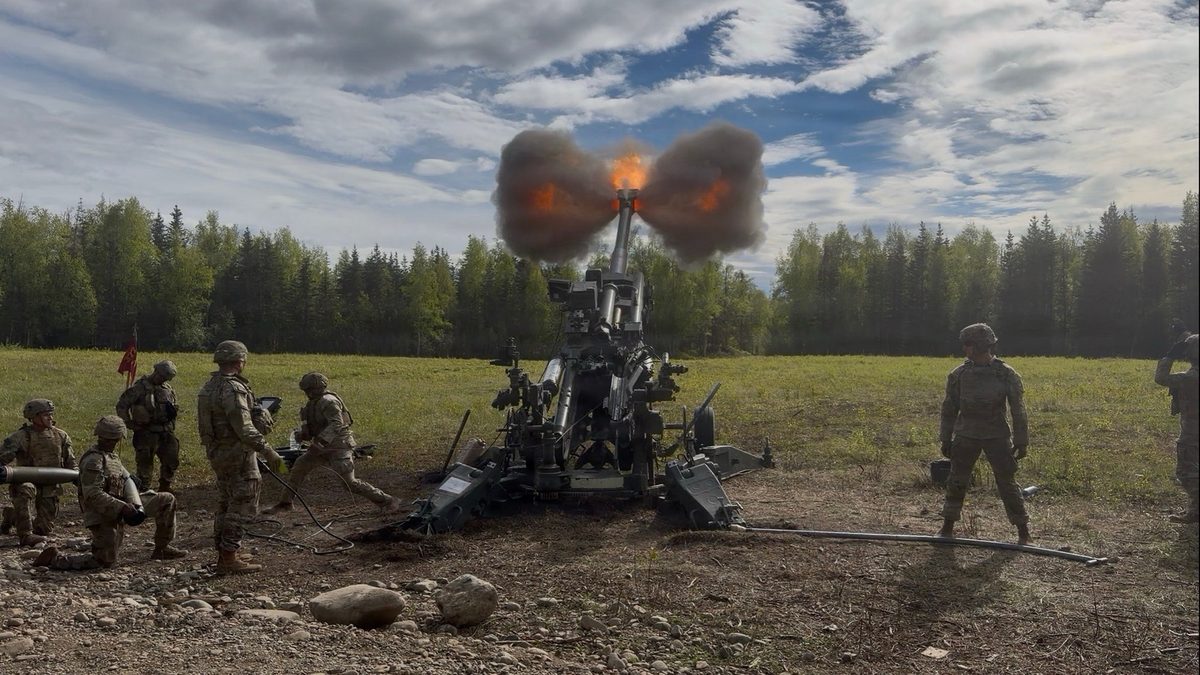
An M777A2 155 mm towed howitzer of 2-377 PFAR, 11th Airborne Division, fires during an Artillery Table VI qualification at Richardson Training Area, Alaska, 2 June 2026. Photo: Maj. Ian Roth, 11th Airborne Division / DVIDS (U.S. Government, public domain).
NATO's Land Ammunition Interchangeability Gap: Why Form and Fit Is Not Enough
Technical Summary
Ammunition interchangeability has returned to the top of the NATO (North Atlantic Treaty Organization) agenda, and the trigger was a logistics chain in Ukraine. When Western nations replaced Ukraine's Soviet-pattern 152 mm artillery with a mixed fleet of 155 mm systems, the American M777, British AS-90, French Caesar and German PzH2000 among them, they also delivered projectiles, fuzes, propelling charges and primers drawn from many national stockpiles. Those components arrived faster than the guidance needed to combine them safely. Ukrainian gunners began asking one recurring question: can this projectile be fired with that charge and that fuze from this gun, and where is the firing table? Multiplied across a battlefield, that question exposed a structural gap reaching well beyond a single calibre.
The gap is one of degree rather than absence. NATO holds a mature interchangeability regime for small arms ammunition up to 40 mm and very little for large-calibre indirect and direct fire. A NATO staff study of just five major artillery-producing nations identified more than 60,000 theoretical projectile, charge, fuze and platform combinations, a figure that scales into the millions once every Ally and partner is counted. Exhaustive physical proof of that population is not affordable or achievable. The real question is therefore not whether a round will chamber, but whether an untested combination will fire safely, fly predictably, and land where the fire-control solution says it should.
A NATO staff study of just five major artillery-producing nations identified more than 60,000 theoretical projectile, charge, fuze and platform combinations. Exhaustive physical proof of that population is neither affordable nor achievable. ISC technical assessment, drawing on European Security & Defence
Three words that are not synonyms
NATO doctrine separates three ideas that everyday usage tends to blur. Interoperability is the ability of allied forces to operate together. Interchangeability is the narrower ability to exchange systems that are similar enough to be used safely and to deliver the same or similar effects. Commonality is the use of identical systems. Ammunition interchangeability sits in the demanding middle of that scale, because it is never enough for a round simply to fit.
To underwrite it, four aspects must be standardised. Form and fit covers physical dimensions, mass and geometry: will the round chamber? Functioning and firing safety asks whether the projectile will survive gun launch, whether the fuze will arm correctly, and whether propellant ignition produces a chamber pressure the weapon can tolerate. Delivery and accuracy concern exterior ballistics and terminal effect, where any variation in chamber pressure, propellant type, primer sensitivity, projectile mass or centre of gravity shifts muzzle velocity, barrel wear, dispersion and the error budget. Handling and logistics covers the cradle-to-grave chain: environmental sensitivity, fuze safety mechanisms, packaging, labelling, storage and demilitarisation. Plenty of combinations clear form and fit and then fail one of the other three.
The four aspects of ammunition interchangeability are: one, form and fit (will the round chamber); two, functioning and firing safety (the projectile survives launch, the fuze arms, and the weapon tolerates the pressure); three, delivery and accuracy (ballistics, dispersion and the error budget); and four, handling and logistics (the cradle-to-grave chain, including storage, packaging and insensitive-munitions characteristics).
| Ammunition class | NATO mechanism and markers | Interchangeability coverage |
|---|---|---|
| Small arms, up to 40 mm | AEP-97 M-C MOPI; EPVAT proof; NATO Design Number plus interchangeability symbol; Regional Test Centres | Mature |
| Indirect fire, mortar and artillery | STANAG 4425 / AOP-29 national data; JBMoU for 155 mm; SG/2 S4 modelling | Partial, data dated |
| Medium and large direct fire | Legacy 105 mm and 120 mm STANAGs cancelled; LCGLE revival study | Largely a gap |
| Cannon calibres, 30 mm and 40 mm | LCGLE scoping (30 mm x 173, 40 mm case-telescoped) | Under study |
Small arms: the working model
For infantry calibres, including 5.56 mm, 7.62 mm, 9 mm and 12.7 mm, NATO has built a genuine qualification system. It is governed by the NATO Army Armaments Group (NAAG, committee AC/225) through its Land Capability Group Dismounted Soldier System, Sub-Group 1 on Small Arms Ammunition Interchangeability (SG/1). Designs are proved against AEP-97, the Multi-Calibre Manual of Proof and Inspection (M-C MOPI), at two NATO Regional Test Centres (RTCs) in the United Kingdom and the United States, or at nationally certified facilities held to continuous compliance monitoring.
The technical core of that manual is Electronic Pressure, Velocity and Action Time (EPVAT) testing, supplemented by function and casualty, precision and terminal-effect trials. EPVAT is a battlefield-performance standard that goes beyond the civilian C.I.P. and SAAMI commercial proof regimes. A design that passes is assigned a NATO Design Number (NDN) and carries the NATO interchangeability symbol, usually stamped on the crate. NATO production testing then verifies that continued manufacture has not drifted from the qualified design, through an annual production sample. The NATO Support and Procurement Agency (NSPA) reinforces the regime with a procurement lever, restricting its Ammunition Support Partnership (ASP) buys of standard small arms ammunition to NATO-qualified designs only.
Indirect fire: where form and fit is not enough
Large-calibre indirect fire has no equivalent. Centralised open-air proof is expensive, hard to replicate, and complicated by the difficulty of designating a reference weapon, so nations certify individually. Under STANAG 4425, the Allied Ordnance Publication AOP-29 compiles national test results and assessments of which projectile, fuze, charge and primer combinations can be fired safely from which platform. It is a shared dataset, not a NATO certification document. Each nation decides whether another country's favourable entry is sufficient, and many re-test regardless because no mutual recognition exists. AOP-29 covers 81 mm and 120 mm mortars together with 105 mm and 155 mm artillery, but much of the data predates the mid-1990s and omits both the platforms fielded since and the systems of Allies that joined later. Among the largest producers a tighter instrument exists: the Joint Ballistics Memorandum of Understanding (JBMoU), signed in 2009 by the United States, United Kingdom, France, Germany and Italy, standardises core 155 mm elements, notably the 23-litre combustion-chamber volume of the 52-calibre barrel and a common reference projectile, to maximise interchangeability, or at a minimum interoperability from breech to target. Even inside that group, signatories still qualify combinations per gun.
The technical reasons matter to anyone planning a fire mission. Modern 155 mm fires through modular charge systems, where propelling-charge modules must be matched to projectile, platform and intended range. A Modular Artillery Charge System (MACS) zone proven safe in one gun is not automatically safe in another, because the pressure-time curve and the muzzle-velocity delta are specific to the gun and projectile pairing and drive the need for a dedicated or extrapolated firing table. Even nominally compatible rounds differ in pressure curve, muzzle velocity and exterior ballistics, and differences of only a few per cent in muzzle velocity or projectile drag open into large miss distances at full range, which is why each combination needs its own firing table or a validated extrapolation rather than an assumption. NATO's expert community here is the NAAG Integrated Capability Group Indirect Fire, Sub-Group 2 on Ballistics, Effectiveness and Fire Control Software (SG/2), whose Shareable Software Suite (S4) supports fire control and can, in suitable cases, postulate results virtually from earlier trials of similar combinations. Virtual testing narrows the gap but does not fully replace a physical firing, and it marks where machine-assisted risk modelling could help triage the untested population. A new digital and living AOP-29, incorporating data from the Ukraine experience, was anticipated before the end of 2025; as of June 2026 no public release has been confirmed in open sources, while SG/2 virtual-modelling and data-integration work continues.
Direct fire and cannon calibres
Medium and large-calibre direct fire is barely standardised at all. The legacy STANAGs on 105 mm and 120 mm tank-gun form, fit and basic proof were cancelled more than a decade ago as obsolete and, in some national views, as an obstacle to innovation. Ukraine has prompted a reconsideration, and the NAAG Land Capability Group Land Engagement (LCGLE) is studying their revival. Parallel scoping work covers the most common cannon natures, such as 30 mm x 173 and the new 40 mm case-telescoped ammunition, commonly written 40 mm x 255 even though the case body is actually 65 mm in diameter.
Why the gap persists
None of this reflects a want of effort, and the obstacles are well understood. Standardisation is deliberately slow, for sound reasons. Testing is expensive. A standardisation decision needs the consensus of 32 nations. Nations stay reluctant to share sensitive lethality data. Industry holds the technical data package and has a commercial interest in not sharing it, while guarantee and maintenance contracts often prescribe specific ammunition and would force fire-control recalibration and firing-table revalidation if changed. Environmental law adds further friction, since bans on certain primary materials push designers toward substitutes that alter ballistic behaviour and trigger requalification, as do insensitive munitions (IM) and lead-free requirements. Batch qualification, already awkward in peacetime, becomes a brake on ammunition flow in war. NATO's principal policy answer is the NATO Ammunition Recognition Programme (NARP), aimed at mutual recognition of national certificates.
Personnel and Safety Considerations
For the practitioner the safety message is specific: physical compatibility is a necessary but insufficient condition. Firing an unproven projectile, charge and fuze combination risks an out-of-tolerance chamber pressure, an unsafe fuze arming sequence, or a round that is ballistically unpredictable, with consequences ranging from a burst barrel to projectiles falling outside the danger area. The handling and logistics chain carries hazards of its own, because mixed national stocks bring different packaging, labelling, shelf-life, cook-off behaviour and insensitive-munitions characteristics into a single storage and transport system. For ammunition technicians and explosive ordnance disposal (EOD) personnel this complicates identification, condition assessment and disposal, since provenance and lot data may not travel with the components. Handling and logistics safety remains the remit of the CNAD Ammunition Safety Group (AC/326, CASG) and the NATO Munitions Safety Information Analysis Centre (MSIAC).
Data Gaps
Several points cannot be confirmed from open sources at the time of writing. The publication status of the new living AOP-29, anticipated before the end of 2025, remains unconfirmed in open sources as of June 2026. The figure of more than 60,000 combinations is an illustrative NATO staff estimate for five nations, not an audited count. The source does not quantify how many AOP-29 entries fall behind the pre-1990s data cut-off, nor the current standing of the LCGLE direct-fire and cannon studies. Provenance, lot and pedigree data for the mixed components in Ukrainian service are not openly available. None of these gaps alters the central finding.
References
Source-evaluated under NATO STANAG 2022 (Reliability A–F / Accuracy 1–6). Tier 1 = government or institutional primary source; Tier 2 = quality news / specialist defence media; Tier 3 = authoritative aggregator / encyclopaedia.
- T2European Security & Defence (Osman Tasman, former NATO Land Armaments Advisor and NAAG Secretary) – The NATO ammunition interchangeability challenge in the land domain, 13 January 2026. (Reliability B / Accuracy 2)
- T1NATO Army Armaments Group – AEP-97 Multi-Calibre Manual of Proof and Inspection (M-C MOPI), public release, NATO Standardization Office. (Reliability A / Accuracy 1)
- T1U.S. Department of State – Joint Ballistics Memorandum of Understanding concerning the Standardization of Elements of 155 mm Weapon and Ammunition Systems (US, UK, FR, DE, IT), signed 18 December 2009. (Reliability A / Accuracy 1)
- T1NATO – Land Battle Decisive Munitions (LBDM) initiative factsheet, NATO Support and Procurement Agency. (Reliability A / Accuracy 2)
- T1NATO Support and Procurement Agency – NSPA, Ammunition Support Partnership. (Reliability A / Accuracy 1)
- T1NATO Munitions Safety Information Analysis Centre – MSIAC, ammunition safety information and analysis. (Reliability A / Accuracy 2)
- T1NATO Standardization Office – NSO, STANAG and Allied Publication catalogue. (Reliability A / Accuracy 2)
- T2Modern War Institute at West Point – Guns and Ammo: The Ukraine War and NATO's Ammunition Interoperability Problem. (Reliability B / Accuracy 2)
Corrections & updates welcome. If you hold open-source data that refines or corrects any parameter in this article, please contact [email protected] citing the specific claim and your source. Verified corrections will be incorporated and credited in the revision history. AI-assisted technical assessment based on open-source material. Not a formal intelligence product.