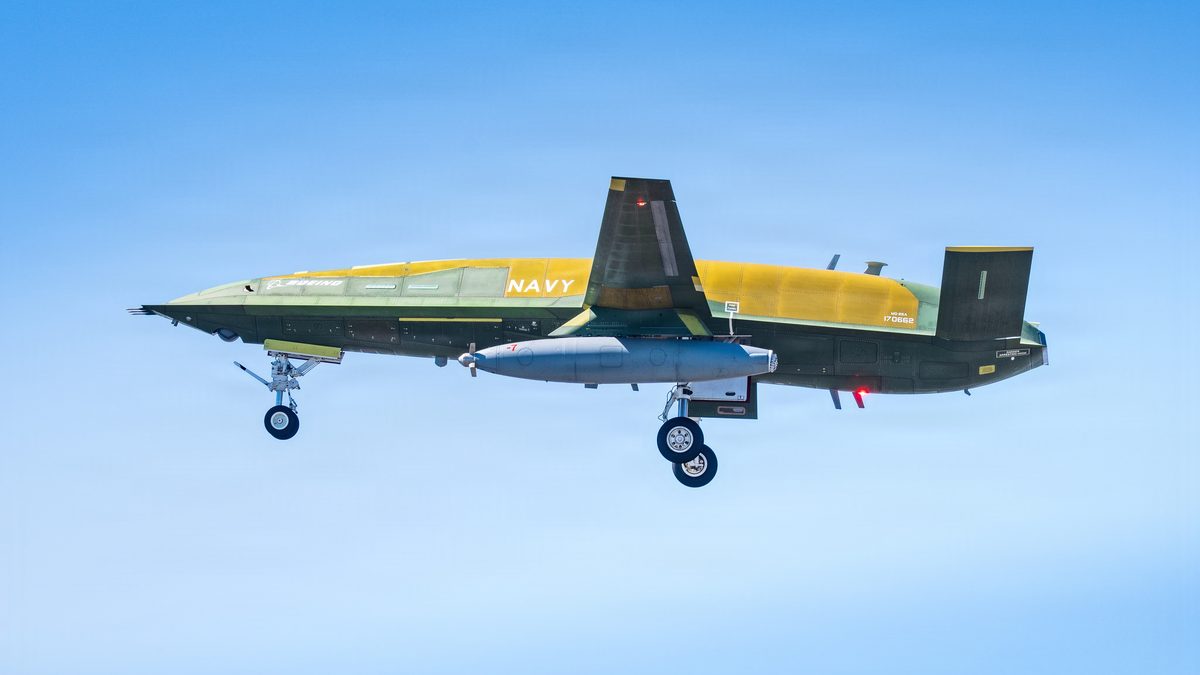
Photo: U.S. Navy / Jamie Cosgrove, Naval Air Warfare Center Aircraft Division, via DVIDS (public domain). MQ-25A first flight, 25 April 2026.
The MQ-25A Stingray: What It Is, What It Could Be, and Who Paid for It
What It Is
The Boeing MQ-25A Stingray is the United States Navy's first operational carrier-based unmanned aircraft, and its job is to refuel other aircraft in flight. It is an uncrewed aerial tanker that launches from and recovers aboard a nuclear-powered aircraft carrier, with a secondary role in intelligence, surveillance and reconnaissance (ISR). It is not a weapon and it is not a strike aircraft. The airframe is a clean-sheet design that grew out of an earlier carrier-drone effort and was redirected, late in its life, to the tanking mission.
That redirection is the key to understanding the aircraft. Most of the confusion in popular coverage comes from describing the Stingray as the stealthy armed carrier drone the Navy once wanted, rather than the tanker it actually bought. This guide sets out what it is, the requirement it was built to meet, the roles it has and could take on, and the offices that paid for it across nearly three decades.
A decade of carrier strike and surveillance ambition was traded, in a single 2016 decision, for fuel and reach. The Stingray is the tanker that decision produced. ISC assessment, 6 June 2026
The Original Specification and Requirements
The MQ-25A programme is built around two Key Performance Parameters (KPPs): sea-based tanking and carrier suitability. Everything else is secondary. Carrier suitability means the aircraft has to operate from the carrier like any other air-wing asset, launching off the catapults and recovering on the arresting gear, fitting the deck cycle and the hangar, and integrating with the ship's systems. Sea-based tanking sets the fuel it must pass: a threshold requirement to offload 14,000 lb of fuel at 500 nautical miles from the carrier, with an objective of roughly 15,000 lb at the same range.
ISR was written in as a secondary capability, not a primary requirement, which is why the sensor fit followed the tanker design rather than driving it. The programme also emphasised open mission systems and a common control segment, the Unmanned Carrier Aviation Mission Control System (UMCS), so the aircraft could be updated and, in principle, joined by other unmanned types later. The production aircraft is powered by a single Rolls-Royce AE 3007N turbofan in the 10,000 lbf (pound-force) thrust class, passes fuel through the Cobham Aerial Refueling Store (ARS) already used by F/A-18 Super Hornets in the buddy-tanking role, and measures roughly 51 ft long with a folding wingspan near 75 ft.
Baseline specification (open sources)
| Role | Carrier-based unmanned aerial refuelling; secondary ISR |
| Primary KPPs | Sea-based tanking and carrier suitability |
| Fuel offload | 14,000 lb (threshold) / ~15,000 lb (objective) at 500 nautical miles |
| Powerplant | One Rolls-Royce AE 3007N turbofan, 10,000 lbf class |
| Refuelling store | Cobham Aerial Refueling Store (hose and drogue) |
| Dimensions | ~51 ft length; ~75 ft wingspan (folding) |
| Control segment | Unmanned Carrier Aviation Mission Control System (UMCS) |
The Options: What It Does and What It Could Do
The roles attached to the Stingray span a wide range of maturity, and they should not be read as equivalent. Three are current or funded. The rest are proposals at varying distances from reality. The table grades them.
| Role | Status | Maturity |
|---|---|---|
| Aerial refuelling (tanking) | Primary mission | Funded, in low-rate production |
| Carrier suitability | Primary KPP | In flight test |
| ISR (forward surveillance) | Designed secondary role | Fields after the tanker mission |
| Relay / manned-unmanned teaming node | Secondary role | Teaming shown 2021; networked node is concept |
| Strike (e.g. anti-ship missile) | Proposed future variant | Display model only; unfunded |
| Cargo / logistics ("ammunition and supply") | Commentary proposal | No requirement; airframe not optimised |
The funded core is tanking, with carrier suitability as its twin requirement, ISR as a designed secondary role that arrives after the tanker mission, and a relay and manned-unmanned teaming (MUM-T) function that Boeing and the Navy first demonstrated in 2021. The proposed possibilities are more speculative. Boeing has shown a model carrying two AGM-158C Long-Range Anti-Ship Missiles (LRASM), and the Navy talks about a spiral path that could add combat roles once tanking is proven, but that is a concept and a display model, not a funded variant. Cargo and logistics carriage, sometimes stretched in commentary to "ammunition and supply delivery", is advocacy rather than a requirement: there is no cargo specification and the airframe is not built around a hold.
Who Funded It: From UCLASS to Low-Rate Production
The Stingray is the survivor of a programme that changed identity more than once, and the money trail runs through several offices. Its origins lie in late-1990s unmanned-combat-air-vehicle research by the Defense Advanced Research Projects Agency (DARPA) with the Navy and Air Force, which became the Joint Unmanned Combat Air Systems (J-UCAS) effort. The 2006 Quadrennial Defense Review cancelled J-UCAS, and the Navy carried the work forward alone as the Unmanned Combat Air System Demonstration (UCAS-D), which produced the Northrop Grumman X-47B and its carrier launch, recovery and aerial-refuelling demonstrations between 2013 and 2015.
In 2011 the Navy received approval to plan an operational programme, the Unmanned Carrier-Launched Airborne Surveillance and Strike (UCLASS) system, whose requirements swung between an ISR-heavy design and a penetrating-strike design without settling. The decisive change came in 2016, when a Pentagon portfolio review led by Deputy Secretary of Defense Bob Work, in the Office of the Secretary of Defense (OSD), converted UCLASS into the Carrier-Based Aerial Refueling System (CBARS), bought alongside extra Super Hornets and accelerated F-35s to blunt a looming strike-fighter shortfall. The carrier drone the Navy had debated for a decade became a tanker for budget reasons as much as operational ones. It was redesignated MQ-25A Stingray, and after a 2017 competition the Engineering and Manufacturing Development (EMD) contract, worth $805 million, went to Boeing on 30 August 2018.
Day to day the programme sits with the Unmanned Carrier Aviation program office (PMA-268) at Naval Air Station Patuxent River, under the Program Executive Officer for Unmanned Aviation and Strike Weapons, with the air warfare directorate of the Navy staff (OPNAV N98) as resource sponsor. Funding has run through Navy Research, Development, Test and Evaluation (RDT&E) accounts during development and is now moving into Aircraft Procurement, Navy (APN) for production. The Navy requested about $898 million for the programme in its fiscal year 2025 submission and about $1.04 billion in fiscal year 2026, in both cases to start the first three low-rate aircraft, although Congress trimmed three aircraft from the programme in the fiscal year 2025 appropriations. A 2025 Government Accountability Office (GAO) assessment put total acquisition cost at about $15.9 billion and unit cost at about $209 million, a four per cent rise on its previous estimate, and warned that starting low-rate initial production (LRIP) before testing the production aircraft risks further cost growth and delay. The Milestone C production decision followed on 19 May 2026, with initial operational capability (IOC) now set for 2029.
| Stage | When | Lead / funding owner |
|---|---|---|
| UCAV research, J-UCAS | 1999–2003 | DARPA, with US Navy and US Air Force |
| Navy-only UCAS-D (X-47B) | 2006–2015 | US Navy (DARPA heritage), Northrop Grumman |
| UCLASS planning and requirements churn | 2011–2015 | US Navy, PMA-268, OPNAV sponsor |
| OSD converts UCLASS to CBARS tanker | 2016 | Deputy SecDef Bob Work / OSD |
| EMD contract, $805 million | Aug 2018 | US Navy, awarded to Boeing |
| Production facility opened (MidAmerica) | 2024 | Boeing ($200 million) |
| GAO cost estimate; FY2025 cut of three aircraft | 2025 | GAO / Congress |
| Milestone C and LRIP; first production-rep flight | 2026 | US Navy / Boeing |
| Initial operational capability (planned) | 2029 | US Navy |
WOME scope note
The baseline MQ-25A is not a Weapons, Ordnance, Munitions and Explosives (WOME) subject. It carries no warhead, explosive fill or fuze, so Hazard Division and Compatibility Group, Net Explosive Quantity, and terminal-effects analysis are all not applicable; the only hazardous material is its fuel. The two roles that would re-open WOME scope are the least mature ones. An armed strike variant would carry real ordnance with its own hazard classification, and an ammunition-delivery role would make the cargo itself energetic. For now, the platform's WOME relevance runs inverse to its capability maturity.
References
Source-evaluated under NATO STANAG 2022 (Reliability A–F / Accuracy 1–6). Tier 1 = government or manufacturer primary source; Tier 2 = quality news / specialist defence media; Tier 3 = authoritative aggregator. The original prompting article (The Drone Front, 15 March 2026) rated Reliability D / Accuracy 3 and is corrected throughout.
- T2USNI News: Pentagon to Navy: Convert UCLASS Program Into Unmanned Aerial Tanker, 1 February 2016. (Reliability B / Accuracy 1)
- T1Congressional Research Service: MQ-25 Stingray: Background and Issues for Congress (IF12972), 2025–2026. (Reliability A / Accuracy 1)
- T1U.S. Government Accountability Office: Navy Unmanned Aerial Refueling System: Acquisition Addresses Validated Requirements (GAO-17-647), 2017. (Reliability A / Accuracy 1)
- T1NAVAIR: Unmanned Carrier Aviation Program Office (PMA-268), accessed June 2026. (Reliability A / Accuracy 2)
- T1Boeing: U.S. Navy Awards Boeing $805 million MQ-25 Contract, 30 August 2018. (Reliability A / Accuracy 1)
- T2USNI News: Navy Pushes MQ-25A Stingray IOC Back to 2029 while Production Aircraft Takes First Flight, 27 April 2026. (Reliability B / Accuracy 1)
- T2USNI News: MQ-25A Stingray Certified to Enter Low-Rate Initial Production, 19 May 2026. (Reliability B / Accuracy 1)
Corrections & updates welcome. If you hold open-source data that refines or corrects any parameter in this article, please contact [email protected] citing the specific claim and your source. Verified corrections will be incorporated and credited in the revision history. AI-assisted technical assessment based on open-source material. Not a formal intelligence product.