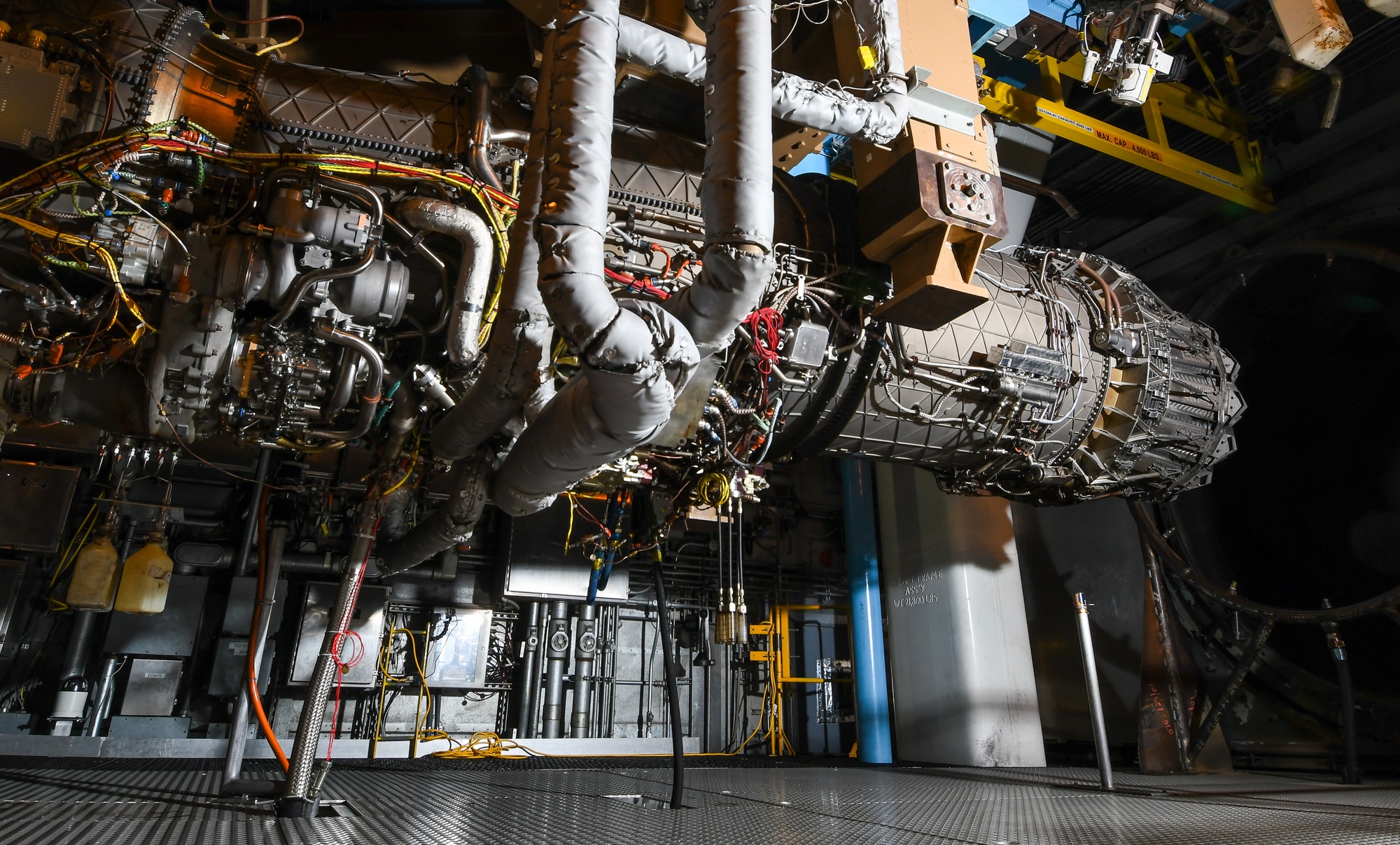
Illustrative: a Pratt & Whitney F135 engine in accelerated mission testing at Arnold Air Force Base, 2021. U.S. Air Force photo by Jill Pickett, public domain via DVIDS. Not the MG-01 installation; Lockheed Martin production imagery is corporate copyright.
Engine In: Germany's First F-35A Becomes a Weapons System Built for the B61-12
Production Milestone
Lockheed Martin has installed the Pratt and Whitney F135-PW-100 engine in the first F-35A Lightning II built for Germany. The company's European division released production-floor photographs from the Fort Worth final assembly line in Texas on 4 June 2026, describing the step as a key milestone on the path to delivering fifth-generation capability to Germany. The aircraft, the German serial MG-01, is the first of 35 ordered by Berlin. A formal rollout could follow within weeks, with first delivery planned by the end of 2026.
Engine mating is one of the defining points in F-35 final assembly. It comes after structural build and before fuel-system checks, ground run-ups, and the software work that ties the engine to the aircraft's flight-control and propulsion-management systems. Once those tests clear, the jet flies for the first time, then moves to formal acceptance by the customer nation. The event matters for a reason beyond the production schedule. The platform that will inherit the German Air Force (Luftwaffe) nuclear strike mission is now physically taking shape on the line.
The F135 is not simply bolted in. Its installation is the point at which the aircraft transitions from an airframe into a functioning weapons system. The Defence Blog – 4 June 2026
From Airframe to Weapons System
The F135 is the most powerful engine ever fitted to a single-engine fighter. Built by Pratt and Whitney, a division of RTX Corporation, it produces roughly 191 kilonewtons (43,000 pounds) of thrust in afterburner. The powerplant is woven into the aircraft's low-observable design. The sawtooth flaps on its exhaust nozzle and the shaped inlet trim the radar return from the front and rear aspects, so the engine forms part of the stealth airframe rather than a unit hung inside it.
There is no second source. The F135 cannot be swapped for an alternative engine, which makes its installation a hard dependency in the production flow. Fitting it is the moment a German airframe stops being a structure and starts becoming a combat system, with propulsion, sensors, and weapons release brought under one management architecture. A Full Authority Digital Engine Control (FADEC) runs the powerplant, and the post-mating software loads bind it to the aircraft's flight-control and weapons-release logic. For an air force that has flown the same nuclear strike platform since the 1980s, that transition carries weight well past the factory.
The Real Purpose: Nuclear Sharing
Germany did not buy the F-35A mainly for conventional air power. The order exists to preserve Berlin's place in the North Atlantic Treaty Organisation (NATO) nuclear-sharing arrangement, under which a non-nuclear ally delivers United States nuclear weapons using its own aircraft and crews. The weapon is the B61-12 nuclear gravity bomb. The retiring platform is the Panavia Tornado IDS, which has held the mission for decades and is now near the end of its service life. No European fighter offered the mix of stealth, survivability, and nuclear certification that the role demands.
Certification is already in hand. In October 2023 the F-35A became the first fifth-generation fighter cleared to deliver the B61-12, several months ahead of the timeline promised to NATO capitals. The B61-12 Life Extension Programme, which modernised the bomb and added a guided tail kit, was formally completed in December 2024. A series of stockpile flight tests followed at the Tonopah Test Range in Nevada, where inert B61-12 shapes were released from the internal bays and tracked to impact in August 2025. Sandia National Laboratories and the United States National Nuclear Security Administration (NNSA) confirmed the results that November.
The handover is scheduled to complete by 2030. Until then the Tornado IDS of Taktisches Luftwaffengeschwader 33 (Tactical Air Wing 33) at Büchel Air Base holds the role. Around 20 United States B61 bombs are widely reported to be stored at Büchel, though the basing has never been officially confirmed. Germany expects to declare initial operational capability for the F-35A in 2028. Aircraft clearance is only half the task. The Büchel wing and its aircrew must also gain their own dual-capable aircraft (DCA) certification, a unit-level step separate from the airframe's 2023 clearance, before the F-35A can stand the German nuclear mission.
What MG-01 Will and Will Not Carry
The nuclear role drives the most important point about how the German jet carries weapons. The F-35A carries up to two B61-12 bombs inside its two internal weapons bays, not on external pylons. Internal carriage preserves the low-observable signature, so the aircraft can take a nuclear weapon into defended airspace and stay hard to detect. That is the break with the Tornado, which carries its ordnance externally and has no stealth. A survivable nuclear delivery platform changes the calculation an adversary's air defence has to make.
On the conventional side, the German package is built around United States missiles. The Foreign Military Sales (FMS) weapons set centres on the RTX AIM-120C-8 Advanced Medium-Range Air-to-Air Missile (AMRAAM) for the medium- and long-range fight, with the short-range AIM-9X Sidewinder also requested. The German-made IRIS-T missile, already carried on the Luftwaffe's Eurofighters, has no formal path onto the F-35A. For now the fleet will fly a largely American weapons inventory.
European missiles come later, and through a route Berlin does not fully control. The MBDA Meteor, a ramjet-powered Beyond-Visual-Range Air-to-Air Missile (BVRAAM) already fielded on German and Italian Eurofighters, is being integrated onto the F-35A as part of the aircraft's Block 4 upgrade, with an operational date in the early 2030s. Block 4 rides on the Technology Refresh 3 (TR-3) hardware standard that the German aircraft are being built to. Ground integration trials are done and flight testing is approaching. The dependency is the part that matters. A European missile, on a European nuclear-sharing aircraft, waits on a software programme the United States manages.
Programme, Industry and Basing
Germany ordered 35 F-35A aircraft through the Foreign Military Sales process, with the intergovernmental Letter of Offer and Acceptance signed on 14 December 2022. The decision was announced in March 2022, in the weeks after Russia's full-scale invasion of Ukraine. The figure usually attached to the programme is about 8.4 billion dollars, and it covers far more than the airframes. Training, simulators, logistics, weapons, and the support infrastructure a new type requires are all inside that number. The order placed Germany alongside the Netherlands, Norway, Denmark, Belgium, Italy, Poland, Finland, and Switzerland in a European F-35 bloc that now shapes the continent's air power planning.
There is German industrial content in the programme. Rheinmetall is building a centre-fuselage production facility at Weeze, which will feed parts into the global F-35 supply chain. The first Luftwaffe aircraft will not go straight home. Like the jets bought by Poland and Finland, they will be based first at Ebbing Air National Guard Base in Fort Smith, Arkansas, where German pilots and ground crews will train. The first aircraft are expected at Büchel in 2027. A larger question sits in the background. With the Future Combat Air System (FCAS) facing delay and doubt, Germany has been weighing further F-35 purchases on top of the original 35.
Assessment and Data Gaps
Several points remain open at the time of writing. The formal rollout date for the first aircraft has not been announced. The count of B61 weapons held in Germany, and the Büchel storage itself, rest on open-source reporting rather than official confirmation. The Block 4 timeline that governs Meteor integration has slipped before and could slip again. The size and timing of any follow-on German F-35 order remain undecided. None of these gaps changes the central fact. The engine is in, and the nuclear succession is moving from plan to hardware.
References
Source-evaluated under NATO STANAG 2022 (Reliability A–F / Accuracy 1–6). Tier 1 = government or manufacturer primary source; Tier 2 = quality news / specialist defence media; Tier 3 = authoritative aggregator / encyclopaedia.
- T1Lockheed Martin (F-35.com) – Germany's First F-35A Advances to Final Assembly, 23 March 2026. (Reliability A / Accuracy 2 – manufacturer primary, promotional framing)
- T1Sandia National Laboratories (LabNews) – B61-12 flight tests yield positive results, 13 November 2025. (Reliability A / Accuracy 1 – US national laboratory primary)
- T2Defence Industry Europe – Germany's first F-35A takes shape as F135 engine is installed at Fort Worth production line, 4 June 2026. (Reliability B / Accuracy 2)
- T2The Defence Blog – Lockheed installs engine in Germany's first F-35 fighter jet, 4 June 2026. (Reliability B / Accuracy 2)
- T2FlightGlobal – Lockheed begins final assembly of Germany's first F-35A, March 2026. (Reliability B / Accuracy 2)
- T2Janes – ILA 2024: MBDA presses Germany to integrate Meteor missile onto F-35A, June 2024. (Reliability B / Accuracy 2)
- T2The War Zone – F-35A Is Officially Certified For Nuclear Strike, 2024. (Reliability B / Accuracy 2)
- T2Air & Space Forces Magazine – F-35 Completes Final Test for Nuclear-Capable B61 Series Weapons, 2025. (Reliability B / Accuracy 2)
Corrections & updates welcome. If you hold open-source data that refines or corrects any parameter in this article, please contact [email protected] citing the specific claim and your source. Verified corrections will be incorporated and credited in the revision history. AI-assisted technical assessment based on open-source material. Not a formal intelligence product.