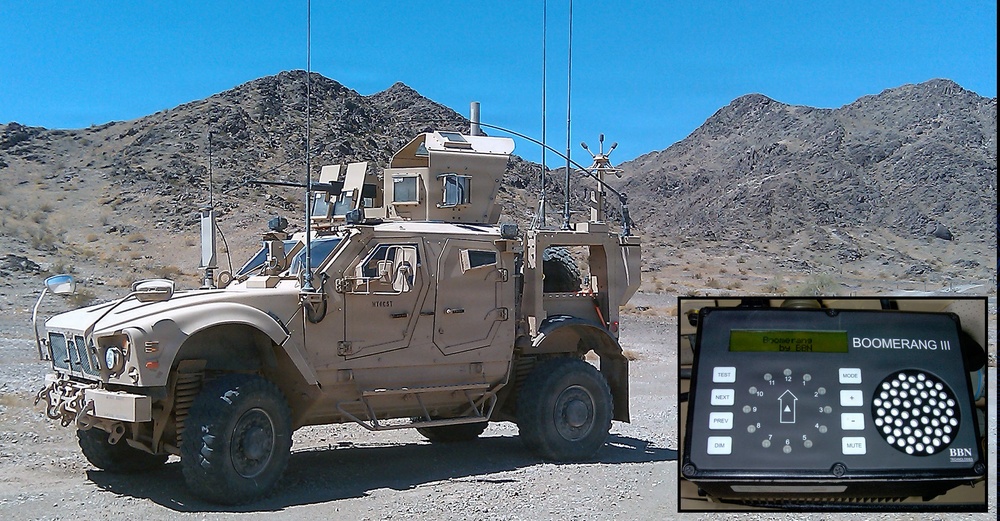
Illustrative: the U.S. Army Boomerang Generation III (BG III) gunshot-detection system, shown as the closest fielded U.S. equivalent to the passive acoustic approach behind SONUS. Boomerang is principally a small-arms shot detector; SONUS is a larger passive counter-battery weapon locator. Image: Brian Cooper, U.S. Army, via DVIDS (VIRIN 260113-O-BN542-2415), public domain. The appearance of U.S. Department of Defense visual information does not imply or constitute endorsement.
SERPENS reaches Minimum Deployment Capability eleven weeks after contract award
A short timeline for a defence programme
Project SERPENS, the British Army's next-generation weapon-locating effort under the Land Intelligence, Surveillance, Target Acquisition and Reconnaissance (Land ISTAR) Programme, has reached Minimum Deployment Capability (MDC). According to the British Army Programmes account, the milestone was met roughly eleven weeks, about two and a half months, after the contract was placed. By the normal rhythm of defence acquisition, that is a very short timeline.
The capability behind the milestone is SONUS, Leonardo UK's passive acoustic weapon-locating system, selected under SERPENS against an £18.3 million contract announced on 14 February 2026. SONUS lets soldiers detect incoming gunfire, mortar fire and explosions by reading the acoustic pressure waves they produce, and it does so without radiating any electronic signature of its own. Troops can therefore identify the source of fire quickly and covertly.
We've accelerated our procurement of this equipment by five years to provide additional layers of safety for our personnel through more durable, lightweight systems in a new era of threat. Luke Pollard MP, Minister for Defence Readiness and Industry, 14 February 2026
What the milestone means
Minimum Deployment Capability marks the point at which a system is judged fit to deploy in a defined initial form, ahead of fuller fielding. The Ministry of Defence (MoD) had already framed the SONUS contract as arriving five years earlier than originally planned. Reaching MDC within about eleven weeks of award compresses the front end of that schedule again. The British Army Programmes statement credits the pace to close work between Army Headquarters, Defence Equipment & Support (DE&S) and Leonardo.
One caveat belongs up front. ISC has not been able to confirm the exact MDC date, or the precise scope of capability it represents, from an independent primary source. The eleven-week figure rests on the originating Army statement, and is treated here as such (see Data Gaps).
How SONUS works
SONUS is a passive sensor. Where a counter-battery radar emits energy and times the return, SONUS listens. Sensor posts spread across the ground pick up the sounds a firing weapon and its projectile generate, and the system computes geometry from the small differences in when each sound reaches each post.
Three distinct acoustic events carry the information. The first is the muzzle blast, the report of propellant gases leaving the barrel. The second is the supersonic crack, the shockwave shed by a projectile travelling faster than sound, known as the Mach cone. The third is the detonation or impact at the target. By triangulating these signatures across several posts, SONUS returns both a point of origin and a point of impact.
The survivability argument follows directly. Because the system never transmits, it offers an adversary no emissions to detect, locate or strike. In a contested electromagnetic environment, that silence is the central reason armies keep a passive option alongside radar.
Passive sound ranging is not new, and neither are its limits. Armies have located guns by sound since the First World War, and the physics still imposes the same constraints. Wind, temperature gradients, terrain that masks or echoes a report, heavy rain and battlefield background noise all degrade an acoustic fix, so accuracy depends on sensor spacing, calibration and the propagation modelling behind the software rather than on the microphones alone. Spreading several posts across good geometry is what buys back robustness, through redundancy and a wider baseline.
That is also why passive and active sensors work best as a pair. A silent acoustic locator can hand a rough bearing to an emitting radar, which then confirms and refines the track while the radar stays off until it is needed. SERPENS is built around exactly this kind of cross-cueing, with a command-and-control layer meant to fuse the passive and radar pictures.
Lighter, faster, harder to find
The clearest engineering gains are in size, weight and set-up time. Leonardo states that SONUS is 50% smaller and weighs 70% less than its predecessor, with reduced power draw that lengthens how long a post can stay in the field between resupply. The sensor posts carry integrated Global Positioning System (GPS) microphones, which let a detachment bring the system into action in under three minutes.
SONUS is the latest version of Leonardo's Hostile Artillery Location (HALO) family, developed over more than two decades. The company says it is in service with thirteen users including six NATO members, with operational use spanning Bosnia, Iraq, Afghanistan and, most recently, Ukraine. An open-architecture design is intended to let later sensors and upgrades be added at lower risk.
How the United States made it wearable
Britain is not the first to push passive acoustic detection towards the individual soldier. The United States has fielded man-worn and vehicle-mounted gunshot detectors for well over a decade. The aim there is different: those systems hunt the sniper and the small-arms shooter, the direct-fire threat, rather than the artillery and mortars that SONUS is built to locate. The shared idea is portability, a small passive sensor a soldier can carry and bring into action quickly.
The closest parallel is the Individual Gunshot Detector (IGD), built by QinetiQ North America. It pairs four small acoustic sensors, each about the size of a deck of cards, with a compact display clipped to the body armour that shows the direction and distance of incoming fire. The whole kit weighs under two pounds, around 0.9 kg, and reacts in a fraction of a second by reading the supersonic crack of a passing round. From 2011 the US Army began issuing more than 13,000 of them to dismounted soldiers in Afghanistan, at a planned rate of up to 1,500 a month.
The IGD grew out of QinetiQ's EARS family of gunshot-localisation systems and its Soldier-Wearable Acoustic Targeting System (SWATS). SWATS is a shoulder-worn sensor roughly three inches square and 6.4 ounces in weight that fixes a shooter's location in under a quarter of a second, across a full 360 degrees, even from a moving vehicle. QinetiQ has reported more than 19,500 EARS and SWATS units shipped to around a dozen nations, with combat use in Iraq and Afghanistan. The vehicle-mounted Boomerang shown above, from Raytheon's BBN Technologies, attacks the same direct-fire problem from a platform rather than a person, and a dismounted variant exists.
| System | Maker | Form factor | Primary threat | What it locates | Notes |
|---|---|---|---|---|---|
| SONUS (SERPENS) | Leonardo (UK) | Networked ground sensor posts | Artillery and mortars (indirect fire) | Point of origin and point of impact | Sub-3-minute setup; 70% lighter than predecessor; counter-battery |
| HALO (legacy) | Leonardo (UK) | Networked ground sensor posts (predecessor) | Artillery and mortars (indirect fire) | Point of origin and point of impact | The system SONUS replaces; larger and heavier (SONUS is 50% smaller, 70% lighter) |
| Boomerang (BG III) | Raytheon BBN (US) | Vehicle-mounted; dismounted variant | Small arms and snipers (direct fire) | Shooter bearing and range | Long-running US vehicle fit; the hero image above |
| Individual Gunshot Detector (IGD) | QinetiQ North America (US) | Man-worn: four sensors plus body-armour display | Small arms and snipers | Direction and distance to shooter | Under 2 lb (about 0.9 kg); 13,000+ fielded in Afghanistan from 2011 |
| EARS SWATS | QinetiQ North America (US) | Shoulder-worn (also vehicle and fixed) | Small arms and snipers | Shooter location across 360 degrees | About 6.4 oz; under 0.25 second; 19,500+ units across roughly 12 nations |
The distinction worth holding onto is mission class. SONUS and the wider HALO line locate indirect-fire weapons, mortars and guns, by netting several ground posts together and triangulating across an area, then passing that fix into the targeting chain. The US wearables locate the man with the rifle for immediate local protection, one soldier or one vehicle at a time. All of them listen for the same physics, the muzzle blast and the supersonic crack, which is why they read as cousins. Where they part company is range, scale and purpose. SONUS is light and quick to set up for its class, yet it remains a networked counter-battery locator rather than a body-worn alarm.
Why the pace matters
Speed of fielding has become a capability in its own right. Ukraine has shown how fast the counter-battery fight evolves, and how exposed an emitting sensor can be. Narrowing the gap between contract and usable equipment shrinks the window in which a requirement can drift or an opponent can adapt. The MoD has tied SERPENS to a wider acquisition-reform drive and to the Army's stated aim of doubling its lethality by 2027.
The deal also carries an industrial dividend that government is keen to log. The contract sustains around 250 jobs across the United Kingdom, notably at Leonardo's Basildon site, and draws in 29 small and medium-sized enterprises (SMEs) through the supply chain. That framing sits inside the Strategic Defence Review (SDR) and the Defence Industrial Strategy (DIS), and the planned rise in defence spending to 2.6% of gross domestic product (GDP) from 2027.
Where SONUS sits in SERPENS
SONUS is one piece of a larger programme. SERPENS is renewing the Royal Artillery's whole weapon-locating line, and it is built in segments: a long-range Deep Find radar, for which the United Kingdom has looked to a Netherlands partnership; a shorter-range Close Find radar, with around 25 sets planned to arrive through 2027; and a passive segment that pairs acoustic and electro-optic sensors. SONUS is the acoustic half of that passive segment, and it replaces the Army's legacy HALO sets.
What ties the segments together is the command-and-control system that fuses their feeds and lets one sensor cue another. SERPENS is meant to retire several ageing systems at once, among them the MAMBA radar (the Saab ARTHUR in British service) and the AN/TPQ-49 lightweight counter-mortar radar, both due out of service around 2026. SONUS reaching deployable status first means the passive, hardest-to-detect layer of that future architecture is the part already moving into service.
Land ISTAR and the Digital Targeting Web
SERPENS does not stand alone. It is one strand of the Land ISTAR Programme, the land component of the Army's Digital Targeting Web, the network meant to connect sensors to decision-makers and shooters so a detected target can be understood and engaged faster. Land ISTAR's digital backbone is Project ZODIAC, which is intended to fuse multiple sensor feeds into a single intelligence picture and automate parts of collection and analysis.
Read against that backdrop, a passive locator such as SONUS is both a sensor and a node. Its worth grows once its point-of-origin data flows into the wider web rather than staying inside one regiment. The first SONUS platforms are to be delivered to 5th Regiment Royal Artillery, the Army's dedicated Surveillance and Target Acquisition (STA) regiment, over twelve months.
Data gaps
Several points stay open from open sources. The exact date and working definition of the MDC milestone rest on the British Army Programmes statement and are not, at the time of writing, set out in an independent primary source. The number of systems covered by the £18.3 million contract has not been published. Detailed performance values, such as location accuracy, detection range and the number of posts per baseline, are not in the public domain, which is normal for a fielded weapon-locating capability. One figure also needs care: Leonardo's "over 25 years" of HALO development and the "over 40 years" of passive acoustic weapon-locating experience cited by Leonardo's Olly Manning describe different things and should not be merged into a single number.
References
Source-evaluated under NATO STANAG 2022 (Reliability A–F / Accuracy 1–6). Tier 1 = government or company primary source; Tier 2 = quality news / specialist defence media; Tier 3 = authoritative aggregator; Tier 5 = social media post by named institutional account.
- T1Ministry of Defence (GOV.UK) – Enemy weapons detector in the hands of soldiers five years early, 14 February 2026. (Reliability A / Accuracy 1)
- T1Leonardo UK – Leonardo selected to provide British Army with operationally-proven Hostile Artillery Location System, 14 February 2026. (Reliability B / Accuracy 2)
- T1Defence Equipment & Support – DE&S helps deliver new lethal digital-targeting web system to soldiers, 2026. (Reliability A / Accuracy 2)
- T2UK Defence Journal – Army fast-tracks SONUS gunfire detector by five years, February 2026. (Reliability B / Accuracy 2)
- T2Janes – Leonardo's SONUS to be delivered to British Army's 5th Regiment Royal Artillery over next 12 months, 2026. (Reliability B / Accuracy 2)
- T3New Atlas – British Army adopts acoustic system to pinpoint enemy artillery, February 2026. (Reliability C / Accuracy 3)
- T2Euro-SD (European Security & Defence) – Towards a New UK Weapon-Locating Capability, 2023. (Reliability B / Accuracy 2)
- T3Future Warfare Magazine – SERPENS: competition for the Close Find weapon-locating radar starts, 2025. (Reliability C / Accuracy 3)
- T2Janes – UK looks to Netherlands tie-up for SERPENS Deep Find radar, 2025. (Reliability B / Accuracy 2)
- T1U.S. Army – Army deploying 'Individual Gunshot Detector', 2011. (Reliability A / Accuracy 2)
- T1QinetiQ – EARS Gunshot Localization Systems, including SWATS, accessed June 2026. (Reliability B / Accuracy 2)
- T1U.S. Army via DVIDS (hero image, public domain) – PM TS: Boomerang Generation III (BG III), VIRIN 260113-O-BN542-2415, credit Brian Cooper, 13 January 2026. Used illustratively as the US equivalent. (Reliability A / Accuracy 2)
- T5British Army Programmes (LinkedIn) – statement that SERPENS reached Minimum Deployment Capability roughly eleven weeks after contract award, June 2026. Originating source for the MDC claim; not independently corroborated at time of writing. (Reliability F / Accuracy 3)
Corrections & updates welcome. If you hold open-source data that refines or corrects any parameter in this article, please contact [email protected] citing the specific claim and your source. Verified corrections will be incorporated and credited in the revision history. AI-assisted technical assessment based on open-source material. Not a formal intelligence product.