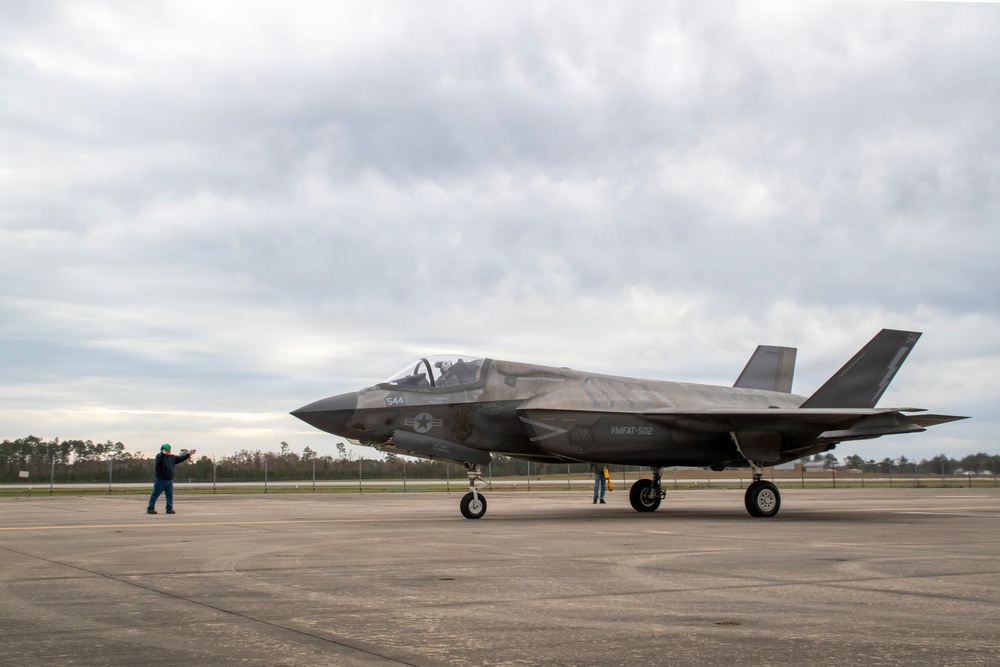
An F-35B Lightning II begins a functional check flight inspection at Fleet Readiness Center East, Marine Corps Air Station Cherry Point, North Carolina. Photo: Joe Andes, FRC East Public Affairs, via DVIDS (US Government, Public Domain).
TR-3 Retrofit Begins: The Backbone for the F-35's Block 4 Weapons
What happened
The United States has started converting in-service F-35 fighters to a new computing standard, and the work is being done on aircraft that have already flown operationally rather than on the production line. On 19 February 2026, the F-35 Joint Program Office (JPO) and Fleet Readiness Center East (FRC East) at Marine Corps Air Station Cherry Point, North Carolina, inducted the first three fielded F-35B Lightning II jets for conversion from the Technology Refresh 2 (TR-2) configuration to Technology Refresh 3 (TR-3).
The three aircraft are United States Marine Corps F-35Bs, the short take-off and vertical landing (STOVL) variant, designated BF-105, BF-81 and BF-88. Two have already returned to the fleet, BF-105 on 14 May and BF-88 on 21 May, with BF-81 due to complete its conversion in July. New-build F-35s have rolled off the line with TR-3 hardware for some time. What is new here is that existing TR-2 jets are now being retrofitted, and the JPO says more than 700 already-fielded aircraft are in line to follow. The induction follows roughly six years of planning, training and production preparation by the JPO Air Vehicle Program Management Office and its industry partners.
We also have more than 700 aircraft already fielded that must be upgraded. These aircraft are the first of many. This is the starting point for an effort that will grow year after year. Lt Col Matthew Hawkins, materiel leader for F-35 modifications and retrofits, F-35 JPO Air Vehicle PMO
What TR-3 actually delivers
TR-3 is not a weapon or a sensor. It is the computing foundation that newer weapons and sensors need in order to function. The package centres on a new integrated core processor (ICP), a panoramic cockpit display (PCD) and the wiring and hardware to host advanced electronic warfare (EW) and future mission systems. In plain terms, it is a large increase in processing power, memory and data-handling headroom.
The headline figures come from industry rather than the program office. The integrated core processor supplier and Lockheed Martin have described the new processor as offering on the order of 25 times the computing power of the TR-2 unit, with some published metrics citing a 37-fold gain on specific processing tasks and roughly 20 times the onboard memory. The program office keeps to more conservative wording, citing a "substantial increase in computing power, memory and processing capacity." Either way the intent is the same: to give the aircraft the spare capacity that its current avionics cannot provide.
Two design points matter more than the raw numbers. TR-3 moves the F-35 toward a more open, modular mission-system architecture, and that is what lets Block 4 arrive as a stream of incremental software drops rather than monolithic rebuilds, while also easing the integration of allied weapons. The refresh also feeds the parts of Block 4 that are not kinetic at all: faster sensor fusion, stronger electronic warfare processing and the data throughput that networked weapons rely on. The panoramic cockpit display is the crew-facing end of the same upgrade, presenting that fused picture with less pilot workload.
The Block 4 weapons unlock
This is where TR-3 matters for the weapons community. The upgrade is the named hardware prerequisite for Block 4, the F-35's next major capability programme, and Block 4 is largely a weapons-and-sensors story. The advanced sensors, the data fusion and the new munitions planned under Block 4 all assume the processing and memory that TR-3 provides. Without the refresh, much of the Block 4 arsenal cannot be fully integrated or cleared for carriage.
The munitions queued behind Block 4 span the full air-to-air and air-to-ground spectrum:
- AIM-260 Joint Advanced Tactical Missile (JATM): a longer-range successor to the AIM-120 Advanced Medium-Range Air-to-Air Missile (AMRAAM), intended to counter long-reach threats such as the Chinese PL-15 and Russian R-77M.
- AGM-88G AARGM-ER: the Advanced Anti-Radiation Guided Missile - Extended Range, for Suppression and Destruction of Enemy Air Defences (SEAD and DEAD), giving the F-35 a stand-in capability against modern integrated air-defence systems.
- GBU-53/B StormBreaker: the Small Diameter Bomb II (SDB II), a network-enabled, all-weather precision weapon with a tri-mode seeker for moving targets.
- The "Sidekick" weapons rack: a carriage change that lifts the internal air-to-air load of the F-35A and F-35C from four to six AMRAAM-class missiles, a 50 per cent increase in magazine depth without breaking the stealth signature. The short take-off and vertical landing F-35B does not share this gain, because its lift fan reduces internal bay volume, so the variant now entering TR-3 retrofit keeps a shallower internal air-to-air magazine.
- Joint Strike Missile (JSM): the Kongsberg-developed anti-ship and land-attack missile sized for internal carriage, extending the F-35's reach against surface vessels.
Each of these is more demanding of the mission system than a legacy bomb or missile. Network-enabled weapons, advanced seekers and beyond-visual-range engagement all depend on sensor fusion, fast data links and software that the TR-2 computer was never designed to run at scale. The retrofit now starting at Cherry Point is the quiet precondition behind every one of those weapon headlines.
The UK and allied dimension
For the United Kingdom, the stakes sit squarely with the carrier strike weapons fit. The Royal Navy and Royal Air Force operate the same F-35B variant as the US Marine Corps, and the two UK-specific weapons that matter most for the type, both built by MBDA, are tied directly to TR-3 and Block 4.
The first is SPEAR 3 (Selective Precision Effects At Range, Capability 3), the UK's networked precision strike missile designed for internal F-35B carriage, with up to eight rounds per aircraft. A US Marine Corps F-35B carried four inert SPEAR 3 rounds in an internal weapons bay during captive-carry testing at Naval Air Station Patuxent River, flown by a Royal Navy test pilot from the UK Air and Space Warfare Centre. The second is the Meteor beyond-visual-range air-to-air missile (BVRAAM), whose ramjet sustainer gives a far larger no-escape zone than the AMRAAM. Inert Meteor test flights have been conducted on the F-35B at Patuxent River, with fit checks and ground vibration testing on the F-35A completed at Edwards Air Force Base in late 2025.
The testing is progressing, but the in-service dates are not close. UK officials and analysts now expect Meteor and SPEAR 3 to reach front-line F-35B units around 2032, gated by the Block 4 software increments and, beneath them, the TR-3 hardware standard. The UK fleet will need its own TR-3 retrofit before those missiles are usable, which places British jets in the same multi-year depot queue now forming behind the US Marine Corps aircraft. The allied depot footprint reflects this shared dependency: FRC East is one of five global F-35 depots, alongside Hill Air Force Base and Ogden in Utah, Cameri in Italy and Williamstown in Australia, the latter two serving the Italian and Australian F-35 fleets.
Programme risk and the schedule problem
The retrofit is a genuine milestone, but it arrives against a difficult programme backdrop, and the weapons timelines inherit that risk. TR-3 itself ran years late, chiefly on software, and triggered a roughly year-long pause in new F-35 deliveries across 2023 and 2024. Deliveries resumed in mid-2024, initially with truncated software that was training-capable rather than fully combat-ready. The US Director of Operational Test and Evaluation (DOT&E) reported that no combat-capable TR-3-configured F-35s were delivered during fiscal year 2025, an indication of how much software maturation still has to run.
Block 4 sits further out again. The US Government Accountability Office (GAO) has estimated that Block 4 will not be complete before 2031, a multi-year slip from the original plan, with cost estimates that have climbed past 16 billion US dollars. The hardware retrofit and the software that brings the weapons to life are separate efforts, and both must converge before a given munition is cleared on a given jet. The Cherry Point induction moves the hardware side forward. It does not, on its own, shorten the weapons timeline.
The retrofit also sits inside a wider modernisation bow-wave. The added Block 4 electronics draw more electrical power and produce more heat than the current jet was built to dissipate, which is driving two further efforts: the Pratt & Whitney F135 Engine Core Upgrade and a new Power and Thermal Management System. Neither is part of the TR-3 induction at Cherry Point, and both run on their own schedules, with the upgraded engine not expected to fly until around 2029 and the cooling upgrade targeted for the late 2020s. They matter to this story because they compete for the same depot capacity, engineering effort and budget that the TR-3 retrofit needs.
Data gaps
Several figures relevant to planners are not yet in the public record. The program office has not disclosed the per-aircraft conversion time at FRC East, the planned annual throughput once full-rate processes are established, or how the 700-plus retrofit total is phased across the five depots. The schedule for converting allied fleets, including the UK F-35B force, has not been published. Nor has the program office mapped publicly which Block 4 increment will clear each individual weapon, so the link between a given retrofit slot and a given munition entering service remains an estimate rather than a confirmed sequence.
References
Source-evaluated under NATO STANAG 2022 (Reliability A–F / Accuracy 1–6). Tier 1 = government primary source; Tier 2 = quality news / specialist defence media; Tier 3 = authoritative aggregator / encyclopaedia.
- T1F-35 Joint Program Office, via DVIDS – First F-35Bs receive key TR-3 upgrade at FRC East, 2 June 2026. (Reliability A / Accuracy 1)
- T2Defence Industry Europe – First operational F-35B aircraft begin TR-3 upgrade work at Fleet Readiness Center East, June 2026. (Reliability B / Accuracy 2)
- T2Air & Space Forces Magazine – First F-35 Block 4 Updates Start to Roll Out, Block 5 List Taking Shape, 2026. (Reliability B / Accuracy 2)
- T2The War Zone – F-35 To Get Meteor, SPEAR 3 Missiles "By End Of Decade", 2025. (Reliability B / Accuracy 2)
- T2UK Defence Journal – Meteor F-35 integration shows no signs of urgency, 2025. (Reliability C / Accuracy 3)
- T2The Aviationist – DOT&E Says No Combat-Capable TR-3-Configured F-35s Were Delivered in FY2025, 25 March 2026. (Reliability B / Accuracy 2)
- T2L3Harris Technologies – TR-3: The Open Architecture Backbone of the F-35 Lightning II (integrated core processor figures), 2023. (Reliability C / Accuracy 3)
- T2Air & Space Forces Magazine – Pratt & Whitney Gets $1.3 Billion to Mature F-35 Engine Core Upgrade, 2025. (Reliability B / Accuracy 2)
Corrections & updates welcome. If you hold open-source data that refines or corrects any parameter in this article, please contact [email protected] citing the specific claim and your source. Verified corrections will be incorporated and credited in the revision history. AI-assisted technical assessment based on open-source material. Not a formal intelligence product.