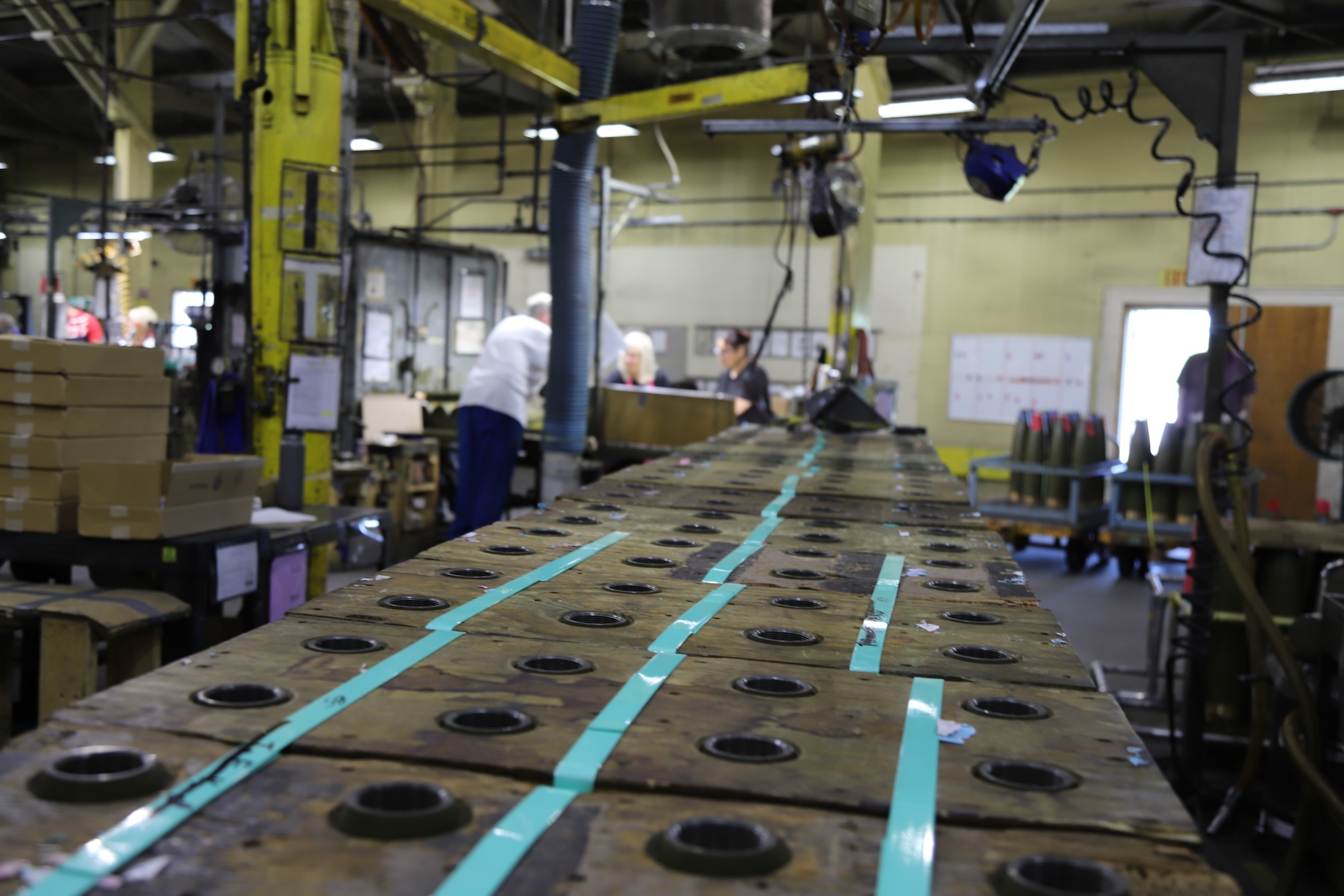
The Polish Armaments Group (Polska Grupa Zbrojeniowa, PGZ) and BAE Systems took the British-Polish Collaboration Award on 29 May 2026 for their partnership to build a new 155mm artillery ammunition plant in Poland. The headline is a trophy. The substance is a transfer of a complete production capability, arriving in the same week that London and Warsaw signed a defence treaty.
The British Embassy in Warsaw and the British Polish Chamber of Commerce (BPCC) presented the award jointly, as part of the second edition of the UK-Poland Business Awards. A jury of senior Embassy and BPCC figures selected the winners (BAE Systems reference 058/2026). The citation singles out cooperation on 155mm artillery ammunition, pairing UK technological expertise with Polish industrial capacity at a point of sustained high demand.
The timing rewards a closer look. Two days earlier, on 27 May 2026, the United Kingdom and Poland signed a Security and Defence Partnership Treaty at RAF Northolt, the wartime home of Polish airmen. BAE Systems referenced that treaty directly in announcing the award. Read together, the plant is less a standalone commercial deal than the industrial expression of a deepening UK-Poland defence relationship.
How the partnership was formed
The collaboration rests on a Strategic Partnership Agreement signed in September 2025. Polish Prime Minister Donald Tusk announced the technology transfer on 12 September 2025 during a visit to Zakłady Metalowe Dezamet in Nowa Dęba. PGZ chose BAE Systems after a year-long evaluation against three stated criteria: production sovereignty, technological solution, and price.
Under the agreement BAE Systems transfers production technology, manufacturing know-how, and automated production lines, while PGZ builds and operates the facility. The scope is wider than shells. Both companies describe a platform for further cooperation across a broader range of munitions and components, and for the manufacture of energetics. Crucially, the flow is two-way: PGZ has signalled an intent to introduce its own explosives production technology into the British market.
What the principals said
“The economic partnership between the United Kingdom and Poland is stronger today than ever before. The second edition of the UK–Poland Business Awards demonstrates how dynamically and on multiple fronts our cooperation is developing — from growing direct investment and trade to joint initiatives in energy transition, new technologies, and security. The recipients of these awards perfectly illustrate the ambition and potential of our cooperation.”
Dame Melinda Simmons DCMGHis Majesty’s Ambassador to the Republic of Poland
“We are honoured to be recognised in such a positive way alongside our friends at PGZ. As Poland’s proven defence partner, BAE Systems remains dedicated to the mission of helping to ensure national security through the provision of 155mm artillery ammunition in great quantities and high quality to meet our nation’s objectives.”
Mirosław JanickiDirector, BAE Systems Poland
“We are benefiting from BAE Systems’ vast experience and know-how, and on the other, we are opening a path to the British market, where we can introduce our explosives production technologies. I am confident that this collaboration will continue to develop in a direction beneficial to both sides and, above all, the Polish Armed Forces and the Polish defence industry.”
Adam LeszkiewiczPresident of the Management Board, PGZ S.A.
The 155mm projectile is a system, not a commodity
For Weapons, Ordnance, Munitions and Explosives (WOME) practitioners, the meaningful detail is that this transfers a whole production capability rather than a single supply contract. A 155mm High Explosive (HE) round is an assembly of qualified parts, and sovereign production means qualifying each one rather than importing finished natures.
A complete round breaks down roughly as follows:
- Body. High-strength forged and machined steel. Wall thickness, ogive profile, and driving-band geometry are critical for 52-calibre compatibility. Poland already produces shell bodies under licence (work tied to MSM Group of Slovakia has been running at Kraśnik).
- Explosive fill. Conventional melt-pour Composition B (a Royal Demolition Explosive, RDX, and trinitrotoluene, TNT, mix) or pure TNT remains common and cost-effective. Modern lines increasingly support insensitive-munition (IM) fills, for example IMX-class or DNAN-based (dinitroanisole) compositions, which typically need cast-cure or precision press processes rather than simple melt-pour. That changes line design, temperature control, and vacuum and pressure cycling.
- Ancillary components. Booster pellet, supplementary charge where required, threaded fuze well and adapter, base plug or base-bleed unit for extended-range natures, and an obturator.
- Finishing. Automated painting, laser or ink marking, lot numbering, and packaging to the qualified hazard standard.
Where the sixteen-fold figure comes from
PGZ states the plant will lift its 155mm output roughly sixteen-fold. That number deserves a precise reading. It describes the gain the automated architecture delivers at BAE Systems’ UK reference plant relative to a low, largely manual legacy baseline. BAE’s UK output had been measured in a few thousand shells a year, so even a sixteen-fold lift at that single site reaches the order of 80,000 rounds annually.
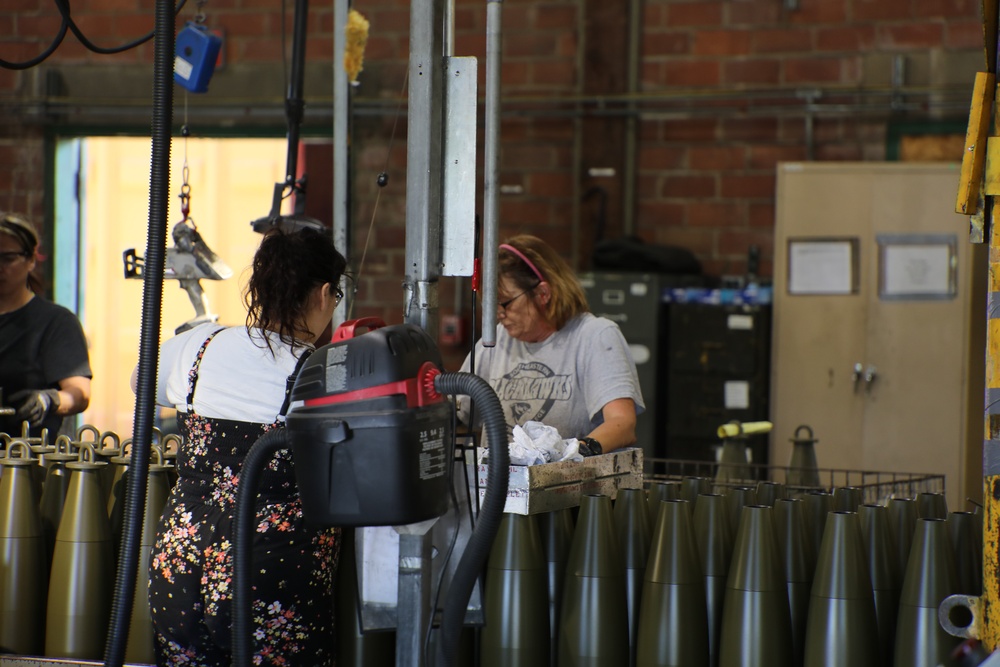
Applied in Poland, the same line plus parallel state investment is what underwrites the move from a national baseline near 20,000 complete sets a year toward the stated 150,000 to 180,000 target, with about 130,000 rounds a year achievable once the new facilities mature around 2027 to 2028. The automation does the technical heavy lifting: robotic shell transport, filling stations with real-time weight and volume monitoring, vision systems for defect detection, and closed-loop process control. The payoff is lower operator exposure to energetics, higher first-pass yield, tighter dimensional and explosive-mass tolerances, and smoother lot acceptance.
The reference plant is not without friction. BAE’s UK facility at Glascoed is built and in testing, but its opening slipped after a mid-2025 decision to double its planned capacity. That is a useful reminder that commissioning a modern energetics line is itself a demanding engineering programme, in Wales or in Subcarpathia.
Energetics, insensitive munitions, and the safety case
A new filling and assembly facility carries process-safety obligations across the full lifecycle, and the choice of energetic fill governs much of the downstream picture. Packaged 155mm HE projectiles are typically assigned Hazard Division (HD) 1.1, the mass-explosion risk class, with a defined Compatibility Group. The Net Explosive Quantity (NEQ) per round, on the order of several kilograms of high explosive for an M795-class projectile, together with the per-pallet total, drives quantity-distance (QD) separation at the plant and its magazines.
This is where insensitive munitions earn their place. IM-compliant fills, assessed under NATO Standardization Agreement (STANAG) 4439 and the associated Allied Ordnance Publication AOP-39, can in certain configurations achieve a lower hazard division and reduced reaction violence. That allows denser storage and a smaller quantity-distance footprint, a real-estate and resilience advantage over the life of a programme rather than a one-off saving. The trade is upfront: IM fills tend to demand the more exacting cast-cure or press processes noted above.
Before any nature enters the wider NATO supply chain, the line needs a full explosives safety case, proof and acceptance testing of early lots, and lot-acceptance sampling against the qualified specification. NATO quality assurance for defence procurement runs through the Allied Quality Assurance Publications (AQAP), with AQAP-2110 the design-and-production workhorse. Ballistic interoperability across allied 155mm systems is held together by the Joint Ballistics Memorandum of Understanding (JBMOU), which standardises chamber and projectile profile so a round fires safely and predictably from both 39- and 52-calibre ordnance.
Fit with Polish guns
The output has a ready home. Poland’s Krab (a 155mm, 52-calibre system marrying an AS90-derived turret to a Korean K9 chassis) and its K9A1 howitzers fire the standard NATO 155mm family: M795-type HE, base-bleed extended-range natures, and modular charge systems, with point-detonating, proximity, and precision-guidance fuzes. New domestic production must qualify across that fuze and charge set without forcing changes to existing fire-control. Get that right and the rounds are fungible across Poland’s rapidly growing gun fleet and exportable to allied users.
The bigger picture: Poland as a 155mm hub
The BAE and PGZ line is one pillar of a deliberate build-out, not the whole structure. Several efforts are running in parallel.
- State investment. In July 2025 Poland committed about PLN 2.4 billion (roughly USD 662 million) across four PGZ companies: Dezamet (PLN 1.36 billion, shell bodies and 155mm capacity), Mesko (PLN 887 million, 155mm shells), Nitro-Chem (PLN 113 million, filling and elaboration lines), and Gamrat (PLN 66 million, base-bleed units). The target is full operating capacity by the end of 2027.
- A parallel Western line. In February 2026 Poland’s Niewiadów signed a framework agreement with Northrop Grumman to produce more than 180,000 155mm shells a year, aimed at Polish, US, and European customers, and now in certification preparation. This sits separately from the BAE and PGZ line.
- EU financing. Poland signed a EUR 43.7 billion Security Action for Europe (SAFE) loan package, the largest allocation of any member state, and began signing the first SAFE-backed contracts in late May 2026, with PGZ the principal recipient and ammunition among the named priorities.
- Demand pull. In the same week, PGZ took contracts for nearly 100 additional Krab howitzers with hundreds of thousands of large-calibre rounds, plus a second batch of Borsuk infantry fighting vehicles. The guns and the shells are being bought together.
The two-way clause is the part worth watching. Leszkiewicz framed the deal as opening the British market to Polish explosives technology, not merely importing UK know-how. If that materialises, the United Kingdom gains a potential second-source energetics supplier precisely when its own Glascoed ramp has slipped. For Poland, the prize is a sovereign artillery-ammunition base that feeds its own forces first and NATO stocks second. For the alliance, more qualified 155mm capacity across more sites is the resilience lesson of the past four years, written into concrete and steel.
DATA GAPS (carried forward and refined). These are normal at the technology-transfer stage and should resolve during detailed design and qualification across 2026 to 2027.
Nature and family: the specific 155mm projectile (HE, base-bleed extended-range, or other) is not confirmed in open source. Fill: the energetic fill type and its insensitive-munitions status are not stated. Qualification regime: the applicable STANAG references and AQAP coverage for the Polish line are not disclosed. Hazard data: per-round NEQ and the HD and Compatibility Group assignment for the planned natures are not given. Facility: exact location, in-service date, and proof-range arrangements are not yet public, though construction was expected from late 2025 with operating capability targeted for 2027 to 2028.
References
- BAE Systems, “PGZ and BAE Systems win British-Polish collaboration award” (official news release, ref 058/2026, 29 May 2026). baesystems.com A2
- Defence Industry Europe, “PGZ and BAE Systems win British-Polish collaboration award for 155mm ammunition industrial partnership” (29 May 2026). defence-industry.eu B2
- GOV.UK, “Security and Defence Partnership Treaty: the projects the UK and Poland will deliver together” (27 May 2026). gov.uk A1
- Defense News, “Poland picks BAE Systems for artillery ammunition ramp-up” (15 September 2025). defensenews.com B2
- Notes From Poland, “Poland forms strategic partnership with Britain’s BAE Systems to produce artillery shells” (12 September 2025). notesfrompoland.com B2
- European Security & Defence, “PGZ selects BAE as partner” (September 2025). euro-sd.com B3
- Breaking Defense, “Poland invests in the production of 155mm ammunition” (July 2025). breakingdefense.com B2
- Notes From Poland, “Northrop Grumman and Niewiadów to jointly produce artillery shells in Poland” (12 February 2026). notesfrompoland.com B2
- Notes From Poland, “Poland signs first defence contracts under EU’s SAFE programme” (29 May 2026). notesfrompoland.com B2
- Defense Express, “UK aimed for 16x output boost in 155mm shells but BAE’s new plant is behind schedule” (Glascoed reference, 2026). en.defence-ua.com C3
- Defence Industry Europe, “Poland enhances artillery forces with new contract for nearly 100 Krab howitzers and hundreds of thousands of large-calibre rounds” (30 May 2026). defence-industry.eu B2
- Image: U.S. Army / Defense Visual Information Distribution Service (DVIDS), “Projectile production at Iowa Army Ammunition Plant” and “M795 production”, photos by Dori Whipple (public domain). dvidshub.net A1
Source evaluation (NATO STANAG 2022). Reliability A–F, Accuracy 1–6. Core facts (the award, the named principals and their verbatim quotes, the September 2025 Strategic Partnership Agreement, the 27 May 2026 UK-Poland treaty) rest on the primary BAE Systems release (A2) and the official GOV.UK record (A1), corroborated by multiple independent trade outlets (B2). Capacity figures and the sixteen-fold gain are consistently reported across B2 and B3 sources but remain company-stated targets rather than audited output. The Glascoed schedule reference is rated C3 (fairly reliable, possibly true) and is used only as context.
AI-assisted technical assessment prepared by ISC Defence Intelligence from open-source material. Not a formal intelligence product and not affiliated with BAE Systems, PGZ, or His Majesty’s Government. Direct quotations are reproduced verbatim from the official BAE Systems release (ref 058/2026). Hero and inline imagery are U.S. Government public-domain photographs used for illustration and do not depict the Polish facility. Open Source / Unclassified.