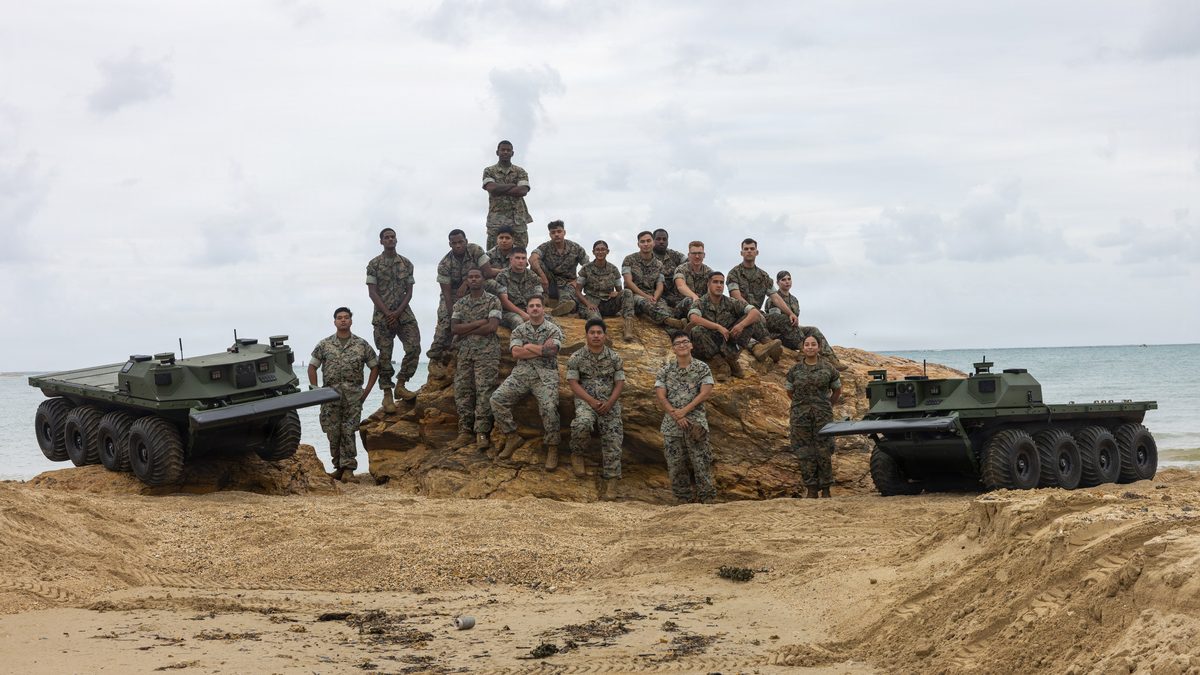
Rheinmetall Mission Master uncrewed ground vehicles during 3d Marine Division training, 21 October 2025. U.S. Marine Corps photo by Cpl. Joaquin Carlos Dela Torre (DVIDS, public domain). Appearance of U.S. personnel does not imply endorsement.
Scale Belongs to the Listed: Europe's Defence-SME Capital Gap and the ELTIF 2.0 Remedy
Two Tiers of Capital
Europe wants its defence industry to scale at speed. Its capital markets are not cooperating. A 2024 study commissioned by the European Commission found that roughly 40% of defence small and medium-sized enterprises (SMEs) rated access to finance as difficult or very difficult. Across 2021 and 2022, about two-thirds of defence SMEs chose not to seek equity at all, and close to half avoided debt financing. The comparable figure for EU SMEs as a whole was 6.6%.
The same study put numbers on the shortfall: an equity financing gap averaging around 2 billion euros, and a debt gap of 1 to 2 billion euros. Both estimates are described as conservative. They capture only part of the dual-use sector, where one component can serve a tractor and a turret alike. The structural point is simple. Two tiers of access now exist, and many of the firms doing Europe's most specialised work sit in the wrong one.
Around 40% of European defence SMEs rate access to finance as difficult or very difficult. Two-thirds did not seek equity at all over 2021 and 2022, against a 6.6% average for EU small firms. European Commission study on equity financing for defence SMEs, January 2024
What a Listed Prime Can Do
Set that against the top tier. On 27 May 2026, American Rheinmetall and Harbinger Motors announced a partnership to field a family of robotic and uncrewed ground vehicles (UGVs) for the United States Department of War (DoW). American Rheinmetall brings vehicle integration, mission systems and modular architecture. Harbinger supplies a commercially derived, autonomy-ready chassis: drive-by-wire, hybrid-electric, with a scalable battery and a range-extended powertrain that allows silent watch, lower thermal and acoustic signatures, and longer endurance.
The pitch is mass you can afford to lose. The companies describe an attritable, sovereign and rapidly scalable option, built at a price that makes fielding in real numbers possible while keeping crews out of the vehicle through autonomy and teleoperation. The first targets are autonomous tactical wheeled vehicles, contested-logistics resupply and next-generation robotic platforms. Joint demonstrations are due this summer, with prototyping through Commercial Solutions Openings (CSOs), Other Transaction Authorities (OTAs) and conventional programmes of record.
What makes the offer credible is the balance sheet behind it. American Rheinmetall runs six facilities across Michigan, Ohio and Maine, more than 1.7 million square feet, with over 1,500 staff. It bought Loc Performance Products in 2024 for 950 million dollars and is consolidating its headquarters in Auburn Hills, Michigan, on the back of a 31.7 million dollar expansion and 450 new jobs. The parent, Rheinmetall AG, is listed in Frankfurt. "Engineered here, built here" reads as a marketing line. It is also a description of what deep, patient, equity-backed money buys: the freedom to acquire a track maker, expand a plant, and absorb a commercial partner at the pace of relevance.
Why the Mittelstand Cannot Follow
Most of Europe's defence innovators cannot move like that. Many are family-owned Mittelstand firms in Germany, mid-sized integrators and niche specialists in France, the Netherlands and Canada. They are dependable suppliers, often the sole source of a critical sub-system. They are also chronically under-capitalised. The barriers are well documented. Procurement cycles run for years. Export-control and foreign-investment screening deters generalist investors. Environmental, social and governance (ESG) screens lead some banks and funds to refuse defence accounts outright, a trend EU defence ministers named in a joint statement in November 2024.
Payment delays of four to six months drain working capital. That cash-conversion cycle sits awkwardly against the multi-year qualification and certification timelines, from Allied Quality Assurance Publications (AQAP) and military standards to dual-use export licensing, that govern sovereign sub-systems. Late-stage private backers are scarce. The European Commission study was blunt about the deeper failing: the EU lacks an ecosystem of specialised funds. France, Germany and Spain show some venture-capital and private-equity activity in defence, yet the pool stays small set against the United States and the United Kingdom. A listed prime can draw on equity, debt and its own cash flow. A non-listed specialist with a strong product and a full order book can still be turned down by its bank.
ELTIF 2.0 as the Bridge
An instrument already exists for exactly this mismatch. The European Long-Term Investment Fund, reformed under Regulation (EU) 2023/606 and in force since 10 January 2024, is a closed-end alternative investment fund (AIF) built for long-horizon, illiquid stakes in the real economy. The reform, known as ELTIF 2.0, widened the range of eligible assets, scrapped the old retail minimum and the 10% portfolio cap, and kept a single marketing passport across all 27 member states. One fund can now raise from professional and retail investors alike. It runs closed-end for up to 30 years, a term that matches the rhythm of defence industrialisation rather than fighting it.
The technical fit is close. ELTIF 2.0 cut the minimum eligible-asset allocation from 70% to 55%, lifted the single-issuer concentration limit from 10% to 20%, and scrapped both the old 10,000 euro retail minimum and the 10% retail-portfolio cap. The closed-end structure stays, with a term of up to 30 years and limited extension options, alongside optional liquidity windows. For a non-listed supplier that means a fund can hold an illiquid position, whether new production-line equity, dual-use sensor intellectual property, or a specialised forging line, across the long build-out of an industrial capability rather than forcing an early exit. The cash-flow profile of sovereign, attritable systems suits this far better than short-horizon venture capital or conventional bank debt.
| Parameter | ELTIF 1.0 (2015) | ELTIF 2.0 (Reg (EU) 2023/606) | Why it matters for defence SMEs |
|---|---|---|---|
| Eligible-asset floor | 70% | 55% | More room for hybrid debt, equity and real-asset strategies |
| Single-issuer concentration limit | 10% | 20% | Allows meaningful stakes in mid-sized integrators |
| Retail entry conditions | 10,000 euro minimum and 10% portfolio cap | Both removed | Opens mass retail savings to long-horizon defence bets |
| Liquidity | Closed-end, limited | Optional liquidity windows, still closed-end up to 30 years | Retail participation without forcing early asset sales |
| Eligible-asset scope | Narrower | Broadened, with simpler fund-of-funds rules | Fits dual-use and production-infrastructure plays |
No dedicated European defence ELTIF has launched publicly as of late May 2026. The wrapper is what makes one feasible. Such a fund would sit alongside public money, not replace it, complementing the Defence Equity Facility run by the European Investment Fund (EIF) under the EU Defence Innovation Scheme (EUDIS). That public layer is real but bounded. By March 2026 the Facility, a 175 million euro envelope made up of 100 million from the European Defence Fund and 75 million from the EIF, had committed about 161 million euros and aimed to mobilise up to 500 million euros in private money, with a 2026 expansion now targeting a pan-European defence and cyber fund-of-funds of around 1 billion euros. The reliance runs deeper than equity: when the Commission awarded 1.07 billion euros to 57 European Defence Fund projects in April 2026, smaller companies were more than 38% of participants yet took only about 21% of the funding. Public facilities seed and signal. An ELTIF can channel broad private and retail capital into the long, unglamorous work of standing up production lines, pulling in household and institutional savings rather than duplicating the public money. That is the capital the lower tier needs, and the form it has lacked.
Open Questions
Several unknowns remain. No sponsor has committed publicly to a defence-focused ELTIF, so manager appetite is untested. The ESG classification of such a fund under EU sustainable-finance rules is unsettled, and retail demand for the sector is unmeasured. The 2 billion euro equity gap is a sector average, not a per-firm figure, and the dual-use share is only partly captured. None of this weakens the core argument. It marks where the evidence stops, and where a sponsor, a regulator or a member state would have to move first.
References
Source-evaluated under NATO STANAG 2022 (Reliability A–F / Accuracy 1–6). Tier 1 = government primary source; Tier 2 = quality news / specialist or corporate primary; Tier 3 = authoritative analyst commentary.
- T1EUR-Lex (Official Journal of the EU) – Regulation (EU) 2023/606 amending Regulation (EU) 2015/760 on European Long-Term Investment Funds (ELTIF 2.0), in force 10 January 2024. (Reliability A / Accuracy 1)
- T1European Commission, Defence Industry and Space – Study results: Access to equity financing for European defence SMEs, 11 January 2024. (Reliability A / Accuracy 1)
- T2Rheinmetall – American Rheinmetall and Harbinger: partnership for robotics and uncrewed ground vehicles, 27 May 2026. (Reliability A / Accuracy 2)
- T2PR Newswire – American Rheinmetall and Harbinger announce partnership to deliver next-generation robotics and UGVs to the Department of War, 27 May 2026. (Reliability B / Accuracy 2)
- T2European Investment Fund / EUDIS – Defence Equity Facility, 2024. (Reliability A / Accuracy 2)
- T1European Investment Fund – InvestEU Defence Equity Facility (envelope and commitment figures), accessed 31 May 2026. (Reliability A / Accuracy 1)
- T1European Commission, Defence Industry and Space – Commission to invest 1.07 billion euros in 57 defence projects supporting European Readiness Flagships, 15 April 2026. (Reliability A / Accuracy 1)
- T3Deloitte – Private capital in European defence: from peripheral sector to strategic imperative, 2024. (Reliability C / Accuracy 3)
Further reading
Background cross-reads, not cited as sources above.
- European Defence Agency (EDA), Annual Defence Data and reporting on the European Defence Technological and Industrial Base (EDTIB), 2025 edition.
- Mario Draghi, The Future of European Competitiveness, 2024, on strategic autonomy and industrial scaling.
- International Institute for Strategic Studies (IISS), analysis of the European Defence Fund and industrial cooperation, 2024.
Corrections & updates welcome. If you hold open-source data that refines or corrects any figure in this article, please contact [email protected] citing the specific claim and your source. Verified corrections will be incorporated and credited in the revision history. AI-assisted analytical assessment based on open-source material. Not a formal intelligence product, and not investment advice.