Reach Over the Front Line: Ukraine Could Receive the Meteor Long-Range Air-to-Air Missile
Sweden's pledge of 16 Saab JAS 39 Gripen C/D fighters carries a quieter line in the small print: the munitions package can include the Meteor, the European ramjet-powered Beyond Visual Range Air-to-Air Missile (BVRAAM). If it ships, Ukraine gains a weapon with the reach to hold Russian Su-34 strike aircraft at risk while they release glide bombs from deep behind the line, a reach its current air-to-air inventory does not have.
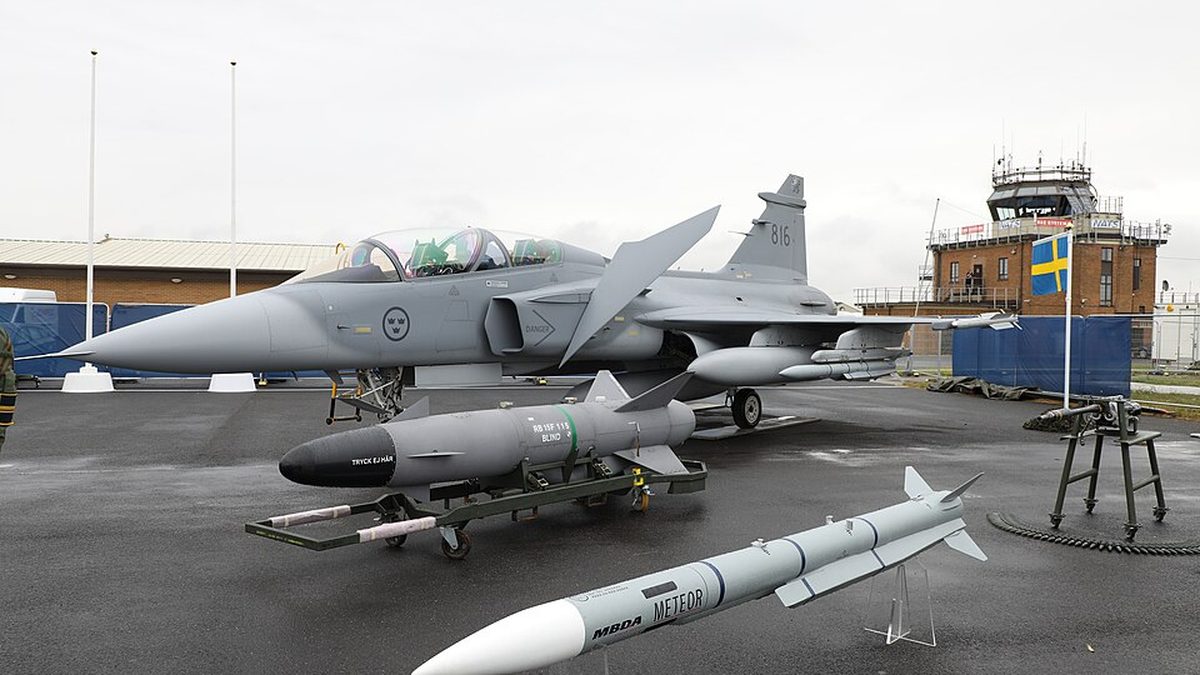
A Saab JAS 39 Gripen carrying the MBDA Meteor air-to-air missile, Royal International Air Tattoo 2019. Image: Walter Civitico (wallycacsabre) via Wikimedia Commons, CC BY 2.0.
The Swedish government announced on 28 May 2026 that it intends to donate up to 16 used Saab JAS 39 Gripen C/D fighters to Ukraine, with the first aircraft potentially contributing to the defence of Ukrainian airspace from 2027. The donation is conditioned on Ukraine actually signing for the newer Gripen E/F, and Stockholm states that the package can include qualified munitions: IRIS-T, the AIM-120 AMRAAM (Advanced Medium-Range Air-to-Air Missile), and the long-range Meteor. The Meteor line is the one that changes the air-combat arithmetic, because it would be the first time the Ukrainian Air Force has fielded a missile in that class.
The framing throughout matters. Sweden has said the package can include Meteor, not that it will. Quantities, release sequencing, and the integration timeline onto Ukrainian-operated Gripen C/D are not in the public statement. What is firm is the capability the missile represents, and why a small number of rounds would still register at the operational level.
What the Meteor is
The Meteor is an active-radar-guided BVRAAM built by the missile house MBDA under a six-nation European programme (Germany, France, the United Kingdom, Italy, Spain, and Sweden) led by the United Kingdom. It is designed to engage highly agile targets beyond visual range, and it is composed of three principal sections: a radar seeker with its associated electronics, the warhead, and the propulsion unit. The German share of the programme, put at 16 per cent, covers the warhead system from TDW (MBDA Deutschland, Schrobenhausen), the Inertial Measurement Unit (IMU) from Northrop Grumman LITEF GmbH (Freiburg), and the motor from Bayern-Chemie (MBDA Deutschland, Aschau am Inn).
What sets the Meteor apart from conventional rocket-motor missiles is its propulsion. It uses a throttleable solid-fuel ramjet, the Throttleable Ducted Rocket (TDR), which keeps the motor producing thrust through the cruise and into the terminal phase rather than burning out early and coasting. On manufacturer and programme figures the missile can reach beyond 200 km in range, sustain average speeds around Mach 4, and operate at altitudes above 20,000 m. The throttleable motor lets the missile manage its energy across the engagement instead of trading it all away in a single early burn.
The No-Escape Zone, in plain terms
The No-Escape Zone (NEZ) is the band around a launch aircraft from which a target cannot escape even with an immediate 180-degree turn away and maximum-g evasion. Because the Meteor's motor still has thrust in hand at intercept, that zone is far larger than on a coasting missile. The German source places it two to five times larger than earlier missiles; English-language manufacturer material commonly frames it as up to three times that of the AIM-120 AMRAAM. The figures vary by source and baseline, but the direction is consistent: a much wider lethal envelope.
The datalink, and why it is the other half of the story
The Meteor carries a two-way datalink, and this is as significant as the motor. Older fielded missiles supported only a one-way link from aircraft to weapon. With a two-way link, the missile can report back to the launch platform: its functional and kinematic state, what it is tracking, and whether its seeker has acquired the target. The pilot can then refine the weapon's flight path against the current air picture rather than committing blind.
The link also accepts third-party target data. A different platform, another fighter or an Airborne Warning and Control System (AWACS) aircraft, can pass updates to the missile in flight, so the engagement can continue against a target the launch aircraft is no longer tracking itself. The tactical pay-off is that the shooter can turn away to a new air-to-air or air-to-ground problem moments after launch, rather than holding a supporting radar lock all the way to intercept. For an outnumbered air force, that ability to fire and reposition is worth as much as raw missile range.
Against the Su-34 glide-bomb problem
The clearest operational case for the Meteor is the Russian Su-34 fitted with stand-off glide bombs. Through the war these aircraft have released guidance-kitted bombs from tens of kilometres behind the front line, striking Ukrainian positions while staying outside the reach of most Ukrainian air defences and air-to-air weapons. Open-source reporting places typical release points in the order of 60 to 100 km behind the line of contact. A missile that can credibly threaten the launch aircraft at that distance forces the Su-34 either to release earlier, which degrades the glide bomb's reach and accuracy, or to operate further back still, which does the same. Either way the threat to Ukrainian troops is pushed outward.
This is the gap in the current inventory. Ukraine's existing air-to-air missiles, including the AIM-120 variants carried on its F-16 fleet and its Soviet-legacy rounds, do not offer the same reach. Pairing the Meteor's sustained-thrust kinematics with the Gripen's sensors and the missile's datalink would let Ukrainian pilots engage Russian combat aircraft considerably deeper than they can today, and would erode the sanctuary the Su-34 force has relied on.
The British stake in the deal
The agreement also lands as a UK industrial story, and the British government has presented it as one. In a Ministry of Defence press release on 28 May 2026, the UK welcomed Sweden's leadership in brokering the deal and set out Britain's share of the aircraft itself. The Gripen is described as a collaboration between the United Kingdom, Sweden, and the United States, with British-based companies supplying critical components including the radar and the landing gear. The Ministry puts UK content at more than 30 per cent of each aircraft, involving at least 50 British-based firms, from Saab UK in Fareham to Leonardo UK in Edinburgh, and supporting over 5,000 UK jobs.
The framing is squarely about jobs and industrial return. Prime Minister Keir Starmer said the deal "shows what British industry can achieve on the world stage", while the Minister for Defence Readiness and Industry, Luke Pollard, called it "a big boost for Ukraine's air power and a show of confidence in our world-leading UK defence industry". Notably, the UK release foregrounds the airframe, the supply chain, and the jobs, and does not itself name the Meteor or any specific munition. The capability claim and the industrial claim come from different statements and are best read as such.
The UK numbers, as stated by the Ministry of Defence
More than 30% UK content per aircraft · at least 50 British-based firms · over 5,000 UK jobs · £11.4 billion combined UK and Swedish military support to Ukraine since February 2022 · £100 million Saab investment in its Fareham site. The Ministry also cites a Swedish Gripen deployment to Poland alongside the Royal Air Force for NATO air policing in summer 2025, and Gripen export wins in Colombia and Thailand.
Data gaps and what to watch
Several questions remain open, and they bear on how much the announcement actually delivers. The number of Meteor rounds, if any, is not stated. Whether the missile is released in the first tranche or held for later is not stated. Integration, training, and sustainment for a complex BVRAAM take time, and the 2027 marker attaches to the first Gripen C/D airframes, not necessarily to a Meteor-armed force on day one. The donation itself is conditional on Ukraine signing for the Gripen E/F. And published range and NEZ figures are manufacturer-and-programme derived headline numbers; the effective envelope in any real engagement is shorter and depends on launch altitude, speed, target aspect, and electronic warfare conditions, which no open source can specify.
ISC Commentary
The capability story is real, but it should be read as a deterrent and shaping tool rather than a switch that clears the sky. A modest stock of Meteor would not let Ukraine contest Russian airspace at will. What it would do is impose caution. Once Russian crews must assume that a Gripen orbiting well back can reach them during the vulnerable release window, the economics of the daily glide-bomb campaign change, even before a single round is fired. Uncertainty about where the threat ring now sits is itself the effect.
The conditionality is the part to keep in view. Sweden has tied the donation to a Gripen E/F purchase and has framed the munitions as something the package can contain. That is a negotiating structure as much as a capability pledge, and the Meteor sits inside it as leverage. The European industrial fingerprint also deserves a flag: with a German warhead, a German-built IMU, a German motor, and a UK-led six-nation programme behind it, any transfer touches the export-control equities of several partner states at once. None of that blocks a transfer, but it does mean the decision runs through more than one capital, and the timeline will reflect that.
Two governments are also telling two different stories about the same deal, and both are accurate. Stockholm's statement is the one that carries the Meteor line; London's is the one that counts British radar, landing gear, and 5,000 jobs. For Westminster the agreement is partly a domestic industrial win, with over 30 per cent of each Gripen built in the UK, which is a reminder that backing Ukraine and backing the home defence base are being presented as the same policy. The capability that matters to a Ukrainian pilot, and the jobs that matter to a Fareham or Edinburgh worker, sit in the same announcement but answer to different audiences. Reading the deal whole means holding both.
For Ukraine, the prize is not a headline range number. It is the combination the Meteor completes: a sustained-energy missile, a modern fighter sensor, and a two-way datalink that lets an outnumbered force shoot and survive. That is the capability worth tracking as the Gripen deal moves from announcement to signature.