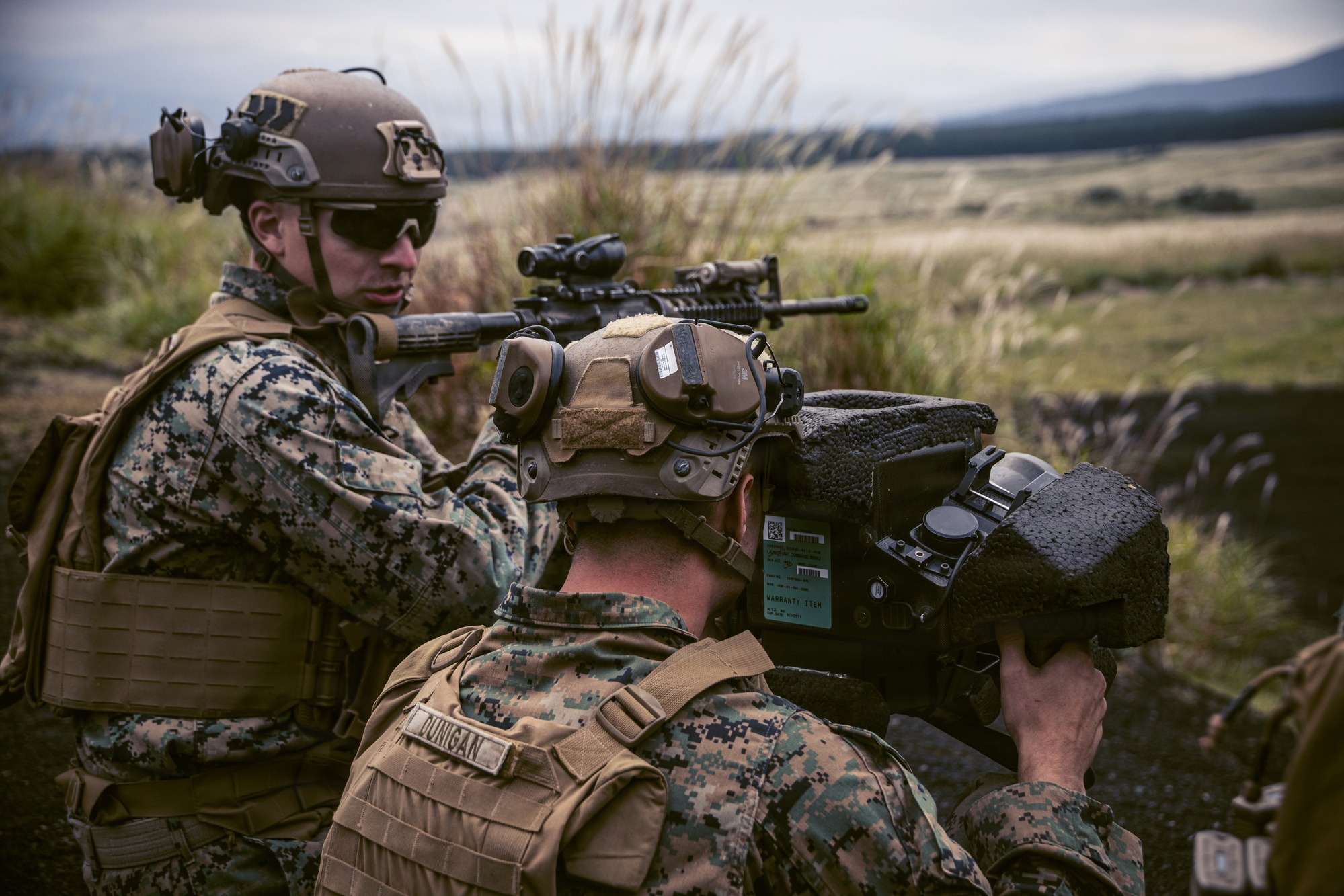
Illustrative title card. ISC open-source assessment, 28 May 2026. A sourced image will accompany the published edition where a rights-clean one is available.
Javelin LWCLU enters US Army service: a lighter sight that finally lets the gunner use the missile’s full reach
The Javelin Joint Venture has delivered the first Lightweight Command Launch Units to the US Army. The new sight is roughly a quarter lighter and detects targets at about twice the range of the legacy unit. Contrary to a common reading, that extra sight range is matched by a real increase in usable engagement distance, not wasted beyond the missile’s envelope.
Revision note (29 May 2026)
This version corrects an analytical error in the original 28 May filing, which stated that the LWCLU’s doubled detection range placed targets “outside the missile’s engagement envelope.” Open-source figures show the opposite: the legacy sight’s recognition range was a binding constraint on usable reach, and the LWCLU lets gunners exploit the missile’s demonstrated ~4,000 m performance. Media, contractual references, technical comparisons and a NATO peer assessment have also been added.Bottom line up front
On 26 May 2026 the Javelin Joint Venture (JJV), the Raytheon (an RTX business) and Lockheed Martin partnership that builds the FGM-148 Javelin anti-tank guided missile (ATGM), delivered the first Lightweight Command Launch Units (LWCLU) to the US Army. The LWCLU is the reusable sighting and fire-control unit; it replaces the legacy Command Launch Unit (CLU) and is, in the manufacturer’s words, “adaptable and compatible with all current, past and future Javelin variants.”
The manufacturer’s headline figures, stated consistently across the May 2026 delivery release and the October 2024 contract award, are a 25 per cent reduction in weight, a 30 per cent reduction in size (volume), and approximately twice the target detection and recognition range compared with the current Block I CLU. For a dismounted anti-armour team, the operational value is not an abstract sensor upgrade: a sight that recognises targets at roughly double the distance removes the binding constraint that previously kept effective engagements well inside the missile’s kinematic reach.
A heavier sight you cannot see far enough through caps the range of a missile that can already fly further. The LWCLU lifts that cap.
The delivery and the contract: the official record
The first delivery was announced from the JJV’s Tucson, Arizona facility. Raytheon states it has invested US $22 million to modernise the LWCLU production line and expand capacity, and that, working with the US Army, Tucson is “ramping annual production.”
The deliveries flow from two production contracts totalling US $267 million awarded to the JJV by the US Army on 15 October 2024: the first for full-rate production (FRP) of the LWCLU and the second for low-rate initial production (LRIP). The contract announcement states the work supports US Army and US Marine Corps requirements alongside Foreign Military Sales (FMS) to Estonia, Latvia and Lithuania, the three Baltic states that anchor NATO’s eastern-flank land deterrent. Production is in Tucson, with stated completion in 2026 and 2028. For scale, the JJV reports having built more than 50,000 Javelin missiles and more than 12,000 reusable Command Launch Units to date.
The correction: detection range versus engagement range
This is the point most worth getting right, and it is where the original filing erred. The Javelin missile’s qualified maximum range is 2,500 m, but the US Army records that the missile has “demonstrated performance to 4,000 meters in most operational conditions” (per CSIS Missile Threat, citing the US Army Acquisition Support Center). Historically the limiting factor on reaching out toward that figure was not the rocket motor. It was the gunner’s ability to detect, recognise and lock a target at distance through the legacy CLU’s thermal sight.
By roughly doubling detection and recognition range, the LWCLU relaxes that constraint. Independent reporting frames the effect plainly: Military Times reports the new sight raises the practical system engagement range toward 4 km, and CSIS lists the Javelin’s range as “2.5 km (4.5 with Lightweight CLU).” The figures from different sources cluster between 4.0 and 4.5 km; ISC does not collapse them into a single false-precise number. The directional finding is unambiguous and is the opposite of the original claim: the LWCLU’s longer sight range is matched by a longer usable engagement range, not stranded beyond it.
Previous model versus LWCLU
The legacy Block I CLU weighs 6.4 kg (about 14 lb) and uses a passive, cooled infrared sight with 4× day and 4×/9× night magnification. Reducing that mass by a manufacturer-stated 25 per cent implies an LWCLU of roughly 10.5 lb (about 4.8 kg), a derived figure; the JJV has not published an absolute mass. The table below holds verified figures only; estimates and unknowns are labelled as such.
| Attribute | Legacy Block I CLU | LWCLU | Source |
|---|---|---|---|
| Role | Reusable command launch unit: surveillance, target acquisition, fire control (not an energetic component) | CSIS | |
| Mass | 6.4 kg (~14 lb) | ~25% lighter; implied ~4.8 kg / ~10.5 lb (no official absolute) | CSIS; RTX; Military Times |
| Size (volume) | baseline | ~30% smaller | RTX |
| Target detection / recognition range | baseline | ~2× (absolute not published) | RTX |
| Usable engagement range enabled | ~2.5 km (qualified) | toward ~4.0–4.5 km (missile demonstrated to 4,000 m) | CSIS; Military Times |
| Thermal sight | Cooled IR; night-sight cool-down ~2.5–3.5 min | “Modern infrared camera technology… easier and faster target detection”; cooled vs uncooled not disclosed | GlobalSecurity; Breaking Defense / DOT&E |
| Battery | BA-5590/U, lithium–sulphur dioxide (Li/SO₂), standard issue | Not published (see data gap) | GlobalSecurity / US Army |
| Missile compatibility | Block 0/I and later rounds | All current, past and future Javelin variants | RTX |
| Indicative unit cost | — | ~US $514,000 (FY22 estimate; Army expects reductions) | CSIS (FY22 Army budget) |
Test and fielding status: the part the press release omits
The delivery release is silent on quantities, unit cost and recipient formations; Breaking Defense reports that neither the companies nor the Army would confirm how many units were delivered, what they cost, or which units received them. The independent record on maturity comes from the Pentagon’s Director, Operational Test & Evaluation (DOT&E). DOT&E’s FY2023 reporting found the LWCLU did not meet its reliability requirement during follow-on operational test and evaluation owing to a “new software fault”; the Army stated the fault was resolved in 2024, and the FY2025 DOT&E report confirmed the fix and indicated “urgent fielding” was expected in the second quarter of fiscal year 2026, consistent with the 26 May 2026 delivery. Earlier Army intent (2024) had been to begin fielding in mid-FY2025, so the programme has run roughly a year behind that marker.
Analysis of effects (WOME perspective)
For the fires planner and the dismounted anti-armour team, three effects matter. First, reach becomes usable. A doubled recognition range converted into engagements toward 4 km widens the keep-out distance against main battle tanks and, equally important, lets the gunner identify, classify and hand off targets the missile cannot yet reach, cueing mortars, attack aviation or loitering munitions. Second, dwell time and mobility improve. Removing roughly 3.5 lb from the sight, on top of a 30 per cent volume reduction, lengthens the time a team can hold an observation position and reduces the load penalty in arctic, mountainous or extended dismounted operations. Third, the procurement logic is decoupling. Because the LWCLU is backward-compatible with the entire missile inventory, NATO holders of Block 0/I stockpiles can modernise the sight without touching the missile fleet, separating sight-modernisation cost and timelines from missile-modernisation cost. That is precisely the attraction for the Baltic FMS recipients.
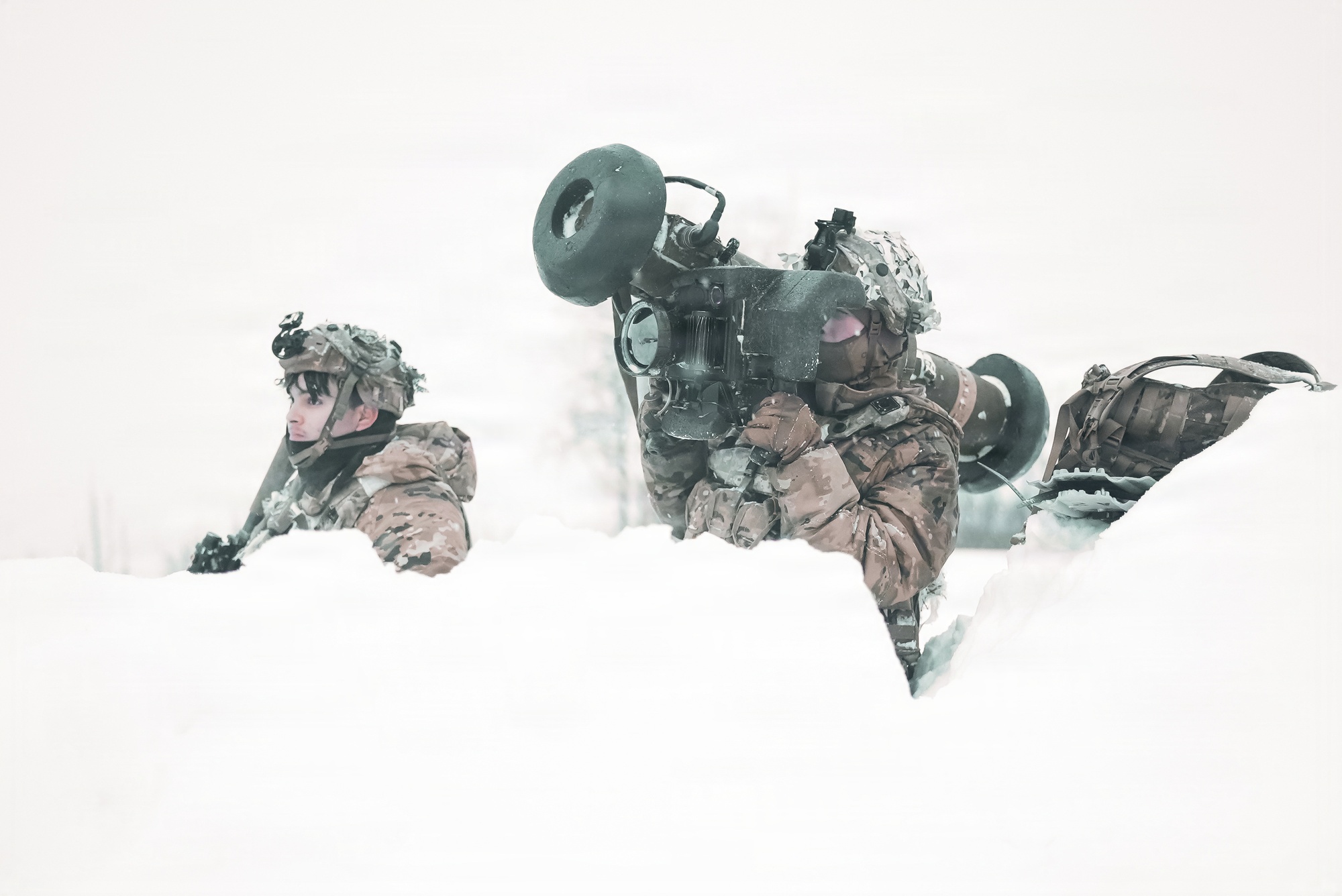
Where the LWCLU sits among NATO anti-tank options
The LWCLU upgrade keeps the Javelin competitive at the launcher level, but the wider NATO picture is one of parallel medium-range fire-and-forget systems. The most relevant peers are Rafael’s Spike LR2 (marketed across Europe by EuroSpike) and MBDA’s Akeron MP (formerly MMP); Saab’s NLAW is included as the contrasting light, short-range complement that many of the same armies field alongside a medium ATGM. Figures below are each attributed; ISC compares at round/system level because the systems divide responsibilities between missile and sight differently.
| System | Origin / prime | Class | Max range | Guidance | Round / system mass |
|---|---|---|---|---|---|
| FGM-148 Javelin (with LWCLU) | US: Javelin Joint Venture (Raytheon / Lockheed Martin) | Medium ATGM, fire-and-forget | 2.5 km qualified; ~4.0–4.5 km usable with LWCLU/F-model | Lock-on-before-launch imaging IR; top- or direct-attack; no datalink | Missile 22.1 kg; CLU 6.4 kg (LWCLU ~25% lighter) |
| Spike LR2 | Israel: Rafael; EuroSpike (Rheinmetall, Diehl, Rafael) in Europe | Medium ATGM, fire-and-forget / fire-observe-update | 5.5 km ground-launched; up to 10 km from helicopters | Imaging IR seeker + two-way fibre-optic datalink; LOBL & LOAL, non-line-of-sight | Missile ~13 kg |
| Akeron MP (MMP) | France: MBDA | Medium ATGM, fire-and-forget + man-in-the-loop | 4 km (5 km demonstrated in 2018 trials) | Imaging IR/TV + fibre-optic datalink; LOBL & LOAL, NLOS, in-flight retarget | Missile ~15 kg incl. launch tube |
| NLAW | Sweden / UK: Saab | Light, short-range single-shot | 20–800 m | Predicted Line of Sight (PLOS); no in-flight guidance; overfly-top or direct attack | 12.5 kg complete (disposable) |
Sources: Javelin: CSIS Missile Threat, RTX, Military Times; Spike LR2: Rafael / EuroSpike, Army-Technology; Akeron MP: MBDA, Army Recognition, Wikipedia (citing MBDA/DGA); NLAW: Saab. Ranges are manufacturer/qualified figures and vary with target, optics and launch platform.
Two readings follow. On pure stated reach, Spike LR2 (5.5 km ground) and Akeron MP (4 km, with in-flight retargeting) out-range even an LWCLU-equipped Javelin, and both add a two-way datalink that Javelin’s pure fire-and-forget design does not have, useful for non-line-of-sight shots and abort/retarget. Javelin’s counter-arguments are a vast installed base (more than 50,000 missiles built), combat-proven simplicity, soft-launch from enclosures, and now a modernised sight delivered without disturbing the missile stockpile. Notably, NATO is buying across the field rather than choosing one winner: Germany placed a Spike order reported at roughly €2 billion in 2025, Latvia signed an €81 million EuroSpike contract in June 2025, while Latvia is also a Javelin LWCLU FMS recipient under the October 2024 award. The Baltic states are layering systems, not standardising on one.
Personnel and safety considerations
The LWCLU is a sighting and fire-control unit, not an energetic store; the explosive hazards remain with the missile round in its launch tube (tandem shaped-charge High-Explosive Anti-Tank warhead; the round is transported and stored under its own hazard classification, which sits separately from the inert launcher). The handling change introduced by the sight is doctrinal rather than energetic: a near-doubling of recognition range without an equivalent doubling of the missile’s reach can encourage premature engagement of targets that are visible but still outside lethal range. Trainers should expect a transition period in which target-handover discipline (deciding what the Javelin engages versus what it merely cues for other fires) matters more than before.
On the power source, the legacy CLU runs the disposable BA-5590/U lithium–sulphur-dioxide (Li/SO₂) battery, which carries its own transport and disposal regime (UN 3090 for lithium-metal batteries). Whether the LWCLU retains the BA-5590/U family or moves to a different pack is not disclosed; ammunition technical officers and logisticians should confirm the battery type and its disposal route at unit issue rather than assume carry-over, because a change of lithium chemistry changes the transport classification and the disposal protocol.
Data gaps & confidence
The following are not established in open source and are flagged rather than estimated: absolute LWCLU mass and dimensions; absolute detection/recognition range in metres under defined target signature and conditions; thermal-imager type (cooled MWIR vs uncooled LWIR microbolometer); battery type and endurance for the LWCLU; presence of an integrated laser range-finder distinct from the targeting laser; compatibility detail with the in-development extended-range FGM-148G round; total US Army quantity, unit price and recipient formations under the US $267 million tranche; and the Baltic FMS quantity split. Confidence is high on contract, delivery and headline performance claims (primary source); moderate on engagement-range figures (which vary 4.0–4.5 km across sources); low where marked “not published.”References
Official & contractual
- RTX (Raytheon / Lockheed Martin), “First Javelin Lightweight Command Launch Units delivered to the U.S. Army,” 26 May 2026. rtx.com
- RTX, “U.S. Army awards Javelin Joint Venture First Lightweight Command Launch Unit full-rate production contract,” 15 October 2024 (two contracts totalling US $267 million; FMS Estonia, Latvia, Lithuania). rtx.com
- US DoD, Director, Operational Test & Evaluation (DOT&E), FY2025 Annual Report (LWCLU reliability fix; urgent fielding Q2 FY2026). dote.osd.mil
- US Army Acquisition Support Center (USAASC), Javelin programme portfolio (CLU specifications; demonstrated 4,000 m performance). asc.army.mil
Technical reference
- CSIS Missile Threat, “FGM-148 Javelin” (range 2.5 km / 4.5 km with LWCLU; CLU 6.4 kg; variants A–G; LWCLU ~US $514k FY22 estimate). missilethreat.csis.org
- GlobalSecurity.org, FGM-148 Javelin design / CLU and BA-5590/U battery and cool-down data. globalsecurity.org
- Defense News, “Lockheed-Raytheon’s deadlier F-Model Javelin antitank missile rolls into production,” 6 May 2020 (FGM-148F, multi-purpose warhead, updated CLU). defensenews.com
Independent media corroboration
- Breaking Defense (C. Welch), “Raytheon, Lockheed deliver first next-gen Javelin launchers to Army,” 26 May 2026 (DOT&E history; no quantity/cost/unit disclosure). breakingdefense.com
- Military Times, “US Army receives first lightweight Javelin launchers,” 27 May 2026 (~14 lb legacy CLU; ~3.5 lb saved; engagement range to 4 km). militarytimes.com
NATO comparison systems
- Rafael / EuroSpike, Spike LR2 (5.5 km ground; up to 10 km air; ~13 kg missile; fibre-optic datalink). rafael.co.il · eurospike.com
- Army Recognition, “Germany Orders €2B Spike LR2…” (2025) and Latvia EuroSpike €81M (June 2025). armyrecognition.com
- MBDA, Akeron MP (MMP) product page; range 4 km, 5 km demonstrated 2018; replaced MILAN. mbda-systems.com
- Saab, NLAW (20–800 m; 12.5 kg; predicted line of sight; overfly-top attack; 500 mm penetration). saab.com
Imagery
- DVIDS asset 9369886 (VIRIN 251010-M-MH864-1011), “31st MEU | BLT 1/7 conducts Javelin Missile Range,” LCpl Victor Gurrola, 31st Marine Expeditionary Unit, 10 Oct 2025. dvidshub.net. Public domain (17 U.S.C. § 105); editorial use with non-endorsement disclaimer.
- DVIDS asset 9532960 (VIRIN 260222-A-ED188-6159), “11th Airborne Division Soldiers Engage OPFOR During JPMRC,” Spc. Brandon Vasquez, 11th Airborne Division, 22 Feb 2026. dvidshub.net. Public domain (17 U.S.C. § 105).